Highlights

Velocity-dependent Lyapunov exponents in many-body quantum, semiclassical, and classical chaos

Vedika Khemani, David A. Huse, and Adam Nahum

Phys. Rev. B 98, 144304 (2018) - Published 16 October, 2018

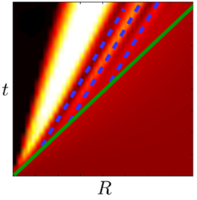
It has been a long-standing challenge to expand the notion of exponential sensitivity to small perturbations in the initial conditions from the realm of classical chaos to that of many-body quantum systems. Recently, exponential growth in a measure known as the out-of-time-order commutator (OTOC) has been proposed as a diagnostic of chaos in the setting of many-body quantum systems. The authors examine the behavior of the OTOC along rays of different velocities for a variety of spatially local extended many-body quantum systems, both integrable and nonintegrable. They find that the velocity-dependent Lyapunov exponents are negative for velocities greater than a characteristic “butterfly speed”, which defines the light cone for the spreading of operators. It is demonstrated that a regime with well-defined positive Lyapunov exponents inside the light-cone may only exist for classical, semiclassical, weakly interacting, or large-N systems, but not for fully quantum systems with strong short-range interactions and local Hilbert space dimensions of order one.

Berry electrodynamics: Anomalous drift and pumping from a time-dependent Berry connection

Swati Chaudhary, Manuel Endres, and Gil Refael

Phys. Rev. B 98, 064310 (2018) - Published 31 August, 2018

The Berry connection and curvature encode the geometry of a particle’s wave functions, and they can modify the motion of particles in a nontrivial manner. They are also dual to the vector potential and magnetic field. A little-explored avenue is what happens when the Berry connection changes with time. This must have an effect on the anomalous velocity of particles, just as the time dependence of the vector potential produces an electric field in standard electrodynamics. In this work, the authors outline how these ‘Berry-electrodynamics’ effects can be measured, how they relate to shift currents, and how both could be put together to produce a pumping cycle in honeycomb lattices.

Macroscopic electric polarization and microscopic electron dynamics: Quantitative insight from femtosecond x-ray diffraction

Christoph Hauf, Michael Woerner, and Thomas Elsaesser

Phys. Rev. B 98, 054306 (2018) - Published 24 August, 2018

Phenomena in the macroscopic world are described by classical physics while processes at the microscopic atomic scale are governed by the laws of quantum mechanics. The connection between microscopic and macroscopic physical quantities is far from being trivial and remains partly unexplained. This study presents a novel theoretical approach for calculating macroscopic polarizations from transient microscopic charge densities that are derived from ultrafast time-resolved x-ray diffraction experiments. This is important for understanding the properties of polar and ionic materials and, in particular, those of ferroelectrics with widespread technical applications.

Topological Bloch oscillations

J. Höller and A. Alexandradinata

Phys. Rev. B 98, 024310 (2018) - Published 31 July, 2018

The traditional view of Bloch oscillations is that they rely on the translational symmetry of crystals. These oscillations occur with a fundamental period TB, the time it takes a semiclassical wave packet to travel across the Brillouin zone. We introduce a new type of Bloch oscillation whose period equals an integer multiple of TB. The period multiplication relies on crystalline point-group symmetries, as exemplified by rotations and reflections. The integer-valued multiplier is robust against symmetric deformations of the crystal. It is the first example of a crystalline-symmetry-protected topological invariant in electric transport.

Mapping of the dark exciton landscape in transition metal dichalcogenides

Gunnar Berghäuser, Philipp Steinleitner, Philipp Merkl, Rupert Huber, Andreas Knorr, and Ermin Malic

Phys. Rev. B 98, 020301(R) (2018) - Published 9 July, 2018

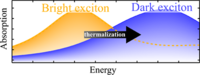
Transition-metal dichalcogenides (TMDs) exhibit a remarkable exciton landscape with a majority of optically forbidden dark excitonic states. Here, the authors present a study that combines microscopic theory with femtosecond infrared spectroscopy. It allows to map the excitonic landscape of an arbitrary TMD material by investigating the temporal evolution of the intraexcitonic 1s-2p transition. By resolving the optical response shortly after the excitation and after the exciton thermalization, the authors reveal the relative position of bright and dark excitonic states. The theoretical prediction is confirmed on the exemplary WSe2 material as shown in the picture.

Universal scaling laws for correlation spreading in quantum systems with short- and long-range interactions

Lorenzo Cevolani, Julien Despres, Giuseppe Carleo, Luca Tagliacozzo, and Laurent Sanchez-Palencia

Phys. Rev. B 98, 024302 (2018) - Published 5 July, 2018

The ability of many-body systems to spread out information has fundamental impact on quantum information, thermodynamics, and transport dynamics. Long-range interactions are particularly appealing as they pave the way to nonballistic dynamics, and recent observations challenge existing bounds. Here, the authors develop a general theory based on quasiparticles that unifies short-range and long-range systems. They show that, in general, two signals coexist and carry complementary information about the many-body spectrum. One of the signals is subballistic while the other may be superballistic. This result has fundamental implications on the interpretation of experiments and offers tools to probe many-body systems.

Quantum dynamics in sine-square deformed conformal field theory: Quench from uniform to nonuniform conformal field theory

Xueda Wen and Jie-Qiang Wu

Phys. Rev. B 97, 184309 (2018) - Published 31 May, 2018

Sine-square deformed conformal field theory has received extensive attention in both condensed matter physics and high-energy physics recently. This is due to its unusual properties, such as having a continuous Virasoro algebra. Here, the authors investigate its nonequilibrium dynamics by studying the entanglement evolution after a quantum quench. New physical effects, such as the absence of revivals in entanglement evolution, are observed in both analytical and numerical calculations. This effect could potentially be used when engineering a gapless system with cold atoms, in order to reduce finite-size effects. The work here also sheds new light on the nonequilibrium dynamics of conformal field theory in curved spacetime.

Efficient nonparametric n-body force fields from machine learning

Aldo Glielmo, Claudio Zeni, and Alessandro De Vita

Phys. Rev. B 97, 184307 (2018) - Published 24 May, 2018

The authors present a scheme to construct classical n-body force fields using Gaussian Process (GP) Regression, appropriately mapped over explicit n-body functions (M-FFs). The procedure is possible, and will yield accurate forces, whenever prior knowledge allows to restrict the interactions to a finite order n, so that the “universal approximator” resolving power of standard GPs or Neural Networks is not needed. Under these conditions, the proposed construction preserves flexibility of training, systematically improvable accuracy, and a clear framework for validation of the underlying machine learning technique. Moreover, the M-FFs are as fast as classical parametrized potentials, since they avoid lengthy summations over database entries or weight parameters.

Sum-frequency ionic Raman scattering

Dominik M. Juraschek and Sebastian F. Maehrlein

Phys. Rev. B 97, 174302 (2018) - Published 16 May, 2018

Coherently excited phonons are a unique tool to control the properties of materials in their electronic ground state on the picosecond timescale. Here, the authors complete the map of four excitation mechanisms for Raman-active phonons, which are either directly mediated by photons or work with the help of nonlinearly coupled phonons. Each process can be achieved by using a sum- or difference-frequency mixing of the scattering particles. The general model here captures all four mechanisms, which is demonstrated for different types of material using density functional theory. This study may serve as a guide for the selective excitation of phonons and Raman-active modes in general.

P31 NMR study of discrete time-crystalline signatures in an ordered crystal of ammonium dihydrogen phosphate

Jared Rovny, Robert L. Blum, and Sean E. Barrett

Phys. Rev. B 97, 184301 (2018) - Published 1 May, 2018

Periodic driving of an interacting spin system may lead to unusual out-of-equilibrium states of matter, such as the discrete time crystal (DTC). Two recent experiments have reported a key signature of the DTC: for long enough interaction times, the system’s response becomes rigidly locked to one half of the driving frequency. Using nuclear magnetic resonance, the authors observe this DTC signature in the most unexpected system to date: a three-dimensional, spatially ordered crystal. This challenges the paradigm that the DTC arises from many-body localization. Furthermore, hidden coherence in the system is revealed by the “DTC echo” experiment, and the effect of interactions during drive pulses is demonstrated.

Quantum and classical ripples in graphene

Juraj Hašík, Erio Tosatti, and Roman Martoňák

Phys. Rev. B 97, 140301(R) (2018) - Published 4 April, 2018

As is well known, graphene is not flat and develops ripples even when freestanding, due to thermal and quantum out-of-plane fluctuations. Atomistic path integral quantum Monte Carlo simulations show how the well-known large and locally smooth thermal ripples gradually cross over upon cooling to globally flatter, yet locally rougher quantum ripples, giving graphene a surprising quantum corrugation, as shown in the image. As a result, even at cryogenic temperatures, graphene is locally tilted by as much as several degrees over the average plane. This spectacular manifestation of quantum zero-point motion in a macroscopic membrane will probably be measurable by electron diffraction at temperatures below 50 K.

Theory of many-body radiative heat transfer without the constraint of reciprocity

Linxiao Zhu, Yu Guo, and Shanhui Fan

Phys. Rev. B 97, 094302 (2018) - Published 7 March, 2018

Understanding electromagnetic heat transfer in many-body systems is critical to exploring new physics effects that can arise in reciprocal and nonreciprocal many-body systems. Here, the authors develop explicit and compact formulas for electromagnetic heat transfer in systems consisting of a large number of bodies without the constraint of reciprocity. They go on to demonstrate the emergence of a persistent heat current at thermal equilibrium and a directional heat flow at nonequilibrium in systems composed of multiple magneto-optical particles. This opens up possibilities for controlling near-field electromagnetic heat transfer using complex reciprocal and nonreciprocal systems.

Fluctuations in a model ferromagnetic film driven by a slowly oscillating field with a constant bias

Gloria M. Buendía and Per Arne Rikvold

Phys. Rev. B 96, 134306 (2017) - Published 13 October, 2017

Ferromagnets perturbed by time-dependent fields are technologically important examples of nonequilibrium physics. Using kinetic Monte Carlo simulations and droplet theory of magnetization reversal, the authors explain recent experiments on ordered uniaxial ferromagnetic films driven by oscillating fields. The associated dynamic phase transition at a critical field period is known to be in the equilibrium Ising universality class. Consistent with experiments, the authors find that the response to a constant bias field in the supercritical period limit differs from an equilibrium ferromagnet above criticality in that, instead of a wide central susceptibility maximum, side bands are observed, which are shown to result from stochastic resonance.

Origins of Willis coupling and acoustic bianisotropy in acoustic metamaterials through source-driven homogenization

Caleb F. Sieck, Andrea Alù, and Michael R. Haberman

Phys. Rev. B 96, 104303 (2017) - Published 11 September, 2017

In addition to conventional acoustic properties (mass density and compressibility), recent research has shown that inhomogeneous acoustic media may require coupling tensors between effective volume strain and momentum fields. These coupling tensors imply conversion between monopolar and dipolar motion in the effective material response. Intrinsic coupling between strain and momentum is known as Willis coupling in elastodynamics, and it is analogous to bianisotropy in electromagnetism. This paper investigates the microscale and mesoscale effects that lead to Willis coupling, studies the proper homogenization of acoustic metamaterials with non-negligible Willis coupling, and demonstrates the impact of Willis coupling on defining physically meaningful effective material parameters.

Quantum correlations at infinite temperature: The dynamical Nagaoka effect

Márton Kanász-Nagy, Izabella Lovas, Fabian Grusdt, Daniel Greif, Markus Greiner, and Eugene A. Demler

Phys. Rev. B 96, 014303 (2017) - Published 14 July, 2017

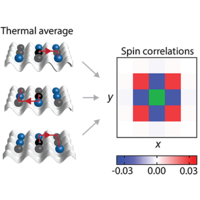
The interplay of quantum correlations and thermal decoherence is key to understanding the fundamental properties of many-body systems. Coherence is usually easily destroyed by interaction with the environment and local fluctuations inherent to thermal ensembles. Hence experimental demonstrations of many-body quantum correlations rely on cooling the system close to its ground state or pumping it into a well-defined quantum state. Here, the authors instead show how quantum correlations can arise in the opposite limit of an infinite temperature. Motivated by recent experiments with ultracold atoms in optical lattices, they study the dynamics of a hole created in a fermionic or bosonic Mott state in the atomic limit. They demonstrate that the propagating hole entangles the surrounding spins leading to sizable and lasting dynamical spin correlations. In the absence of interactions, these correlations arise solely due to quantum interference. Furthermore, they are both ferromagnetic and antiferromagnetic, in contrast to the equilibrium Nagaoka effect.

Acoustic waves undetectable by transient reflectivity measurements

Chuan He, Oliver Ristow, Martin Grossmann, Delia Brick, Yuning Guo, Martin Schubert, Mike Hettich, Vitalyi Gusev, and Thomas Dekorsy

Phys. Rev. B 95, 184302 (2017) - Published 11 May, 2017

In laser ultrasonics, ultrashort light pulses generate coherent acoustic pulses of picosecond duration via multiple possible physical mechanisms, involving optoacoustic conversion processes. These wide-band GHz acoustic signals are optically detected at the sample surfaces by ultrafast time-delayed probe light pulses. When the coherent acoustic pulses in GaAS are detected via the Brillouin scattering of probe light pulses of 400 nm wavelength, certain spectral components of the acoustic pulses remain invisible. The theoretical analysis relates this observation to the existence of zeros in the spectral transformation function of acousto-optic conversion. The phenomenon of zero sensitivity of the optical reflectivity to coherent acoustic phonons of particular frequencies is rather general and depends on both the probe light wavelength and the evaluated material. These findings substantially contribute to picosecond ultrasonics and laser-based nondestructive testing.

Effects of grain boundaries and defects on anisotropic magnon transport in textured Sr14Cu24O41

Xi Chen, Karalee Jarvis, Sean Sullivan, Yutao Li, Jianshi Zhou, and Li Shi

Phys. Rev. B 95, 144310 (2017) - Published 27 April, 2017

The strong spin-spin exchange interaction in some low-dimensional magnetic materials can give rise to a high group velocity and thermal conductivity contribution from magnons, which are energy quanta of collective spin excitations. Examples are the incommensurate layered compounds (Sr,Ca,La)14Cu24O41, with strong antiferromagnetic interaction along the ladders. The effects of grain boundaries and defects on quasi-one-dimensional magnon transport in these compounds are not well understood. Here, the authors report the microstructures and anisotropic thermal transport properties of textured Sr14Cu24O41. TEM clearly reveals nanolayered grains and the presence of dislocations and planar defects. The thermal conductivity contribution and mean free paths of magnons in the textured samples are evaluated with the use of a kinetic model for one-dimensional magnon transport, and found to be suppressed significantly compared to single crystals at low temperatures. The experimental results can be explained by a one-dimensional magnon-defect scattering model, provided that the magnon–grain boundary scattering mean free path in the anisotropic magnetic structure is smaller than the average length of these nanolayers along the c axis. The finding suggests low transmission coefficients for energy-carrying magnons across grain boundaries.

Acoustic solitons: A robust tool to investigate the generation and detection of ultrafast acoustic waves

Emmanuel Péronne, Nicolas Chuecos, Laura Thevenard, and Bernard Perrin

Phys. Rev. B 95, 064306 (2017) - Published 14 February, 2017

Solitons are self-preserving traveling waves of great interest in nonlinear physics, offering many interesting application such as high-bandwidth optical fiber communication. Solitons can also appear in ultrafast acoustics, and several observations suggest acoustic solitons as short as 200 fs. Here, the authors designed an experimental setup to observe and characterize acoustic solitons traveling through a GaAs(001) substrate. The experimental signal is explained well with the help of the Korteweg–de Vries equation, demonstrating the particlelike nature and the unique properties of the solitons. Moreover, the temporal distribution of the solitons is also analyzed with the help of the inverse scattering method. Such investigations provide a new tool to probe transient properties of highly excited matter through the study of the solitons due to the acoustic pulse emitted after laser excitation.

Nonequilibrium effective field theory for absorbing state phase transitions in driven open quantum spin systems

Michael Buchhold, Benjamin Everest, Matteo Marcuzzi, Igor Lesanovsky, and Sebastian Diehl

Phys. Rev. B 95, 014308 (2017) - Published 27 January, 2017

Phase transitions to absorbing states are among the simplest examples of critical phenomena out of equilibrium. The characteristic feature of these models is the presence of a fluctuationless configuration that the dynamics cannot leave, which has proved a rather stringent requirement in experiments. Recently, a proposal to seek such transitions in highly tunable systems of cold atomic gases offers to probe this physics and, at the same time, to investigate the robustness of these transitions to quantum coherent effects. Here, the authors specifically focus on the interplay between classical and quantum fluctuations in a simple driven open quantum model which, in the classical limit, reproduces a contact process, which is known to undergo a continuous transition in the “directed percolation” universality class. The authors derive an effective long-wavelength field theory for the present class of open spin systems and show that, due to quantum fluctuations, the nature of the transition changes from second to first order, passing through a critical point which appears to belong instead to the “tricritical directed percolation” class.

Mode decomposition based on crystallographic symmetry in the band-unfolding method

Yuji Ikeda, Abel Carreras, Atsuto Seko, Atsushi Togo, and Isao Tanaka

Phys. Rev. B 95, 024305 (2017) - Published 13 January, 2017

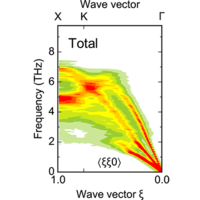
The band-unfolding method is now widely used to calculate the effective band structures of a disordered system from its supercell model. The unfolded band structures are obtained as if the disordered system really has the crystallographic symmetry of its underlying structure. However, it has still been difficult to decompose the unfolded band structures into the modes based on the crystallographic symmetry of the underlying structure. This has prohibited detailed analyses of, e.g., selection rules and avoided band crossings for the unfolded band structures. The authors here develop a procedure to decompose the unfolded band structures according to the small representations (SRs) of the little groups. The decomposition is performed using the projection operators for SRs derived from the group representation theory. Using this procedure, the authors investigate the phonon band structure of disordered face-centered-cubic Cu0.75Au0.25, which has large variations of atomic masses and force constants among the atomic sites due to the chemical disorder. In the unfolded phonon band structure, several peculiar behaviors such as discontinuous and split branches are found in the decomposed modes corresponding to specific SRs.

Sign In to Your Journals Account

Filter

Section

Filter

Article Lookup

Enter a citation