Highlights

Weak coupling of pseudoacoustic phonons and magnon dynamics in the incommensurate spin-ladder compound Sr14Cu24O41

Xi Chen, Dipanshu Bansal, Sean Sullivan, Douglas L. Abernathy, Adam A. Aczel, Jianshi Zhou, Olivier Delaire, and Li Shi

Phys. Rev. B 94, 134309 (2016) - Published 21 October, 2016

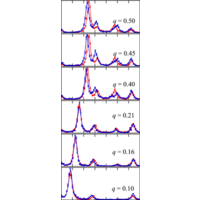
Incommensurate compounds consist of two or more interpenetrating sublattices with lattice periods incommensurate along one or more crystal axes. Intriguing lattice dynamics have been predicted for these compounds and are relevant to not only the thermal properties but also electronic, optical, and magnetic properties via coupling between different energy excitations. Here, the authors report inelastic neutron scattering measurements of phonon and magnon dispersions in Sr14Cu24O41, which contains incommensurate chain and ladder substructures. Two distinct acoustic phononlike modes, corresponding to the sliding motion of one sublattice against the other, are observed for atomic motions polarized along the incommensurate axis. In the long-wavelength limit, it is found that the sliding mode shows a remarkably small energy gap, indicating very weak interactions between the two incommensurate sublattices. The measurements also reveal an appreciable contribution from gapped magnons to the low-temperature specific heat, as well as a gapped and steep linear magnon dispersion of the ladders. The high group velocity of this magnon branch and weak coupling with acoustic phonons can explain the large magnon thermal conductivity in Sr14Cu24O41 crystals. These findings offer new insights into the phonon and magnon dynamics and thermal transport properties of incommensurate magnetic crystals that contain low-dimensional substructures.

Exact steady states for quantum quenches in integrable Heisenberg spin chains

Lorenzo Piroli, Eric Vernier, and Pasquale Calabrese

Phys. Rev. B 94, 054313 (2016) - Published 23 August, 2016

What is the long-time behavior of a quantum system after it is brought out of equilibrium? In a generic case, it has been proposed that an effective thermalization occurs, and the local properties of the system can then be described by a thermal Gibbs ensemble. However, in integrable systems, with infinitely many conservation laws, the answer is far more complicated. It was shown in several special cases that the long-time steady state can be exactly described by the so called complete generalized Gibbs ensemble. The latter can be obtained by maximizing the entropy with constraints imposed by the conservation of energy, but also by additional carefully chosen subset of the integrals of motion. In this work, the authors analyze more general initial states, focusing on integrable XXZ Heisenberg spin chains. They find that the complete generalized Gibbs ensemble indeed correctly describes the system at long times after the quench.

Acoustic transmission through compound subwavelength slit arrays

G. P. Ward, A. P. Hibbins, J. R. Sambles, and J. D. Smith

Phys. Rev. B 94, 024304 (2016) - Published 12 July, 2016

Arrays of subwavelength slit cavities have been of interest to the acoustic metamaterial community for some years now, giving rise to such phenomena as “enhanced acoustic transmission”, where sound of certain wavelengths can transmit through the slit array structure as if it were not there. This behaviour is widely accepted as a coupling effect between diffraction evanescent waves arising from structure factor, and Fabry-Perot like resonances supported along the length of each slit cavity. Here, the authors explore the effect of altering the spacing, or width, of some of the slits that form the array, thereby forming a “compound” grating, where each periodic unit cell is comprised of multiple slit cavities. The transmission of such structures is experimentally recorded, where it is found that as one increases the number of slit cavities per unit cell, broad and deep minima can appear in the peaks of the primary enhanced acoustic transmission resonance that may have a strong angular dependence. These features owe their existence to the “phase resonance”, where new degrees of freedom available to the near field allow adjacent slit cavities to be out-of-phase with one another and thus destructively interfere with the re-radiated pressure wave. Such behaviour has been studied extensively in the electromagnetic case, where a surface wave band folding picture could be used to predict the dispersive nature of these phase resonances. A similar explanation of the underlying surface wave physics is extended here to the acoustic case.

Analogue of Rashba pseudo-spin-orbit coupling in photonic lattices by gauge field engineering

Y. Plotnik, M. A. Bandres, S. Stützer, Y. Lumer, M. C. Rechtsman, A. Szameit, and M. Segev

Phys. Rev. B 94, 020301(R) (2016) - Published 7 July, 2016

Engineering the gauge field of a physical system is a crucial step in the effort to control the behavior of waves. In the past few years, scientists have demonstrated the ability to design and implement artificial gauge fields in a variety of physical systems, which have played a major role in demonstrating various fascinating phenomena in both photonic and cold-atoms settings. In this Rapid Communication, the authors explore, theoretically and experimentally, a method to create artificial gauge fields. They implement this method for demonstrating the Rashba effect – the photonic equivalent of the spin-orbit coupling known from electronic systems.

Ferroelectricity in corundum derivatives

Meng Ye and David Vanderbilt

Phys. Rev. B 93, 134303 (2016) - Published 4 April, 2016

Perovskite and double perovskite oxides are perhaps the most studied ferroelectric and multiferroic materials. The authors present in this manuscript an extensive analysis of another promising family of ferroelectrics, the corundum derivatives ABO3 and A2BB′O6. Despite a superficial similarity of the chemical formulas to single and double perovskites, the corundum derivatives have an entirely different structure and the mechanism for the polarization reversal. The authors perform a detailed first-principles study and arrive at empirical rules for evaluating the ferroelectric properties of materials in this class.

Time-dependent many-body treatment of electron-boson dynamics: Application to plasmon-accompanied photoemission

M. Schüler, J. Berakdar, and Y. Pavlyukh

Phys. Rev. B 93, 054303 (2016) - Published 16 February, 2016

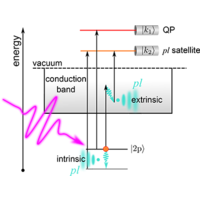
The authors present a time-dependent nonequilibrium Green’s function formalism for electrons interacting with bosonic excitation such as phonons, photons, or plasmons. In this scheme, the equations of motion for the Green’s functions – the Kadanoff-Baym equations – of electrons and bosons are treated on equal footing and therefore require substantial modifications as compared to the usual two-times propagation scheme. Motivated by recent experiments, the authors apply their formalism to time-resolved photoemission from bulk magnesium core states, a prominent system where the excitation of collective electronic motion in the conduction band leads to the characteristic plasmon satellites in the spectrum. The two corresponding pathways for this electron energy-loss effect – intrinsic or extrinsic losses – are usually hard to disentangle due to their quantum interference. The authors demonstrate how the loss channels manifest in a time-dependent picture and discuss how to discern them in the time domain.

Effect of magnetism on lattice dynamics in SrFe2As2 using high-resolution inelastic x-ray scattering

N. Murai, T. Fukuda, T. Kobayashi, M. Nakajima, H. Uchiyama, D. Ishikawa, S. Tsutsui, H. Nakamura, M. Machida, S. Miyasaka, S. Tajima, and A. Q. R. Baron

Phys. Rev. B 93, 020301(R) (2016) - Published 25 January, 2016

Phonons in iron pnictide materials were predicted to show large effects from magnetic ordering that had not been observed, and, indeed, the overall phonon dispersion has been in poor agreement with \textit{ab initio} calculations. By carefully detwinning a sample of SrFe2As2, clear phonon splitting was observed below TN, allowing the authors to suggest an improved model for the phonon response for both the antiferromagnetically ordered phase below TN and the paramagnetic phase above TN.

Origin of negative density and modulus in acoustic metamaterials

Sam H. Lee and Oliver B. Wright

Phys. Rev. B 93, 024302 (2016) - Published 14 January, 2016

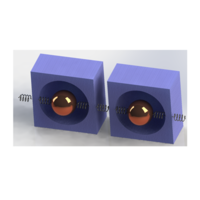
This paper provides a warning to the acoustic metamaterials community to be careful not to mistake the sign or value of the effective parameters, i.e. the density and modulus, of acoustic metamaterials for want of an overall picture of the physics involved. The authors here provide a new picture of the functioning of acoustic metamaterials based on hidden forces and hidden sources of volume. The new ansatz is tested on some established acoustic metamaterials with elements based on membranes, Helmholtz resonators, springs, and masses. It should provide the basis for a clearer vision of acoustic metamaterials and a faster route to real-world applications.

Reflection thermal diffuse x-ray scattering for quantitative determination of phonon dispersion relations

A. B. Mei, O. Hellman, C. M. Schlepütz, A. Rockett, T.-C. Chiang, L. Hultman, I. Petrov, and J. E. Greene

Phys. Rev. B 92, 174301 (2015) - Published 3 November, 2015

The ability to spectrally resolve phonon energies and dispersion relations is central to the understanding and controlling of structural properties and thermal transport of crystalline solids. However, many of the existing probing techniques are limited by the requirement of large sample sizes. In this work, the authors have demonstrated a new method for determining phonon dispersion relations of solids based upon synchrotron reflection x-ray thermal diffuse scattering measurements. The application of this method was demonstrated in the model system of MgO thin films. Such techniques may become valuable for determining vibrational properties of heteroepitaxial thin films since x-ray penetration depths can be selectively tuned through the use of grazing incidence.

Dynamics of many-body localization in a translation-invariant quantum glass model

Merlijn van Horssen, Emanuele Levi, and Juan P. Garrahan

Phys. Rev. B 92, 100305(R) (2015) - Published 28 September, 2015

The authors present evidence of many-body localization in a translationally invariant model Hamiltonian. The model, Ising-like, arises in the study of quantum glasses. The authors show that this model exhibits two regimes: one of fast relaxation and one of slow relaxation with dynamical features typically associated with many-body localized phases.

Wannier interpolation of the electron-phonon matrix elements in polar semiconductors: Polar-optical coupling in GaAs

J. Sjakste, N. Vast, M. Calandra, and F. Mauri

Phys. Rev. B 92, 054307 (2015) - Published 31 August, 2015

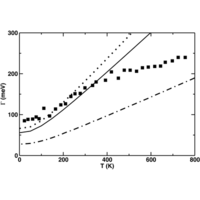
A new computational method is introduced that allows interpolation of the electron-phonon matrix elements in the space of localized Wannier functions, extending a previous method for study of polar semiconductors. The amount of broadening of the bands in GaAs due to electron-phonon scattering is presented, showing good agreement with experimental results. The method is shown to perform better than an empirical pseudopotential.

Raman study of lattice dynamics in the Weyl semimetal TaAs

H. W. Liu, P. Richard, Z. D. Song, L. X. Zhao, Z. Fang, G.-F. Chen, and H. Ding

Phys. Rev. B 92, 064302 (2015) - Published 6 August, 2015

The shift of attention in topological matter is quickly shifting from topological insulators to Weyl semimetals after the recent much publicized theoretical prediction and experimental verification in TaAs. Reported here is the first Raman study of a Weyl semimetal. As with topological insulators, Raman phonons will be routinely used as probes to characterize the quality and the conditions of samples and devices. The study here identifies all the optic phonon modes and finds some additional interesting features, and should provide a good guide for future work.

Heat-flux control and solid-state cooling by regulating chemical potential of photons in near-field electromagnetic heat transfer

Kaifeng Chen, Parthiban Santhanam, Sunil Sandhu, Linxiao Zhu, and Shanhui Fan

Phys. Rev. B 91, 134301 (2015) - Published 13 April, 2015

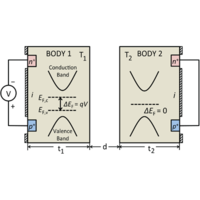
Near-field electromagnetic heat transfer is studied in a theoretical semiconductor heterojunction system in the presence of a non-zero chemical potential (via a bias voltage). Changing the potential enables electronic control of near-field heat transfer and suggests a novel and very exciting new possibility for achieving solid-state cooling, a holy grail in thermal science.

Distributions of phonon lifetimes in Brillouin zones

Atsushi Togo, Laurent Chaput, and Isao Tanaka

Phys. Rev. B 91, 094306 (2015) - Published 20 March, 2015

A collaboration of researchers from Japan and France present a comprehensive study of phonon lifetimes and thermal conductivity for 33 zincblende- and wurtzite compounds using linearized phonon Boltzmann equation and first-principles anharmonic phonon calculations. The software that the authors created for this study will be released as an open source package and should be of help in the search of new materials for thermoelectric applications.

Coexistence of excited polarons and metastable delocalized states in photoinduced metals

Sharareh Sayyad and Martin Eckstein

Phys. Rev. B 91, 104301 (2015) - Published 3 March, 2015

Using a nonequilibrium dynamical mean-field theory the authors study relaxation of a hot-electron distribution coupled to optical phonons. Their main interest is in the adiabatic regime of phonon frequencies smaller than the electronic bandwidth and in an extended analysis of photoemission spectra. In this limit initial coherent phonon oscillations become strongly damped, leaving the system in a mixture of excited polaron states and metastable delocalized states.

Real-time decay of a highly excited charge carrier in the one-dimensional Holstein model

F. Dorfner, L. Vidmar, C. Brockt, E. Jeckelmann, and F. Heidrich-Meisner

Phys. Rev. B 91, 104302 (2015) - Published 3 March, 2015

Nonequilibrium dynamics of interacting quantum many-body physics has recently attracted great attention. The authors address here the nonequilibrium dynamics of a single electron interacting through a Holstein-like coupling with dispersionless phonons on a one dimensional lattice. Using diagonalization in a limited functional space, they identify two different regimes: (1) the relaxation regime where, during a characteristic time scale, a net energy is transferred between the electronic and the phononic subsystem; and (2) the stationary regime, characterized by zero energy transfer and by persisting coherent oscillations in the dynamics of observables.

Enhanced performance of joint cooling and energy production

O. Entin-Wohlman, Y. Imry, and A. Aharony

Phys. Rev. B 91, 054302 (2015) - Published 3 February, 2015

A three-terminal thermoelectric junction is studied theoretically and a counterintuitive result is obtained. The cooling efficiency is increased for configurations when not only one terminal is cooled but also electric power is generated.

Superabsorption of acoustic waves with bubble metascreens

Valentin Leroy, Anatoliy Strybulevych, Maxime Lanoy, Fabrice Lemoult, Arnaud Tourin, and John H. Page

Phys. Rev. B 91, 020301(R) (2015) - Published 6 January, 2015

Antireflective acoustic coatings for hiding submarines and other watercraft could be made much thinner than those in use today.

Wave propagation in twisted metamaterials

Amir Nader Askarpour, Yang Zhao, and Andrea Alù

Phys. Rev. B 90, 054305 (2014) - Published 25 August, 2014

Twisted metamaterials, i.e. arrays of identical planar metasurfaces stacked with a sequential rotation, offer new possibilities for manipulating and engineering wave propagation. This paper presents a generalized Floquet analysis to discuss wave propagation in these kind of structures. The authors show that the eigenmodes support specific circular polarization properties based on a lattice effect even when achiral inclusions are considered.

Theory of nonlinear phononics for coherent light control of solids

Alaska Subedi, Andrea Cavalleri, and Antoine Georges

Phys. Rev. B 89, 220301(R) (2014) - Published 11 June, 2014

A microscopic theory for ultrafast control of solids with tera-hertz optical pulses account for a light-induced insulator-to-metal transition.

Sign In to Your Journals Account

Filter

Section

Filter

Article Lookup

Enter a citation