Browse by Subject

Continuous-Variable Quantum State Designs: Theory and Applications

Joseph T. Iosue, Kunal Sharma, Michael J. Gullans, and Victor V. Albert

Phys. Rev. X 14, 011013 (2024) - Published 8 February, 2024

Quantum t-designs—ensembles of states that mimic uniform averaging—for infinite-dimensional spaces do not exist, but an alternative “rigged t-design” is possible.

Sublinear Scaling in Non-Markovian Open Quantum Systems Simulations

Moritz Cygorek, Jonathan Keeling, Brendon W. Lovett, and Erik M. Gauger

Phys. Rev. X 14, 011010 (2024) - Published 1 February, 2024

An exact algorithm to calculate process tensors—compact representations of environmental influences—provides a scaling advantage over previous algorithms and enables tackling problems in open quantum systems that are currently out of reach.

Hyperoptimized Approximate Contraction of Tensor Networks with Arbitrary Geometry

Johnnie Gray and Garnet Kin-Lic Chan

Phys. Rev. X 14, 011009 (2024) - Published 26 January, 2024

A new framework for approximate evaluation, or contraction, of a tensor network greatly expands the range of problems in quantum physics and computer science that may be accurately approximated by tensor network methods.

High-Sensitivity ac-Charge Detection with a MHz-Frequency Fluxonium Qubit

B.-L. Najera-Santos, R. Rousseau, K. Gerashchenko, H. Patange, A. Riva, M. Villiers, T. Briant, P.-F. Cohadon, A. Heidmann, J. Palomo, M. Rosticher, H. le Sueur, A. Sarlette, W. C. Smith, Z. Leghtas, E. Flurin, T. Jacqmin, and S. Deléglise

Phys. Rev. X 14, 011007 (2024) - Published 24 January, 2024

Researchers have demonstrated an unprecedentedly low-frequency superconducting “fluxonium” qubit, which could facilitate experiments that probe macroscopic quantum phenomena.

Measuring Nonlocal Brane Order with Error-Corrected Quantum Gas Microscopes

Junhyeok Hur, Wonjun Lee, Kiryang Kwon, SeungJung Huh, Gil Young Cho, and Jae-yoon Choi

Phys. Rev. X 14, 011003 (2024) - Published 8 January, 2024

An error-correction method for large-scale neutral atom quantum simulators using optical lattices can distinguish correlated particle-hole pairs from uncorrelated holes in the Mott insulator.

Bogoliubov Excitations Driven by Thermal Lattice Phonons in a Quantum Fluid of Light

Irénée Frérot, Amit Vashisht, Martina Morassi, Aristide Lemaître, Sylvain Ravets, Jacqueline Bloch, Anna Minguzzi, and Maxime Richard

Phys. Rev. X 13, 041058 (2023) - Published 26 December, 2023

Quantum fluids of light are coupled to their environments. A joint theory-experiment analysis shows this environment includes the thermal vibrations of the lattice hosting the fluid.

Qubit-Reuse Compilation with Mid-Circuit Measurement and Reset

Matthew DeCross, Eli Chertkov, Megan Kohagen, and Michael Foss-Feig

Phys. Rev. X 13, 041057 (2023) - Published 22 December, 2023

A technique for compressing a quantum program into a small number of qubits pushes quantum computing closer to its goal of solving meaningful problems that cannot be solved on classical computers.

A Race-Track Trapped-Ion Quantum Processor

S. A. Moses et al.

Phys. Rev. X 13, 041052 (2023) - Published 18 December, 2023

Major technical improvements to a quantum computer based on trapped ions could bring a large-scale version closer to reality.

Theory of Free Fermions under Random Projective Measurements

Igor Poboiko, Paul Pöpperl, Igor V. Gornyi, and Alexander D. Mirlin

Phys. Rev. X 13, 041046 (2023) - Published 8 December, 2023

A new analytic theory of a monitored 1D free-fermion system shows the absence of a measurement-induced entanglement phase transition conjectured in recent studies.

Nonlinear Sigma Models for Monitored Dynamics of Free Fermions

Michele Fava, Lorenzo Piroli, Tobias Swann, Denis Bernard, and Adam Nahum

Phys. Rev. X 13, 041045 (2023) - Published 8 December, 2023

A field-theoretic description of monitored free fermions reveals the entanglement phase diagram of one class of such systems and new universality classes of phase transitions.

Measurement-Altered Ising Quantum Criticality

Sara Murciano, Pablo Sala, Yue Liu, Roger S. K. Mong, and Jason Alicea

Phys. Rev. X 13, 041042 (2023) - Published 5 December, 2023

In 1D Ising systems, a protocol for weakly measuring the critical degrees of freedom uncovers a rich interplay between measurements and correlations accessible by both experiment and theory.

Microwave-Based Quantum Control and Coherence Protection of Tin-Vacancy Spin Qubits in a Strain-Tuned Diamond-Membrane Heterostructure

Xinghan Guo, Alexander M. Stramma, Zixi Li, William G. Roth, Benchen Huang, Yu Jin, Ryan A. Parker, Jesús Arjona Martínez, Noah Shofer, Cathryn P. Michaels, Carola P. Purser, Martin H. Appel, Evgeny M. Alexeev, Tianle Liu, Andrea C. Ferrari, David D. Awschalom, Nazar Delegan, Benjamin Pingault, Giulia Galli, F. Joseph Heremans, Mete Atatüre, and Alexander A. High

Phys. Rev. X 13, 041037 (2023) - Published 29 November, 2023

Strain engineering of diamond provides a way to realize high-performance tin-vacancy spin qubits that avoid many of the trade-offs inherent to optical quantum control techniques.

Midcircuit Operations Using the omg Architecture in Neutral Atom Arrays

Joanna W. Lis, Aruku Senoo, William F. McGrew, Felix Rönchen, Alec Jenkins, and Adam M. Kaufman

Phys. Rev. X 13, 041035 (2023) - Published 22 November, 2023

Three research groups have exploited the nuclear spins of ytterbium-171 to manipulate qubits before they are read out—an approach that could lead to efficient error-correction schemes for trapped-atom computing platforms.

Emergence of Classical Magnetic Order from Anderson Towers: Quantum Darwinism in Action

O. M. Sotnikov, E. A. Stepanov, M. I. Katsnelson, F. Mila, and V. V. Mazurenko

Phys. Rev. X 13, 041027 (2023) - Published 8 November, 2023

In certain magnetic systems, one superposition of quantum eigenstates leads to a particular classical order, demonstrating that quantum-classical connections can be made via not only observables but also quantum states.

Quantum Many-Body Jarzynski Equality and Dissipative Noise on a Digital Quantum Computer

Dominik Hahn, Maxime Dupont, Markus Schmitt, David J. Luitz, and Marin Bukov

Phys. Rev. X 13, 041023 (2023) - Published 2 November, 2023

The Jarzynski equality is a fundamental law connecting equilibrium processes with nonequilibrium fluctuations. Experiments, for the first time, test it in the quantum many-body regime.

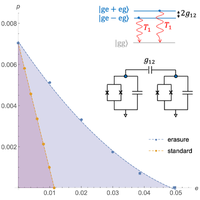
Erasure Qubits: Overcoming the T1 Limit in Superconducting Circuits

Aleksander Kubica, Arbel Haim, Yotam Vaknin, Harry Levine, Fernando Brandão, and Alex Retzker

Phys. Rev. X 13, 041022 (2023) - Published 1 November, 2023

A simple scheme to convert amplitude-damping noise in superconducting circuits to easier-to-correct heralded erasure noise overcomes conventional limits on quantum information fidelity.

Broadband Quantum Enhancement of the LIGO Detectors with Frequency-Dependent Squeezing

D. Ganapathy et al. (LIGO O4 Detector Collaboration)

Phys. Rev. X 13, 041021 (2023) - Published 30 October, 2023

The LIGO experiment has demonstrated a noise-squeezing technique for its entire frequency-detection range—a feat that could boost the detection rate of black hole mergers by up to 65%.

Tackling Sampling Noise in Physical Systems for Machine Learning Applications: Fundamental Limits and Eigentasks

Fangjun Hu, Gerasimos Angelatos, Saeed A. Khan, Marti Vives, Esin Türeci, Leon Bello, Graham E. Rowlands, Guilhem J. Ribeill, and Hakan E. Türeci

Phys. Rev. X 13, 041020 (2023) - Published 30 October, 2023

A framework to quantify the computational capacity of arbitrary physical systems in the presence of sampling noise provides a tool for best harnessing them for machine learning.

Fabry-Pérot Interferometry at the ν=2/5 Fractional Quantum Hall State

J. Nakamura, S. Liang, G. C. Gardner, and M. J. Manfra

Phys. Rev. X 13, 041012 (2023) - Published 23 October, 2023

Fabry-Perot interferometry can observe anyon behavior at complex fractional states—a key requirement for analyzing non-abelian states that are sought after for intrinsically fault-tolerant qubits.

Temporal Entanglement in Chaotic Quantum Circuits

Alessandro Foligno, Tianci Zhou, and Bruno Bertini

Phys. Rev. X 13, 041008 (2023) - Published 11 October, 2023

To simulate the action of an effective bath in a chaotic system of many quantum particles, one needs resources that grow exponentially in time.

Sign In to Your Journals Account

Filter

Filter

Article Lookup

Enter a citation