Recent Articles

Spatiotemporal Mapping of a Photocurrent Vortex in Monolayer MoS2 Using Diamond Quantum Sensors

Brian B. Zhou, Paul C. Jerger, Kan-Heng Lee, Masaya Fukami, Fauzia Mujid, Jiwoong Park, and David D. Awschalom

Phys. Rev. X 10, 011003 (2020) - Published 6 January, 2020

Experiments reveal the path traced by light-induced electric currents in a monolayer semiconductor by using nitrogen-vacancy centers in diamond to sense magnetic fields from those currents.

Spectroscopic Visualization of a Robust Electronic Response of Semiconducting Nanowires to Deposition of Superconducting Islands

Jonathan Reiner, Abhay Kumar Nayak, Amit Tulchinsky, Aviram Steinbok, Tom Koren, Noam Morali, Rajib Batabyal, Jung-Hyun Kang, Nurit Avraham, Yuval Oreg, Hadas Shtrikman, and Haim Beidenkopf

Phys. Rev. X 10, 011002 (2020) - Published 3 January, 2020

The electronic behavior of indium arsenide nanowires is barely affected by the presence of superconducting aluminum electrodes, an insight that could be useful for designing robust quantum-based technologies.

High-Fidelity Measurement of Qubits Encoded in Multilevel Superconducting Circuits

Salvatore S. Elder, Christopher S. Wang, Philip Reinhold, Connor T. Hann, Kevin S. Chou, Brian J. Lester, Serge Rosenblum, Luigi Frunzio, Liang Jiang, and Robert J. Schoelkopf

Phys. Rev. X 10, 011001 (2020) - Published 2 January, 2020

By using redundant measurements and multiphoton states, a new approach to encoding and reading quantum bits drastically reduces errors that typically lead to a loss of information.

Topological Electronic Structure and Intrinsic Magnetization in MnBi4Te7: A Bi2Te3 Derivative with a Periodic Mn Sublattice

Raphael C. Vidal et al.

Phys. Rev. X 9, 041065 (2019) - Published 31 December, 2019

For the first time, experiments reveal a material with both an intrinsic net magnetization and a topological band inversion, a major advance in the search for materials with tunable topological properties.

Asymptotic Security Analysis of Discrete-Modulated Continuous-Variable Quantum Key Distribution

Jie Lin, Twesh Upadhyaya, and Norbert Lütkenhaus

Phys. Rev. X 9, 041064 (2019) - Published 30 December, 2019

A new analysis demonstrates that discrete-modulated CV QKD, a quantum key establishment protocol, can become a cost-effective tool for securing current classical and future quantum networks over long distances.

Quantum Skyrmions in Frustrated Ferromagnets

Vivek Lohani, Ciarán Hickey, Jan Masell, and Achim Rosch

Phys. Rev. X 9, 041063 (2019) - Published 27 December, 2019

Magnetic skyrmions, whirls of magnetization in some materials, have quantum properties quite different from all other quantum particles.

Crossover of Charge Fluctuations across the Strange Metal Phase Diagram

Ali A. Husain, Matteo Mitrano, Melinda S. Rak, Samantha Rubeck, Bruno Uchoa, Katia March, Christian Dwyer, John Schneeloch, Ruidan Zhong, G. D. Gu, and Peter Abbamonte

Phys. Rev. X 9, 041062 (2019) - Published 26 December, 2019

In contrast to conventional metals, so-called strange metals lack well-defined plasmons, exhibiting instead a featureless continuum that is a key test of theories aimed at describing this phase of matter.

Intrinsic Anomalous Nernst Effect Amplified by Disorder in a Half-Metallic Semimetal

Linchao Ding, Jahyun Koo, Liangcai Xu, Xiaokang Li, Xiufang Lu, Lingxiao Zhao, Qi Wang, Qiangwei Yin, Hechang Lei, Binghai Yan, Zengwei Zhu, and Kamran Behnia

Phys. Rev. X 9, 041061 (2019) - Published 24 December, 2019

Experiments reveal that disorder in the semimetal Co3Sn2S2 boosts the strength of the anomalous Nernst effect, where a thermal gradient in a magnetic material induces a voltage perpendicular to both.

Black Hole Ringdown: The Importance of Overtones

Matthew Giesler, Maximiliano Isi, Mark A. Scheel, and Saul A. Teukolsky

Phys. Rev. X 9, 041060 (2019) - Published 23 December, 2019

Overtones in the gravitational ringdown following a merger of two black holes can provide a precise estimate of the final black hole mass and spin as well as test the famed no-hair theorem using current detectors.

Erratum: Engineering Matter Interactions Using Squeezed Vacuum [Phys. Rev. X 7, 021041 (2017)]

Sina Zeytinoğlu, Ataç İmamoğlu, and Sebastian Huber

Phys. Rev. X 9, 049903 (2019) - Published 20 December, 2019

Weak Crystallization of Fluctuating Skyrmion Textures in MnSi

J. Kindervater, I. Stasinopoulos, A. Bauer, F. X. Haslbeck, F. Rucker, A. Chacon, S. Mühlbauer, C. Franz, M. Garst, D. Grundler, and C. Pfleiderer

Phys. Rev. X 9, 041059 (2019) - Published 20 December, 2019

The paramagnetic state of MnSi shows signatures of topological complexity that mark preexisting conditions of the emergence of skyrmions—magnetic vortices whose stability makes them ideal for novel information processing.

Topological Elasticity of Nonorientable Ribbons

Denis Bartolo and David Carpentier

Phys. Rev. X 9, 041058 (2019) - Published 19 December, 2019

The twisted topology of a Möbius strip leads to unique mechanical properties that could aid in the design of structures with elastic memory.

Experimental Evidence of Hydrodynamic Instantons: The Universal Route to Rogue Waves

Giovanni Dematteis, Tobias Grafke, Miguel Onorato, and Eric Vanden-Eijnden

Phys. Rev. X 9, 041057 (2019) - Published 18 December, 2019

A theory for rogue waves based on instantons—a mathematical concept developed in quantum chromodynamics—has been successfully tested in controlled laboratory experiments.

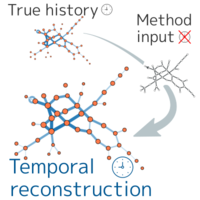
Phase Transition in the Recoverability of Network History

Jean-Gabriel Young, Guillaume St-Onge, Edward Laurence, Charles Murphy, Laurent Hébert-Dufresne, and Patrick Desrosiers

Phys. Rev. X 9, 041056 (2019) - Published 17 December, 2019

It is possible to accurately recover the past of an evolving complex network by running a model of its evolution backward, a remarkable possibility since there are usually intractably many possible pasts compatible with an observed network.

Topological Insulator-to-Weyl Semimetal Transition in Strongly Correlated Actinide System UNiSn

Vsevolod Ivanov, Xiangang Wan, and Sergey Y. Savrasov

Phys. Rev. X 9, 041055 (2019) - Published 16 December, 2019

Two well-studied electronic phases in the actinide compound UNiSn correspond to two well-known topological phases, an insight that provides a new link between correlated systems and topological materials.

Linker-Mediated Phase Behavior of DNA-Coated Colloids

Janna Lowensohn, Bernardo Oyarzún, Guillermo Narváez Paliza, Bortolo M. Mognetti, and W. Benjamin Rogers

Phys. Rev. X 9, 041054 (2019) - Published 13 December, 2019

A new paradigm for material self-assembly uses DNA sequences in solution to encode instructions for assembling colloids into complex structures.

Repetition Cat Qubits for Fault-Tolerant Quantum Computation

Jérémie Guillaud and Mazyar Mirrahimi

Phys. Rev. X 9, 041053 (2019) - Published 12 December, 2019

A new implementation of quantum error-correcting “cat codes” could be extended to a fully tolerant, universal quantum computer with minimal hardware overhead.

An Atomic-Array Optical Clock with Single-Atom Readout

Ivaylo S. Madjarov, Alexandre Cooper, Adam L. Shaw, Jacob P. Covey, Vladimir Schkolnik, Tai Hyun Yoon, Jason R. Williams, and Manuel Endres

Phys. Rev. X 9, 041052 (2019) - Published 11 December, 2019

An optical clock based on an array of individually trapped atoms provides a new twist in atom-based timekeeping.

Thermal Conductivity of the Quantum Spin Liquid Candidate EtMe3Sb[Pd(dmit)2]2: No Evidence of Mobile Gapless Excitations

P. Bourgeois-Hope, F. Laliberté, E. Lefrançois, G. Grissonnanche, S. René de Cotret, R. Gordon, S. Kitou, H. Sawa, H. Cui, R. Kato, L. Taillefer, and N. Doiron-Leyraud

Phys. Rev. X 9, 041051 (2019) - Published 10 December, 2019

Thermal conductivity measurements of a quantum spin-liquid candidate show—in contrast to earlier work—no evidence that spinons contribute to heat transport, instead attributing heat conduction to phonons scattered by spin excitations.

Characterizing Optical Fiber Transmission Matrices Using Metasurface Reflector Stacks for Lensless Imaging without Distal Access

George S. D. Gordon, Milana Gataric, Alberto Gil C. P. Ramos, Ralf Mouthaan, Calum Williams, Jonghee Yoon, Timothy D. Wilkinson, and Sarah E. Bohndiek

Phys. Rev. X 9, 041050 (2019) - Published 9 December, 2019

A technique for removing image distortion induced by light traversing a bent optical fiber could pave the way to obtaining microscopic images deep within the human body.

Sign In to Your Journals Account

Filter

Recent Issues

Vol. 16, Iss. 4
October - December 2026
Vol. 16, Iss. 3
July - September 2026
Vol. 16, Iss. 2
April - June 2026
Vol. 16, Iss. 1
January - March 2026
Category
Article Type

Filter

Article Lookup

Enter a citation