Recent Articles

Tailoring Surface Codes for Highly Biased Noise

David K. Tuckett, Andrew S. Darmawan, Christopher T. Chubb, Sergey Bravyi, Stephen D. Bartlett, and Steven T. Flammia

Phys. Rev. X 9, 041031 (2019) - Published 12 November, 2019

Quantum error correcting “surface codes” can be tailored to the specific noise characteristics of the system, promising substantial gains in future quantum computing implementations.

Real-Time Characterization of Period-Doubling Dynamics in Uniform and Dispersion Oscillating Fiber Ring Cavities

Florent Bessin, François Copie, Matteo Conforti, Alexandre Kudlinski, Arnaud Mussot, and Stefano Trillo

Phys. Rev. X 9, 041030 (2019) - Published 11 November, 2019

Experiments directly reveal the real-time dynamics of the modulation instability process in resonators.

Unsupervised Classification of Quantum Data

Gael Sentís, Alex Monràs, Ramon Muñoz-Tapia, John Calsamiglia, and Emilio Bagan

Phys. Rev. X 9, 041029 (2019) - Published 8 November, 2019

A new protocol sorts and classifies quantum data by the state in which they were prepared, outperforming a comparable classical algorithm.

Momentum-Space Atom Correlations in a Mott Insulator

Cécile Carcy, Hugo Cayla, Antoine Tenart, Alain Aspect, Marco Mancini, and David Clément

Phys. Rev. X 9, 041028 (2019) - Published 7 November, 2019

Observations provide the full 3D distribution of momentums of helium atoms in a Mott insulator, an insulating phase of strongly interacting quantum matter, and lead to several new insights into the behavior of this exotic phase.

Unusual Formation of Point-Defect Complexes in the Ultrawide-Band-Gap Semiconductor β−Ga2O3

Jared M. Johnson, Zhen Chen, Joel B. Varley, Christine M. Jackson, Esmat Farzana, Zeng Zhang, Aaron R. Arehart, Hsien-Lien Huang, Arda Genc, Steven A. Ringel, Chris G. Van de Walle, David A. Muller, and Jinwoo Hwang

Phys. Rev. X 9, 041027 (2019) - Published 6 November, 2019

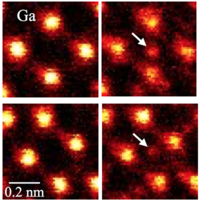
An investigation of the material β-Ga2O3 reveal defects in the crystalline structure that correlate with theoretical structures predicted to alter the material’s electrical properties, a key step in harnessing such defects for technological development.

How Dissipation Constrains Fluctuations in Nonequilibrium Liquids: Diffusion, Structure, and Biased Interactions

Laura Tociu, Étienne Fodor, Takahiro Nemoto, and Suriyanarayanan Vaikuntanathan

Phys. Rev. X 9, 041026 (2019) - Published 5 November, 2019

An analysis of liquids driven far from equilibrium by external fields or internal activity draws explicit constraints between their dissipation, structure, and dynamics, enabling finer control of spatial organization.

Nanorheology of Interfacial Water during Ice Gliding

L. Canale, J. Comtet, A. Niguès, C. Cohen, C. Clanet, A. Siria, and L. Bocquet

Phys. Rev. X 9, 041025 (2019) - Published 4 November, 2019

The liquid layer that forms between ice and any object gliding along its surface is far thinner and more viscous than imagined, setting the stage for new ways of thinking about why ice is so slippery.

Lattices of Hydrodynamically Interacting Flapping Swimmers

Anand U. Oza, Leif Ristroph, and Michael J. Shelley

Phys. Rev. X 9, 041024 (2019) - Published 1 November, 2019

A new minimal model explores how individual creatures in a fish school or bird flock benefit from different arrangements of the group, revealing the configurations that provide the greatest hydrodynamic benefits.

Physical-Layer Supervised Learning Assisted by an Entangled Sensor Network

Quntao Zhuang and Zheshen Zhang

Phys. Rev. X 9, 041023 (2019) - Published 31 October, 2019

A new paradigm for performing machine learning tasks on a quantum processor offers a potential boost to sensing applications using readily available quantum devices and components.

Two-Tone Optomechanical Instability and Its Fundamental Implications for Backaction-Evading Measurements

Itay Shomroni, Amir Youssefi, Nick Sauerwein, Liu Qiu, Paul Seidler, Daniel Malz, Andreas Nunnenkamp, and Tobias J. Kippenberg

Phys. Rev. X 9, 041022 (2019) - Published 30 October, 2019

Experiments reveal a novel optomechanical instability in devices that attempt to surpass quantum limits in ultraprecise displacement measurements, an effect that must be considered in future quantum sensing experiments.

Quantifying and Controlling Prethermal Nonergodicity in Interacting Floquet Matter

K. Singh, C. J. Fujiwara, Z. A. Geiger, E. Q. Simmons, M. Lipatov, A. Cao, P. Dotti, S. V. Rajagopal, R. Senaratne, T. Shimasaki, M. Heyl, A. Eckardt, and D. M. Weld

Phys. Rev. X 9, 041021 (2019) - Published 29 October, 2019

An experimental demonstration of the complete characterization and control of a prethermal quantum gas sets the stage for new ways of studying nonequilibrium quantum systems.

Chromatin Compaction, Auxeticity, and the Epigenetic Landscape of Stem Cells

Kamal Tripathi and Gautam I. Menon

Phys. Rev. X 9, 041020 (2019) - Published 28 October, 2019

An unusual mechanical behavior in the nuclei of mouse stem cells may be linked to the compaction of chromatin (DNA and the proteins that bind to it), a step toward understanding how and why stem cells become other cell types.

Transport of Neutral Optical Excitations Using Electric Fields

Ovidiu Cotleţ, Falko Pientka, Richard Schmidt, Gergely Zarand, Eugene Demler, and Atac Imamoglu

Phys. Rev. X 9, 041019 (2019) - Published 25 October, 2019

Polaritons—comprised of photons and electric dipoles—can respond to electric and magnetic fields much like charged particles, suggesting a way to control the motion of these quasiparticles within a material.

FeO Content of Earth’s Liquid Core

Monica Pozzo, Chris Davies, David Gubbins, and Dario Alfè

Phys. Rev. X 9, 041018 (2019) - Published 24 October, 2019

Calculations show that oxygen could have entered Earth’s iron-nickel core shortly after our planet’s formation, which would have influenced the dynamics of the core and, in turn, Earth’s magnetic field.

A Universal Operator Growth Hypothesis

Daniel E. Parker, Xiangyu Cao, Alexander Avdoshkin, Thomas Scaffidi, and Ehud Altman

Phys. Rev. X 9, 041017 (2019) - Published 23 October, 2019

A mathematical analysis fully quantifies a leading hypothesis for how quantum systems achieve thermal equilibrium despite being fully reversible.

Spin Seebeck Imaging of Spin-Torque Switching in Antiferromagnetic Pt/NiO Heterostructures

Isaiah Gray, Takahiro Moriyama, Nikhil Sivadas, Gregory M. Stiehl, John T. Heron, Ryan Need, Brian J. Kirby, David H. Low, Katja C. Nowack, Darrell G. Schlom, Daniel C. Ralph, Teruo Ono, and Gregory D. Fuchs

Phys. Rev. X 9, 041016 (2019) - Published 22 October, 2019

A tabletop setup for imaging antiferromagnetic order shows how electron spin domains in a thin film of NiO respond to an external electric current, a useful insight for building fast computer memories.

Symmetry and Topology in Non-Hermitian Physics

Kohei Kawabata, Ken Shiozaki, Masahito Ueda, and Masatoshi Sato

Phys. Rev. X 9, 041015 (2019) - Published 21 October, 2019

Researchers have developed a general theory of symmetry and topology in open systems.

Many-Body Delocalization in the Presence of a Quantum Bath

Antonio Rubio-Abadal, Jae-yoon Choi, Johannes Zeiher, Simon Hollerith, Jun Rui, Immanuel Bloch, and Christian Gross

Phys. Rev. X 9, 041014 (2019) - Published 18 October, 2019

A small homogenous bath of cold atoms can destroy many-body localization in a coupled ensemble, a new experimental insight into how some quantum systems fail to thermalize.

Dimensional Quantum Memory Advantage in the Simulation of Stochastic Processes

Farzad Ghafari, Nora Tischler, Jayne Thompson, Mile Gu, Lynden K. Shalm, Varun B. Verma, Sae Woo Nam, Raj B. Patel, Howard M. Wiseman, and Geoff J. Pryde

Phys. Rev. X 9, 041013 (2019) - Published 17 October, 2019

Experiments confirm that a new quantum simulator outperforms all classical counterparts in simulating a stochastic process with a smaller memory storage than classically possible.

Asymmetric Protocols for Scalable High-Rate Measurement-Device-Independent Quantum Key Distribution Networks

Wenyuan Wang, Feihu Xu, and Hoi-Kwong Lo

Phys. Rev. X 9, 041012 (2019) - Published 16 October, 2019

Theory suggests that high-rate quantum networks with untrusted relays can be built in which users can be added or deleted in real time.

Sign In to Your Journals Account

Filter

Recent Issues

Vol. 16, Iss. 4
October - December 2026
Vol. 16, Iss. 3
July - September 2026
Vol. 16, Iss. 2
April - June 2026
Vol. 16, Iss. 1
January - March 2026
Category
Article Type

Filter

Article Lookup

Enter a citation