Recent Articles

Universal productivity patterns in research careers

Andre S. Sunahara, Matjaž Perc, and Haroldo V. Ribeiro

Phys. Rev. Research 5, 043203 (2023) - Published 5 December, 2023

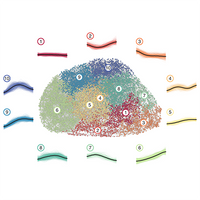
Methods from time series analysis, dimensionality reduction, and network science are combined to show evidence for the natural emergence of six universal patterns of productivity in scientific careers: constant, u-shaped, decreasing, periodic, increasing, and canonical curves. Canonical curves are the most prevalent pattern, but contrary to expectations, productivity peaks occur much more frequently around midcareer rather than early.

Dragon kings in self-organized criticality systems

Guram Mikaberidze, Arthur Plaud, and Raissa M. D'Souza

Phys. Rev. Research 5, L042013 (2023) - Published 19 October, 2023

Models of self-organized criticality can surprisingly produce dragon king failures—massive, self-amplifying cascading events. It is analytically demonstrated that dragon kings are created by the trade-off between driving impulse and dissipation rate.

Lyapunov spectra of chaotic recurrent neural networks

Rainer Engelken, Fred Wolf, and L. F. Abbott

Phys. Rev. Research 5, 043044 (2023) - Published 16 October, 2023

The Lyapunov spectrum of recurrent neural networks is calculated and analytical approximations through random matrix theory are provided. The dependency of attractor dimensions and entropy rates on coupling strength and input fluctuations is identified and a point symmetry of the Lyapunov spectrum is revealed. A link is shown between Lyapunov exponents to error propagation and stability in trained recurrent networks for machine-learning applications.

Particle acceleration by magnetic Rayleigh-Taylor instability: Mechanism for flares in black hole accretion flows

Vladimir Zhdankin, Bart Ripperda, and Alexander A. Philippov

Phys. Rev. Research 5, 043023 (2023) - Published 9 October, 2023

This article uses magnetic Rayleigh-Taylor instability in relativistic collisionless plasma as an example of an astrophysical process for nonthermal particle acceleration, and uncover the onset of large-scale plumes formed by accumulation of small ones via particle-in-cell simulations. This is posed as a potential mechanism for flares.

Optical stimulated-Raman sideband spectroscopy of a single Be+9 ion in a Penning trap

Juan M. Cornejo, Johannes Brombacher, Julia A. Coenders, Moritz von Boehn, Teresa Meiners, Malte Niemann, Stefan Ulmer, and Christian Ospelkaus

Phys. Rev. Research 5, 033226 (2023) - Published 28 September, 2023

A sideband spectroscopy of a single beryllium ion in a Penning trap is demonstrated, finding a temperature of (3.1 ± 0.4) mK. This is a key step for ground-state cooling, so that motional degrees of freedom in Penning traps can be manipulated at the single-quantum level for quantum logic applications and precision measurements.

Active nematics on flat surfaces: From droplet motility and scission to active wetting

Rodrigo C. V. Coelho, Hélio R. J. C. Figueiredo, and Margarida M. Telo da Gama

Phys. Rev. Research 5, 033165 (2023) - Published 7 September, 2023

Active nematic droplets on surfaces are studied at different activities on a wide range of surfaces. The analysis provides a global description of the dynamical regimes reported for active nematic droplets, such as active wetting, propulsion, and chaotic motion, and it reveals the dimensionless parameters that characterize the dynamics of droplets on surfaces.

Entangling quantum memories via heralded photonic Bell measurement

Prajit Dhara, Dirk Englund, and Saikat Guha

Phys. Rev. Research 5, 033149 (2023) - Published 1 September, 2023

Analytical modeling of a quantum communication link is based on a photonic swap in the middle architecture. The effect of network and hardware nonidealities on the distributed entangled state is analyzed with the density operator formalism and with implications on the choice of distillation circuits of heralded states.

Optically trapped Feshbach molecules of fermionic Dy161 and K40

E. Soave, A. Canali, Zhu-Xiong Ye, M. Kreyer, E. Kirilov, and R. Grimm

Phys. Rev. Research 5, 033117 (2023) - Published 18 August, 2023

A pure sample of bosonic Feshbach molecules composed of fermionic Dy-161 and K-40 atoms has been prepared in an optical trap, with a phase-space density of about 0.1. Investigation of the molecular cloud decay in the presence of 1064-nm trapping light points to a one-photon coupling to electronically excited states as the main factor limiting the sample lifetime. This observation, together with a refined understanding of the molecule properties and behavior as a function of the magnetic field, offers crucial insights and experimental progress toward achieving quantum-degenerate samples of DyK molecules and novel superfluids based on mass-imbalanced fermion mixtures.

Pressure-enhanced fractional Chern insulators along a magic line in moiré transition metal dichalcogenides

Nicolás Morales-Durán, Jie Wang, Gabriel R. Schleder, Mattia Angeli, Ziyan Zhu, Efthimios Kaxiras, Cécile Repellin, and Jennifer Cano

Phys. Rev. Research 5, L032022 (2023) - Published 17 August, 2023

The effect of applied pressure on fractional Chern insulators (FCIs) in moiré TMDs is numerically studied, indicating that pressure can enhance the many-body gap of these topologically ordered phases. This is supported by showing that, within the region of stability of the FCI, the quantum geometry of the topmost moiré flat band almost satisfies the ideal condition.

Photon emission statistics of a driven microwave cavity

Pedro Portugal, Fredrik Brange, Kalle S. U. Kansanen, Peter Samuelsson, and Christian Flindt

Phys. Rev. Research 5, 033091 (2023) - Published 8 August, 2023

A theory that can predict the photon-emission statistics from driven microwave cavities is developed. Specifically, it’s shown how the photon-emission statistics is fully determined by a Riccati equation.

Simple extension of the plane-wave final state in photoemission: Bringing understanding to the photon-energy dependence of two-dimensional materials

Christian S. Kern, Anja Haags, Larissa Egger, Xiaosheng Yang, Hans Kirschner, Susanne Wolff, Thomas Seyller, Alexander Gottwald, Mathias Richter, Umberto De Giovannini, Angel Rubio, Michael G. Ramsey, François C. Bocquet, Serguei Soubatch, F. Stefan Tautz, Peter Puschnig, and Simon Moser

Phys. Rev. Research 5, 033075 (2023) - Published 3 August, 2023

The photoemission cross section of graphene is measured for two light polarizations and a wide range of photon energies at a flux-calibrated synchrotron light source. Modeling scattering effects by a simplistic model and sophisticated time-dependent density-functional-theory calculations, the complex phase shifts in the photoemission final state are extracted from the experiment to obtain complete information about the photoemission process.

Prediction of a roton-type feature in warm dense hydrogen

Paul Hamann, Linda Kordts, Alexey Filinov, Michael Bonitz, Tobias Dornheim, and Jan Vorberger

Phys. Rev. Research 5, 033039 (2023) - Published 21 July, 2023

This paper provides confirmation that a roton-type correlation effect manifest itself in warm dense hydrogen.

Bounded-confidence model of opinion dynamics with heterogeneous node-activity levels

Grace J. Li and Mason A. Porter

Phys. Rev. Research 5, 023179 (2023) - Published 21 June, 2023

A bounded-confidence model of opinion dynamics on networks with node weights, which encode heterogeneous activity levels, is studied. The presence of heterogeneous node weights increases both opinion fragmentation and convergence times to steady state.

Dynamics of all-optical single-shot switching of magnetization in Tb/Co multilayers

K. Mishra, T. G. H. Blank, C. S. Davies, L. Avilés-Félix, D. Salomoni, L. D. Buda-Prejbeanu, R. C. Sousa, I. L. Prejbeanu, B. Koopmans, Th. Rasing, A. V. Kimel, and A. Kirilyuk

Phys. Rev. Research 5, 023163 (2023) - Published 14 June, 2023

The spatial and temporal dynamics of laser-induced single-shot magnetization switching are studied for various compositions of Tb/Co multilayers to understand the underlying mechanism. This is shown to be drastically different from the ones in Tb-Co alloys as well as in the previously studied toggle-switching Gd-containing ferrimagnets.

Crafting the dynamical structure of synchronization by harnessing bosonic multilevel cavity QED

Riccardo J. Valencia-Tortora, Shane P. Kelly, Tobias Donner, Giovanna Morigi, Rosario Fazio, and Jamir Marino

Phys. Rev. Research 5, 023112 (2023) - Published 19 May, 2023

Quantum correlations can induce chaos in the collective dynamical response of multilevel atoms in cavity QED experiments.

Polymorphism in tubulin assemblies: A mechanical model

Ireth García-Aguilar, Steven Zwaan, and Luca Giomi

Phys. Rev. Research 5, 023093 (2023) - Published 12 May, 2023

The mechanical origin of polymorphism in two-dimensional tubulin assemblies, including microtubules and other structures such as twisted ribbons, flat sheets, and macrotubules, is examined by modeling these as anisotropic elastic shells. Varying asymmetries at a dimer level, expressed as spontaneous curvature, naturally gives rise to the polymorphic landscape. The results provide insight in the robustness of cylindrical structures and mechanical aspects of microtubule disassembly.

Indirect evidence for elemental hydrogen in laser-compressed hydrocarbons

D. Kraus et al.

Phys. Rev. Research 5, L022023 (2023) - Published 3 May, 2023

In situ x-ray diffraction of shock-compressed plastics suggests the formation of liquid metallic hydrogen via carbon-hydrogen phase separation.

Gauge-invariant and anyonic-symmetric autoregressive neural network for quantum lattice models

Di Luo, Zhuo Chen, Kaiwen Hu, Zhizhen Zhao, Vera Mikyoung Hur, and Bryan K. Clark

Phys. Rev. Research 5, 013216 (2023) - Published 29 March, 2023

Development of gauge-invariant and anyonic-symmetric autoregressive neural networks for quantum many-body physics simulations.

First detection of the atomic O18 isotope in the mesosphere and lower thermosphere of Earth

Helmut Wiesemeyer, Rolf Güsten, Rebeca Aladro, Bernd Klein, Heinz-Wilhelm Hübers, Heiko Richter, Urs U. Graf, Matthias Justen, Yoko Okada, and Jürgen Stutzki

Phys. Rev. Research 5, 013072 (2023) - Published 1 February, 2023

The magnetic dipole transitions between the fine-structure ground-state levels of atomic oxygen residing in the mesosphere and the lower thermosphere of Earth are measured in absorption against the Moon. The small isotope shifts allow determining the 16O/18O abundance ratio in this remote environment, found to be typical of isotopic oxygen fractionations in the lower atmosphere and to significantly fall below the solar wind value.

Absolute frequency referencing for swept dual-comb spectroscopy with midinfrared quantum cascade lasers

K. N. Komagata, V. J. Wittwer, T. Südmeyer, L. Emmenegger, and M. Gianella

Phys. Rev. Research 5, 013047 (2023) - Published 26 January, 2023

A scheme to calibrate a frequency-swept frequency comb against a reference laser is developed. Its application to a dual-comb spectrometer based on midinfrared quantum cascade lasers results in molecular spectra with high-frequency accuracy at fast refresh rates.

Sign In to Your Journals Account

Filter

Recent Issues

Vol. 8, Iss. 4
October - December 2026
Vol. 8, Iss. 3
July - September 2026
Vol. 8, Iss. 2
April - June 2026
Vol. 8, Iss. 1
January - March 2026
Category
Article Type

Filter

Article Lookup

Enter a citation