Physics of Neuroscience has emerged as an area of research at the edge of a breadth of multiple disciplines, ranging from statistical physics and computer science all the way to biomedical research. As a venue committed to multi- and interdisciplinary work with a connection to physics, Physical Review Research is delighted to start a Collection, organized by guest editors David Schwab and Carina Curto, to host the outstanding research that is being produced in this field and to invite this burgeoning community to partner with us in our mission to disseminate novel and significant content to the public.

The articles published in this collection were rigorously peer-reviewed. The Physical Review Research editorial team managed the peer review and made all editorial decisions.

The authors introduce a geometric formalism that determines when and how two neurons must be synaptically connected.

The authors use data from free recall experiments to infer the statistics of unreported recalls and identify post-retrieval processes.

Memory recall is highly variable, with the number of recalled words widely different across people and trials. Analyzing distributions of recall performance provides a way to access the validity of theoretical models.

Neurons in the brain organize in spatially connected networks. This analytical work shows that interactions between neurons in spatially arranged networks generate correlated fluctuations on multiple spatial and temporal scales. The spatial and temporal scales of correlations are interdependent and jointly defined by the connectivity profile.

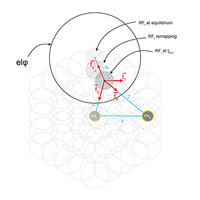
A simple, elegant, yet powerful mathematical framework—retinotopic mechanics—is introduced. It specifies a fundamental law and the neural architecture that allow cells to transiently exhibit spatiotemporal contortions within and beyond the spatial extent of their anatomical receptive fields.

Few analytic results exist for the firing-rate dynamics of spatially extended neuron models driven by distributed synaptic input. Using an upcrossing approximation for the firing rate, the statistics of spatiotemporal voltage dynamics are derived and show that minimal dendritic models exhibit an unexpectedly sustained high-frequency response.

Boltzmann-Shannon entropy is a measure of the information hidden within multiple indistinguishable rearrangements of a single system. An alternative metric (“selection entropy”) is derived, which instead quantifies the hidden information associated with indistinguishable selections that can take place between systems. Selection entropy is shown to be more sensitive than the KL-divergence (relative entropy) in the context of neuroimaging time series analysis.

Neuronal nonlinearity and short-term plasticity affect inhibition stabilization, the paradoxical effect, and the relationship between the two.

The TMD is a morphology descriptor for neurons which, when applied to path length, is equivalent to extended persistent homology and can be used to characterize differences between healthy and diseased mouse neurons.

The Lyapunov spectrum of recurrent neural networks is calculated and analytical approximations through random matrix theory are provided. The dependency of attractor dimensions and entropy rates on coupling strength and input fluctuations is identified and a point symmetry of the Lyapunov spectrum is revealed. A link is shown between Lyapunov exponents to error propagation and stability in trained recurrent networks for machine-learning applications.

A generalized theoretical framework of neuronal coding is developed. The theory assumes that neuronal populations implement efficient coding that maximizes the Shannon mutual information between stimuli and spikes. The resulting optimal neuronal activation functions partition the stimulus space equally, and the mutual information is independent of the fraction of ON and OFF neurons.

A crucial challenge in targeted manipulation of neural activity is to identify perturbation sites whose stimulation exerts significant effects downstream with high efficacy, a procedure currently achieved by labor-intensive trial and error. It is demonstrated that the effects of electrical microstimulation on neural activity in the prefrontal cortex of alert monkeys can be predicted solely based on the functional connectivity estimated from cortical recordings at rest.

Detecting exponential growth in a time series is essential for accurate prediction and control. Hypothesizing that neurons detect such growth in their inputs predicts adaptation of the temporal kernel with the SNR of the input observed experimentally.

This article uses the methods of nonlinear dynamics to establish the conditions for system consolidation, the temporal organization of memories.

Sign In to Your Journals Account

Filter

Filter

Article Lookup

Enter a citation