Recent Articles

Zero-field and field-symmetric anomalous transverse resistance in LaAlO3/KTaO3(111) interfacial superconductors

Wenze Pan, Yishuai Wang, Jirong Sun, and Yanwu Xie

Phys. Rev. Materials 9, 104802 (2025) - Published 7 October, 2025

Transverse resistance (Hall effect) offers a sensitive probe into the properties of two-dimensional superconductors. In this work, the authors systematically investigate the transverse resistance in superconducting LaAlO3/KTaO3(111) interfaces and observe two distinct anomalies: a sharp transverse resistance peak during zero-field cooling, and a strongly even-symmetric signal under magnetic field sweeps–markedly departing from the conventional odd-symmetric Hall behavior. These features are explained by microscopically uneven vortex distributions, reflecting intrinsic inhomogeneity and unique vortex dynamics at the oxide interface.

Magnetically induced tunable photonic band gaps in cholesteric liquid crystals in external magnetic field at light oblique incidence

A. A. Malinchenko, N. A. Vanyushkin, S. S. Golik, and A. H. Gevorgyan

Phys. Rev. Materials 9, 105201 (2025) - Published 7 October, 2025

Quantum anomalous Hall effect of Mo-doped LiMgAs monolayer with high transmittance

Zhen Wang, Xianglin Liu, Yuxin Li, Yuli Xiong, Jie Zhang, Yifu Luo, Shoubing Ding, Tie Yang, Zhenxiang Cheng, and Zhimin Wu

Phys. Rev. Materials 9, 104202 (2025) - Published 6 October, 2025

Interface energy anisotropy and interface step structure in γ-Ni/γ′−Ni3Al: An atomistic simulations perspective

Sourav Ghosh, Rajdip Mukherjee, and Christian Brandl

Phys. Rev. Materials 9, 103601 (2025) - Published 3 October, 2025

Weak itinerant ferromagnetism in MAX phase compound Cr1.9Fe0.1GeC

Suman Mondal, Mohamad Numan, Kurt Kummer, Sawada Masahiro, and Subham Majumdar

Phys. Rev. Materials 9, 104402 (2025) - Published 3 October, 2025

Decoratypes: An extensible crystal taxonomy for machine learning-guided materials discovery

Kyle D. Miller, Michele Campbell, Danilo Puggioni, and James M. Rondinelli

Phys. Rev. Materials 9, 104404 (2025) - Published 3 October, 2025

The authors present decoratypes, a new extensible crystal taxonomy that offers a more granular lens for structure–property relationships by classifying materials by hierarchical property-site mappings. For example, the framework generalizes anti-structures into polaritypes, a subclass of decoratype. They demonstrate its utility by building a polaritype-based active learning workflow for discovering ferroelectric and hyperferroelectric materials. Our approach identified six novel candidates, including three strain-activated ferroelectrics and three strain-activated hyperferroelectrics. These findings highlight how decoratypes can provide a novel perspective on the search for functional materials in underexplored chemical spaces.

Vortex matter and strong pinning in underdoped PrFeAs(O,F) with atomic-sized defects

Andrey V. Sadakov, Vladimir A. Vlasenko, A. Yu. Levakhova, I. V. Zhuvagin, E. M. Fomina, V. A. Prudkoglyad, A.Y. Tsvetkov, A. S. Usoltsev, and N. D. Zhigadlo

Phys. Rev. Materials 9, 104801 (2025) - Published 3 October, 2025

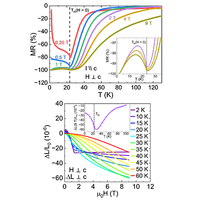
Magnetic polaron formation in EuZn2P2

Matthew S. Cook, Elizabeth A. Peterson, Caitlin S. Kengle, E. R. Kennedy, J. Sheeran, Clément Girod, G. S. Freitas, Samuel M. Greer, Peter Abbamonte, P. G. Pagliuso, J. D. Thompson, Sean M. Thomas, and P. F. S. Rosa

Phys. Rev. Materials 9, 104403 (2025) - Published 2 October, 2025

Colossal magnetoresistance (CMR) is widely observed in Eu-based semiconductors, despite the absence of the conventional mechanisms that drive CMR in the perovskite manganites. In this work, the authors demonstrate compelling evidence for magnetic polaron formation as the origin of CMR in antiferromagnetic EuZn2P2 using comprehensive analysis of electrical transport, magnetization, dilatometry, and electron spin resonance (ESR) measurements. A peak in the CMR response near the antiferromagnetic ordering temperature is accompanied by a field-induced lattice strain, while ESR analysis suggests strong ferromagnetic exchange interactions between Eu2+ moments and conduction electrons. The authors’ collective observations in EuZn2P2 support the view that magnetic polaron formation is central to the emergence of CMR in Eu2+-based compounds.

Composition dependence of atomic order in strain-relaxed, metastable GeSn alloys

J. Zachary Lentz, Ashildur Fridriksdottir, J. C. Woicik, Ryan Davis, Apurva Mehta, and Paul C. McIntyre

Phys. Rev. Materials 9, 104601 (2025) - Published 2 October, 2025

Fermi surface and effective masses of IrO2 probed by de Haas-van Alphen quantum oscillations

K. Götze, M. J. Pearce, S. Negi, J.-R. Soh, D. Prabhakaran, and P. A. Goddard

Phys. Rev. Materials 9, 104201 (2025) - Published 1 October, 2025

Data-driven high-throughput search for the accelerated discovery of rare-earth-free permanent magnets

Junaid Jami, Nitish Bhagat, and Amrita Bhattacharya

Phys. Rev. Materials 9, 104401 (2025) - Published 1 October, 2025

Exploring the anodic performance of InSnPS/GaGeAsSe heterostructure as an ultra-high rate rechargeable Li ion battery via first-principles study

Francis Opoku, Eric Selorm Agorku, Michael Kumi, and Penny Poomani Govender

Phys. Rev. Materials 9, 105401 (2025) - Published 1 October, 2025

Point defect structures in hexagonal close packed metals and across the Periodic Table

Andrew R. Warwick, Pui-Wai Ma, and Sergei L. Dudarev

Phys. Rev. Materials 9, 093605 (2025) - Published 30 September, 2025

Coupling between small polarons and ferroelectricity in BaTiO3

Darin Joseph and Cesare Franchini

Phys. Rev. Materials 9, 094415 (2025) - Published 30 September, 2025

Optical properties of vacancies in aluminum oxide (α−Al2O3) from first principles

Christoph Wilhelmer, Mark E. Turiansky, Dominic Waldhör, Lukas Cvitkovich, Chris G. Van de Walle, and Tibor Grasser

Phys. Rev. Materials 9, 096202 (2025) - Published 30 September, 2025

Alumina (Al2O3) is widely used as a dielectric, in applications ranging from transistors to qubits. Defects can affect the functionality of such devices. In this work, the authors characterize optical transitions at vacancies in alumina from first principles. The results allow the attribution of experimental absorption and luminescence spectra to specific electronic transitions at the oxygen vacancy. The authors identify the origin of spectra related to the F and F+ centers, which have been debated for decades. They also analyze the stability of the aluminum vacancy in different configurations.

Structural and electronic properties of twisted hBN flakes on graphene

Yazeed Obaidallah Alnafie, Oliver J. Conquest, Sherif Abdulkader Tawfik, and Catherine Stampfl

Phys. Rev. Materials 9, 094002 (2025) - Published 29 September, 2025

Diffusion of acceptor dopants in monoclinic β−Ga2O3

Channyung Lee, Michael A. Scarpulla, Elif Ertekin, and Joel B. Varley

Phys. Rev. Materials 9, 094602 (2025) - Published 29 September, 2025

Thermal properties of hexagonal diamond: Machine learning potential and molecular dynamics study

Jian Zhang, Zhuo Zhao, Miao Jiang, Yuan Cheng, and Gang Zhang

Phys. Rev. Materials 9, 094603 (2025) - Published 29 September, 2025

Uniaxial stress tuning of interfacial thermal conductance in cubic BAs/4H-SiC heterostructures

Lei Zhang, Fei Tian, Ke Chen, Zhongbo Yan, and Kun Cao

Phys. Rev. Materials 9, 094604 (2025) - Published 29 September, 2025

Nanoindentation simulations for copper and tungsten with adaptive-precision potentials

David Immel, Matous Mrovec, Ralf Drautz, and Godehard Sutmann

Phys. Rev. Materials 9, 093805 (2025) - Published 26 September, 2025

Modern machine learning (ML) potentials provide quantum accurate models of atomic interactions. They are, however, significantly more computationally expensive than much simpler empirical potentials, which limits applicability for large simulations. The authors show that adaptive-precision interatomic potentials (APIP) overcome the performance gap between accurate ML and fast empirical potentials by using the computationally less efficient ML potential only for specific, automatically detected atoms of interest. In nanoindentation simulations all observations obtained with an all ML-potential are reproduced by APIP, but with a 20-30 times speedup, while simulations with empirical potentials show qualitatively different results. Therefore, APIPs are beneficial for materials where simple empirical potentials are not appropriate.

Sign In to Your Journals Account

Filter

Recent Issues

Vol. 10, Iss. 11
November 2026
Vol. 10, Iss. 10
October 2026
Vol. 10, Iss. 9
September 2026
Vol. 10, Iss. 8
August 2026
Category
Article Type
Section

Filter

Article Lookup

Enter a citation