Bend contour electron tomography (BCET): Quantitative strain and topography mapping
Henry G. Bell, Chenhang Xu, Arthur McCray, Minyong Han, Yicheng Zhuang, Harold Y. Hwang, Colin Ophus, and Alfred Zong
Phys. Rev. Materials 10, L110801 (2026) - Published 2 November, 2026
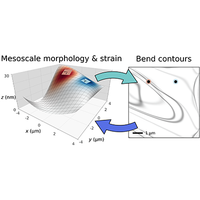
The authors have developed Bend Contour Electron Tomography (BCET), a computational framework that turns conventional electron microscope images into quantitative maps of morphology and strain tensors in ultrathin materials, which are essential for understanding and designing their mechanical, magnetic, and optical properties. Rather than scanning a sample point-by-point, BCET analyzes full-field images by decoding bend contours created as electrons scatter through a deformed crystal. Combining images acquired at different viewing angles then allows the reconstruction of both the membrane shape and its local strain. BCET offers an accessible route to efficiently mapping nanoscale deformation and, ultimately, tracking how ultrathin materials respond dynamically to light, heat, and applied forces.