Recent Articles

Magnetic and electric properties of the metallic kagome antiferromagnet CrRhAs

Franziska Breitner, Bin Shen, Anton Jesche, Alexander A. Tsirlin, and Philipp Gegenwart

Phys. Rev. Materials 10, 064204 (2026) - Published 30 June, 2026

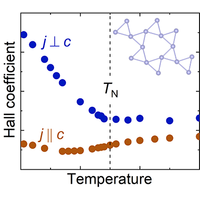
Antiferromagnetic kagome metals remain far less explored than their ferromagnetic counterparts, despite predictions of unconventional spin textures and emergent transport phenomena. Here, the authors report the growth of single crystals of the metallic kagome antiferromagnet CrRhAs and investigate its magnetic and electronic properties. While no nonlinear Hall effect is observed, Hall measurements reveal an unexpected sign reversal upon changing the current direction, together with a pronounced enhancement below the antiferromagnetic transition. These findings point to a strong coupling between magnetic order and an anisotropic electronic structure, highlighting CrRhAs as a promising platform for exploring transport phenomena in antiferromagnetic kagome metals.

The impact of interfacial chemistry on the band offset of GaAs/Ga2O3 heterostructures

Sofia Apergi, Alfredo Pasquarello, Charles Cornet, and Laurent Pedesseau

Phys. Rev. Materials 10, L061601 (2026) - Published 30 June, 2026

Facilitating electrical and laser-induced skyrmion nucleation with a dipolar-field-enhanced effective Dzyaloshinskii-Moriya interaction

Mark C. H. de Jong, Dinar Khusyainov, Julian Hintermayr, Bart Sanders, Dmitry Kozodaev, Aleksei V. Kimel, Bert Koopmans, Theo H. M. Rasing, and Reinoud Lavrijsen

Phys. Rev. Materials 10, 064415 (2026) - Published 29 June, 2026

Magnetic skyrmions are promising nanoscale information carriers, but creating them efficiently remains a central challenge. Here the authors show that a multilayer’s own dipolar field can be turned from a complication into a design tool. By reversing the Ir/Co/Pt stacking order in half of the film, the layer-resolved Dzyaloshinskii–Moriya interaction is made to work with, rather than against, the dipolar field. This dipolar-field-enhanced effective DMI enables both nanosecond current pulses and femtosecond laser pulses to generate up to twenty times denser, more stable skyrmion populations—without substantially changing the nucleation threshold.

Tuning superconductivity in high entropy nitrides

Gabriel Pristáš, Slavomír Gabáni, Július Bačkai, Oleksandr Onufriienko, Lukas Kölbl, Magdalena Kirchmair, Christian Mitterer, and Karol Flachbart

Phys. Rev. Materials 10, 064805 (2026) - Published 29 June, 2026

Generalized machine-learning descriptor for identifying superionic materials

Yijie Zhu, Qing Lu, Jiuyang Shi, Junjie Wang, Zhongwei Zhang, Tianheng Huang, Yu Han, Chi Ding, and Jian Sun

Phys. Rev. Materials 10, 065801 (2026) - Published 29 June, 2026

FeS phase diagram and thermal Equation of State under high pressure

Guillaume Morard, Daniele Antonangeli, Francesca Miozzi, Marzena Anna Baron, Eric Edmund, Valerio Cerantola, and Mohamed Mezouar

Phys. Rev. Materials 10, 063605 (2026) - Published 25 June, 2026

Molecular modeling of the time-dependent shock response in polyurea with Hugoniostat and explicit impact simulations

Benjamin Xu and Thomas C. O'Connor

Phys. Rev. Materials 10, 065607 (2026) - Published 25 June, 2026

Anisotropic multiband magnetotransport in LaAg2Ge2 thin films

Mizuki Ohno, Reiley Dorrian, Veronica Show, and Joseph Falson

Phys. Rev. Materials 10, 063403 (2026) - Published 24 June, 2026

Facilitation of pyramidal dislocation slip in Mg-Bi alloys: A molecular dynamics study via machine learning potential

Kun Luo, Rui Zhou, Bin Li, and Qi An

Phys. Rev. Materials 10, 063604 (2026) - Published 24 June, 2026

Tailoring ultrathin magnetic multilayers at terraced topologically insulating interfaces for perpendicularly magnetized domains

Benjamin A. Brereton, Soumyarup Hait, Ahmet Yagmur, Christy J. Kinane, Francesco Maccherozzi, Michele Conroy, Satoshi Sasaki, Thomas A. Moore, Sarnjeet S. Dhesi, Sean Langridge, and Christopher H. Marrows

Phys. Rev. Materials 10, 064413 (2026) - Published 24 June, 2026

Topological insulators are known for their highly efficient spin-to-charge conversion, capable of exerting spin-orbit torques in adjacent magnetic multilayers, yet their usefulness in the manipulation of spin textures remains largely unexplored. This work describes the optimization process of a combined topological insulator-magnetic multilayer heterostructure where, through the minimization of the density of characteristic Bi2Se3 surface terraces and the insertion of a refractory metal buffer layer, conventional magnetic multilayers with full perpendicular magnetic anisotropy can be grown. Labyrinthine, zero-field domains de-pinned from the TI topography are observed, raising the possibility of future, highly efficient electrical control of hosted spin textures.

Noncollinear ferrimagnetic structures and spin dynamics in Al-doped lithium ferrites

S.-H. Park, A. Arauzo, S. Inckemann, and M. Avdeev

Phys. Rev. Materials 10, 064414 (2026) - Published 24 June, 2026

Screening for wide-gap, high-refractive-index materials via frequency-dependent dielectric function prediction aided by convolutional autoencoders

Pedro Borlido and Fernando Nogueira

Phys. Rev. Materials 10, 064606 (2026) - Published 24 June, 2026

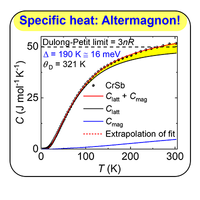
Thermodynamic and transport properties of high-quality single crystals of the altermagnet CrSb

Shubhankar Paul, Atsutoshi Ikeda, Giordano Mattoni, Shingo Yonezawa, and Chanchal Sow

Phys. Rev. Materials 10, 063402 (2026) - Published 23 June, 2026

Altermagnons are collective spin excitations in altermagnets, characterized by anisotropic magnon dispersions. The altermagnet CrSb has emerged as a compelling material owing to its substantial spin-splitting energy. Here, the authors report on the growth of high-quality CrSb single crystals and investigate their thermodynamic and transport properties. A large positive magnetoresistance of nearly 80% is observed at 3.5 K. Interestingly, the room-temperature specific heat exceeds the Dulong-Petit limit, attributed to a broad altermagnon contribution with an energy gap of ~16 ± 1 meV. These findings highlight the potential of CrSb for room-temperature magnonic and spintronic applications.

Anisotropy, frustration, and saddle point in the twisted kagome compound ErPdPb

Resham Babu Regmi, Sk Jamaluddin, Y. Lee, Hari Bhandari, Po-Hao Chang, Peter E. Siegfried, Abhijeet Nayak, Mohamed El Gazzah, Bence G. Márkus, Anna Nyáry, Zachary T. Messegee, Miya P. Zhao, Xiaoyan Tan, László Forró, Liqin Ke, Igor I. Mazin, and Nirmal J. Ghimire

Phys. Rev. Materials 10, 065001 (2026) - Published 23 June, 2026

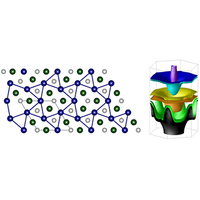
The kagome lattice has long attracted interest because its geometric frustration can give rise to unusual quantum states. When this lattice is distorted into a twisted or buckled arrangement, the resulting magnetic and electronic behavior becomes even richer. In this work, the authors synthesize and characterize single crystals of ErPdPb, a twisted kagome antiferromagnet in which the Er atoms form a frustrated magnetic network within the noncentrosymmetric ZrNiAl-type structure. Below 2.7 K, ErPdPb enters a strongly anisotropic magnetic state marked by fractional magnetization plateaus, competing exchange interactions, and pronounced directional dependence in its electronic properties. First-principles calculations in the field-polarized ferromagnetic state further reveal a spin-split saddle point close to the Fermi level and a quasi-one-dimensional Fermi surface. Together, these findings identify ErPdPb as a promising platform for investigating the interplay of magnetic frustration, electronic anisotropy, and topological band structure.

Erratum: Reststrahlen band and optical bandgaps in semiconducting CrN films [Phys. Rev. Materials 10, 044602 (2026)]

Duc V. Dinh, Xiang Lü, Oliver Brandt, Dilara Sen, Olivia Fairlamb, Frank Peiris, Farihatun Lima, Alexander Bordovalos, Suresh Chaulagain, Ambalanath Shan, and Nikolas J. Podraza

Phys. Rev. Materials 10, 069902 (2026) - Published 23 June, 2026

General statistical framework for vacancy and self-interstitial properties in concentrated multicomponent solids

Jacob Jeffries, Hyunsoo Lee, Anter El-Azab, and Enrique Martinez

Phys. Rev. Materials 10, 063802 (2026) - Published 22 June, 2026

Electrical stability of Cr2O3/β-Ga2O3 and NiOx/β-Ga2O3 heterojunction diodes

Yizheng Liu, Haochen Wang, Carl Peterson, Chinmoy Nath Saha, Chris G. Van de Walle, and Sriram Krishnamoorthy

Phys. Rev. Materials 10, 064605 (2026) - Published 22 June, 2026

Cs2MBiCl6 (M=Na, Ag) double perovskites: Emphanisis-driven charge carrier dynamics and piezoelectricity for their application as nanocomposites in mechanical energy harvesting

Souvik Bhattacharjee, Pulak Pal, Suvankar Poddar, Biplab Ghosh, Kalyan Kumar Chattopadhyay, and Aswini Ghosh

Phys. Rev. Materials 10, 065405 (2026) - Published 22 June, 2026

Interfacial control of orbital occupancy and spin state in LaCoO3

Ellen M. Kiens, Nicolas Gauquelin, Arno Annys, Emma van der Minne, Iris C. G. van den Bosch, Matthijs A. van Spronsen, Zezhong Zhang, Annick De Backer, Sandra Van Aert, Jo Verbeeck, Gertjan Koster, Bastian Mei, Frank M. F. de Groot, and Christoph Baeumer

Phys. Rev. Materials 10, 066003 (2026) - Published 22 June, 2026

Interfacial engineering offers a powerful route to control electronic states in correlated oxides. Here, the authors demonstrate tunable Co 3d orbital occupancy in LaCoO3 heterostructures, spanning partial d5 to d7 configurations via tailored interfaces with LaTiO₃, LaMnO₃, LaNiO₃, and LaAlO₃. Combining X-ray absorption spectroscopy with multiplet calculations reveals interface-dependent charge transfer and spin-state modulation, while atomic-scale microscopy links these effects to strain and structural distortions. Notably, inserting a LaAlO₃ spacer suppresses charge transfer, stabilizing an unexpected low-spin d6 state. These findings highlight how interfacial design governs orbital occupation and spin, providing a versatile platform for tuning functionality in oxide electronics and catalysis.

Nearly full magnetization recovery after a strong collision between Fe nanoparticles

Nicolás Plaza-Alcafuz, Samuel E. Baltazar, Gonzalo dos Santos, Svetoslav Valeriev Nikolov, Herbert M. Urbassek, and Eduardo M. Bringa

Phys. Rev. Materials 10, 066004 (2026) - Published 22 June, 2026

Sign In to Your Journals Account

Filter

Recent Issues

Vol. 10, Iss. 10
October 2026
Vol. 10, Iss. 9
September 2026
Vol. 10, Iss. 8
August 2026
Vol. 10, Iss. 7
July 2026
Category
Article Type
Section

Filter

Article Lookup

Enter a citation