Recent Articles

Wall vortex induced by the collapse of a near-wall cavitation bubble: Influence of the water surface

Jianlin Huang, Jingzhu Wang, Wenlu Guo, and Yiwei Wang

Phys. Rev. Fluids 9, 053602 (2024) - Published 8 May, 2024

Wall vortex occurs when a cavitation bubble oscillates far from a single rigid wall (at a dimensionless standoff distance γr>1.3). This study finds that a wall vortex in an expanded new regime forms instead of a free vortex at a smaller γr value, when introducing a water surface. Criteria for vortex flow patterns are proposed based on the direction of the bubble centroid migration at the beginning of the second cycle tc though a theoretical model developed with a Lagrangian formulation. Numerical analysis reveals that the wall vortex flow with the influence of the water surface contributes to a greater wall shear stress and larger area, thus increasing the surface cleaning potential.

Stability of plane Couette flow with constant wall transpiration

W. Sun, A. Yalcin, and M. Oberlack

Phys. Rev. Fluids 9, 053906 (2024) - Published 8 May, 2024

The instability behavior of plane Couette flow is notoriously difficult, because it has no classical unstable modes, and this for any high Reynolds number. Here, the plane Couette flow is modified by means of a constant wall transpiration, i.e. simultaneous blowing from below, which has a destabilizing effect, and suction from above, which has a stabilizing effect. These opposing effects led to a changed in an unpredictable way, i.e. a destabilization at a certain point with increasing transpiration rate, the increase in instability then reaches a maximum and then leads to a slow stabilization again as the transpiration rate increases further. The destabilizing effects clearly dominate here.

Isotropic turbulence of variable-density incompressible flows

L. Reynier, B. Di Pierro, and F. Alizard

Phys. Rev. Fluids 9, 054604 (2024) - Published 8 May, 2024

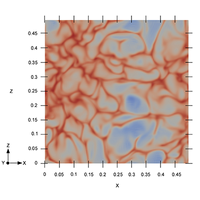
The effects of density variations on structures developing in an isotropic incompressible turbulence flow are investigated. Statistical analyses are carried out on datasets obtained from direct numerical simulations of forced turbulence. Numerical evidence shows that the introduction of a variable-density field into a turbulent field modifies the coherent structures and the energy spectrum in the inertial range.

Model for the structure function constant for index of refraction fluctuations in Rayleigh-Bénard turbulence

Robert A. Handler, Richard J. Watkins, Silvia Matt, and K. P. Judd

Phys. Rev. Fluids 9, 054605 (2024) - Published 8 May, 2024

Kolmogorov scaling is used to derive a model for the structure function constant associated with index of refraction fluctuations in Rayleigh-Benard turbulence. The model predicts that the normalized structure function constant depends on the heat flux to the four-thirds power, and is independent of the Rayleigh number. The model agrees with the results of numerical simulations, thereby lending support to the assumptions underlying the theory.

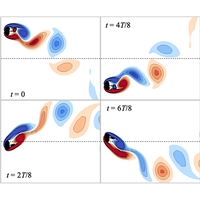
Direct numerical simulations of a cylinder cutting a vortex

Steven Soriano and Rodolfo Ostilla-Mónico

Phys. Rev. Fluids 9, 054701 (2024) - Published 8 May, 2024

The interaction between a vortex and an impacting body is complex due to the interaction of inviscid and viscous mechanisms. We conduct the first three-dimensional direct numerical simulations of this process and vary the relative impact velocity of the cylinder to explore the parameter space and analyze this process in detail. Strong vortices lead to ejection and interaction of secondary vorticity from the cylinder’s boundary layer, while weak vortices lead to approximately inviscid interaction of the cylinder with the primary vortex through deformations.

Low-frequency unsteadiness in hypersonic swept shock wave-boundary layer interactions

Alessandro Ceci, Andrea Palumbo, Johan Larsson, and Sergio Pirozzoli

Phys. Rev. Fluids 9, 054603 (2024) - Published 7 May, 2024

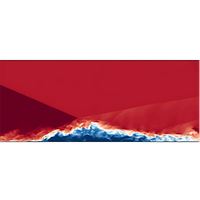
We carry out a numerical study of swept shock wave/turbulent boundary layer interaction (SBLI) in the hypersonic regime, where a crossflow velocity component is added to the incoming flow to mimic three-dimensional interactions with cylindrical symmetry. The spatiotemporal dynamics of wall pressure well conform with the previously introduced formula for swept supersonic interactions, extending the validity of the model to SBLIs in the hypersonic regime.

Expediting viscous spreading with liquid-infused solids

Saurabh Nath and David Quéré

Phys. Rev. Fluids 9, 054001 (2024) - Published 6 May, 2024

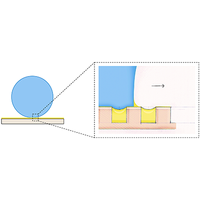
A viscous drop spreads slowly on a solid at a velocity selected by its viscosity. We show here that liquid-infused solids – a class of materials with properties in between a solid and a liquid – can expedite the spreading dynamics due to interfacial slip, which we investigate at short time.

Boundary-layer flows over deforming surfaces

N. Hanevy, J. Ferguson, P. M. J. Trevelyan, and P. T. Griffiths

Phys. Rev. Fluids 9, 054101 (2024) - Published 6 May, 2024

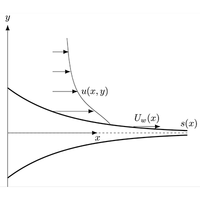
In this paper a formulation of the incompressible Navier-Stokes equations is introduced which allows one to model boundary-layer flows induced by the motion of a deforming surface. Such a formulation may be used to model flows relevant in a wide variety of industries from polymer processing to glass manufacturing. We show that for particular sheet geometries and velocities, similarity solutions may be obtained that account for sheet thinning (or thickening) and roughness patterns observed in extrusion-type processes.

Effect of aspect ratio on the unlimited flow-induced vibration of an elliptical cylinder-plate assembly

Ying Wu, Fue-Sang Lien, Eugene Yee, and Guang Chen

Phys. Rev. Fluids 9, 054102 (2024) - Published 6 May, 2024

We report numerical simulations for the transverse flow-induced vibration (FIV) of an elastically supported elliptical cylinder-plate assembly in the regime of low Reynolds number. We investigate the combined effect of the aspect ratio of the elliptical cylinder (namely, AR = 0.5-2), the reduced velocity (namely, Ur = 2-30), and the splitter-plate length (namely, LSP/D = 0.75 and 2.5). Among numerous factors that exert impacts on the assembly’s FIV over an unlimited range of reduced velocity, the aspect ratio determines the nature and width of the synchronization branch in the amplitude response.

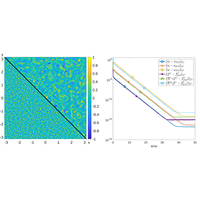
Identifying the body force from partial observations of a two-dimensional incompressible velocity field

Aseel Farhat, Adam Larios, Vincent R. Martinez, and Jared P. Whitehead

Phys. Rev. Fluids 9, 054602 (2024) - Published 6 May, 2024

An algorithm is developed, rigorously justified, and numerically implemented that is capable of determining the full body force used to generate chaotic, turbulent dynamics in two-dimensional Navier-Stokes fluid dynamics. The primary contribution of this result is that the accurate reconstruction of the force requires only partial observation of the state, i.e. sparse observations of the state are sufficient to recover not only the state itself but the unknown forcing function as well even in the fully developed turbulent setting.

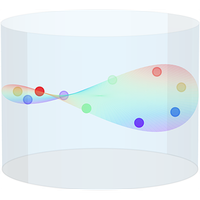
Generation of interfacial waves by rotating magnetic fields

Gerrit Maik Horstmann, Yakov Nezihovski, Thomas Gundrum, and Alexander Gelfgat

Phys. Rev. Fluids 9, 054801 (2024) - Published 6 May, 2024

We present an experimental and theoretical study of interfacial waves generated in a two-phase swirling flow by a low-frequency (1 - 10 Hz) rotating magnetic field (RMF) oriented parallel to the interface. In contrast to surface waves excited by axial magnetic fields, we find that the first and dominant wave mode resembles a hyperbolic paraboloid. A good agreement of experiment with a linearized model was obtained. These results can have important implications for metallurgical processes and point the way to further research in the dynamics of the swirl flow, particularly by extending into the nonlinear regime.

Two-layer baroclinic turbulence with arbitrary layer depths

Gabriel Hadjerci and Basile Gallet

Phys. Rev. Fluids 9, L051802 (2024) - Published 6 May, 2024

While heat transport by baroclinic turbulence in oceans and planetary atmospheres is well described by a two-layer model, the relative depth of the two layers varies greatly depending on the situation of interest, making it an important parameter governing the transport properties of the system. Focusing on the low-drag turbulent regime, we extend the vortex-gas scaling theory to address the case of arbitrary layer depths.

Motion and deformation of capsules flowing through a corner in the inertial and non-inertial regimes

Damien P. Huet, Antoine Morente, Guodong Gai, and Anthony Wachs

Phys. Rev. Fluids 9, 053601 (2024) - Published 3 May, 2024

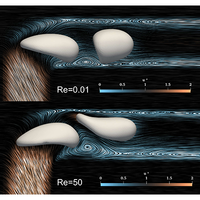
We investigate the inertial and noninertial dynamics of three-dimensional elastic capsules flowing through a square channel presenting a sharp corner. The channel Reynolds number Re ranges from 0.01 to 50 and the Capillary number Ca, which measures the ratio of the viscous and elastic stresses, ranges from 0.075 to 0.35. We report trajectory, surface area, velocity and membrane stress in the case of a single capsule, two capsules and a train of ten capsules released upstream of the corner. This study contributes to the elaboration of practical guidelines for controlling capsule breakup and predicting throughput in both inertial and noninertial microfluidic experiments.

Fluidic control of a precessing axisymmetric body by near-wake coupling

Thomas J. Lambert, Bojan Vukasinovic, and Ari Glezer

Phys. Rev. Fluids 9, 053904 (2024) - Published 3 May, 2024

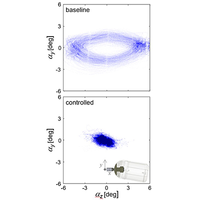
The reciprocal coupled interactions between a forebody gimbaled axisymmetric bluff body, free to precess in pitch, yaw, and roll, and the body’s near wake are exploited for prescribing its attitude using fluidic actuation. It was shown that closed-loop control of pitch and yaw can significantly attenuate the inherent model’s baseline oscillations by more than 80%, or the control could be tuned to achieve a rapid large-amplitude response to amplify the natural yaw or pitch oscillations by more than 225% of the baseline motion. Either suppression or amplification of the natural oscillations of the model are associated with induced changes in the symmetry of the primary dynamical wake modes.

Noise-induced transitions past the onset of a steady symmetry-breaking bifurcation: The case of the sudden expansion

Yves-Marie Ducimetière, Edouard Boujo, and François Gallaire

Phys. Rev. Fluids 9, 053905 (2024) - Published 3 May, 2024

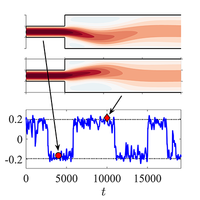
We consider flows subject to a steady symmetry-breaking bifurcation and forced by a weak noise acting on a slow timescale. By employing a multiple-scale weakly nonlinear expansion technique, we derive a stochastically forced Stuart-Landau equation for the dominant symmetry-breaking mode. The probability density function of the solution, and of the escape time from one attractor to the other, are then determined by solving the associated Fokker-Planck equation, which is made possible by the extremely low dimensionality of the amplitude equation. The validity of this reduced order model is then tested on the flow past a planar sudden expansion.

Barriers and chutes for mixing of active particles in a vortex chain flow

Nghia Le, Casey M. Miller, Julianna S. Detrick, Cameron R. Lodi, Kevin A. Mitchell, and Thomas H. Solomon

Phys. Rev. Fluids 9, 054501 (2024) - Published 3 May, 2024

Self-propelled (active) particles in laminar fluid flows are blocked by one-way barriers called “swimming invariant manifolds” (SwIMs). The SwIM theory is a generalization of manifold approaches previously applied to the mixing of passive tracers. We verify the blocking behavior of SwIMs experimentally for algae swimming in a vortex chain flow. The SwIMs also form chutes that transport swimmers between vortices with a predicted inter-vortex flux that is consistent with the experiments, despite noise and nonuniformities in the swimming directions of the microbes.

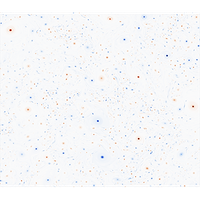
Spectrum of passive scalar carried by particles in isotropic turbulence

Izumi Saito, Takeshi Watanabe, and Toshiyuki Gotoh

Phys. Rev. Fluids 9, 054601 (2024) - Published 3 May, 2024

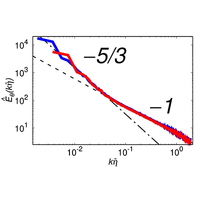
The turbulent transport of small particles (dust particles, cloud droplets, etc.) can be viewed macroscopically as a problem of passive scalar turbulence with extremely high Schmidt numbers. To investigate the spectrum of a passive scalar carried by such particles, we conducted Lagrangian particle simulations in homogeneous isotropic turbulence. The scalar variance spectrum obeys the -5/3 and -1 power laws in the lower and higher wavenumber ranges, respectively, with a clear transition at normalized wavenumber of about 0.04. The dimensionless constants for each range are also consistent with the estimations obtained from previous laboratory and simulation studies.

Rising droplets in a centrifugal field: A way to avoid interfacial contamination in liquid-liquid flow

Hassan El Itawi, Benjamin Lalanne, Subhadarshinee Sahoo, Emmanuel Cid, Gladys Massiera, Nathalie Le Sauze, and Olivier Masbernat

Phys. Rev. Fluids 9, L051601 (2024) - Published 3 May, 2024

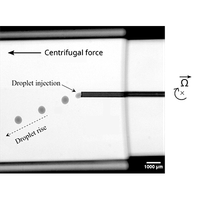
Substituting a centrifugal field to gravity makes possible the study of the dynamics of rising deformable drops in another immiscible liquid, keeping free from contamination of the interface. In this experiment, impurities do not have time to adsorb during the very short residence time due to the strong acceleration. Experiments are used to validate direct numerical simulation results in liquid-liquid systems, and the aspect ratio of rising ellipsoidal droplets is found to be a growing function of the sole Weber number, with a smaller rate compared to clean bubbles.

Gyre turbulence: Anomalous dissipation in a two-dimensional ocean model

Lennard Miller, Bruno Deremble, and Antoine Venaille

Phys. Rev. Fluids 9, L051801 (2024) - Published 3 May, 2024

We unveil a gyre turbulence regime within a two-dimensional wind-driven ocean model, where energy dissipation becomes independent of fluid viscosity. This anomalous dissipation is driven by a vigorous two-dimensional vortex gas overlaying a low energy western-intensified gyre, shedding light on the effect of boundary instabilities in disrupting the inverse energy cascade.

Direct numerical simulation of backward-facing step turbulent flow controlled by wave-machine-like traveling wave

Junichi Morita, Ryuichi Kimura, Hiroya Mamori, and Takeshi Miyazaki

Phys. Rev. Fluids 9, 053903 (2024) - Published 2 May, 2024
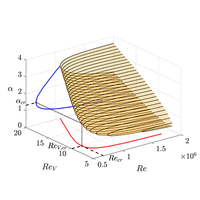
A direct numerical simulation of turbulent flow over a backward-facing step is performed. To control flow separation, a wall-normal body force in the form of a wave-machine-like traveling wave is applied to the top surface of the step. In this control, the recirculation bubble is periodically released in time and in the streamwise direction. In addition, a pair of longitudinal vortices is generated above the step and in the recirculation bubble and the released separation bubble, which causes three effects that reduce the reattachment length: a decrease in the secondary bubble streamwise length, an enhancement of the negative wall-normal velocity, and an increase in Reynolds shear stress.

Sign In to Your Journals Account

Filter

Recent Issues

Vol. 11, Iss. 10
October 2026
Vol. 11, Iss. 9
September 2026
Vol. 11, Iss. 8
August 2026
Vol. 11, Iss. 7
July 2026
Category
Article Type
Section

Filter

Article Lookup

Enter a citation