Recent Articles

Impact of harmonic inflow variations on the size and dynamics of the separated flow over a bump

Himpu Marbona, Daniel Rodríguez, Alejandro Martínez-Cava, and Eusebio Valero

Phys. Rev. Fluids 9, 053901 (2024) - Published 1 May, 2024

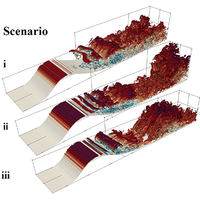
Direct numerical simulations examine the separated flow over a wall-mounted bump subjected to harmonic inflow oscillations, resembling the passage of wakes from the preceding stage along the suction side of low-pressure turbine blade conditions. Three scenarios unfold: (i) analog to the steady inflow where the separated-flow laminar-to-turbulent transition is initiated by self-sustained Kelvin-Helmholtz (KH) instability; (ii) intermittent large vortex cluster formation replacing the KH during a part of the inflow period; and (iii) a continuous vortex cluster formation and release that shorten the separated flow length compared to steady inflow, the desirable one for practical applications.

Measurement of pressure gradients near the interface in the viscous fingering instability

Savannah D. Gowen, Thomas E. Videbæk, and Sidney R. Nagel

Phys. Rev. Fluids 9, 053902 (2024) - Published 1 May, 2024

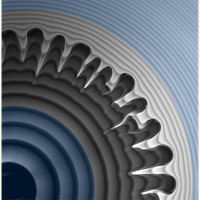
The iconic branching patterns of the viscous fingering instability, where one fluid invades another in a thin gap, are unconventionally visualized in an experiment that allows us to measure the velocity field throughout the fluid as the patterns form and grow. We find that local pressure gradients decay, both in front of and behind the interface, with a characteristic decay length. This elegant visualization allows us to see how the structure seeded at the interface continues to influence flow long after the instability onset. With this technique we capture features of the late-time flow field that have traditionally been hard to access by simulation or experiment.

Enhanced diffusiophoresis in dead-end pores with time-dependent boundary solute concentration

Robben E. Migacz, Morgan Castleberry, and Jesse T. Ault

Phys. Rev. Fluids 9, 044203 (2024) - Published 30 April, 2024

The diffusiophoretic velocity of a particle depends nonlinearly on solute concentration. We examine the implications of this nonlinearity in a dead-end pore, which is a geometry found both in nature and in microfluidic devices. We define the efficiency of injection and withdrawal processes, then describe particle dynamics with a step-like change in solute concentration at the pore inlet (commonly used in experiments) and with time-dependent boundary solute concentration. We show that particle migration becomes linear with slow transitions in solute concentration and demonstrate changes in particle dynamics with oscillatory solute concentration at the pore inlet.

Flow rate–pressure drop relations for shear-thinning fluids in deformable configurations: Theory and experiments

SungGyu Chun, Evgeniy Boyko, Ivan C. Christov, and Jie Feng

Phys. Rev. Fluids 9, 043302 (2024) - Published 25 April, 2024

The flow rate–pressure drop relations for laminar flow of Newtonian fluids in common geometries are well understood. However, a complete understanding of how the interplay between shear-thinning rheology and wall compliance sets the flow rate–pressure drop relation for a deformable configuration is still lacking. Here, we provide detailed quantitative comparisons between theory and experiments for the flow rate–pressure drop relation for Newtonian and shear-thinning fluids in two common deformable configurations: a rectangular channel and an axisymmetric tube. Such a comparison is of fundamental importance since it provides insight into the adequacy of the constitutive model used.

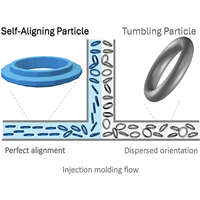
Robust microstructure of self-aligning particles in a simple shear flow

Neeraj S. Borker, Abraham D. Stroock, and Donald L. Koch

Phys. Rev. Fluids 9, 043301 (2024) - Published 24 April, 2024

A self-aligning particle (SAP) attains near perfect alignment with the fluid lamellae of a low Reynolds number simple shear flow without application of external torques in contrast with the continuous rotation exhibited by most rigid bodies including thin fibers and disks. We characterize the robustness of the flow alignment of SAPs to secondary perturbations such as flow disturbances, Brownian motion, inter-interparticle interactions, and the presence of a wall using dynamic simulations of ring-shaped SAP geometries. The robust flow alignment of SAPs provides an alternative route to access highly aligned microstructures that are inaccessible to suspensions of traditional particle geometries.

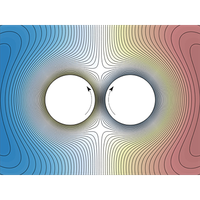
Flow induced by the rotation of two circular cylinders in a viscous fluid

E. Dormy and H. K. Moffatt

Phys. Rev. Fluids 9, 044102 (2024) - Published 22 April, 2024

Stokes flow driven by rotation of two parallel cylinders inside a cylinder of large radius R0 is investigated, and the flow in this triply-connected domain is determined numerically, with particular focus on the narrow-gap situation, when the local behavior is well described by lubrication theory. The asymptotic situation for infinite R0 is inferred (i) when the cylinder axes are unconstrained, and (ii) when they are held fixed. Contributions to the far-field are identified: a torquelet and a radial quadrupole in the counter- and co-rotating cases, respectively. In the former case, when the cylinders make contact (zero gap) a contact force acting on the cylinder pair is identified.

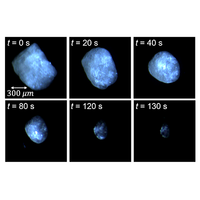
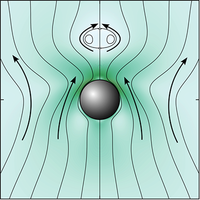
Sedimentation of a single soluble particle at low Reynolds and high Péclet numbers

Nan He, Yutong Cui, David Wai Quan Chin, Thierry Darnige, Philippe Claudin, and Benoît Semin

Phys. Rev. Fluids 9, 044502 (2024) - Published 22 April, 2024

We report experiments on the dissolution of a single particle during its sedimentation in a quiescent aqueous solution in the regime of low Reynolds and high Péclet numbers. We use butyramide, a chemical which does not change the density of water when it dissolves. The particle shrinks at a rate independent of its initial radius, in agreement with the model that we derive assuming Stokes drag and a mass transfer rate given by Levich (1962). This model becomes quantitative when including two correction factors to account for the non-sphericity of the particle and for the inclusions of air bubbles inside the particle.

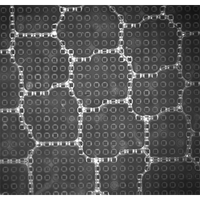
Straight to zigzag transition of foam pseudo-Plateau borders on textured surfaces

Alexis Commereuc, Sandrine Mariot, Emmanuelle Rio, and François Boulogne

Phys. Rev. Fluids 9, L041601 (2024) - Published 22 April, 2024

The structure of liquid foams follows simple geometric rules formulated by Plateau 150 years ago. On smooth surfaces, the foam liquid channels, also called pseudo Plateau borders, are straight between vertices. We demonstrate experimentally that on rough surfaces and under some conditions that we establish, the bubble footprint exhibits a morphological transition. The footprint can adopt a zigzag shape between vertices. We rationalize the number of zigzag segments by a geometric distribution describing the observations made with the footprint perimeter and the mesh size of the asperities.

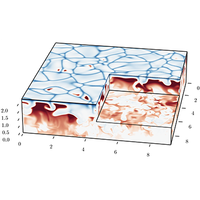
Direct comparison of density-driven convective mixing in a three-dimensional porous medium using experiments and simulation

Rebecca Liyanage, Xiaojing Fu, Ronny Pini, and Ruben Juanes

Phys. Rev. Fluids 9, 043802 (2024) - Published 18 April, 2024

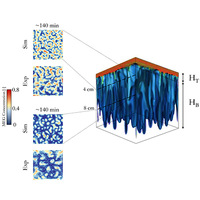
We examine how fluids mix in three-dimensional (3D) porous materials due to differences in density which represent one mechanism of underground carbon dioxide storage. The experiment closely matched the simulation in terms of the patterns and speed of mixing. Interestingly, the experiment reveals columnar plumes self-organizing into a reticular pattern, previously seen only in 3D simulations. Results demonstrate quantitative matching over time in concentration, variance, scalar dissipation rate, and dissolution flux. A new relation between dissipation rate and flux is established, highlighting a 30% higher flux in 3D versus 2D systems, affirming prior estimations.

Instability and trajectories of buoyancy-driven annular disks: A numerical study

G. Corsi, P. G. Ledda, G. Vagnoli, F. Gallaire, and A. De Simone

Phys. Rev. Fluids 9, 043907 (2024) - Published 17 April, 2024

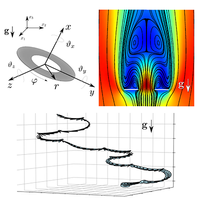
Seed dispersal strategies exemplify the role of morphology in defining falling paths. Here, macroscopic geometry effects are systematically studied by considering trajectories of annular disks. Via linear stability analysis, we identify the stability boundary for vertical fall, with a non-monotonic behavior of the critical falling velocity with the hole size, before increasing for large holes. Nonlinear simulations confirm linear analyses and suggest strategies for annular seed release at different heights, with the emergence of paths possibly beneficial for controlled positioning or advantageous for covering large lateral distances, depending on the hole size and disk weight.

Extended spreading of saline droplets upon impact on a frosty surface

Hao Zeng, Feng Wang, and Chao Sun

Phys. Rev. Fluids 9, 044001 (2024) - Published 16 April, 2024

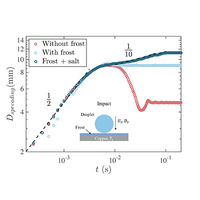
The impact and freezing process of a water droplet are studied experimentally, incorporating the presence of frost and salt. A distinct transition of the spreading dynamics is observed, altering from the well-known 1/2 inertial scaling law to a 1/10 capillary-viscous scaling law. By considering the effect of impact inertia, partial-wetting behavior, and salinity, the mechanism of this transition is elucidated, and a unified model for predicting the droplet arrested diameter is proposed.

Degrees of freedom and the dynamics of fully developed turbulence

Diego Donzis and Shilpa Sajeev

Phys. Rev. Fluids 9, 044605 (2024) - Published 15 April, 2024

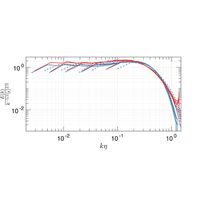
Turbulent flows comprise a multitude of scales which make them extremely difficult to analyze and simulate. In this work, we study homogeneous isotropic turbulence using a novel approach which solves the Navier-Sokes equations on a reduced set of modes that are sampled stochastically. The complementary set are solved using trivial dynamics. This method, called Selected Eddy Simulations, is able to capture broad dynamics of turbulence with just 10% of resolved modes, suggesting the turbulence attractor may be smaller or more robust to modeling than previously thought. This result also holds promise for developing alternative low-cost numerical approaches to study turbulent flows.

Electrocapillary, thermocapillary, and buoyancy convection driven flows in the Melcher-Taylor experimental setup

Alexander Yu. Gelfgat and Gerrit Maik Horstmann

Phys. Rev. Fluids 9, 044101 (2024) - Published 12 April, 2024

Electrocapillary flows in a classical experiment of Melcher and Taylor are studied. The computed streamlines qualitatively represent the experimental image. With the increase of electrocapillary forcing, the main circulation localizes near a boundary with a larger electric potential. When a dielectric liquid is replaced by a poorly conducting one, the system becomes non-isothermal owing to the Joule heating, and the flow is driven also by buoyancy and thermocapillary convection. The results show that consideration of the two-phase model is mandatory. The Lippmann equation, connecting electrically induced surface tension with nonuniform surface electric potential, is numerically verified.

Turbulence modulation by suspended finite-sized particles: Toward physics-based multiphase subgrid modeling

S. Balachandar, C. Peng, and L.-P. Wang

Phys. Rev. Fluids 9, 044304 (2024) - Published 11 April, 2024

The presence of a dispersed phase substantially modifies small-scale turbulence. Here we present a comprehensive mechanistically based model to predict turbulence modulation, the predictions of which, compared with particle-resolved simulations and experiments, is shown.

Particle hydrodynamics in acoustic fields: Unifying acoustophoresis with streaming

Xiaokang Zhang, Jake Minten, and Bhargav Rallabandi

Phys. Rev. Fluids 9, 044303 (2024) - Published 10 April, 2024

Acoustic fields are used in numerous applications to induce movement of suspended particles. We develop a rigorous theory that systematically unifies inviscid acoustophoresis with viscous streaming. The theory connects particle motion to a generalized form of the secondary radiation force, which depends on the Stokes layer thickness around the particle, and the contrast of density and compressibility between the particle and the fluid. We identify a reversal of particle motion when inertial and viscous forces are comparable, validated with numerical solutions. This has significant implications for applications involving particle sorting or focusing based on size or material properties.

Internally heated and fully compressible convection: Flow morphology and scaling laws

Whitney T. Powers, Evan H. Anders, and Benjamin P. Brown

Phys. Rev. Fluids 9, 043501 (2024) - Published 9 April, 2024

In stars and planets natural processes heat convective flows in the bulk of a convective region rather than at hard boundaries. Internally heated convection has been studied extensively in incompressible fluids, but the effects of stratification and compressibility have not been examined in detail. In this work, we study fully compressible convection driven by a spatially uniform heating source in a suite of two- and three-dimensional Cartesian, hydrodynamic simulations. We characterize how Mach, Reynolds, and Nusselt numbers scale with the characteristic strength of the internal heat source. We also measure kinetic energy power spectra and discuss the flow morphologies.

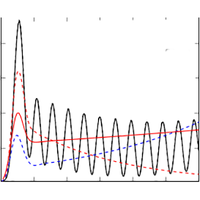
Transient energy growth in channel flow with compliant walls

Frédéric Alizard, Benoît Pier, and Smail Lebbal

Phys. Rev. Fluids 9, 043905 (2024) - Published 9 April, 2024

Shear flows in contact with compliant boundaries exhibit a rich dynamics involving traveling-wave-flutter, Tollmien-Schlichting, as well as divergence instabilities. In this context, maximum transient growth effects are the result of optimal energy exchanges during the fluid-structure interaction process. The present investigation studies the detailed contribution of the different interacting modes. In particular, it is found that the optimal gain may be associated with a large-amplitude oscillatory behavior and that wall-compliance enhances this phenomenon.

Floquet stability analysis of pulsatile flow in toroidal pipes

J. Simon Kern, Valerio Lupi, and Dan S. Henningson

Phys. Rev. Fluids 9, 043906 (2024) - Published 9 April, 2024

Unsteady flows in curved pipes are ubiquitous in science and engineering but their stability characteristics are not well understood in most cases of practical interest. We study the linear stability of pulsatile flow in the archetypal configuration of a toroidal pipe, which appears e.g. in aortic blood flow. The Floquet stability analysis of the harmonically forced system reveals that the curvature leads to nonlinear interactions in the baseflow andconsiderable stabilization that can be orders of magnitude larger than in the corresponding planar case. The figure shows a typical snapshot of the streamwise velocity field in a torus subject to a pulsating pressure gradient.

Dense fluid transport through nanoporous graphene membranes in the limit of steric exclusion

Runfeng Zhou, Mathew M. Swisher, Akshay Deshmukh, Chengzhen Sun, John H. Lienhard, and Nicolas G. Hadjiconstantinou

Phys. Rev. Fluids 9, 044202 (2024) - Published 9 April, 2024

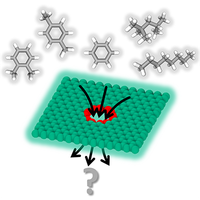
We develop a model that describes the permeance of simple fluids as well as small hydrocarbon molecules through nanoporous, atomically thin membranes. The model is in agreement with molecular dynamics simulations for a wide range of pore sizes, including pores approaching the steric exclusion limit, as needed for understanding separation processes using such membranes.

Lagrangian coherent structures control solute dispersion in heterogeneous poroelastic media

Junhong Wu, Daniel Lester, Michael G. Trefry, and Guy Metcalfe

Phys. Rev. Fluids 9, 044501 (2024) - Published 9 April, 2024
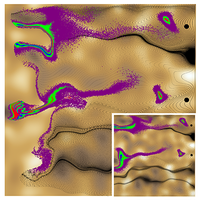
This study focuses on how Lagrangian coherent structures (LCSs) control solute dispersion in heterogeneous poroelastic media (HPM). We show how interactions between medium compressibility, conductivity heterogeneity, and periodic forcing give rise to complex flows and diverse LCS types (KAM islands, chaotic saddles, etc) that have profound impacts on diffusive solute transport (main image) that do not arise in the steady counterpart (inset). Strongly anomalous transport impacts both spatial moments and residence time distributions and persists at low Péclet numbers. This study reveals the complex transport phenomena that can arise in HPM and shows how LCSs govern solute dispersion.

Sign In to Your Journals Account

Filter

Recent Issues

Vol. 11, Iss. 10
October 2026
Vol. 11, Iss. 9
September 2026
Vol. 11, Iss. 8
August 2026
Vol. 11, Iss. 7
July 2026
Category
Article Type
Section

Filter

Article Lookup

Enter a citation