Recent Articles

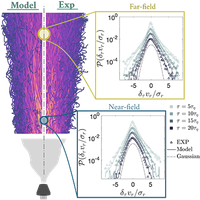
Lagrangian modeling of a nonhomogeneous turbulent shear flow: Molding homogeneous and isotropic trajectories into a jet

Bianca Viggiano, Thomas Basset, Mickaël Bourgoin, Raúl Bayoán Cal, Laurent Chevillard, Charles Meneveau, and Romain Volk

Phys. Rev. Fluids 9, 044604 (2024) - Published 9 April, 2024

We propose a novel approach to accurately model complex flow, ultimately predicting the behavior of a turbulent jet by molding a set of velocity signals input from an idealized flow (readily available from numerical databases online). The model uses fundamental properties of the jet, such as velocity means and standard deviations, easily accessible from textbooks, experiments, or low-order simulations (RANS, LES). The modeled jet reproduces many subtle and intricate properties of the turbulent flow, including the intermittent extreme events known to exist in turbulent flows, which have been typically thought of as not capable of being captured with current modeling techniques.

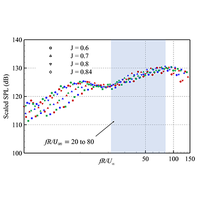
Experimental study of the turbulence ingestion noise of rotor blades

Han Wu, Yuhong Li, Xin Zhang, Siyang Zhong, and Xun Huang

Phys. Rev. Fluids 9, 044801 (2024) - Published 9 April, 2024

In this work, we experimentally investigate turbulence ingesting rotor noise under various thrusting states. The broadband noise caused by turbulence ingestion is found to dominate at the normalized frequency range of fR/U∞ = 20 to 80 when the rotor is under low-thrusting conditions. Results also suggest that the turbulence ingestion broadband noise can be scaled by Mach number scaling of M∞2Mc4, where M∞ is the freestream Mach number, and Mc is the corresponding blade tip Mach number.

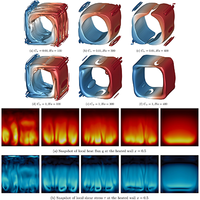
Effects of wall conductivities on magnetoconvection in a cube

Hai-Tao Zhu, Long Chen, and Ming-Jiu Ni

Phys. Rev. Fluids 9, 043701 (2024) - Published 8 April, 2024

This numerical simulation investigates the vertical convection of liquid metal with varying magnetic fields and wall conductivities. The applied horizontal magnetic field alters plume dynamics and topology, leading to a more coherent large-scale flow structure but weakening convection through Joule dissipation. This competition between rectification and magnetic damping determines the magnetic field’s impact on heat transfer, with the quasi-two-dimensional state being the threshold. Our analysis demonstrates that while the plume area remains constant, condensation of coherent structures enhances horizontal heat transport per unit area, significantly improving overall heat transfer.

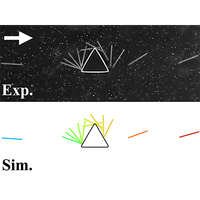
Dynamics of rigid fibers interacting with triangular obstacles in microchannel flows

Zhibo Li, Clément Bielinski, Anke Lindner, Olivia du Roure, and Blaise Delmotte

Phys. Rev. Fluids 9, 044302 (2024) - Published 8 April, 2024

We combine experiments and numerical simulations to investigate the interaction between a rigid fiber and a triangular obstacle in a microfluidic channel. We find different dynamics depending on the initial position and orientation of the fiber. We show that these dynamics are dictated by the fiber configuration in the vicinity of the obstacle. Some dynamics induce a cross-stream migration which grows with the fiber length. Our findings could in the future be used to design and optimize microfluidic sorting devices to sort rigid fibers by length.

Transitional pressure drop in a cavitied microchannel

Yan Yan Liu, Sjouke W. Schekman, Mo Xiao Li, Tian Jian Lu, and Tongbeum Kim

Phys. Rev. Fluids 9, 044201 (2024) - Published 5 April, 2024

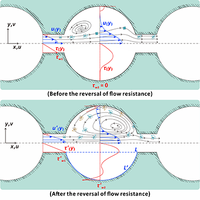
A flow progression from laminar flow slippage to rotational vortices in cavitied microchannels is shown to cause a reversal of flow resistance, i.e. a reduced flow resistance at low Reynolds numbers compared to an unmodified microchannel but a comparatively higher flow resistance at high Reynolds numbers. Furthermore, an earlier transition of initial laminar flow to turbulent flow is suggested to be triggered by instabilities generated along shear layers, formed between the mainstream flow and rotational vortices in each cavity that modifies the sidewalls of microchannels.

Machine-learning-augmented domain decomposition method for near-wall turbulence modeling

Shiyu Lyu, Jiaqing Kou, and Nikolaus A. Adams

Phys. Rev. Fluids 9, 044603 (2024) - Published 5 April, 2024

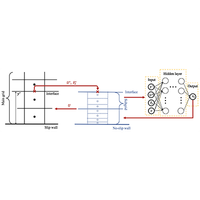
In this work, we developed a novel framework for incorporating the near-wall non-overlapping domain decomposition (NDD) method with the machine learning technique. It allows the solution to be calculated with a Robin-type (slip) wall boundary condition on a relatively coarse mesh and then be corrected in the near-wall region by solving the thin boundary-layer equations on a fine subgrid. Through an estimated turbulent viscosity profile provided by a neural network, the proposed method can be easily extended to different turbulence models and achieve commendable accuracy for the test cases of turbulent wall-bounded flows at various Reynolds numbers.

Microcontinuum approach to multiscale modeling of multiphase reactive flow during mineral dissolution

Zhiying Liu (刘志颖), Qianghui Xu (许强辉), Junyu Yang (杨君宇), Kai H. Luo (罗开红), and Lin Shi (史琳)

Phys. Rev. Fluids 9, 043801 (2024) - Published 4 April, 2024

The existing hybrid-scale micro-continuum approach faces difficulties in numerical diffusion issues at the gas-liquid interface and the solid boundary. This article proposes a multiscale compressive Continuum Species Transfer (MC-CST) scheme and a concentration extrapolation algorithm to improve the accuracy of two-phase reactive flow simulations. Furthermore, a case study simulating calcite dissolution in a porous medium is presented to underscore the importance of multiscale fluid-rock interactions for an in-depth comprehension of the dissolution regime.

Learning in two dimensions and controlling in three: Generalizable drag reduction strategies for flows past circular cylinders through deep reinforcement learning

Michail Chatzimanolakis, Pascal Weber, and Petros Koumoutsakos

Phys. Rev. Fluids 9, 043902 (2024) - Published 4 April, 2024

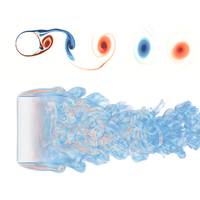
We present the automated discovery of control strategies for drag reduction in cylinder flows. Reinforcement Learning algorithms discover control strategies for two-dimensional configurations that generalize to three dimensional flows. We discuss the physical processes involved in the drag reduction mechanisms along with their generalization capabilities. This work demonstrates a practical approach to handling the computationally intensive task of deploying Reinforcement Leaning for bluff body flow control problems: namely train in 2D and control in 3D.

Passive stabilization of crossflow instabilities by a reverse lift-up effect

Jordi Casacuberta, Stefan Hickel, and Marios Kotsonis

Phys. Rev. Fluids 9, 043903 (2024) - Published 4 April, 2024

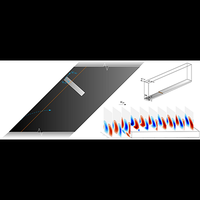
A physical mechanism has been identified through which a small surface add-on to a swept (angled-back) aircraft wing can delay the development of turbulent disorganized airflow. To reduce the aerodynamic drag of an aicraft, it is important to maximize the extent of smooth laminar airflow around its wings. The mechanism, termed “reverse lift-up effect”, dampens out the critical instability waves leading to turbulent airflow over swept aircraft wings under certain conditions. This may be achieved through particular design of a surface pattern on the aicraft wings. Overall, the present findings aim to contribute to novel design methodologies for future generations of laminar aicraft wings.

Heat transfer and transport property contrast effects on the compressible Rayleigh-Taylor instability

Kevin Cherng, Sanjiva Lele, and Daniel Livescu

Phys. Rev. Fluids 9, 043904 (2024) - Published 4 April, 2024

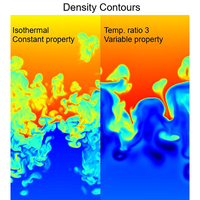
We systematically examine how heat conduction between two fluids at different temperatures, large contrasts in transport properties, and sudden changes in transport properties can affect the fully compressible Rayleigh-Taylor instability (RTI) using direct numerical simulations. These variations cause departures from the classical self-similar development of the RTI, along with misalignment between regions of mixing and regions of most intense turbulent activity. Under certain conditions, dynamical quantities such as vorticity and dissipation appear to depend only on the transport properties and not on past flow history.

Revisiting Taylor's hypothesis in homogeneous turbulent shear flow

Frank G. Jacobitz and Kai Schneider

Phys. Rev. Fluids 9, 044602 (2024) - Published 3 April, 2024

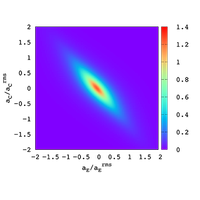
Taylor’s hypothesis of frozen flow is revisited in homogeneous turbulent shear flow by examining the cancellation properties of Eulerian and convective accelerations at different spatial flow scales. The anti-alignment in the joint pdf given in the figure shows that the Eulerian and convective accelerations cancel for small scales of the turbulent motion, indicating that Taylor’s hypothesis holds. This is not so for the large-scale motion of homogeneous turbulent shear flow.

Finite speed of sound effects on asymmetry in multibubble cavitation

Mandeep Saini, Youssef Saade, Daniel Fuster, and Detlef Lohse

Phys. Rev. Fluids 9, 043602 (2024) - Published 2 April, 2024

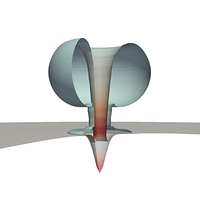
Cavitation bubbles are present in a plethora of industrial and medical applications, and their understanding proves crucial to the development and tuning processes. In this study, we perform three dimensional direct numerical simulations (DNS) of multiple cavitation bubbles driven by pressure waves. Similarly observed in previously conducted experiments, it is found that these bubbles can exhibit an asymmetry in the direction of wave propagation. We show that this asymmetry is a consequence of the force induced by the wave on the bubbles, due to the finite speed of sound in the liquid medium.

Mutual interaction of a collapsing bubble and a nearby viscoelastic solid

Jihoo Moon, Ehsan Mahravan, and Daegyoum Kim

Phys. Rev. Fluids 9, 043603 (2024) - Published 2 April, 2024

This work investigates the interaction of a viscoelastic solid and a nearby collapsing bubble, using numerical simulations. The Deborah number, which quantifies the relative time scales of solid deformation and bubble dynamics, is found to effectively characterize the bubble-solid interaction. Analyses on the temporal distribution of energy components and the imbalance in pressure distribution surrounding the bubble reveal the rationale behind changes in bubble behaviors with respect to the viscosity and elasticity of the solid. Furthermore, the solid deformation induced by an expanding and collapsing bubble and the shape of the crater formed by a bubble jet are examined.

Detuned secondary instabilities in three-dimensional boundary-layer flow

Antoine Jouin, Nicola Ciola, Stefania Cherubini, and Jean Christophe Robinet

Phys. Rev. Fluids 9, 043901 (2024) - Published 2 April, 2024

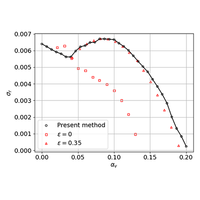
A three-dimensional boundary layer is the seat of a spatially amplified instability, the crossflow instability, which is encountered for example on swept wings. Beyond a certain amplitude, the flow destabilizes again through a secondary instability. The objective of this work is to show that by using a discrete spatial Floquet method (Block method) from a certain transversally periodic elementary pattern, there can exist a large-scale modulation linked to amplification mechanisms involving detuned modes.

Viscous rebound of a quasi-two-dimensional cylinder on a solid wall

Alicia Aguilar-Corona, Micheline Abbas, Matthieu Mercier, and Laurent Lacaze

Phys. Rev. Fluids 9, 044301 (2024) - Published 2 April, 2024

The concept of apparent coefficient of restitution is extended, to describe the wall-bouncing of a cylinder falling in a viscous fluid. When the Stokes number (St) is increased, the coefficient of restitution increases from 0 to 1 over two decades of St, with a critical Stc=75±25 (compared to Stc≈10 for spheres). While rationalizing results from experiments and numerical simulations, we evidence the relevance of lumping the complex details of physical phenomena involved during contact into a simple concept based on the contact apparent roughness and elasticity. The increase of dissipation associated with the contact elasticity is well captured by a model based on solid contact time scale.

Near-wall streamwise turbulence intensity as Reτ→∞

Yongyun Hwang

Phys. Rev. Fluids 9, 044601 (2024) - Published 2 April, 2024

Two possible and physically meaningful scalings for near-wall streamwise turbulence intensity are derived using velocity spectra. First, if viscous wall effect on the wall-attached inactive motions from the log and outer layers is negligible enough so that the related spectrum does not diminish with Reynolds number, the near-wall turbulence intensity grows indefinitely and scales as ln Reτ. Whereas if it is strong enough so that the near-wall turbulence intensity remains finite at all Reynolds numbers, it scales as 1/ln Reτ. The existing measurement data favors the latter scaling, but the issue will be settled by the availability of such data at higher Reynolds numbers.

Cuboid drop: A low-dimensional model of drop dynamics on a substrate

Tristan Gilet

Phys. Rev. Fluids 9, 043601 (2024) - Published 1 April, 2024

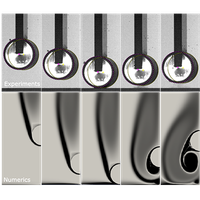
The dynamics of a liquid drop attached to a solid and subjected to arbitrary accelerations can be qualitatively reproduced with a low-dimensional model in which the drop is replaced by a cuboid. The cuboid deforms, vibrates and slides similarly to a drop, while being much simpler to describe mathematically.

Investigation of the inclination angles of wall-attached eddies for streamwise velocity and temperature fields in compressible turbulent channel flows

Tianyi Bai, Cheng Cheng, and Lin Fu

Phys. Rev. Fluids 9, 034611 (2024) - Published 29 March, 2024

This work explores the streamwise inclination angle of attached eddies in both the streamwise velocity and temperature fields using direct numerical simulations of turbulent channel flows. Though it has been well studied in incompressible flows, scarce work exists in compressible flows. A high statistical similarity is found between the velocity and temperature fluctuations. The increasing trend of the inclination angle with Reynolds numbers observed in incompressible flows remains. On the contrary, the current database shows a minor Mach-number effect on it. These conclusions could serve as references for extending the attached eddy model from incompressible to compressible flows.

Depinning of water droplets from a horizontal solid surface by wall-bounded shear flows

Xueqing Zhang, Jeremy D. Newton, Serhiy Yarusevych, and Sean D. Peterson

Phys. Rev. Fluids 9, 034004 (2024) - Published 28 March, 2024

Liquid droplets depinning due to shear flow aerodynamic loading is relevant to a range of engineering applications. Factors influencing depinning include droplet volume and submergence, shear flow velocity profile and acceleration, and surface wettability. A series of experiments are performed to assess the critical depinning velocity of liquid droplets subjected to an accelerating (i) laminar boundary layer, and (ii) slot jet at varying impingement angles. Critical depinning velocity, cast into a nondimensional critical Weber number, is found to be strongly related to a newly introduced volumetric shape factor, which encapsulates droplet shape and related aspects of substrate wettability.

Hydrodynamic resistance of a yeast clog

T. Desclaux, L. Santana, I. Verdeille, P. Duru, P. Joseph, M. Delarue, and O. Liot

Phys. Rev. Fluids 9, 034202 (2024) - Published 28 March, 2024

Bioclogging, the clogging of pores with living particles, is a complex process that involves various coupled mechanisms such as hydrodynamics, particle deformability, and polydispersity. This article aims to study a yeast clog’s permeability in a microfluidic device. We can finely measure the clog’s permeability for different hydrodynamic forcing using an original and precise on-chip flow rate meter. It reveals that yeast clog’s permeability decreases when the applied pressure increases, with saturation at high pressure. A semi-empirical model based on a double-porosity structure accurately captures the experimental observations.

Sign In to Your Journals Account

Filter

Recent Issues

Vol. 11, Iss. 10
October 2026
Vol. 11, Iss. 9
September 2026
Vol. 11, Iss. 8
August 2026
Vol. 11, Iss. 7
July 2026
Category
Article Type
Section

Filter

Article Lookup

Enter a citation