Recent Articles

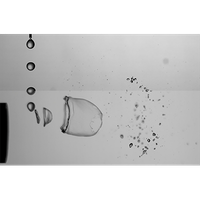
Droplet breakup and size distribution in an airstream: Effect of inertia

Someshwar Sanjay Ade, Pavan Kumar Kirar, Lakshmana Dora Chandrala, and Kirti Chandra Sahu

Phys. Rev. Fluids 9, 084004 (2024) - Published 13 August, 2024

Our study experimentally investigates the morphology and breakup of a droplet descending into an airstream, analyzing child droplet size distributions through high-speed shadowgraphy and in-line holography. We found that varying the droplet’s release height results in different breakup modes — from vibrational to retracting bag-stamen breakup at the same Weber number — each with distinct size distributions. Our theoretical model, which incorporates the effective Weber number, accurately predicts these distributions, underscoring the critical impact of droplet dynamics and aerodynamic interactions on breakup behavior.

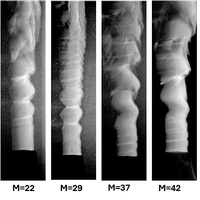
Self-sustained oscillations in a low-viscosity round jet

V. Srinivasan, X. Tan, E. Whitely, I. Wright, A. Dhotre, and J. Yang

Phys. Rev. Fluids 9, 083902 (2024) - Published 12 August, 2024

When a jet of fluid emerges into an ambient medium of the same density but higher viscosity, the dominant mode of instability transitions from axisymmetric at low viscosity ratio M to a helical mode at high M. It is shown that these helical modes are unstable global modes associated with enhanced mixing and the emergence of a single dominant frequency observed everywhere in the near field. These frequencies align well with predictions of absolute instability from spatiotemporal linear stability theory.

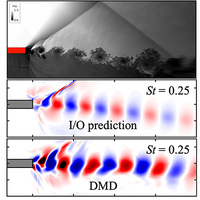
Responses to disturbance of supersonic shear layer: Input-output analysis

Mitesh Thakor, Yiyang Sun, and Datta V. Gaitonde

Phys. Rev. Fluids 9, 084603 (2024) - Published 12 August, 2024

The perturbation dynamics in a supersonic shear layer are characterized using large-eddy simulations and linear-operator-based input-output analysis. The Kelvin-Helmholtz instability emerges as the primary mechanism for disturbance energy amplification. To identify feasible actuator placement locations, we conduct a state-space restricted input-output analysis, revealing the splitter plate trailing surface as the most receptive region. Furthermore, simulations with applied forcing demonstrate that the coherent structures predicted by linear analysis remain active within a highly nonlinear turbulent flow.

Prediction of turbulent channel flow using Fourier neural operator-based machine-learning strategy

Yunpeng Wang, Zhijie Li, Zelong Yuan, Wenhui Peng, Tianyuan Liu, and Jianchun Wang

Phys. Rev. Fluids 9, 084604 (2024) - Published 12 August, 2024

The implicit U-Net enhanced Fourier neural operator (IUFNO) combines the loop structure of implicit FNO (IFNO) with U-Net, leading to enhanced long-term predictive ability in the large-eddy simulations (LES) of turbulent channel flow. It is found that the IUFNO outperforms the traditional dynamic Smagorinsky model (DSM) and the wall-adapted local eddy-viscosity (WALE) model at coarse LES grids. The predictions of both the mean and fluctuating quantities by IUFNO are closer to the filtered direct numerical simulation (fDNS) benchmark compared to the traditional LES models, while the computational cost of IUFNO is much lower.

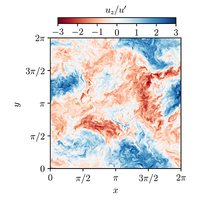
Artificial bottleneck effect in large eddy simulations

Mostafa Kamal and Perry L. Johnson

Phys. Rev. Fluids 9, 084605 (2024) - Published 12 August, 2024

This paper addresses the artificial bottleneck effect in large-eddy simulations (LES), causing erroneous energy spectrum overshoots due to residual stress model inaccuracies. We use Stokes Flow Regularization (SFR) to improve LES models with detailed residual kinetic energy considerations. Adding a nonlinear gradient component to the residual stress closure accurately captures local stress structures, reduces kinetic energy over-predictions, and enhances energy cascade representation. The mixed model produces vortex tube-like structures similar to those in filtered direct numerical simulations (DNS), while the eddy viscosity model yields shear layer-like features.

Effects of thermal stratification on detonation development in hypersonic reactive flows

Pengfei Yang, Dehai Yu, Zheng Chen, Honghui Teng, and Hoi Dick Ng

Phys. Rev. Fluids 9, 083202 (2024) - Published 9 August, 2024

In this paper, we first examine the wave morphology induced by reactant thermal stratification in hypersonic reactive flows. Three flow regimes are observed: autoignition-driven reaction front, detonation wave, and decoupled shock/reaction front. The results suggest that local autoignition behavior can be significantly influenced by reactivity nonuniformity in the reactive flow; and an undesirable detonation wave can be initiated given a suitable temperature gradient. This also indicates that oblique detonation waves can be generated without mechanical devices such as blunt bodies and wedges.

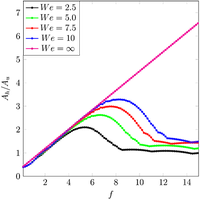
Varicose dynamics of liquid curtain: Linear analysis and volume-of-fluid simulations

Alessandro Della Pia, Matteo Chiatto, and Luigi de Luca

Phys. Rev. Fluids 9, 084003 (2024) - Published 9 August, 2024

The varicose dynamics of gravitational liquid sheet flows issuing into a quiescent gaseous ambient is relevant for technological applications such as coating deposition, where varicose perturbations of the curtain shape can arise due to velocity fluctuations coming from the delivering pump placed upstream of the coating die. We investigate this problem using a one-dimensional linear model and two-dimensional nonlinear simulations, finding novel scaling laws for the curtain oscillation frequency and amplitude with the Weber number. Moreover, an interesting numerical break-up phenomenon of the curtain is outlined, driven by the progressive curtain thinning induced by the varicose disturbances.

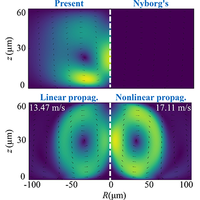
Eckart streaming with nonlinear high-order harmonics: An example at gigahertz

Shiyu Li, Weiwei Cui, Thierry Baasch, Bin Wang, and Zhixiong Gong

Phys. Rev. Fluids 9, 084201 (2024) - Published 8 August, 2024

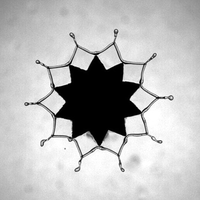
Rim dynamics and droplet ejections upon drop impact on star-shaped poles

Tobias Bauer and Tristan Gilet

Phys. Rev. Fluids 9, 083602 (2024) - Published 7 August, 2024

When a drop impacts next to the edge of a solid substrate, it spreads beyond the edge and forms a liquid sheet surrounded by a rim. As the rim decelerates, ligaments may form, then destabilize in droplets. This fragmentation scenario has been extensively investigated in the axisymmetric configuration of centered impacts on small circular targets. In this work, we investigate star-shaped targets. We show that the rim is shaped complementarily to the substrate: it goes farther and yields more droplet ejections in directions corresponding to troughs in the substrate edge profile.

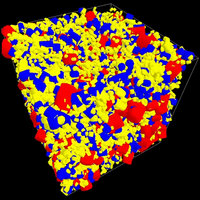
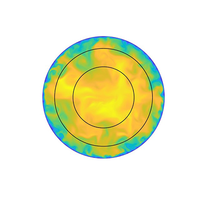
Response of turbulent energy spectrum and flow structures when vortical motion of a certain scale is suppressed by artificial forcing

Masato Hirota, Seiichiro Izawa, and Yu Fukunishi

Phys. Rev. Fluids 9, 084602 (2024) - Published 7 August, 2024

The energy cascade in turbulence is explored through a novel approach in which the vortical structures of a certain scale in the inertial subrange, colored by yellow, is forcibly suppressed. Their disappearance leads to a slight increase in kinetic energy in the larger scale range and a decrease in the smaller scale range. The vortex-tracking analysis reveals that the vortices twice as large as the target, colored by blue, exhibit smaller curvatures and longer lifespans, while no remarkable changes are found for the vortices that are four times larger, colored by red. These findings indicate that the larger vortices are locally bent by the smaller vortices, shortening their lifespans.

Curvature-driven transport of thin Bingham fluid layers in airway bifurcations

Cyril Karamaoun, Haribalan Kumar, Médéric Argentina, Didier Clamond, and Benjamin Mauroy

Phys. Rev. Fluids 9, L081101 (2024) - Published 7 August, 2024

We uncover and study a physical process that is hidden in the healthy lung. This process can be triggered by the thickening of the thin layer of mucus lining the bronchi walls. At the air-mucus interface, surface tension and curvature can combine to oppose the physiological motion of mucus induced by cilia, causing mucus to stall or, even, move in reverse. Representing mucus as a Bingham fluid, we characterize analytically the fluid dynamics in the thin layer using dimensionless quantities and employ numerical simulations to compute the layer velocity field in airways bifurcations. This work sheds new light on the intricate workings of the respiratory system.

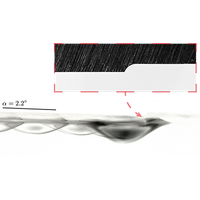
Gravito-capillary trapping of pendant droplets under wet uneven surfaces

Etienne Jambon-Puillet

Phys. Rev. Fluids 9, L081601 (2024) - Published 7 August, 2024

Pendant drops spontaneously appear on the underside of wet surfaces through the Rayleigh-Taylor instability. Here, I show that such pendant drops can get stuck on topographic defects, despite having no contact line. Unlike traditional pinning, the trapping force has a gravito-capillary origin: liquid has to move up or down and the interface has to deform for the drop the pass the defect. I model this topography induced force, demonstrate how to harness it to guide pendant drops, and expect it to be relevant to other contact line free systems.

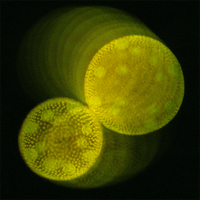
Biophysical fluid dynamics in a Petri dish

George T. Fortune, Eric Lauga, and Raymond E. Goldstein

Phys. Rev. Fluids 9, 083101 (2024) - Published 5 August, 2024

In biological fluid dynamics, as studied in the lab or in natural environments, it is often the case that organisms swim in a thin fluid layer above a bottom no-slip surface and below an upper stress-free interface. Here we examine in this “Petri dish” geometry the image system for the elementary and composite singularities of Stokes flow: the Stokeslet, rotlet, source, rotlet dipole, source dipole and stresslet. As an application of these results, we reconsider the problem of hydrodynamic bound states of spherical microswimmers in finite-depth chambers.

Improved two-temperature model with correction of non-Boltzmann effect for oxygen and nitrogen

Rui Xiong, Yufeng Han, and Wei Cao

Phys. Rev. Fluids 9, 083201 (2024) - Published 5 August, 2024

The substantial rise in fluid temperature behind the shock at the head of hypersonic vehicles induces molecular internal energy excitation and dissociation, potentially resulting in thermochemical nonequilibrium flow. The high vibrational energy molecule of oxygen and nitrogen undergo overdistribution and underdistribution states, resulting in increased and decreased dissociation rates in nonequilibrium flow. The latter state dominates and notably increases fluid temperature and wall heat flux, impacting the vehicle’s thermal protection design. This study proposes an improved two-temperature dissociation rate model to more accurately simulate the nonequilibrium flow behind the shock.

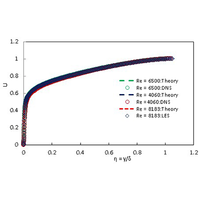
Approximate derivation of the power law for the mean streamwise velocity in a turbulent boundary layer under zero-pressure gradient

J. Dey

Phys. Rev. Fluids 9, 084601 (2024) - Published 5 August, 2024

Using a Reyolds shear stress model in the boundary layer equations for flow over a flat plate, the streamwise velocity (U) is related to the wall-normal velocity (V). The empirical power-law U∼η1/n for the streamwise velocity is derived theoretically, followed by a power-law for V.

Sensitivity study of resolution and convergence requirements for the extended overlap region in wall-bounded turbulence

Sergio Hoyas, Ricardo Vinuesa, Peter Schmid, and Hassan Nagib

Phys. Rev. Fluids 9, L082601 (2024) - Published 5 August, 2024

Direct Numerical Simulations (DNS) are among the most powerful tools for studying turbulent flows. Even though the achievable Reynolds numbers are lower than those obtained through experimental means, DNS offers a clear advantage: the entire velocity field is known, allowing for evaluating any desired quantity. One is the indicator function, which is crucial for understanding inner and outer interactions in wall-bounded flows and describing the overlap region between them. We find a clear dependence of this indicator function on the mesh distributions we examined, raising questions about classical mesh and convergence requirements for DNS and achievable accuracy.

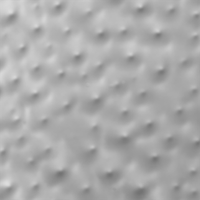
Localized jammed clusters persist in shear-thickening suspension subjected to swirling excitation

Li-Xin Shi (石理新) and Song-Chuan Zhao (赵松川)

Phys. Rev. Fluids 9, 083301 (2024) - Published 2 August, 2024

This study reports a novel dynamic in shear-thickening suspensions with a free surface under bottom shear, revealing localized, persistent jammed clusters (bumps in the image). We clarify the essential role of shear-thickening properties and the effect of suspension depth, showing that at small depth this heterogeneous state could occur below the minimum density of discontinuous shear-thickening. Moreover, our findings emphasize the critical role of free surfaces in cluster growth. This advances our understanding of the evolution of heterogeneity associated with shear-thickened states.

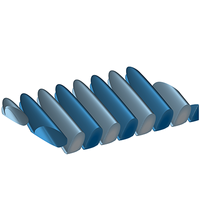
Transient growth in diabatic boundary layers with fluids at supercritical pressure

Pietro Carlo Boldini, Benjamin Bugeat, Jurriaan W. R. Peeters, Markus Kloker, and Rene Pecnik

Phys. Rev. Fluids 9, 083901 (2024) - Published 2 August, 2024

Is transient growth critical for boundary-layer stability in fluids at supercritical pressure with their strong property variations across the pseudo-boiling line? This study on non-modal growth and its competition with modal growth under various heat-transfer scenarios reveals new insights into instability mechanisms in non-ideal fluids. We identify optimal growth in streamwise-modulated streaks as the fluid is heated beyond the pseudo-boiling line, with transcritical Mode II responsible. In this scenario, transition below the critical Reynolds number might prevail, mimicking the effect of an adverse pressure gradient in the ideal-gas regime.

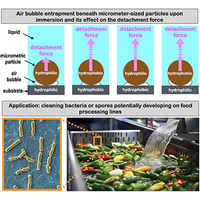
Retention or repulsion forces induced by bubbles trapped at the base of an immersed microparticle on a substrate

Anna Ipatova, Alexis Duchesne, H. N. Yoshikawa, Pascal Mariot, Corenthin Leroy, Christine Faille, Ichiro Ueno, Georg F. Dietze, and Farzam Zoueshtiagh

Phys. Rev. Fluids 9, 084301 (2024) - Published 2 August, 2024

Our study investigates the entrapment of air bubbles beneath micrometer-sized particles upon immersion, employing theoretical, computational, and experimental approaches. We reveal that the wettability of both particles and substrates significantly influences the adhesion forces due to trapped bubbles. Our findings, validated through experiments, highlight that hydrophobic surfaces increase the likelihood of bubble entrapment, thereby enhancing particle detachment forces. This work offers valuable insights for various industries, such as food processing, where optimizing surface coatings could improve cleaning efficiency and promote greener practices.

From mixing to displacement of miscible phases in porous media: The role of heterogeneity and inlet pressures

Yahel Eliyahu-Yakir, Ludmila Abezgauz, and Yaniv Edery

Phys. Rev. Fluids 9, 084501 (2024) - Published 2 August, 2024
Miscible multiphase flow in porous media is a key phenomenon in various industrial and natural processes, such as hydrogen storage and geological carbon sequestration. We experimentally find that inlet pressures and heterogeneity levels control the miscible displacement of high-viscosity glycerol by low-viscosity water and their mixing due to shear forces, by transitioning from uniform to fingering patterns at the pore scale. We derive a non-dimensional modified Sherwood number that links these microscale patterns to physical properties like velocity distribution, diffusion, and viscosity contrasts; thus linking pore-scale dynamics with macroscale Darcy-scale observations.

Sign In to Your Journals Account

Filter

Recent Issues

Vol. 11, Iss. 10
October 2026
Vol. 11, Iss. 9
September 2026
Vol. 11, Iss. 8
August 2026
Vol. 11, Iss. 7
July 2026
Category
Article Type
Section

Filter

Article Lookup

Enter a citation