Recent Articles

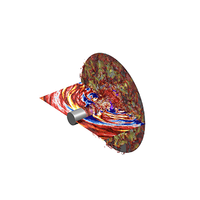
Physics-informed machine-learning solution to log-layer mismatch in wall-modeled large-eddy simulation

Soju Maejima, Kazuki Tanino, and Soshi Kawai

Phys. Rev. Fluids 9, 084609 (2024) - Published 26 August, 2024

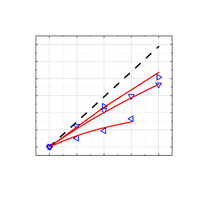
This study proposes a machine-learning solution to address the log-layer mismatch problem that occurs when the erroneous near-wall flow variables are used as the input for the wall model in a wall-modeled large eddy simulation. Neural networks are employed to correct the errors in the near-wall flow variables before they are used as the input for the wall model. The input and output features of the neural networks are selected based on the physical relations of the turbulent boundary layer for robustness against various Reynolds and Mach number conditions. The proposed neural networks enable the wall model to accurately predict the wall shear stress and the resultant turbulence statistics.

Cascades of turbulent kinetic energy and multicomponent scalars in a momentum-scalar coupling turbulence driven by multiple mechanisms under homogeneous and isotropic hypotheses

Wei Zhao

Phys. Rev. Fluids 9, 084610 (2024) - Published 26 August, 2024

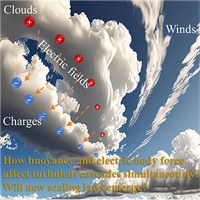
Turbulence is ubiquitous in our world, attributed to diverse mechanisms that may act alone or together. Traditionally, inspired by the reductionist approach, the dominant turbulence-inducing mechanism has been isolated and minor ones neglected. However, are the minor factors truly negligible? Recent research, grounded in conservation of kinetic energy and multicomponent scalar variance fluxes, suggests otherwise. Even weaker mechanisms, such as electric body forces, can significantly influence the cascades of turbulence in the presence of a dominant mechanism like buoyancy-driven turbulence, leading to the emergence of new scaling indices and diverse observations in real-world turbulence.

Viscous influences on impulsively generated focused jets

Xianggang Cheng, Xiao-Peng Chen, Hang Ding, Chun-Yu Zhang, Haibao Hu, and Laibing Jia

Phys. Rev. Fluids 9, L082001 (2024) - Published 23 August, 2024

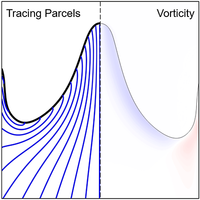
Impulsively generated focused jets play significant roles in advanced manufacturing and biomedical applications, where the viscous effects are crucial in jet dynamics. In this study, we find that mass and momentum transfer along the tangential direction of the free surface contribute to focused jet formation. The viscosity-induced diffusion of the shear flow and vorticity near the free surface reduces the jet speed. These findings offer new perspectives on viscous interface dynamics.

Surfactant-laden bubble bursting: Dynamics of capillary waves and Worthington jet at large Bond number

P. Pico, L. Kahouadji, S. Shin, J. Chergui, D. Juric, and O. K. Matar

Phys. Rev. Fluids 9, 083606 (2024) - Published 22 August, 2024

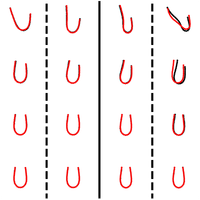
This study investigates the key stages before aerosol formation by bursting bubbles: capillary wave propagation, convergence at the bubble apex, Worthington jet ascent, and droplet release. We focus on overlooked factors: surface-active agents and gravitational effects, quantified by the Bond number. Our results propose a new mechanism explaining capillary wave retardation in surfactants, involving the transition from bi- to uni-directional Marangoni stresses, which counter wave motion. We also elucidate the varying wave velocities with different surfactant properties, challenging the constant velocity observed in clean interfaces.

Robust experimental data assimilation for the Spalart-Allmaras turbulence model

Deepinder Jot Singh Aulakh, Xiang Yang, and Romit Maulik

Phys. Rev. Fluids 9, 084608 (2024) - Published 22 August, 2024

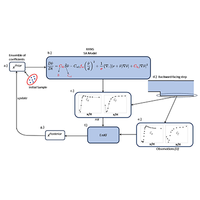
The presented methodology fuses computational models with experimental data to enhance the Spalart-Allmaras (SA) turbulence model for Reynolds-averaged Navier-Stokes equations. By leveraging the Ensemble Kalman filtering approach (EnKF), this study refines the SA model’s coefficients, ensuring improved performance on separated flows without any accuracy trade-off on flows already well captured by SA. Validated on different flow conditions, including a backward-facing step and a NASA wall-mounted hump, the recalibrated model demonstrates significant improvements in key metrics.

Self-scaling generalized Townsend-Perry constants for high-order moments in turbulent boundary layers

Xibo He, Hongyou Liu, and Xiaojing Zheng

Phys. Rev. Fluids 9, L082602 (2024) - Published 22 August, 2024

The reason for the deviation of measured generalized Townsend-Perry (T-P) constants from the previous Gaussian prediction based on the attached eddy model is found and the universal expression of the generalized T-P constants, regardless of the eddy type, is derived. These findings may contribute further insight into the fundamental statistical characteristics of coherent motions in flow fields and provide good indications for testing the accuracy of numerical simulations in high-Reynolds-number flows.

Translation of a sphere towards a rigid plane in an Oldroyd-B fluid

Tachin Ruangkriengsin, Rodolfo Brandão, Bimalendu Mahapatra, Evgeniy Boyko, and Howard A. Stone

Phys. Rev. Fluids 9, 083303 (2024) - Published 21 August, 2024

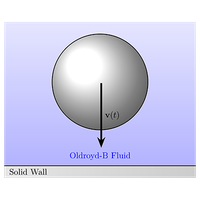
Viscoelastic fluids may exhibit complex flow behaviors, such as nontrivial normal stress differences and time-dependent responses, which can significantly impact the settling dynamics of suspended particles. We investigate particle-wall interactions for the case of a sphere moving close to and normal to a wall in an Oldroyd-B fluid, considering both prescribed velocity and force scenarios; the lubrication approximation and Deborah number perturbation techniques are used.

Tones and upstream-traveling waves in ideally expanded round impinging jets

Igor A. Maia, Maxime Fiore, and Romain Gojon

Phys. Rev. Fluids 9, 083904 (2024) - Published 21 August, 2024

We study the role played by upstream-traveling guided waves on the generation of tones by a supersonic, ideally-expanded round jet impinging on a flat plate. We explore a finite-thickness stability model for the prediction of allowable frequency ranges for resonance based on the dynamics of such waves. We show that the frequency ranges predicted by the finite-thickness model are consistent with the vast majority of experimental and numerical data available in the literature, correcting discrepancies observed previously with vortex sheet models. This provides further evidence for the involvement of guided jet modes in the resonance mechanism.

Single theoretical model for breakup of viscous thread with and without a fiber

Hyejoon Jun and Hyoungsoo Kim

Phys. Rev. Fluids 9, 084005 (2024) - Published 20 August, 2024

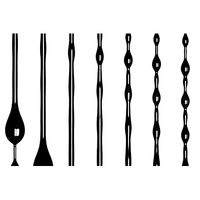
We present a theoretical model for viscous liquid systems exhibiting Rayleigh-Plateau instability, considering cases with and without a solid fiber. Using the lubrication approach and hydrodynamic interactions at the solid-liquid interface, we derive one-dimensional evolution equations for the breakup of viscous liquid threads and films on fibers. Our model aligns well with experimental results, unifying Goren’s liquid film on a fiber and Rayleigh’s viscous liquid thread findings. It identifies the most unstable mode as proportional to the wavenumber quadratically and reveals the exponential decay of satellite droplet volume with increasing wavenumber.

Effects of initial packing density and cohesion on submerged granular collapse

Rui Zhu, Zhiguo He, and Eckart Meiburg

Phys. Rev. Fluids 9, 084302 (2024) - Published 20 August, 2024

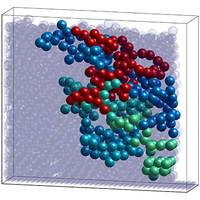
Cohesive force chain networks during a granular collapse process. Such networks can be identified by means of community detection approaches.

Droplet impact on rotating surfaces: The effect of centrifugal force and wettability on spreading dynamics

Dongdong Liu, Hongdong Yin, Zeyu Wu, and Xiang Luo

Phys. Rev. Fluids 9, 083605 (2024) - Published 19 August, 2024

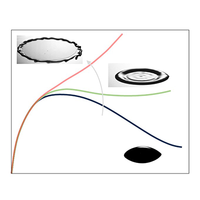
Droplet impacting on rotating surface experiences the tangential shear force from the rotating surface, generating a centrifugal force that either enhances the spreading or destabilizes the expanding lamella. In this study, we experimentally characterize the impacting of droplets with a wide range of viscosity on rotating surfaces with various wettabilities, and theoretically analyze the observed impacting dynamics, including the enhanced spreading and the transition to the destabilization of the expanding lamella. We propose a simplified approach to predict these key parameters, and validate the theoretical prediction by experimental measurement.

Convection in the active layer speeds up permafrost thaw in coarse-grained soils

M. Magnani, S. Musacchio, A. Provenzale, and G. Boffetta

Phys. Rev. Fluids 9, L081501 (2024) - Published 19 August, 2024

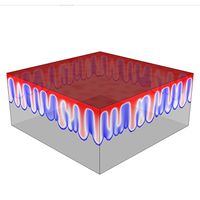
Permafrost thaw plays a crucial role in climate change dynamics, yet the intricate small-scale processes driving thawing remain inadequately understood. Here we reveal that the density anomaly of water has the potential to trigger convection in coarse-grained soils above permafrost. By using high-resolution numerical simulations of the primitive equations in porous media we show that convection significantly accelerates the thawing process. Climate models that predominantly account for thawing induced by diffusive processes alone overlook this aspect, which can self-reinforce and lead to enhanced climate-permafrost feedback.

Data-driven low-dimensional model of a sedimenting flexible fiber

Andrew J. Fox and Michael D. Graham

Phys. Rev. Fluids 9, 084101 (2024) - Published 16 August, 2024

The dynamics of flexible filaments entrained in flow are important for understanding many biological and industrial processes. This work describes a data-driven technique to create high-fidelity low-dimensional models of flexible fiber dynamics using machine learning; the technique is applied to sedimentation in a quiescent, viscous Newtonian fluid, using results from detailed simulations as the data set. Over a wide range of fiber flexibilities, the filament shape dynamics can be represented with high accuracy with only four degrees of freedom.

Coupling atomization, emulsification, and polymerization steps for creating gel microspheres

S. Danial Naghib, Matin Mirbaha, Kristina Logushkova, Jérôme Bibette, and Nicolas Bremond

Phys. Rev. Fluids 9, 083604 (2024) - Published 15 August, 2024

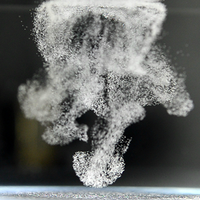
We report a high throughput strategy to produce gel microspheres. This method is based on the controlled fragmentation of an aqueous jet in air that results in droplets of monomer solution, their entry and collection in an oil bath containing a catalyzer and surfactants, followed by polymerization of the emulsion droplets which thus turn into gel beads. Adjusting the impact area of the stream of droplets at the free surface with an electric field allows to minimize coalescence of droplets as well as mass transport between the droplets and the continuous phase which is correlated to the sedimentation flow features of the dilute emulsion.

Maintenance mechanism of a circular surface wave in a magnetohydrodynamic cell and limits of its existence

Vladislav Eltishchev, Gennadiy Losev, and Peter Frick

Phys. Rev. Fluids 9, 083702 (2024) - Published 15 August, 2024

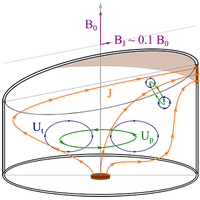
A circular surface wave (CSW) of a low-temperature gallium alloy in the immovable cell with a central bottom electrode and an upper ring electrode exposed to axial magnetic fields is studied experimentally. The mechanism which provides the existence of a stable CSW is suggested. It is determined that, depending on the force parameter and geometrical characteristics of the cell, three modes can occur in the cell: rest, CSW, or axial rotation with a deep funnel on the surface providing the circular contact of the liquid metal with the electrode. A mode map showing the boundaries of the CSW existence domain is plotted on the parameter plane.

Flooding as a sub-critical instability in open channels

Serge Mora, Martine Le Berre, and Yves Pomeau

Phys. Rev. Fluids 9, 084607 (2024) - Published 15 August, 2024

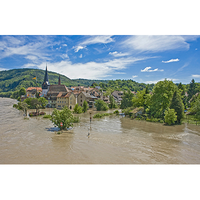
During floods caused by a continuous increase in river flow, the water level often rises suddenly, while the recession takes much longer. This behavior is consistent with the subcritical instability highlighted in this article. This instability emerges for uniform, quasi-stationary flows at high Reynolds numbers in a channel. With increasing flow, a sudden jump in water level occurs when a well-defined flow rate is reached. If the flow rate subsequently decreases, the water level drops again suddenly, but at a flow rate well below the previous one.

Confinement induced three-dimensional trajectories of microswimmers in rectangular channels

Byjesh N. Radhakrishnan, Ahana Purushothaman, Ranabir Dey, and Sumesh P. Thampi

Phys. Rev. Fluids 9, 083302 (2024) - Published 14 August, 2024

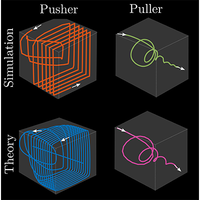
Using lattice Boltzmann simulations and an analytical framework based on far-field approximations and method of images, we study the trajectories of microswimmers inside three-dimensional channels of square and rectangular cross-sections. We find that pusher-type microswimmers move helically inside the square tube, weak pullers slide through the center of the channel while strong pullers exhibit a trajectory which is off-center. The trajectories of the neutral swimmers are challenging to generalize due to the sensitivity to the initial conditions. Finally a method of superposition is used to construct three dimensional trajectories, thus explaining the origin of their apparent complexity.

Numerical investigation on the heat transfer in wind turbulence over breaking waves

Min Lu, Zixuan Yang, Guowei He, and Lian Shen

Phys. Rev. Fluids 9, 084606 (2024) - Published 14 August, 2024

Wave breaking is recognized as one of the most violent air-sea interaction processes, significantly enhancing the transfer of heat, mass, and momentum between the oceans and the atmosphere. In this study, we investigate heat transfer in wind turbulence over breaking waves using direct numerical simulation, with a particular focus on the effects of wave age. Our findings suggest that temperature responds in a more complex way to wave age than velocity does, emphasizing the need to incorporate this phenomenon into air-sea interaction and weather forecasting models.

Platelet margination dynamics in blood flow: The role of lift forces and red blood cells aggregation

Mariam Dynar, Hamid Ez-Zahraouy, Chaouqi Misbah, and Mehdi Abbasi

Phys. Rev. Fluids 9, 083603 (2024) - Published 13 August, 2024

The presence of platelets near vessel walls is crucial for clot formation to stop bleeding. We examine platelet margination influenced by red blood cell (RBC) aggregation through numerical simulation. Our findings indicate that moderate to strong RBC aggregation enhances platelet margination in microcirculation, thereby improving the capacity to stop bleeding. This mechanism offers a natural counteraction against major bleeding in conditions such as diabetes, where strong RBC aggregation is commonly observed.

Subcritical axisymmetric solutions in rotor-stator flow

Artur Gesla, Yohann Duguet, Patrick Le Quéré, and Laurent Martin Witkowski

Phys. Rev. Fluids 9, 083903 (2024) - Published 13 August, 2024
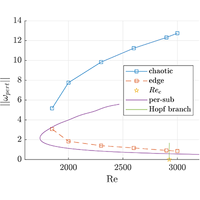
In the present study the axisymmetric flow in an aspect ratio R/H=10 cavity is revisited. The base state is shown to lose stability in a supercritical Hopf bifurcation. Branches of periodic and chaotic self-sustained solutions are computed using harmonic balance method and time integration. In addition, edge states separating the steady laminar and chaotic regimes are identified using a bisection algorithm. All the self-sustained solutions found are shown to exist only for a high enough Reynolds number and are therefore disconnected from the experimentally observed circular rolls.

Sign In to Your Journals Account

Filter

Recent Issues

Vol. 11, Iss. 10
October 2026
Vol. 11, Iss. 9
September 2026
Vol. 11, Iss. 8
August 2026
Vol. 11, Iss. 7
July 2026
Category
Article Type
Section

Filter

Article Lookup

Enter a citation