Recent Articles

Attached and separated rotating flow over a finite height ridge

S. Frei, E. Burman, and E. Johnson

Phys. Rev. Fluids 9, 084801 (2024) - Published 2 August, 2024

We investigate the effect of rotation on the two-dimensional boundary layer on a ridge in high Reynolds number flow using numerical simulations to consider both shallow and deep flows as well as flow past a horizontal cylinder, motivated by experimental results by Machicoane et al. In all cases the boundary layer remains attached, even at large Reynolds numbers (Re), provided the Rossby number (Ro) is sufficiently small. At larger Ro, the flow detaches at sufficiently high Re to form a steady recirculating region in the lee of the ridge; at even higher Re no steady flow is found. The figure shows streamlines at Re=256000 for Ro=1.2, 1.5 and 2.

Deformation of drops at low Reynolds number impact

L. Jørgensen

Phys. Rev. Fluids 9, 083601 (2024) - Published 1 August, 2024

Through experiments and scaling analysis, we describe the deformation of an impacting drop at low impact Reynolds number. We focus on deformations driven by impact inertia and limited by viscous dissipation only. The main result is a universal power-law dependence of the nondimensional contact diameter in the maximum deformation state as a function of the Reynolds number, when the latter is smaller than 1. This specific case was not described before in the literature, despite its relevance in earth sciences for example.

Equatorial blowup and polar caps in drop electrohydrodynamics

Gunnar G. Peng, Rodolfo Brandão, Ehud Yariv, and Ory Schnitzer

Phys. Rev. Fluids 9, 083701 (2024) - Published 1 August, 2024

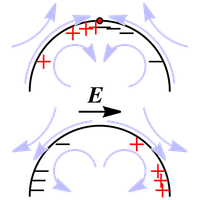
We illuminate effects of surface-charge convection intrinsic to leaky-dielectric electrohydrodynamics by analyzing the symmetric steady state of a circular drop in an external field at arbitrary electric Reynolds number ReE. In particular, we characterise the development of an equatorial charge-density blowup singularity at moderate ReE (in the case where charge relaxation is slower in the drop phase than in the suspending phase) and the formation of polar stagnant caps at large ReE (in the opposite case)

Static Bell test in pilot-wave hydrodynamics

Konstantinos Papatryfonos, Louis Vervoort, André Nachbin, Matthieu Labousse, and John W. M. Bush

Phys. Rev. Fluids 9, 084001 (2024) - Published 1 August, 2024

The experimental violation of Bell’s Theorem in quantum systems is generally taken as proof of the impossibility of local hidden variable theories, as would provide a rational dynamical underpinning for quantum mechanics. We here present a platform for executing Bell tests in pilot-wave hydrodynamics, a system known to capture many features of the quantum realm. We execute a static test in a bipartite tunneling system, and rationalize the emergent violations in terms of the wave-mediated coupling between the two subsystems.

Thermocapillary instability of a surfactant-laden shear-imposed film flow

Arnab Choudhury and Arghya Samanta

Phys. Rev. Fluids 9, 084002 (2024) - Published 1 August, 2024

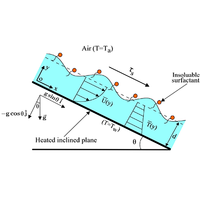
We examine the linear thermocapillary instability of a two-dimensional surfactant-laden gravity-driven shear-imposed film flowing over a uniformly heated inclined wall. We observe that the surfactant Marangoni number stabilizes, while the thermal Marangoni number destabilizes H-mode, S-mode, P-mode, and shear mode. These opposing impacts establish an analytical relationship between surfactant and thermal Marangoni numbers, for which the critical Reynolds numbers for the H-mode instability of the non-isothermal and isothermal film flows coincide. When comparing results with and without inertia, we predict that inertia stabilizes surfactant mode.

Correlations between thermodynamic fluctuations in shock wave/turbulent boundary layer interaction

Ximeng Hou, Dehao Xu, Jianchun Wang, and Shiyi Chen

Phys. Rev. Fluids 9, 073401 (2024) - Published 31 July, 2024

The 2nd moment correlations between thermodynamic fluctuations in shock wave/turbulent boundary layer interaction flows are numerically studied. By introducing Kovasznay modal decomposition, it is shown that the correlations are functions of inter-modal competition and inter-modal correlation. A simplified model is proposed to eliminate the impact of inter-modal correlation, and thus the correlations can be determined merely by the root-mean-square values of thermodynamic fluctuations.

Newtonian fluid dynamics in a misaligned parallel-plate rheometer

Jian Teng, Sungwon La, and Jesse T. Ault

Phys. Rev. Fluids 9, 074103 (2024) - Published 31 July, 2024

This study examines the effect that misalignment has on the viscosity measurements of Newtonian fluids in a parallel-plate rotational rheometer. Our theoretical results show that at small gap heights, misalignment can produce additional secondary velocity components and pressures in the fluid, which affect the forces and moments in the rheometer. These forces and moments on the top plate were found to increase as the misalignment tilt angle increased.

Modal and nonmodal stability of the laminar flow in a channel with longitudinal riblets

Antoine Jouin, Jean-Christophe Robinet, and Stefania Cherubini

Phys. Rev. Fluids 9, 073903 (2024) - Published 29 July, 2024

The influence of a surface covered with riblets on laminar-turbulent transition in channel flow is investigated through modal and non-modal stability analysis of n-periodic systems, allowing to take into account detuned long-wavelength instabilities. For large riblet spacing, a wavenumber lock-in regime is observed, in which the wavelength of the optimal streaks is controlled by the riblet spacing, and the streaks amplitude is modulated in the spanwise direction via a beating mechanism, as in geometric frustration. Moreover, in the presence of harmonic forcing, riblets lead to the development of oblique waves that may trigger an early transition.

Dissociation of red blood cell aggregates in extensional flow

Midhun Puthumana Melepattu, Guillaume Maîtrejean, and Thomas Podgorski

Phys. Rev. Fluids 9, L071101 (2024) - Published 29 July, 2024

Red blood cell aggregation significantly affects blood flow, especially in microcirculatory conditions. Our study employs hyperbolic microfluidic constrictions and a convolutional neural network for image analysis to investigate how these aggregates dissociate under extensional flow, in conditions relevant to microcirculation. This research provides crucial data for validating models, and the proposed technique could enhance evaluations of red blood cell aggregability.

How small droplets form in turbulent multiphase flows

M. Crialesi-Esposito, G. Boffetta, L. Brandt, S. Chibbaro, and S. Musacchio

Phys. Rev. Fluids 9, L072301 (2024) - Published 29 July, 2024

Droplet formation is an important research topic with applications in geophysics, where fragmentation is key in the exchange between atmosphere and ocean, and in industrial processes, with many products obtained by emulsification. Despite its importance this fundamental physical problem remains a puzzle. In this work we examine small droplet formation in turbulent multiphase flows. By surgically acting on the Navier-Stokes equations we show that small-droplet formation is the main cause of high dissipation events characterizing multiphase turbulence, and not vice versa. We also prove that tiny droplets are formed through the internal capillary dynamics of large droplets during break-up.

Investigating the effect of turbulence on hemolysis through cell-resolved fluid-structure interaction simulations of individual red blood cells

Grant Rydquist and Mahdi Esmaily

Phys. Rev. Fluids 9, 073102 (2024) - Published 26 July, 2024

Algorithms used to calculate red blood cell damage are often constructed empirically from laminar flows, and the extensibility of these algorithms to turbulent flows is an open question. To examine this question, we investigate the effect of turbulent flows on red blood cell damage by simulating individual red blood cells in turbulent channel flow using a multiscale computational framework. The results from the turbulence simulations are compared to laminar channel flow at equivalent wall shear stress. While the laminar flows generate greater stretch in a time-averaged sense, the turbulent flows produce spikes in deformation associated with short bursts of high-shear conditions.

Ion steric interactions and electrostatic correlations on electro-osmotic flow in charged nanopores with multivalent electrolytes

Shubhra Sahu, Bapan Mondal, and Somnath Bhattacharyya

Phys. Rev. Fluids 9, 074201 (2024) - Published 26 July, 2024

In this study we have extended the mean-field based model to analyze the layered structure of the electric double layer and found that oscillations in charge density arise in multivalent counterions. Formation of the counterion condensed layer and overscreening creates a larger accumulation of coions in the electric double layer, leading to an electroosmotic flow reversal and attenuation in ion selectivity of the pore. The present model shows that the counterion size has an impact on the condensed layer and hence, overscreening. We demonstrate that the electroosmotic flow reversal of multivalent electrolytes can be suppressed by mixing with monovalent slats.

Dynamics of a magnetic particle in an oscillating magnetic field

I. Misra and V. Kumaran

Phys. Rev. Fluids 9, 074303 (2024) - Published 26 July, 2024

The dynamics of a magnetic particle of moment m in an oscillating magnetic field H has a qualitative dependence on the magnetization model. There are sustained oscillations for a particle with a permanent dipole. The particle is static for an induced dipole with no hysteresis. For an induced dipole with hysteresis, there is a transition between oscillations with a magnetic moment oscillating about a particle axis, and a magnetic moment flipping relative to the particle axis.

Shape reconfiguration for underwater propeller efficiency improvement

Tristan Aurégan, Sylvain Courrech du Pont, and Benjamin Thiria

Phys. Rev. Fluids 9, 074402 (2024) - Published 26 July, 2024

Flexible structures subjected to varying flow conditions are often more resilient than their rigid equivalents. We exploit this bio-inspired strategy, called reconfiguration, to improve the efficiency of a scale model underwater propeller. Using flexible blades that deform passively, we show experimentally that it is possible to program the deformation of the rotor such that the efficiency of the propeller is improved in off-design conditions. We also show that the deformation of the blades can be predicted using a simple model.

Evolution of turbulence using a random jet array

Arefe Ghazi Nezami and Blair Anne Johnson

Phys. Rev. Fluids 9, 074610 (2024) - Published 26 July, 2024

Turbulence generated with a random jet array (RJA) can be homogeneous, isotropic, and exhibit negligible mean flow, making it suitable for many applications. However, achieving these characteristics requires a thorough understanding of the turbulence generation process within RJA facilities. In this study, we investigate the evolution of turbulence within an RJA-driven water tank, from its generation to its decay, and distinct features of the flow. Additionally, we propose a relationship for estimating the energy of the generated turbulence in cases with minimal mean flow, and we introduce an efficiency parameter to compare the input energy with the resulting turbulent flow.

Rupture of a surfactant-laden draining thin film

Atul S. Vivek, Ranabir Dey, and Harish N. Dixit

Phys. Rev. Fluids 9, 074004 (2024) - Published 25 July, 2024

As liquid films on solid substrates approach submicron thickness, they tend to become naturally unstable due to the action of long-range dispersion forces. Interestingly, the presence of surfactants and gravitational drainage alters the stability characteristics of these films. Using linear and nonlinear stability analyses in the lubrication limit, we show that draining films containing surfactants exhibit greater stability compared to stationary films with surfactants, as well as draining films with clean interfaces. Our findings can have potential implications for the stability of a wide variety of thin films, ranging from precorneal tear films to industrial coatings.

Analysis of a turbulent round jet based on direct numerical simulation data at large box and high Reynolds number

Cat Tuong Nguyen and Martin Oberlack

Phys. Rev. Fluids 9, 074608 (2024) - Published 25 July, 2024

A large-scale direct numerical simulation of a spatially evolving turbulent round jet flow has been conducted at a Reynolds number of 3500 based on the orifice diameter and the mean bulk velocity at the orifice. A fully turbulent pipe flow profile is used as the inlet condition, and high-quality statistical data is generated by averaging over 200 washouts of a particle. The present data include statistical moments up to the third order and the probability density function of the axial velocity at various distances from the centerline and the orifice, showing remarkable self-similarity. The present data is compared with data of previous numerical and experimental studies.

Reactive Rayleigh-Taylor turbulence: Influence of mixing on the growth and displacement of the mixing zone

Kevin Ley, Olivier Soulard, Jérôme Griffond, Antoine Briard, and Serge Simoëns

Phys. Rev. Fluids 9, 074609 (2024) - Published 25 July, 2024

How fast can a Rayleigh-Taylor unstable flame accelerate? How rapidly can its width increase? To investigate these issues, a link is established between the level of molecular mixing and the self-similar evolution of a reactive Rayleigh-Taylor turbulent flow.

Analytical solutions for long-time steady state Boussinesq gravity currents flowing along a horizontal boundary of finite length

Safir Haddad, Samuel Vaux, Kevin Varrall, and Olivier Vauquelin

Phys. Rev. Fluids 9, 074803 (2024) - Published 25 July, 2024

This paper presents analytical solutions to the theoretical problem proposed by Ellison and Turner. Their equations describe the longitudinal evolution of a miscible gravity current when it reaches a steady state. The solutions here proposed allow the evolution of the velocity, height and density of the current to be calculated solely from the local Richardson number. The latter is obtained using a universal function F that can be tabulated or plotted whatever the release conditions. The solutions are then extended to configurations in which a jump appears, and finally for several entrainment laws available in the literature.

Heat transport in three-layer turbulent thermal convection

Xiao-Zheng Zhao, Can Qiu, Sheng-Qi Zhou, Yi-Zhen Li, Heng-Dong Xi, and Ke-Qing Xia

Phys. Rev. Fluids 9, 073501 (2024) - Published 24 July, 2024

The mean temperature profile is measured in a three-layer water-FC77-mercury system (FC77 is a type of Fluorinert electronic liquid). The mean temperature profile is measured across (a) the mercury-FC77 interface and (b) the FC77-water interface. The three-layer system provides slippery boundary conditions for the middle FC77 layer in an otherwise standard Rayleigh-Bénard convection system. This results in greatly enhanced heat transport across the FC77 layer, both in magnitude and in the scaling exponent with the Rayleigh number Ra.

Sign In to Your Journals Account

Filter

Recent Issues

Vol. 11, Iss. 10
October 2026
Vol. 11, Iss. 9
September 2026
Vol. 11, Iss. 8
August 2026
Vol. 11, Iss. 7
July 2026
Category
Article Type
Section

Filter

Article Lookup

Enter a citation