Recent Articles

Diffusive and capillary instabilities of viscous fluid threads in microchannels

Thomas Cubaud, Bryan Conry, Xiaoyi Hu, and Thai Dinh

Phys. Rev. Fluids 6, 094202 (2021) - Published 7 September, 2021

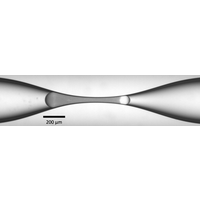
We experimentally investigate the flow behavior of viscous oil threads in a a variety of miscible and immiscible low-molecular weight alcohols in microchannels. A comparative study is conducted between diffusive and capillary regimes using simple functional relationships for the thread characteristics, including diameter and detachment length. We develop a comprehensive classification of immiscible and miscible fluid dynamics in square microfluidic channels and provide a quantitative analysis of the evolution of multiphase flow properties across flow patterns.

Onset of grain motion in eroding subaqueous bimodal granular beds

Marios Galanis, Philip Wang, Mark D. Shattuck, Corey S. O'Hern, and Nicholas T. Ouellette

Phys. Rev. Fluids 6, 094301 (2021) - Published 7 September, 2021

The effect of grain size on the critical shear stress required to initiate sediment transport in erodible granular beds is typically described by the Shields number which compares the hydrodynamic stress to the particle weight. Although this framework works well for beds composed of grains of the same size, we find that it does not capture the behavior of polydisperse beds. In particular, we find that larger grains are mobilized by nominally subcritical stresses when small grains are present. Our results highlight the importance of granular contact and force networks in controlling the onset of sediment transport.

Promoting global stability in data-driven models of quadratic nonlinear dynamics

Alan A. Kaptanoglu, Jared L. Callaham, Aleksandr Aravkin, Christopher J. Hansen, and Steven L. Brunton

Phys. Rev. Fluids 6, 094401 (2021) - Published 7 September, 2021

Modeling realistic fluid and plasma flows is computationally intensive, motivating the use of reduced-order models for a variety of scientific and engineering tasks. However, it is challenging to characterize, much less guarantee, the global stability (i.e., long-time boundedness) of these models. In this work, we illustrate how to modify the objective function in machine learning algorithms to promote globally stable data-driven models of fluid and plasma flows. This innovation significantly extends the applicability of sparse system identification for complex dynamics, such as models of turbulent boundary layers.

Taylor dispersion of elongated rods

Ajay Harishankar Kumar, Stuart J. Thomson, Thomas R. Powers, and Daniel M. Harris

Phys. Rev. Fluids 6, 094501 (2021) - Published 7 September, 2021

In many complex fluids, the geometry of particles in suspension can be complex, prompting the need to understand how shape influences their bulk transport. We consider the Taylor dispersion of passive, elongated Brownian rods subject to a background Poiseuille flow. Monte-Carlo simulations demonstrate that elongated particles exhibit enhanced longitudinal dispersion compared to their spherical counterparts, in excellent agreement with integral expressions derived from asymptotic analysis. For particles of high aspect-ratio, the dispersion coefficient can be collapsed along a single curve, providing a simple correction factor that extends Taylor’s seminal results to elongated particles.

Nonlinear shallow water dynamics with odd viscosity

Gustavo M. Monteiro and Sriram Ganeshan

Phys. Rev. Fluids 6, L092401 (2021) - Published 7 September, 2021

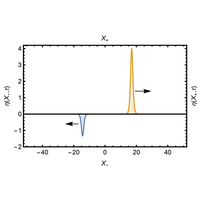
The concept of an “odd” coefficient of viscosity appears in some fluid mechanical contexts, including quantum fluids, electron fluids in mesoscopic systems, as well as some classical systems. Here we study the shallow depth limit of weakly nonlinear surface dynamics with odd viscosity and gravitational effects and obtain an integrable Kortweg-de Vries equation, the solution of which admits right- and left-moving disturbances with some differences. The odd viscosity term plays a role similar to surface tension.

Dynamics of a single free-settling spherical particle driven by a laser-induced bubble near a rigid boundary

Shengji Wu, Bo Li, Zhigang Zuo, and Shuhong Liu

Phys. Rev. Fluids 6, 093602 (2021) - Published 3 September, 2021

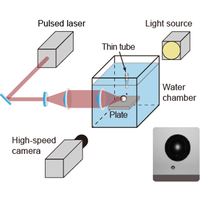
We systematically investigate the dynamics of a free-settling particle driven by a laser-induced bubble near a rigid boundary. Two types of particle-bubble interaction are identified, in terms of the intensity of the influence of the boundary on the particle-bubble dynamics. Two important phenomena where the particle ends up impacting on the boundary at a relatively high velocity are discovered, which provide a potential mechanism for enhanced cavitation erosion in sand-laden water.

Splash of impacting nanodroplets on solid surfaces

Yi-Bo Wang, Yi-Feng Wang, Xin Wang, Ben-Xi Zhang, Yan-Ru Yang, Duu-Jong Lee, Xiao-Dong Wang, and Min Chen

Phys. Rev. Fluids 6, 094201 (2021) - Published 3 September, 2021

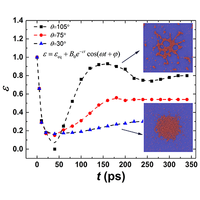
Using molecular dynamics simulations we study the splash of water nanodroplets (ND) on hydrophilic to hydrophobic surfaces. Mechanisms for internal breakup and prompt splash are found to be different from those of macroscale (MS) impacting droplets. Breakup is attributed to initial air holes on solid surfaces for MS, but to vibration of a nanometer spreading film for ND. The prompt splash is initiated by air bubbles under spreading lamella at MS, but for ND by Rayleigh-Taylor instability of ejected rims from rapidly decelerated spreading lamella. ND internal breakup depends on surface wettability because vibration attenuation is larger on hydrophilic than hydrophobic surfaces.

Passage of surfactant-laden and particle-laden drops through a contraction

Franz De Soete, Léa Delance, Nicolas Passade-Boupat, Michael Levant, Emilie Verneuil, François Lequeux, and Laurence Talini

Phys. Rev. Fluids 6, 093601 (2021) - Published 2 September, 2021

The flow of either particle-laden or surfactant-laden drops through a contraction under an imposed pressure has been investigated in a microfluidic setup. The drop deformation generates surface concentration gradients in adsorbed species, which results in surface tension gradients. Crossing of the contraction is driven by the coupling between the drop flow and surface tension gradients and can result in larger passage times for surfactant-laden drops.

Armstrong liquid bridge: Formation, evolution and breakup

Xueqin Pan, Man Hu, Bingrui Xu, Feng Wang, Peng Huo, Fangqi Chen, Zhibo Gu, and Daosheng Deng

Phys. Rev. Fluids 6, 093901 (2021) - Published 2 September, 2021

This work revisits the liquid bridge, which was observed by Lord William G. Armstrong in 1893, from a fresh perspective of its stability and final fate in terms of its lifetime. Remarkably, a water fall and the associated effective length are strongly correlated with the breakup of the liquid bridge. The linear stability analysis of an electrified jet agrees with experiments well. These results shed light on the underlying physical mechanism and on promising technological applications via active regulation and control of a liquid bridge.

Propagation of two-dimensional vibroacoustic disturbances in a rarefied gas

A. Manela and Y. Ben-Ami

Phys. Rev. Fluids 6, 093401 (2021) - Published 1 September, 2021

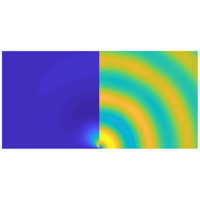
The effect of gas rarefaction on the propagation of two-dimensional vibroacoustic disturbances generated by a nonuniformly oscillating plane is studied. Closed-form descriptions are obtained in the free-molecular (left panel of the figure) and continuum (right panel) limits and complemented by direct simulation Monte Carlo results. The impacts of gas rarefaction on signal decay rate and directivity pattern are highlighted and rationalized.

Artificial neural network approach for turbulence models: A local framework

Chenyue Xie, Xiangming Xiong, and Jianchun Wang

Phys. Rev. Fluids 6, 084612 (2021) - Published 31 August, 2021

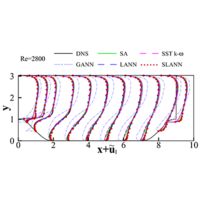
The Reynolds-averaged Navier-Stokes (RANS) unclosed terms can be reconstructed by the local artificial neural network (LANN) based on the local coordinate system which is orthogonal to the curved wall. The LANN model performs better than the Global artifical neural network (GANN), Spalart-Allmaras (SA), and Shear Stress Transport (SST) k−ω models in the predictions of the average velocity, wall-shear stress, and average pressure in the flows over periodic hills. The LANN framework has a great potential to be applied to complex wall-bounded turbulent flows over curved walls.

Shock-induced combustion of aluminum particle clusters investigated with resolved sharp-interface two-dimensional simulations

Pratik Das and H. S. Udaykumar

Phys. Rev. Fluids 6, 083201 (2021) - Published 30 August, 2021

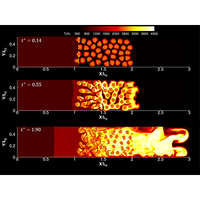
The combustion of aluminum particle clusters in shocked flows is studied with two-dimensional numerical simulations. These simulations examine, for the first time, aspects of the vaporization and burning of molten aluminum particle clusters that are markedly different from an isolated burning aluminum particle. The flame-structure around a particle within a cluster is found to vary along the flow direction: particles at the cluster front end undergo kinetically limited combustion with the formation of a wake flame, while particles located downstream in the cluster burn with an envelope flame indicating combustion limited by transport and mixing.

Comparison of the properties of segregated layers in a bidispersed fluidized bed to those of a monodispersed fluidized bed

Yinuo Yao, Craig S. Criddle, and Oliver B. Fringer

Phys. Rev. Fluids 6, 084306 (2021) - Published 27 August, 2021

Since industrial fluidized-bed reactors typically operate with polydispersed particles, approximating such reactors as the superposition of corresponding monodispersed fluidized beds would greatly simplify their design and operation. To examine the validity of this superposition, we evaluate the effects of bidispersity by comparing three-dimensional liquid-solid monodispersed and segregated bidipsersed fluidized beds. This work demonstrates that, despite the clear segregation into layers that behave like monodispersed beds, the transition region is governed by complex bidispersed mechanisms that cannot be explained in terms of the particle behavior in the segregated layers.

Transient aggregation of particles at interfaces

Antoine Lagarde, Christophe Josserand, and Suzie Protière

Phys. Rev. Fluids 6, 084307 (2021) - Published 27 August, 2021

The formation of an axisymmetric monolayer of dense particles at a liquid interface is explored in order to study the interaction between numerous objects of different sizes randomly distributed on a liquid surface. The individual motion of each bead cannot be solved but the overall clustering can be described statistically. The clustering dynamics of this system with a long-range interaction varies during the aggregation process. The cluster-size distribution evolves with a self-similar mechanism and we observe a well-defined transition between two aggregating regimes that we can characterize.

Conformal invariance of the 1-point statistics of the zero-isolines of 2d scalar fields in inverse turbulent cascades

M. Wacławczyk, V. N. Grebenev, and M. Oberlack

Phys. Rev. Fluids 6, 084610 (2021) - Published 26 August, 2021

For three decades there have been speculations about the existence of conformal invariance in two-dimensional turbulence and possible implications thereof. These speculations have been confirmed by numerical experiments. However, there is a scarcity of relevant analytical studies on this topic. In our work we analyze the underlying equation for the one-point probability density function of a scalar in two-dimensional turbulence. We derive conditions under which the probability measure is conformally invariant and show that with this transformation certain statistics of non-homogeneous fields can be derived based on solutions of the homogeneous one.

Large-scale structures of scalar and velocity in a turbulent jet flow

Jesse Reijtenbagh, Jerry Westerweel, and Willem van de Water

Phys. Rev. Fluids 6, 084611 (2021) - Published 26 August, 2021

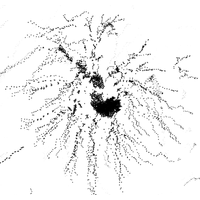
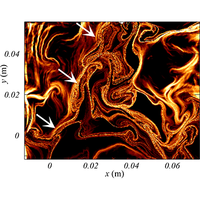
In a turbulent jet flow, finite-time Lyapunov exponents gauge the exponentially fast spreading of fluid parcels. To observe their fine structure, we moved our Particle Image Velocimetry and Laser-Induced Fluorescence cameras with the mean flow. The resulting remarkable shapes in the figure are linked to the organization of a dispersed fluorescent tracer.

Reciprocal theorem for calculating the flow rate–pressure drop relation for complex fluids in narrow geometries

Evgeniy Boyko and Howard A. Stone

Phys. Rev. Fluids 6, L081301 (2021) - Published 26 August, 2021

A key aspect in understanding pressure-driven flows of non-Newtonian fluids in narrow and confined geometries is the relationship between the flow rate and pressure drop. Using the Lorentz reciprocal theorem, we derive a closed-form expression for the flow rate-pressure drop relation of complex fluids in narrow channels of arbitrary shape, which holds for a wide class of viscoelastic and shear-thinning constitutive models. For the weakly non-Newtonian limit, our theory provides the first-order non-Newtonian correction for the flow rate-pressure drop relation solely using the corresponding Newtonian solution, eliminating the need to solve the non-Newtonian flow problem.

Developing horizontal convection against stable temperature stratification in a rectangular container

Daisuke Noto, Tomomi Terada, Takatoshi Yanagisawa, Takehiro Miyagoshi, and Yuji Tasaka

Phys. Rev. Fluids 6, 083501 (2021) - Published 25 August, 2021

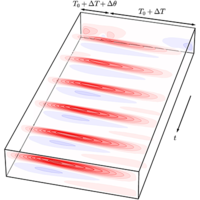
Developing stages of horizontal convection observed during transitions from conduction to thermally equilibrated convection states are studied with visualization experiments imposing horizontally differential heating at the top of low-temperature water. Due to the absence of destabilizing thermal sources, convective rolls, which are localized on the horizontal plane on which differential heating is imposed, are formed only by the baroclinic torque driving force against a braking force due to stable temperature stratification. We find a nondimensional parameter for the balance of the braking force relaxing with time and the baroclinic torque driving force.

Emptying-filling boxes with non-Boussinesq plumes and fountains

R. Mehaddi, P. Boulet, M. Koutaiba, O. Vauquelin, and F. Candelier

Phys. Rev. Fluids 6, 083801 (2021) - Published 25 August, 2021

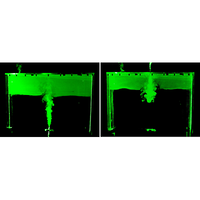
When a light fluid is continuously released from the top (as a fountain) or from the bottom (as a plume) into a box with a top opening, a buoyant layer of constant thickness and density forms under the ceiling at steady state. Both configurations have been investigated using theoretical approaches and small scale air-helium experiments. As a practical application, for a fixed buoyant flux, the fountain and the plume configurations have been compared with respect to their mixing efficiency.

Bifurcation structure of unstable periodic orbits in plane Couette flow with the Smagorinsky model

Eiichi Sasaki, Genta Kawahara, and Javier Jiménez

Phys. Rev. Fluids 6, 084608 (2021) - Published 25 August, 2021
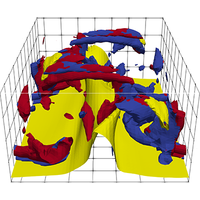
To study the dynamical properties of plane Couette turbulence, this paper describes unstable periodic orbits (UPOs) in a large eddy simulation (LES) system with a Smagorinsky-type eddy viscosity model. At a moderately high Reynolds number, the UPO of the present study possesses spanwise vortices in the central region of the channel, which seem to be caused by a streak instability. These stretched vortices are shown to enhance transfer of the streamwise turbulent momentum, as in developed near-wall turbulence.

Sign In to Your Journals Account

Filter

Recent Issues

Vol. 11, Iss. 10
October 2026
Vol. 11, Iss. 9
September 2026
Vol. 11, Iss. 8
August 2026
Vol. 11, Iss. 7
July 2026
Category
Article Type
Section

Filter

Article Lookup

Enter a citation