Recent Articles

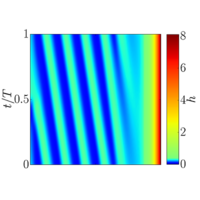
Bifurcation study for a surface-acoustic-wave-driven meniscus

Kevin David Joachim Mitas, Ofer Manor, and Uwe Thiele

Phys. Rev. Fluids 6, 094002 (2021) - Published 15 September, 2021

The deposition of homogeneous and patterned films of partially wetting liquid from a liquid meniscus driven by Rayleigh surface acoustic waves (SAW) is analyzed with a thin-film model. Employing path continuation and time simulation we investigate, in particular, how the time-periodic states corresponding to line deposition and the related bifurcations emerge when changing the Weber number or the SAW strength describing scenarios relevant for a class of deposition and coating processes.

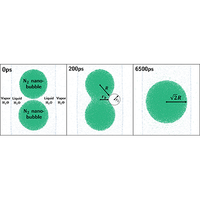
Coalescence characteristics of bulk nanobubbles in water: A molecular dynamics study coupled with theoretical analysis

Eric Bird, Eric Smith, and Zhi Liang

Phys. Rev. Fluids 6, 093604 (2021) - Published 14 September, 2021

Nanobubble coalescence is a process of great importance to a broad range of applications such as froth flotation of fine or ultrafine mineral particles, detergent-free cleaning of clothes, and de-inking of recycled papers. To investigate the differences between nanobubble coalescence and macrobubble coalescence, we use molecular dynamics simulations and theoretical analysis to study the coalescence characteristics of bulk nanobubbles in water. We provide quantitative evidence showing nanobubble coalescence characteristics universally deviate from macroscopic bubble theories due to the small bubble size and the unique effects of Laplace pressure in nanobubbles.

Transportation and coherent structures in MHD turbulent channel flow subject to uniform streamwise and spanwise magnetic fields

Olivier Doche, Sedat Tardu, Jonathan Schillings, and Amandine Capogna

Phys. Rev. Fluids 6, 094605 (2021) - Published 14 September, 2021

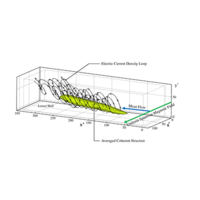
We study the effect of both uniform spanwise and streamwise magnetic fields on the near wall region of a turbulent channel flow. Previous results have shown that the spanwise magnetic field leads to flow relaminarization for magnetic intensity significantly smaller than the streamwise magnetic field. In order to explain these results, a deep analysis of the fine turbulence structure is needed. We perform a detailed analysis through the Reynolds shear-stress transport equations and the conditional averaging deduced from the near wall active eddies, thus connecting the magnetic field orientation effect to the coherent electric current topology.

Wavelet-based adaptive wall-modeled large eddy simulation method for compressible turbulent flows

Xuan Ge, Oleg V. Vasilyev, and M. Yousuff Hussaini

Phys. Rev. Fluids 6, 094606 (2021) - Published 14 September, 2021

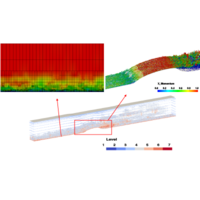
We develop a wavelet-based adaptive wall-modeled large eddy simulation (WA-WMLES) method to overcome the stringent restriction on step size for time integration, caused by mesh resolution requirement to resolve inner viscous sublayer, which becomes computationally expensive as the Reynolds number increases. This approach uses a wavelet-based adaptive large eddy simulation, incorporated into the anisotropic-adaptive wavelet collocation framework, to resolve the outer region of turbulent boundary layer, while the inner part is approximated by the wall-shear-stress model, and extends the application of the wavelet-based adaptive methods to a realistic wall-bounded turbulent flow configuration at a relatively high (order of a million) Reynolds number.

Ice front shaping by upward convective current

Ziqi Wang, Linfeng Jiang, Yihong Du, Chao Sun, and Enrico Calzavarini

Phys. Rev. Fluids 6, L091501 (2021) - Published 14 September, 2021

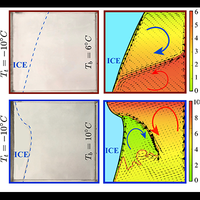
The coupling between turbulent convecting water and the freezing/melting process leads to intriguingly complex phenomena which are of pressing importance for applications in environmental and climatological sciences. Here we study the extent and the morphology of ice forming in a differentially heated cavity filled with water by means of laboratory-scale experiments and numerical simulations. We demonstrate that the characteristic ice shape formed in our system is the result of the competition of two counterrotating convective rolls whose strength depends on the externally prescribed thermal gap.

Nonuniform mixing

Jean-Luc Thiffeault

Phys. Rev. Fluids 6, 090501 (2021) - Published 13 September, 2021

Mixing in fluids is usually thought of as a process of homogenization, but in some circumstances, such as when dealing with filters, particles can have a tendency to accumulate, even at equilibrium. An example is virus particles kept out by a mask: they are more likely to be found near the filter because of a suction effect. A generalization of what we mean by mixing is called for, involving nonuniform, possibly time-dependent ultimate states.

Predominance of pressure transport in spatial energy budget for a mixing layer approaching absolute instability

A. B. Aadhishwaran and Sourabh S. Diwan

Phys. Rev. Fluids 6, L091901 (2021) - Published 13 September, 2021

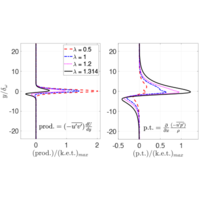
We examine the spatial energy budget for the plane incompressible mixing layer as the convective instability approaches absolute instability. Near onset of absolute instability pressure transport emerges as the primary mechanism responsible for the growth of disturbances, with the production mechanism making an insignificant contribution. Cross-stream profiles of production and pressure transport terms show significant changes in this limit, which are reflected in their contribution to the energy budget. These results, in particular the enhanced correlation between velocity and pressure disturbances, can help understand the physical processes causing absolute instability in a mixing layer.

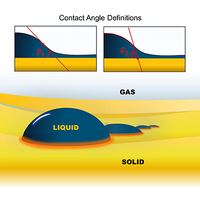
Wetting at nanoscale: Effect of surface forces and droplet size

Nikolai Kubochkin and Tatiana Gambaryan-Roisman

Phys. Rev. Fluids 6, 093603 (2021) - Published 10 September, 2021

The dependence of contact angle on droplet size for droplets of height of the order of a few nanometers has been intensively debated for decades. The size effects are believed to be related to surface forces. In the present work, we use the disjoining pressure concept and solve the Derjaguin equation in order to show that values of the contact angle are dramatically dependent on the droplet height as well as the way the contact angle is defined. For the first time, we demonstrate that different contact angle definitions can even lead to opposite dependencies of the contact angle on the droplet height.

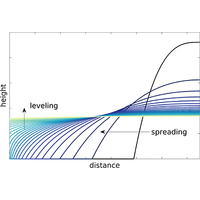
Shape of spreading and leveling gravity currents in a Hele-Shaw cell with flow-wise width variation

Zhong Zheng, Aditya A. Ghodgaonkar, and Ivan C. Christov

Phys. Rev. Fluids 6, 094101 (2021) - Published 10 September, 2021

Self-similarity is a universality phenomenon exhibited from large scales (e.g., supernovae) to small scales (e.g., spreading of droplets). Viscous gravity currents in nonuniform passages exhibit an “incomplete” version of such universality. This combined theoretical–numerical–experimental study provides a theory of the dependence of the universal dynamics on the initial and boundary conditions, and demonstrates two distinct incomplete self-similar regimes in the spreading and leveling of a viscous gravity current.

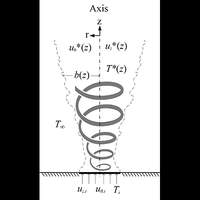
Asymptotic approximations for swirling turbulent plume rising from circular sources

Yuchen Dai, Alexander Klimenko, Yuanshen Lu, and Kamel Hooman

Phys. Rev. Fluids 6, 094604 (2021) - Published 10 September, 2021

Swirling turbulent plumes are investigated with the Morton, Taylor, and Turner model (MTT) and the Γ-approach. We derive the asymptotic solutions using regular perturbation methods, and discuss the influence of swirling motions on the plume properties for lazy and forced plumes, respectively. Specially and intriguingly, by introducing a swirl, a forced plume can even be turned into a lazy one in the near field during the vertical evolution.

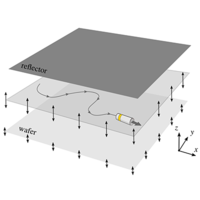
Purely viscous acoustic propulsion of bimetallic rods

Jeffrey McNeill, Nathan Sinai, Justin Wang, Vincent Oliver, Eric Lauga, François Nadal, and Thomas E. Mallouk

Phys. Rev. Fluids 6, L092201 (2021) - Published 10 September, 2021

The rapid propulsion of metallic microrods at the nodal plane of an acoustic standing wave was first reported in 2012. Previous modeling proposed that the acoustic propulsion of metallic rods arises from the nonlinear inertial coupling between rotational and translational perturbation flows (acoustic streaming), but such a mechanism has yet to reproduce experimental data quantitatively. Here we report experiments on the acoustic propulsion of multi-segment bimetallic rods which are properly modeled by a purely viscous flapping mechanism where inertia plays no role.

Ternary phase-field simplified multiphase lattice Boltzmann method and its application to compound droplet dynamics on solid surface in shear flow

Z. Chen, C. Shu, Y. Y. Liu, and L. Q. Zhang

Phys. Rev. Fluids 6, 094304 (2021) - Published 9 September, 2021

A ternary phase-field simplified multiphase lattice Boltzmann method (TPF-SMLBM) is developed in a numerical investigation of a compound droplet placed on solid substrate in shear flow at moderate Reynolds numbers. Three major kinematic modes are recovered: quasi-steady sliding (QSS), tumbling-sliding, and tumbling-detachment. Analysis of QSS dynamics explains the wetting length exponential shrinking rate in the early evolution stage. A new dimensionless parameter, the Tumbling number (Tu), is proposed to identify the mode transition towards tumbling. The dynamics of detachment is also investigated, showing that the critical Capillary number of detachments can be described by a scaling law.

Direct numerical simulation of compressible turbulence in a counter-flow channel configuration

Arash Hamzehloo, David J. Lusher, Sylvain Laizet, and Neil D. Sandham

Phys. Rev. Fluids 6, 094603 (2021) - Published 9 September, 2021

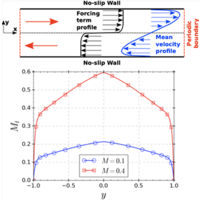
We introduce a counter-flow turbulent channel configuration, amenable to simulation and modeling. It has periodic streamwise and spanwise boundaries and isothermal no-slip walls. A tangent hyperbolic forcing function drives the flow in opposite directions on the upper and lower halves of the channel, forming an antisymmetric mean shear velocity profile. Compared to conventional channel flows, the mean flow is inflectional and the maximum turbulence intensity relative to the maximum mean velocity is nearly an order of magnitude higher. The counter-flow channel can sustain high turbulent Mach numbers which is useful for studying high Reynolds and Mach number turbulent flows.

Dynamics of phase separation of sheared binary mixtures after a nonisothermal quenching

Antonio Bertei, Chih-Che Chueh, and Roberto Mauri

Phys. Rev. Fluids 6, 094302 (2021) - Published 8 September, 2021

A thermodynamics-based phase-field model is developed to simulate phase separation of a binary mixture under a temperature gradient in a constant shear. The effects of meaningful dimensionless numbers, such as the capillary number, the Lewis number, and the dimensionless heat capacity are explored. The temperature gradient breaks the symmetry of phase separation compared to instantaneous quenching while different phase separation patterns, ranging from stripes to drops, can be obtained or even suppressed by a proper choice of parameters.

Hydrodynamic torque on a slender cylinder rotating perpendicularly to its symmetry axis

Jean-Lou Pierson, Mohammed Kharrouba, and Jacques Magnaudet

Phys. Rev. Fluids 6, 094303 (2021) - Published 8 September, 2021

The torque experienced by a circular cylinder rotating steadily about an axis passing trough its centroid and perpendicular to its symmetry axis is computed over a wide range of Reynolds number and aspect ratios using fully resolved simulations. In the creeping-flow regime, numerical results are shown to match predictions of an improved slender-body approximation. In strongly inertial regimes, flow symmetries and boundary layer arguments are employed to derive scaling laws for the various contributions to the torque. We finally obtain an empirical formula for the total torque, valid throughout the parameter range explored in the simulations.

Investigation of properties of superfluid He4 turbulence using a hot-wire signal

P. Diribarne, M. Bon Mardion, A. Girard, J.-P. Moro, B. Rousset, F. Chilla, J. Salort, A. Braslau, F. Daviaud, B. Dubrulle, B. Gallet, I. Moukharski, E.-W. Saw, C. Baudet, M. Gibert, P.-E. Roche, E. Rusaouen, Andrei Golov, Victor L'vov, and Sergey Nazarenko

Phys. Rev. Fluids 6, 094601 (2021) - Published 8 September, 2021

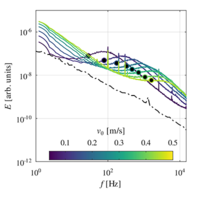
We report hot-wire measurements in flows of high and low turbulence intensities, both in normal and superfluid helium, at 1.6 K, 2 K, and 2.3 K. Consistent with previous studies, we observe a spectral bump at high frequency. Surprisingly, the bump frequency is found to depend on the turbulence intensity of the flow. Using the turbulent Reynolds number rather than the velocity as a control parameter collapses results from both flows.

Wind wave growth in the viscous regime

Jiarong Wu and Luc Deike

Phys. Rev. Fluids 6, 094801 (2021) - Published 8 September, 2021

How water surface waves grow under wind forcing has long been an interesting and challenging question. For short gravity-capillary waves, the viscous effects are important but have not been well studied. In this paper, we simulate the wind-wave growth by directly solving the two-phase Navier-Stokes equations. The numerical method features a momentum conserving scheme, interface reconstruction using Volume of Fluid, and adaptive mesh refinement (AMR). As a result, we observe concurrent growth of the irrotational traveling wave and the rotational drift layer (current). The growth rate of the wave and the evolution of the drift layer under different forcing parameters are discussed respectively.

Nonlinear behavior of electrohydrodynamic flow in viscoelastic fluids

Zheng-Gang Su, Tian-Fu Li, Kang Luo, and Hong-Liang Yi

Phys. Rev. Fluids 6, 093701 (2021) - Published 7 September, 2021

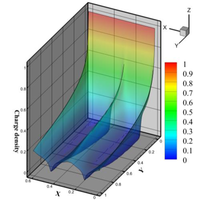
The nonlinear evolution of electrohydrodynamic flow subjected to unipolar injection in the dielectric liquid is extended from Newtonian fluids to viscoelastic fluids. The effect of viscoelasticity not only precipitates the onset of chaos but also leads to new transition sequences to chaos. Moreover, an asymmetric steady flow pattern is observed in a perfectly symmetric geometry. In viscoelastic fluids, the electric current transfer is reduced in most cases, but for weakly elastic fluid, it may be enhanced.

Numerical study of the McIntyre instability around Gaussian floating vortices in thermal wind balance

Michael Le Bars

Phys. Rev. Fluids 6, 093801 (2021) - Published 7 September, 2021

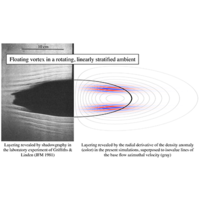
The viscodiffusive McIntyre instability has been suggested as a possible source for density layer formation around laboratory and oceanic floating vortices. This suggestion is here quantitatively addressed using idealized, axisymmetric, numerical simulations of a simple Gaussian-like vortex in thermal wind balance, floating in a rotating, stratified flow.

Surfactant-driven instability of a divergent flow

G. Koleski, J.-C. Loudet, A. Vilquin, B. Pouligny, and T. Bickel

Phys. Rev. Fluids 6, 094001 (2021) - Published 7 September, 2021
The flow of a submerged water jet directed toward the liquid interface is investigated both experimentally and theoretically. We find evidence that the presence of a small amount of surfactants can trigger an azimuthal instability. Our theoretical model reveals that surfactant advection in the Stokes regime contains the minimal ingredients to explain the instability.

Sign In to Your Journals Account

Filter

Recent Issues

Vol. 11, Iss. 10
October 2026
Vol. 11, Iss. 9
September 2026
Vol. 11, Iss. 8
August 2026
Vol. 11, Iss. 7
July 2026
Category
Article Type
Section

Filter

Article Lookup

Enter a citation