Recent Articles

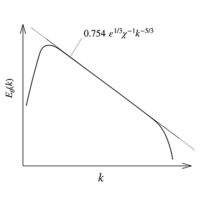
Dynamics of three-dimensional turbulence from Navier-Stokes equations

Katepalli R. Sreenivasan and Victor Yakhot

Phys. Rev. Fluids 6, 104604 (2021) - Published 15 October, 2021

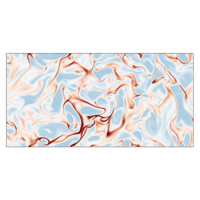
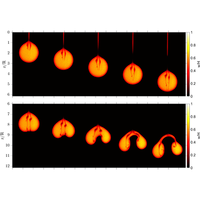
Turbulent flows contain occasional, well-separated sharp features, as illustrated in this picture by Bonn et al. (1993), reproduced with permission, surrounded mostly by low levels of activity. Both interacting structures contribute to the complexity of turbulence. A full theory requires the understanding of both, which is what our paper attempts to do. We predict quantitatively the multi-scaling exponents for these singular-like features of different strengths, while also showing that the background flow is Gaussian. The large spatial separation between the sharp structures enables one to treat them as a “weakly interacting gas”.

Surface tension and instability in the hydrodynamic white hole of a circular hydraulic jump

Jayanta K. Bhattacharjee and Arnab K. Ray

Phys. Rev. Fluids 6, 104801 (2021) - Published 15 October, 2021

A circular hydraulic jump is a discontinuous rise of the downstream height of a radially outflowing liquid (water). The discontinuous circular front, which can be easily seen in a kitchen sink, is a hydrodynamic white hole. When two such impenetrable white holes collide, rather than yielding any ground to each other, they force a wall of liquid to stand between themselves. We associate surface tension with this phenomenon.

Bifurcations of a plane parallel flow with Kolmogorov forcing

Kannabiran Seshasayanan, Vassilios Dallas, and Stephan Fauve

Phys. Rev. Fluids 6, 103902 (2021) - Published 14 October, 2021

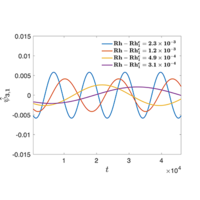
We study the primary bifurcations of a plane parallel flow in a channel with Kolmogorov forcing. We find a new type of bifurcation with both the oscillation frequency and the amplitude of the growing mode being zero at the threshold. We call this a stationary drift bifurcation. The laminar steady flow can display different types of bifurcation depending on the forcing wave number of the base flow. This is in contrast to the case of doubly periodic boundary conditions for which the primary bifurcation is stationary.

Wave damping by flexible marsh plants influenced by current

Xiaoxia Zhang and Heidi Nepf

Phys. Rev. Fluids 6, 100502 (2021) - Published 13 October, 2021

We develop a wave damping model based on a prediction of current- and wave-induced force on individual plants. The model captures the influence of reconfiguration on wave forces, the impact of current on wave group velocity, and the modification of in-canopy time-mean and wave orbital velocity associated with canopy drag, all of which affect the wave dissipation by vegetation. The model explains why weak current reduces wave dissipation while strong current increases wave dissipation, as observed both in the present and previous studies. Further, we explore the impact of plant flexibility and leaf morphology on wave dissipation over a wide range of current to wave velocity ratio.

Impact of viscosity ratio on falling two-layer viscous film flow inside a tube

H. Reed Ogrosky

Phys. Rev. Fluids 6, 104005 (2021) - Published 13 October, 2021

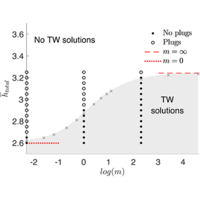
A two-layer falling film consisting of two viscous fluids with identical density but different viscosity lining the interior of a vertical tube is studied using a long-wave asymptotic model. The impact of the viscosity ratio on the film linear stability and nonlinear dynamics are explored. It is shown that a less viscous outer layer can decrease the total film thickness required for plugs to form; the significance of this study for applications, including human airways, is briefly discussed.

Irreversibility and rate dependence in sheared adhesive suspensions

Zhouyang Ge, Raffaella Martone, Luca Brandt, and Mario Minale

Phys. Rev. Fluids 6, L101301 (2021) - Published 13 October, 2021

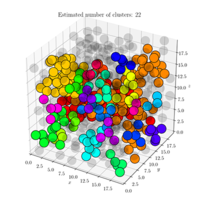
Experiments and simulations of a non-Brownian suspension of particles demonstrate that weak van der Waals (adhesive) interactions induce rate dependence of the rheological response in oscillatory shear flow, with enhanced particle diffusivities and cluster formations below a critical shear rate, even though the steady shear behavior remains rate-independent. Phase diagrams showing the influence of volume fraction, strain amplitude, and oscillation frequency, for a given Hamaker constant, highlight the connection between irreversibility and suspension rheology.

Helical trajectories of swimming cells with a flexible flagellar hook

Zonghao Zou, Wilson Lough, and Saverio Spagnolie

Phys. Rev. Fluids 6, 103102 (2021) - Published 11 October, 2021

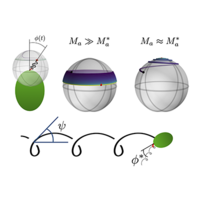
A model bacterium with a flexible flagellar hook generically swims along a helical trajectory, even when incorporating detailed hydrodynamics. A bifurcation in the hook’s equilibrium bending angle below a critical bending stiffness can have a dramatic effect on the trajectory’s helical pitch angle. Analytical predictions for the bifurcation’s dependence on the hook’s spontaneous curvature, the shape of the cell body, and the flagellum geometry are provided.

Effects of spanwise confinement on stratified shear instabilities

Yves-Marie Ducimetière, François Gallaire, Adrien Lefauve, and Colm-cille P. Caulfield

Phys. Rev. Fluids 6, 103901 (2021) - Published 11 October, 2021

We study the influence of transverse confinement on the linear instability properties of velocity and density distributions evoking exchange flows in stratified inclined ducts. In the chosen parameter space, we find that the presence of lateral walls has a stabilizing effect. The growth-rate predictions for the spanwise-invariant cases are almost systematically an upper bound to the growth-rate corresponding to the confined geometry. In addition, accounting for spanwise-varying perturbations result in the proliferation of unstable modes that present an odd-even regularity in their spatial structures, which is rationalized by comparison to the dispersion relation obtained for oblique waves.

Hessian-based Lagrangian closure theory for passive scalar turbulence

Taketo Ariki and Kyo Yoshida

Phys. Rev. Fluids 6, 104603 (2021) - Published 11 October, 2021

A self-consistent closure theory of the passive scalar turbulence has been developed on the basis of the Hessian of the scalar field, where the characteristic timescale of the scalar is properly incorporated via Lagrangian time-advancement of the Hessian. Without relying on any empirical parameter, the theory reasonably predicts the Obukhov-Corrsin spectrum of the inertial-convective range with its universal constant.

Stability of similarity solutions of viscous thread pinch-off

Michael C. Dallaston, Chengxi Zhao, James E. Sprittles, and Jens Eggers

Phys. Rev. Fluids 6, 104004 (2021) - Published 8 October, 2021

We show for the first time that only one similarity solution that describes the break-up of viscous liquid threads is linearly stable, while other similarity solutions are unstable. Complex eigenvalues lead to the presence of oscillations close to the break-up.

Preferential concentration by mechanically driven turbulence in the two-fluid formalism

Sara Nasab and Pascale Garaud

Phys. Rev. Fluids 6, 104303 (2021) - Published 8 October, 2021

Direct Numerical Simulations are employed to investigate preferential concentration of heavy inertial particles in a system in which turbulence is mechanically-driven. Using the two-fluid equations, we study this process and the resulting particle concentration enhancement for particles with St≲O(0.01). The results are similar to those found in previous work, where we established scaling laws to predict maximum and typical particle concentration enhancements in the context of the particle-driven convective instability.

Granular avalanches of entangled rigid particles

Damien P. Huet, Maziyar Jalaal, Rick van Beek, Devaraj van der Meer, and Anthony Wachs

Phys. Rev. Fluids 6, 104304 (2021) - Published 8 October, 2021

We explore the behavior of granular avalanches of nonconvex cross-shaped particles as a step forward in the modeling of entangled granular media. We conduct experiments and simulations of a dam break setup and report several flow regimes such as the top-driven collapse and the intermittent regime, in which the granular column sometimes remains stable and the flow outcome is determined by the random initial microstructure.

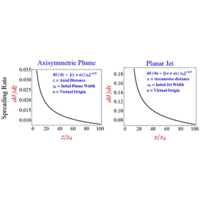
Nonequilibrium turbulent dissipation in buoyant axisymmetric plume

Sunita and G. C. Layek

Phys. Rev. Fluids 6, 104602 (2021) - Published 8 October, 2021

This paper established the existence of non-Kolmogorov turbulence in free shear flows. The authors propose a set of dissipation laws and link them with the spreading rates as well as the entrainment coefficient, which varies with the rise of the plume in contrast to the Kolmogorov case. The work also show how the parameters of two stretching transformations determine both Kolmogorov and non-Kolmogorov turbulence.

Rivulet flow over and through a permeable membrane

Abdulwahed S. Alshaikhi, Stephen K. Wilson, and Brian R. Duffy

Phys. Rev. Fluids 6, 104003 (2021) - Published 7 October, 2021

Motivated by small-scale natural and industrial processes involving flow over and/or through a layer of a porous medium, a mathematical model for the steady gravity-driven flow of a slowly varying and thin rivulet of fluid over and through an even thinner permeable membrane is formulated and analyzed. The three-dimensional shape of the free surface of a rivulet with either fixed semi-width or fixed contact angle is determined, and it is shown how the length, base area and volume of the rivulet on the permeable part of the membrane depend on the physical properties of the system.

Coherent structures associated with interscale energy transfer in turbulent channel flows

Hongping Wang, Zixuan Yang, Ting Wu, and Shizhao Wang

Phys. Rev. Fluids 6, 104601 (2021) - Published 7 October, 2021

The flow fields of direct numerical simulation of turbulent channel flow are decomposed into large scales and small scales based on the interscale energy transfer spectra. The former is characterized by streaks and quasi-streamwise vortices even in the outer layer, and the latter is characterized by hairpin-like vortical structures that are similar to the original flow fields. We further investigated the coherent structures associated with the real-space energy transfer. The formation of small-scale hairpin-like vortices is related to the large-scale shear layer.

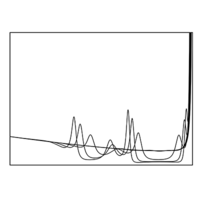
From limited observations to the state of turbulence: Fundamental difficulties of flow reconstruction

Tamer A. Zaki and Mengze Wang

Phys. Rev. Fluids 6, 100501 (2021) - Published 6 October, 2021

Is it possible to reconstruct all the scales of turbulence from limited observations? If so, what is the minimum resolution of observations for a successful reconstruction? How much information about a turbulent flow field can be decoded from an isolated, instantaneous measurement? These fundamental questions are addressed using variational data assimilation, where the observations are infused in simulations and are decoded using the Navier-Stokes equations. We highlight the “dual butterfly effect” and how the stochasticity of turbulence obfuscates the interpretation of measurements.

Fall and break-up of viscous miscible drops in a Hele-Shaw cell

Clément Toupoint, Sylvain Joubaud, and Bruce R. Sutherland

Phys. Rev. Fluids 6, 103601 (2021) - Published 6 October, 2021

We study the fall of pancake-shaped drops in a Hele-Shaw cell filled with a more viscous ambient fluid in the case where the drop and ambient fluid are miscible. We propose a theoretical expression for the falling velocity of the drops which takes into account elongated drops with width smaller than the gap of the cell. We also provide experimental evidence for the break-up of miscible drops, which can be caused by internal fluid motion within the drop, or by an instability in the shape of the drop.

Marginal regeneration-induced drainage of surface bubbles

Jonas Miguet, Marina Pasquet, Florence Rouyer, Yuan Fang, and Emmanuelle Rio

Phys. Rev. Fluids 6, L101601 (2021) - Published 6 October, 2021

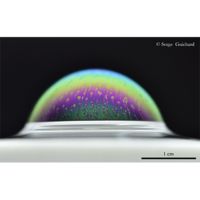
When a soap film drains, marginal regeneration refers to the rise of patches that are thinner than the rest of the film. In this work the rise velocities and sizes of buoyant patches are measured and found to be in good agreement with a Rayleigh-Taylor like instability and a model based on a balance of gravitational and surface viscous forces, as suggested in the literature. Thus, in an environment saturated in humidity, to eliminate evaporation effects, marginal regeneration approximately describes the film drainage at the apex of a draining bubble.

Simple analytic model for peristaltic flow and mixing

Ruy Ibanez, Mohammad Shokrian, Jong-Hoon Nam, and Douglas H. Kelley

Phys. Rev. Fluids 6, 103101 (2021) - Published 5 October, 2021

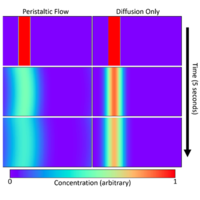
Small-amplitude peristaltic flows occur in many biological systems, and may occur in the inner ear. We present a simple analytic model for such flows, validated using simulations and measurements from a laboratory model of the inner ear. We demonstrate that Lagrangian transport dynamics can be reproduced accurately with our simple analytic model.

Asymmetric coalescence of two droplets with different surface tensions is caused by capillary waves

Michiel A. Hack, Patrick Vondeling, Menno Cornelissen, Detlef Lohse, Jacco H. Snoeijer, Christian Diddens, and Tim Segers

Phys. Rev. Fluids 6, 104002 (2021) - Published 5 October, 2021

When two droplets with different surface tensions collide, the shape evolution of the merging droplets is asymmetric. Here, we reveal the importance of capillary waves in this process, and systematically study the influence of both inertia and surface tension. Counterintuitively, the Marangoni effect reduces the asymmetry.

Sign In to Your Journals Account

Filter

Recent Issues

Vol. 11, Iss. 10
October 2026
Vol. 11, Iss. 9
September 2026
Vol. 11, Iss. 8
August 2026
Vol. 11, Iss. 7
July 2026
Category
Article Type
Section

Filter

Article Lookup

Enter a citation