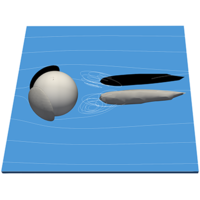
Recent Articles

Shear-induced heat transport and the relevance of generalized Fourier's law in granular Poiseuille flow

Meheboob Alam, Ronak Gupta, and Shashank Ravichandir

Phys. Rev. Fluids 6, 114303 (2021) - Published 10 November, 2021

The relevance of the generalized/nonlinear Fourier’s law in a driven granular gas such as in dust storms is underscored by demonstrating that its linear, isotropic version does not hold even in the continuum limit of zero Knudsen number.

Streamwise inhomogeneity of spectra and vertical coherence of turbulent motions in a finite-size wind farm

Tanmoy Chatterjee and Yulia T. Peet

Phys. Rev. Fluids 6, 114601 (2021) - Published 9 November, 2021

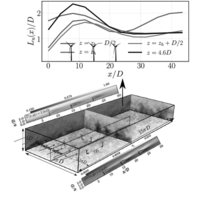
In a finite size wind farm turbulence is streamwise inhomogeneous. This paper examines the evolution of large scale motions on the order of 10 turbine rotor diameters influenced by wake-mixing from turbine rows. Using wavelet-based methods, the analysis illustrates that streamwise and vertically coherent length scales grow significantly past the first row of turbines. The first observation is primarily due to turbulence from the superposition of turbine wakes while the latter one is associated with the development of a global energy transfer mechanism (“sweeps”) between the outer layer and the wind turbine region.

Droplet trapping in bendotaxis caused by contact angle hysteresis

Alexander T. Bradley, Ian J. Hewitt, and Dominic Vella

Phys. Rev. Fluids 6, 114003 (2021) - Published 5 November, 2021

Bendotaxis is a mechanism in which a liquid droplet propels itself along an elastic walled channel: the deformation induced by the droplet’s capillary pressure leads to an imbalance in that pressure that generates motion. However, droplets on real surfaces often suffer contact angle hysteresis. We study the conditions under which contact angle hysteresis is strong enough to trap a droplet, preventing bendotaxis.

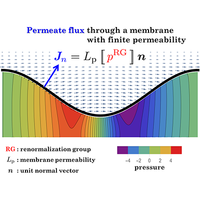
Lubrication pressure model in a non-negligible gap for fluid permeation through a membrane with finite permeability

Shintaro Takeuchi, Toshiaki Fukada, Shuji Yamada, Suguru Miyauchi, and Takeo Kajishima

Phys. Rev. Fluids 6, 114101 (2021) - Published 5 November, 2021

The membrane permeation of a pure fluid driven by lubrication pressure is studied in the range of wall-membrane gap widths that cannot be treated by the Reynolds lubrication equation. This lubrication effect is modeled by including a higher-order pressure component described by the wall-tangential derivative of the local Couette-Poiseuille velocity. A permeate flux model is developed by renormalizing the Couette component, which shows divergent behavior, into the lowest order pressure component, and successfully predicts the permeate flux from infinitesimal to finite permeability.

Estimating the filtration efficacy of cloth masks

Xinyu Mao and A. E. Hosoi

Phys. Rev. Fluids 6, 114201 (2021) - Published 5 November, 2021

Motivated by the current pandemic we analyze the use of cloth masks as effective alternatives to medical masks for the general public. In this paper, we establish a quantitative framework for estimating the filtration efficacy of cloth masks by deriving analytical estimates for the pressure drop across woven heterogeneous fabrics. We then introduce a filtration quality factor to compare the intrinsic filtration capabilities of diverse materials for submicron aerosols. Finally, we present a decision map to illustrate the trade-offs between filtration efficiency and breathability and to provide practical guidance on the selection of cloth masks.

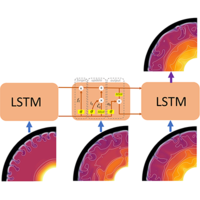
Deep learning for surrogate modeling of two-dimensional mantle convection

Siddhant Agarwal, Nicola Tosi, Pan Kessel, Doris Breuer, and Grégoire Montavon

Phys. Rev. Fluids 6, 113801 (2021) - Published 4 November, 2021

The long-term thermal evolution of rocky planets like Earth, Venus, Mercury, and Mars is governed by mantle convection: the buoyancy-driven creeping flow of silicate rocks. Yet, some key parameters and initial conditions are poorly constrained. Using deep learning, we model two-dimensional surrogates of mantle convection over a wide range of parameters. This paves the way for a rapid evaluation of the parameter space.

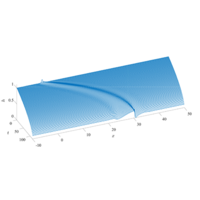
Spatiotemporal evolution of evaporating liquid films sheared by a gas

Omair A. A. Mohamed, Michael C. Dallaston, and Luca Biancofiore

Phys. Rev. Fluids 6, 114002 (2021) - Published 4 November, 2021

The interaction between an evaporating liquid film and a shearing gas is a complicated problem involving rich and interesting dynamics. We tackle this problem by deriving a Benney-like equation governing the flow in the long-wave limit. Subsequently, the temporal and spatiotemporal characteristics of the flow are investigated both (i) in the linear regime using the analytically derived dispersion relationship, and (ii) in the nonlinear regime by solving the governing equation numerically. Finally, we use self-similarity analysis to study the role of the shearing gas on the rupture mechanics of the film.

Size effects in underwater granular collapses: Experiments and coupled lattice Boltzmann and discrete element method simulations

G. C. Yang, L. Jing, C. Y. Kwok, and Y. D. Sobral

Phys. Rev. Fluids 6, 114302 (2021) - Published 3 November, 2021

We perform experiments and simulations of underwater granular column collapses and report an enhanced granular flow mobility as the column size increases. The size effect is attributed to several mechanisms due to the complex fluid-particle interactions. Strong fluid eddies in large cases penetrate through the flowing layer of the granular phase and tend to mobilize more particles disproportionally. The interstitial water lubricates interparticle contacts, causing enhanced basal slip of the fast-moving granular front. This contact lubrication or resistance reduction becomes more prominent in large underwater granular column collapses.

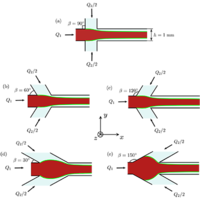
Formation of colloidal threads in geometrically varying flow-focusing channels

V. Krishne Gowda, Cecilia Rydefalk, L. Daniel Söderberg, and Fredrik Lundell

Phys. Rev. Fluids 6, 114001 (2021) - Published 2 November, 2021

Flow focusing of colloidal dispersions can be used to assemble multiscale structured macroscopic materials. In this combined experimental and numerical study, we have investigated the effect of (partly) co- and counter- flowing sheath flows, as compared to the reference case with sheath flows normal to the core flow. The effect of non-normal sheath flows is substantial and, perhaps surprisingly, independent of direction for variations of +/- 30° from normal flow.

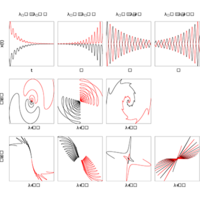
Lyapunov exponent of finite-density inertial particles subjected to Stokes drag

Mahdi Esmaily

Phys. Rev. Fluids 6, 114301 (2021) - Published 2 November, 2021

When placed in a canonical flow (straining, rotational, and vortex stretching corresponding to the top, middle, and bottom row), finite-density particles can follow various paths. The present article analytically predicts their long-term behavior, namely, whether they will cluster or disperse or whether their trajectories cross.

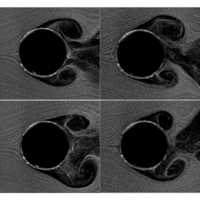
Vortex-induced vibrations of a one-degree-of-freedom cylinder transitioning from the inline to the crossflow degree of freedom

Bridget M. Benner and Yahya Modarres-Sadeghi

Phys. Rev. Fluids 6, 114702 (2021) - Published 2 November, 2021

Vortex-Induced Vibration (VIV) is studied extensively for cases where the oscillations are possible in the direction of flow (IL VIV) or perpendicular to it (CF VIV). In this work, we study VIV for the angles in between and show how the cylinder’s response transitions from a purely IL VIV to a purely CF VIV.

Closely spaced corotating helical vortices: General solutions

A. Castillo-Castellanos, S. Le Dizès, and E. Durán Venegas

Phys. Rev. Fluids 6, 114701 (2021) - Published 1 November, 2021

General solutions for closely spaced corotating helical vortices are obtained using a filament approach. For these vortex structures, helical symmetry is broken but solutions maintain a form of spatial periodicity. We show there exists a moving frame where vortex elements move along the structure without distorting it. Locally, the structure behaves much like a helical pair aligned with the locally tangent flow. However, away from the cores the induced flow is reminiscent of a helical vortex.

Spreading and contact-line arrest dynamics of impacting oxidized liquid-metal droplets

Ryan McGuan, Robert N. Candler, and H. Pirouz Kavehpour

Phys. Rev. Fluids 6, L111601 (2021) - Published 1 November, 2021

A phenomenological study is presented of the impact, spreading, and arrest of Galinstan droplets on a rigid substrate. The maximum diameter at which contact line arrest occurs is found to be a power law of the speed and a model is presented to rationalize the observations.

Spectrogram analysis of surface elevation signals due to accelerating ships

Ravindra Pethiyagoda, Timothy J. Moroney, Gregor J. Macfarlane, and Scott W. McCue

Phys. Rev. Fluids 6, 104803 (2021) - Published 29 October, 2021

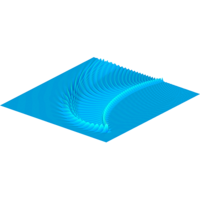
The distinctive wave pattern that forms behind the stern of a moving ship is the result of a combination of divergent and transverse waves across all wavenumbers. At a fixed point in space, as a ship travels past, these waves produce a surface elevation signal in which properties of the ship are encoded in a complicated way. Motivated by the challenge of how to decode such signals, we explore their frequency spectrum using spectrograms. Recent findings are extended to allow for the ship to accelerate along arbitrary paths instead of simply traveling steadily in a straight line.

Self-excited flag vibrations produce post-stall flow control

Junchen Tan, Zhijin Wang, and Ismet Gursul

Phys. Rev. Fluids 6, L102701 (2021) - Published 29 October, 2021

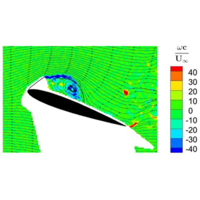
A small flag attached to the surface of an airfoil near the leading-edge exhibits self-excited oscillations when the airfoil is set at a post-stall angle of attack. The limit cycle oscillations of the flag between the airfoil surface and the freestream produce leading-edge vortices periodically, resulting in a remarkable increase in the maximum lift coefficient and stall angle. There are strong similarities between this passive flow control method, which relies on the fluid-structure interactions, and the active flow control methods in producing post-stall lift enhancement.

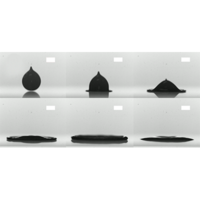
Deformed liquid marble formation: Experiments and computational modeling

Jesse R. J. Pritchard, Mykyta V. Chubynsky, Jeremy O. Marston, and James E. Sprittles

Phys. Rev. Fluids 6, 104007 (2021) - Published 28 October, 2021

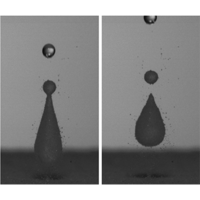
We consider the formation of liquid marbles via impact onto powder beds. Experimentally we analyze how much powder the surface of the drop is able to harvest and discover how this determines the threshold for marble formation. This motivates the development of the first mathematical model for this process and simulations based on this model qualitatively recover many features of the experiments, while also highlighting avenues for future research.

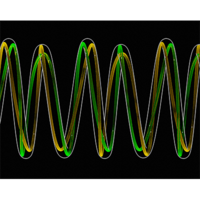
Damping of a pendulum: An experimental test of the Stokesian unsteady friction force on a cylinder

G. Dolfo, J. Vigué, and D. Lhuillier

Phys. Rev. Fluids 6, 104101 (2021) - Published 28 October, 2021

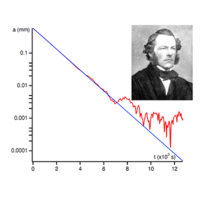
In 1851, Stokes (in insert) calculated the friction force on a cylinder in oscillating motion, neglecting the nonlinear term of the Navier-Stokes equation, an approximation valid for vanishing values of the Reynolds number Re. Previous tests were performed with Re>0.1 and frequently with Re»1. We have measured the oscillation of a macroscopic gravity pendulum. Our position detector with a submicrometer sensitivity enables us to record very small oscillation amplitudes, corresponding to Re=0.0002. The friction force deduced from the damping time constant is in very good agreement with Stokes’ calculation.

Drag and lift forces on a rigid sphere immersed in a wall-bounded linear shear flow

Pengyu Shi, Roland Rzehak, Dirk Lucas, and Jacques Magnaudet

Phys. Rev. Fluids 6, 104309 (2021) - Published 28 October, 2021

Drag and lift forces experienced by a rigid spherical particle translating close to a flat wall in a linear shear flow are determined through fully resolved simulations. Particles are assumed to obey either a non-rotating or a torque-free condition and may either lead the fluid or lag behind it. The simulations cover a wide range of flow regimes, from low-but-finite Reynolds numbers to conditions close to the onset of wake unsteadiness. Results are used to build accurate semiempirical expressions for the two force components valid at arbitrary Reynolds number, relative shear rate, and separation distance from the wall.

Droplet impact on a prewetted mesh

Long Xu, Wenjie Ji, Jie Lu, Yalei Li, Jiguang Hao, Gengkai Hu, and J. M. Floryan

Phys. Rev. Fluids 6, L101602 (2021) - Published 28 October, 2021

The effects of the liquid trapped in a mesh on droplet penetration were investigated. It was found that penetrations could be entirely suppressed by the trapped liquid. A model for predicting the transition thresholds is proposed and compared with experimental results. It is suggested that the impact type is determined by the momentum exchange between the impacting droplet and the liquid trapped in the mesh.

Non-Boussinesq convection at low Prandtl numbers relevant to the Sun

Ambrish Pandey, Jörg Schumacher, and Katepalli R. Sreenivasan

Phys. Rev. Fluids 6, 100503 (2021) - Published 27 October, 2021
The figures on the left show the effect of the Prandtl number (Pr) of the Rayleigh-Bénard problem with Boussinesq conditions, for the same Grashof number of 109. Top: Pr = 12.73; bottom, Pr = 10−4. The plot on the right shows that low molecular Pr yields an inversely varying turbulent Prandtl number; that is, the flow behaves effectively as a high Prandtl number fluid. The data are for non-Boussinesq conditions. The qualitative effect is the same for the Boussinesq case as well, but the dependence has a weaker power law exponent of about −1/3.

Sign In to Your Journals Account

Filter

Recent Issues

Vol. 11, Iss. 10
October 2026
Vol. 11, Iss. 9
September 2026
Vol. 11, Iss. 8
August 2026
Vol. 11, Iss. 7
July 2026
Category
Article Type
Section

Filter

Article Lookup

Enter a citation