Recent Articles

Wall modeling for large-eddy simulation on non-body-conforming Cartesian grids

Yoshiharu Tamaki and Soshi Kawai

Phys. Rev. Fluids 6, 114603 (2021) - Published 24 November, 2021

In this paper a novel methodology is proposed for wall-modeled large eddy simulation (WMLES) on non-body-conforming Cartesian grids. The proposed WMLES employs a partial-slip velocity boundary condition to reduce conservation errors at the wall. In addition, since the slip velocity reduces the shear stress in the near-wall region, a modeled turbulence shear stress is introduced to maintain the shear-stress balance in the near-wall region. The proposed WMLES robustly predicts turbulence statistics in turbulent boundary layers developed on an inclined flat plate without showing log-layer mismatch.

Penetration and secondary atomization of droplets impacted on wet facemasks

Sombuddha Bagchi, Saptarshi Basu, Swetaprovo Chaudhuri, and Abhishek Saha

Phys. Rev. Fluids 6, 110510 (2021) - Published 23 November, 2021

We present a study of wetted facemasks to evaluate their capability in blocking respiratory droplets. We show that the increase in wetness progressively weakens the penetration capability of the impacted droplets. Such behavior is observed for hydrophobic and hydrophilic masks, although the underlying mechanism is different.

Quantifying the effect of a mask on expiratory flows

Philippe Bourrianne, Nan Xue, Janine Nunes, Manouk Abkarian, and Howard A. Stone

Phys. Rev. Fluids 6, 110511 (2021) - Published 23 November, 2021

In addition to their ability to filter pathogenic droplets, masks also represent a porous barrier to exhaled and inhaled air flow. In this study, we characterize the aerodynamic effect of a mask by tracking the air exhaled by a person through a mask. We show how a mask confines the exhaled flows within tens of centimeters in front of a person breathing or speaking.

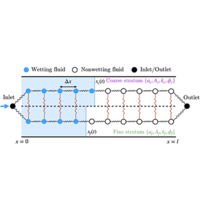
Forced imbibition in stratified porous media: Fluid dynamics and breakthrough saturation

Nancy B. Lu, Daniel B. Amchin, and Sujit S. Datta

Phys. Rev. Fluids 6, 114007 (2021) - Published 23 November, 2021

Imbibition, the displacement of a nonwetting fluid by a wetting fluid, plays a central role in diverse energy, environmental, and industrial processes. While this process is typically studied in homogeneous porous media with uniform permeabilities, in many cases, the media have multiple parallel strata of different permeabilities. Here, we use numerical simulations to examine the fluid dynamics of imbibition in stratified media. Our results highlight how stratification can fundamentally change the dynamics of imbibition, and provide quantitative guidelines for predicting and controlling this process.

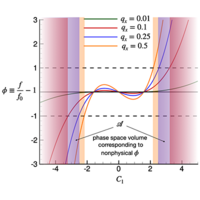
OnsagerNet: Learning stable and interpretable dynamics using a generalized Onsager principle

Haijun Yu, Xinyuan Tian, Weinan E, and Qianxiao Li

Phys. Rev. Fluids 6, 114402 (2021) - Published 23 November, 2021

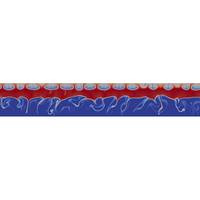
Machine learning is becoming an increasingly popular method for building mathematical models from observations of natural processes. Here, the central challenge is to impart structure into the model parameterization to enforce physical relevance, yet retain a degree of generality so that a large variety of dynamics can be learned. We introduce a novel methodology, based on a data-driven extension of the classical Onsager principle, that strikes a balance between these competing aspects. We demonstrate its efficacy by learning quantitatively accurate and qualitatively faithful reduced order models of the Rayleigh-Bénard convection equations.

Quantitative uncertainty metric to assess continuum breakdown for nonequilibrium hydrodynamics

Narendra Singh and Michael Kroells

Phys. Rev. Fluids 6, L111401 (2021) - Published 23 November, 2021

Multiscale problems such as hypersonic flows with strong nonequilibrium due to strong shocks and expansions result in flow physics which is no longer accurately described by the Navier-Stokes equations (NSE). Similarly, the NSE break down in rarefied (low density) gas flows. Therefore, hybrid methods, which can combine the continuum description using NSE and the kinetic description (KD), are necessary for efficient high-fidelity numerical simulations. A key input to hybrid methods is a metric to identify regions in the flow-field where the NSE breaks down and the KD should be used. In this Letter, starting from kinetic theory, we develop a rigorous metric to assess where the NSE breaks down.

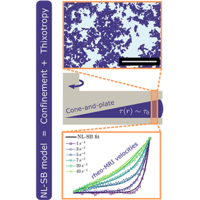
Nonlocal effects in the shear banding of a thixotropic yield stress fluid

M. Raquel Serial, Daniel Bonn, Thom Huppertz, Joshua A. Dijksman, Jasper van der Gucht, John P. M. van Duynhoven, and Camilla Terenzi

Phys. Rev. Fluids 6, 113301 (2021) - Published 22 November, 2021

A simple analytical model is introduced for describing the combined effect of thixotropic and nonlocal flow in a homogeneous stress field. The model adequately describes experimental rheo-MRI velocimetry profiles, measured for a milk microgel suspension in a cone-and-plate geometry.

Bifurcation aspect of polygonal coherence over transitional Reynolds numbers in wide-gap spherical Couette flow

Fumitoshi Goto, Tomoaki Itano, Masako Sugihara-Seki, and Takahiro Adachi

Phys. Rev. Fluids 6, 113903 (2021) - Published 22 November, 2021

In a wide gap spherical Couette flow with η=1/2, the nonlinear branches of the 4,3,2-fold spiral states and the critical Reynolds numbers at which they sequentially bifurcate from the axisymmetric state are solved. The evidence that these states are established as stable states even over the successive critical Reynolds numbers is discussed based on the formation of their unstable manifolds and basins of attraction in the state space. This result substantiates that both the 4-fold and 3-fold spiral state may coexist stably in experiment.

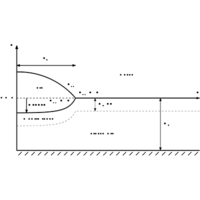
Nanobubble-induced flow of immersed glassy polymer films

Christian Pedersen, Shuai Ren, Yuliang Wang, Andreas Carlson, and Thomas Salez

Phys. Rev. Fluids 6, 114006 (2021) - Published 22 November, 2021

Glassy thin films have been abundantly studied in the past decades and shown to exhibit a liquid-like surface mobile layer. When immersed in water, nanobubbles spontaneously form at their free surface. Here, from a combination of glassy lubrication theory and finite-element numerical integration, we demonstrate that, and study how, the surface is dynamically deformed through a surface flow driven by the inner pressure of the bubble. As a consequence, the film eventually undergoes a dewetting event, for which we predict a typical time scale from the model.

Relaxation dynamics of a flexible rod in a fluid

Ayrton Draux, Hoa-Ai Béatrice Hua, Pascal Damman, and Fabian Brau

Phys. Rev. Fluids 6, 114102 (2021) - Published 22 November, 2021

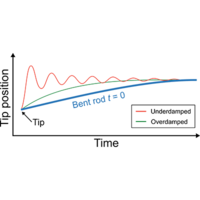
The relaxation dynamics of a bent rod immersed in a fluid is strongly affected by its bending stiffness and the fluid viscosity. For large bending stiffness or low viscosity, the dynamics is underdamped and the rod oscillates around its equilibrium position with a well-defined frequency and a damped amplitude. For low bending stiffness or large viscosity, the dynamics is overdamped and the rod relaxes to its equilibrium position without oscillating. We show the existence of two overdamped regimes where the relaxation dynamics is characterized by two different polynomial decays showing that the viscous force is not proportional to the rod velocity in our experiments.

Nonsymmetric ionic transport in a nonbinary electrolyte at high voltage

Arnon Ratzabi, Tal Eluk, Avi Levy, and Yuri Feldman

Phys. Rev. Fluids 6, 113701 (2021) - Published 19 November, 2021

A phenomenological study focusing on investigation of ionic transport within one- and two-dimensional electrolytic cells operating at high voltage and confined by two open electrodes is presented. The cell is filled with a nonsymmetric electrolyte consisting of one positively charged and two negatively charged species. The study offers a physical interpretation and detailed discussion of the origin and development of electroconvective instability typical of configurations relevant to digital printing technologies.

Effects of parietal suction and injection on the stability of the Blasius boundary-layer flow over a permeable, heated plate

Mushrifah Al-Malki, Zahir Hussain, Stephen Garrett, and Sophie Calabretto

Phys. Rev. Fluids 6, 113902 (2021) - Published 19 November, 2021

We investigate the effects of wall suction and injection on Chemical Vapour Deposition (CVD), a microfabrication process in which a gas mixture is pumped into a reactor and flows over a heated reactant porous surface to chemically deposit a thin film. Regular and cohesive film growth requires that laminar flow be maintained. The energy balance with wall suction for temperature dependence parameter ϵ<0 leads to increasing total mechanical energy due to reducing energy production and dissipation with increasing flow suction; for ϵ>0 there is a stabilization effect on the Tollmien-Schlichting waves mainly due to a large reduction in the energy contribution term.

Thermocapillary instability of an ionic liquid-water mixture in a temperature gradient

Marc Pascual, Axelle Amon, and Marie-Caroline Jullien

Phys. Rev. Fluids 6, 114203 (2021) - Published 18 November, 2021

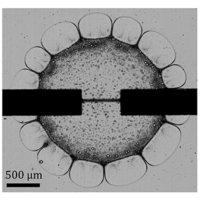
This paper reports the separation dynamics of a binary solution placed in a temperature gradient. We show the existence of three separation regimes, depending on the volume fractions of the components. One of the regimes is associated with a capillary instability of which a typical pattern is shown in this picture. All the observed regimes are rationalized.

Effects of surface tension on the Richtmyer-Meshkov instability in fully compressible and inviscid fluids

Kaitao Tang, Wouter Mostert, Daniel Fuster, and Luc Deike

Phys. Rev. Fluids 6, 113901 (2021) - Published 17 November, 2021

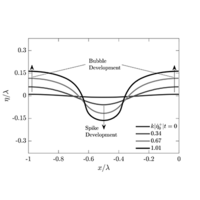
The nonlinear phase of Richtmyer-Meshkov Instability (RMI) is characterized by the development of asymmetric interfacial perturbation structures known as ‘bubbles’ and ‘spikes’, which could potentially be curbed by surface tension. Our work systematically examines such curbing effects of surface tension within a wide range of Weber numbers. Based on numerical results of two-phase compressible simulations, we confirm two existing analytic theories predicting RMI perturbation development respectively at small and asymptotically large Weber numbers, and propose a heuristic criterion identifying the transitional development of RMI at intermediate Weber numbers.

Reynolds number effect on the concentration and preferential orientation of inertial ellipsoids

A. Michel and B. Arcen

Phys. Rev. Fluids 6, 114305 (2021) - Published 17 November, 2021

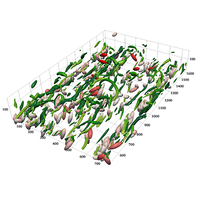
Direct numerical simulations are performed to study the influence of the flow Reynolds number (Re) on the dynamics of inertial, ellipsoidal particles in a turbulent wall-bounded flow. In wall units, the time required for the particle distribution to reach a statistically steady state increases with Re. Once the distribution reached a statistically steady-state, a more uniform concentration profile is observed for higher values of Re, regardless of particle shape, but with a noticeable influence of particle inertia. Finally, in the near-wall region, preferential orientation of all ellipsoids is modified when Re increases, with a strong dependence on the ellipsoids characteristics.

Chemical reaction for mixing studies

Emilie Guilbert, Christophe Almarcha, and Emmanuel Villermaux

Phys. Rev. Fluids 6, 114501 (2021) - Published 16 November, 2021

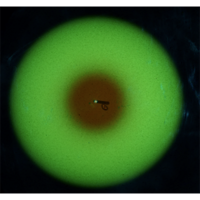
We introduced a new chemical rection for mixing studies, forming a fluorescent product from transparent reactants, with tunable kinetics.

Internal and inertia-gravity wave focusing at large Stokes numbers

Natalia Shmakova, Bruno Voisin, Joel Sommeria, and Jan-Bert Flór

Phys. Rev. Fluids 6, 114804 (2021) - Published 16 November, 2021

Experiments with an oscillating torus in a stratified and/or rotating fluid on the 13 m-diameter Coriolis platform show that, at such large Stokes number, geometrically focusing internal waves compare to some extent with the presented linear theory, but exhibit surprising results in the nonlinear regime: though the waves are very nonlinear with wave triads and increasing energy in the higher harmonics, they do not overturn, and wave breaking is not observed.

Chemical reactions rectify mixtures composition

Emilie Guilbert and Emmanuel Villermaux

Phys. Rev. Fluids 6, L112501 (2021) - Published 16 November, 2021

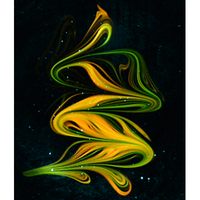
When stirred, is the composition field of the product of a reaction more, or less homogenous than the one of a passive scalar in the same conditions? The composition fluctuations are weaker, and we explain why.

Editorial: Introduction to the 38th Annual Gallery of Fluid Motion (Chicago, IL, USA 2020)

David H. Richter and Saverio E. Spagnolie

Phys. Rev. Fluids 6, 110001 (2021) - Published 15 November, 2021

Rayleigh-Taylor instability in drop impact experiments

Victor Lherm, Renaud Deguen, Thierry Alboussière, and Maylis Landeau

Phys. Rev. Fluids 6, 110501 (2021) - Published 15 November, 2021

Sign In to Your Journals Account

Filter

Recent Issues

Vol. 11, Iss. 10
October 2026
Vol. 11, Iss. 9
September 2026
Vol. 11, Iss. 8
August 2026
Vol. 11, Iss. 7
July 2026
Category
Article Type
Section

Filter

Article Lookup

Enter a citation