Recent Articles

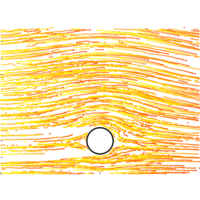
Stochastic model for the hydrodynamic force in Euler–Lagrange simulations of particle-laden flows

Aaron M. Lattanzi, Vahid Tavanashad, Shankar Subramaniam, and Jesse Capecelatro

Phys. Rev. Fluids 7, 014301 (2022) - Published 3 January, 2022

Drag force models generally used in Eulerian-Lagrangian (EL) methods only represent the mean hydrodynamic force acting upon a suspension; higher-order drag force statistics, arising from neighbor-induced flow perturbations, are neglected, affecting particle velocity variance and dispersion predictions. We develop a force Langevin (FL) model that treats neighbor-induced drag fluctuations as a stochastic process. The stochastic EL framework specifies unresolved drag force statistics, leading to the correct evolution of particle velocity variance over a wide range of Reynolds numbers and solids volume fractions, when compared to particle-resolved DNS of freely evolving homogeneous suspensions.

Engineering reconfigurable flow patterns via surface-driven light-controlled active matter

Xingting Gong, Arnold J. T. M. Mathijssen, Zev Bryant, and Manu Prakash

Phys. Rev. Fluids 6, 123104 (2021) - Published 30 December, 2021

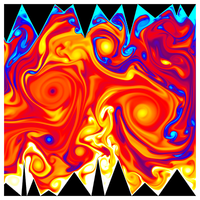
Surface-driven flows are ubiquitous, from subcellular cytoplasmic streaming to organ-scale ciliary arrays. Here, we model how confined geometries can be used to engineer complex hydrodynamic patterns driven by activity prescribed solely on the boundary. We simulate light-controlled surface-driven active matter, probing the emergent properties of a suspension of active colloids that can bind and unbind from surfaces of a closed microchamber, together creating an active carpet. Switching the particle velocities with light, we program the active suspension and demonstrate a rich design space of flow patterns. Our results point towards design and control of surface-driven active fluids.

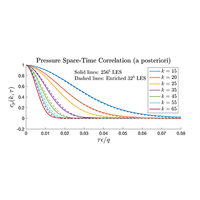
Subgrid-scale pressure field of scale-enriched large eddy simulations using Gabor modes

Ryan D. Hass, Aditya S. Ghate, and Sanjiva K. Lele

Phys. Rev. Fluids 6, 124607 (2021) - Published 30 December, 2021

We cast the sub-grid velocity field in large eddy simulations as a sum of spatially localized stochastic modes, or Gabor modes, which are dynamically coupled to the resolved large-scale field. We evaluate the ability of the Gabor representation to reconstruct second order space-time statistics of the pressure field in homogeneous isotropic turbulence and find the reconstruction to be remarkably accurate in both a priori and a posteriori settings. The small number of modes required results in significant compression in degrees of freedom relative to solving the governing equations on a mesh capable of resolving all scales.

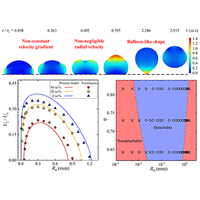
Jumping velocity of an electrowetting-actuated droplet: A theoretical and numerical study

Jiayu Du, Nikolaos T. Chamakos, Athanasios G. Papathanasiou, Yanzhi Li, and Qi Min

Phys. Rev. Fluids 6, 123603 (2021) - Published 27 December, 2021

In this study, we numerically and theoretically investigate the electrowetting-induced detachment of liquid droplets. An analytical model adopting the energy balance approach is derived to predict the jumping velocity of an electrowetting-actuated droplet, which comprehensively accounts for the influence of liquid properties, droplet size and applied voltage. Our main contribution is to reformulate the models of four energy components including the surface energy, kinetic energy, gravitational potential energy at detachment, as well as the viscous dissipation of entire recoiling. The necessity to correct these energy components has also been physically explained.

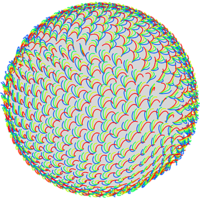
Coordinated motion of active filaments on spherical surfaces

Timothy A. Westwood and Eric E. Keaveny

Phys. Rev. Fluids 6, L121101 (2021) - Published 27 December, 2021

The coordinated motion of active filaments, most notably cilia and flagella, are used by numerous micoorganisms and swimming cells to facilitate swimming. This Letter explores how the coordinated states of active filaments depend on the topology of the surface to which they are attached, as well as whether the surface is held fixed or free to move. Most notably, the Letter demonstrates that for spherical surfaces, the coordinated state changes dramatically when the sphere is released due to defect-induced alterations in filament motion.

Entrainment into particle-laden turbulent plumes

Craig D. McConnochie, Claudia Cenedese, and Jim N. McElwaine

Phys. Rev. Fluids 6, 123502 (2021) - Published 23 December, 2021

We measure the entrainment coefficient of a turbulent plume containing dense particles. When the particle buoyancy flux opposes that of the plume fluid, the entrainment coefficient is increased by up to 40%. In contrast, when the particle buoyancy flux and the plume fluid buoyancy flux act in the same direction, the entrainment coefficient is unaffected. The effect on the entrainment coefficient and difference between the two configurations is linked to particle clustering within the plume.

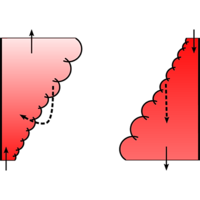
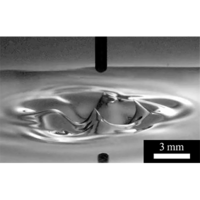
Deformation modes of an oil-water interface under a local electric field: From Taylor cones to surface dimples

Sebastian Dehe and Steffen Hardt

Phys. Rev. Fluids 6, 123702 (2021) - Published 23 December, 2021

Fluidic interfaces between conducting and dielectric media disintegrate under sufficiently strong electric fields, leading to electrohydrodynamic tip streaming, often in form of a Taylor cone. In this article, the governing mechanism of an alternative interface deformation mode is studied, where the interface is pushed away from the electrode, and additional cone structures emerge from the rim of the dimple. Using experimental and numerical methods, we show that the droplets of the conducting liquid play a crucial role in the dimple formation, as they induce a background flow, which in turn leads to the interfacial deformation.

Eulerian spatiotemporal correlations in passive scalar turbulence

Anastasiia Gorbunova, Carlo Pagani, Guillaume Balarac, Léonie Canet, and Vincent Rossetto

Phys. Rev. Fluids 6, 124606 (2021) - Published 22 December, 2021

Using direct numerical simulations we study the spatiotemporal correlations of passive scalars advected both by Navier-Stokes flow and by synthetic velocity fields. Beyond their global behavior, which is either a Gaussian or an exponential decay in time, depending on the carrier flow, we determine with accuracy the prefactors in the exponents, and find a remarkable agreement with recent results from functional renormalization group.

Drag anisotropy of cylindrical solids in fluid-saturated granular beds

Ankush Pal and Arshad Kudrolli

Phys. Rev. Fluids 6, 124302 (2021) - Published 21 December, 2021

The drag anisotropy experienced by cylindrical rods moving through granular sediments is measured and found to be far greater than in viscous fluids at comparable aspect ratios. The flows while moving perpendicular and parallel to the cylinder axis are visualized and related to the observed dependence on aspect ratios, speed, and material properties.

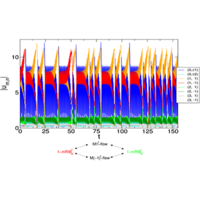
Flow dynamics between two concentric counter-rotating porous cylinders with radial through-flow

Sebastian Altmeyer

Phys. Rev. Fluids 6, 124802 (2021) - Published 20 December, 2021

In nonlinear dynamical systems one finds many examples with the occurrence of a signal that alternates randomly between long periods of regular behavior and relatively short irregular bursts. In other words, the motion is intermittent, nearly periodic with occasional irregular bursts. Such intermittency scenarios are in particular observed within the transition to turbulence and classified into different types. In the present paper an intermittency scenario of type III is observed.

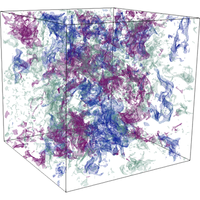
Helical turbulent nonlinear dynamo at large magnetic Reynolds numbers

F. Rincon

Phys. Rev. Fluids 6, L121701 (2021) - Published 20 December, 2021

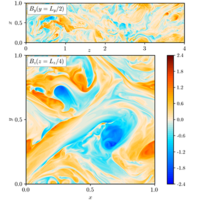
To investigate large-scale magnetic field generation in highly conducting magnetohydrodynamic (MHD) regimes typical of rotating astrophysical systems, we conduct high-resolution MHD simulations in the dynamical regime of large magnetic Reynolds numbers, of turbulence with an inhomogeneous kinetic helicity distribution. We obtain a nonlinear helical dynamo solution, characterized by a weak large-scale magnetic wave slowly propagating over saturated small-scale MHD turbulence, bypassing the catastrophic resistive quenching problem of homogeneous helical dynamos by developing turbulent fluxes of magnetic helicity through the system equator. Hints of fast-reconnection plasmoids are found.

Enhanced heat flux and flow structures in turbulent Rayleigh-Bénard convection with rough boundaries

Krishan Chand, Arnab Kr. De, and Pankaj Kumar Mishra

Phys. Rev. Fluids 6, 124605 (2021) - Published 17 December, 2021

The more the number of large-scale rolls, the larger is the heat flux. Here, the large-scale flow structures transform into multiple rolls due to the presence of tall roughness elements. These rolls efficiently wash-out the cavities leading to frequent thermal plumes. In the present work, this process is exploited to enhance the heat flux.

Hemodynamically efficient artificial right atrium design for univentricular heart patients

Heng Wei, Cynthia S. Herrington, John D. Cleveland, Vaughn A. Starnes, and Niema M. Pahlevan

Phys. Rev. Fluids 6, 123103 (2021) - Published 16 December, 2021

Infants born with single-ventricle physiologies pose significant challenges for mechanical circulatory support devices. We investigated the existence of a hemodynamically optimized geometry for an artificial right atrium (ARA) that can act as a reservoir for circulatory support and may potentially lessen the risk of implementing biventricular supports in Fontan patients. Our results indicate that a hemodynamically optimum shape for an ARA is convex at the outlet and concave at the opposite side that resembles a healthy anatomical right atrium.

Network analysis of Reynolds number scaling in wall-bounded Lagrangian mixing

Davide Perrone, J. G. M. Kuerten, Luca Ridolfi, and Stefania Scarsoglio

Phys. Rev. Fluids 6, 124501 (2021) - Published 16 December, 2021

Network analysis has recently been adopted as a framework to investigate complex turbulent dynamics. We apply these concepts to a set of particle trajectories in turbulent channel flow at different frictional Reynolds numbers (Re) from 180 to 950, building networks accounting for the transition between discrete states of particle distribution. Two main mechanisms determine a reduction in dispersion near the walls, namely the weaker velocity fluctuations at lower Re and the cyclic patterns of motion at higher Re. When exceeding Re of 395, many network properties behave independently of Re when scaled with outer flow variables.

Simulation of the turbulent axisymmetric bluff body wake with pulsed jet forcing

Taihang Zhu and Jonathan F. Morrison

Phys. Rev. Fluids 6, 124604 (2021) - Published 16 December, 2021

A turbulent axisymmetric bluff body wake is investigated using large eddy simulation to uncover key flow dynamics and structures. The effect of low-frequency and high-frequency pulsed jet forcing at the point of separation is studied to reveal the underlying mechanisms involved in the base pressure changes, which provide a reference for bluff body drag reduction and active flow control.

Fluid-structure interactions enable passive flow control in real and biomimetic plants

Keunhwan Park, Aude Tixier, Magnus Paludan, Emil Østergaard, Maciej Zwieniecki, and Kaare H. Jensen

Phys. Rev. Fluids 6, 123102 (2021) - Published 13 December, 2021

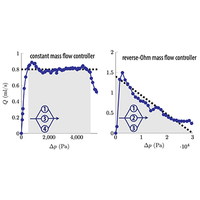
Microscale intercellular pores of tree conduit contain flexible elements that locally restrict flow in response to mechanical stress. This facilitates autonomous flow control in which the cells collectively steer water across the tissue in strikingly complex patterns. With this insight, we are able to design physically programmable inline flow devices that operate without a central control unit. We expect the new approach will strongly impact flow-engineering, due to its conceptual simplicity and low cost.

Effects of the semi-local Reynolds number in scaling turbulent statistics for wall heated/cooled supersonic turbulent boundary layers

Ryo Hirai, Rene Pecnik, and Soshi Kawai

Phys. Rev. Fluids 6, 124603 (2021) - Published 13 December, 2021

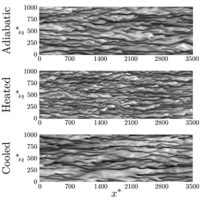
Wall heat-flux effects on turbulence statistics and structures in supersonic turbulent boundary layers with the heated and cooled wall are investigated. To study effects of the semi-local Reynolds number (Reτ*), we conduct large eddy simulation with constant Reτ* by imposing a dynamic viscosity proportional to the square root of the density and comparing to flows with a conventional viscosity given by Sutherland’s law. For constant Reτ*, wall heated and cooled cases show collapsed turbulence statistics and structures when scaling with the semi-local length scale. The results suggest that Reτ* is a similarity parameter of the flows with thermophysical property variations.

Limit of the two-dimensional linear potential theories on the propulsion of a flapping airfoil in forward flight in terms of the Reynolds and Strouhal number

J. Alaminos-Quesada

Phys. Rev. Fluids 6, 123101 (2021) - Published 9 December, 2021

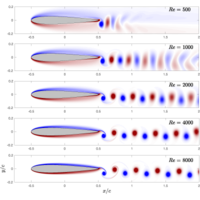
Numerical simulations have been used to estimate the validity range of the linear potential theories of Fernandez-Feria and the classical Garrick model on the propulsion of a pitching airfoil and a heaving airfoil in forward flight, in terms of the Reynolds, Re, and Strouhal number, St.

Droplet motion on chemically heterogeneous substrates with mass transfer. I. Two-dimensional dynamics

Danny Groves and Nikos Savva

Phys. Rev. Fluids 6, 123601 (2021) - Published 9 December, 2021

In this paper, asymptotic analysis and simulations are synergistically used to investigate the dynamics of thin two-dimensional droplets that spread on chemically heterogeneous surfaces and are subjected to mass transfer effects. A set of integrodifferential equations is derived for the motion of the two contact points of the droplet, which is shown to accurately capture the underlying dynamics in a variety of representative cases examined.

Droplet motion on chemically heterogeneous substrates with mass transfer. II. Three-dimensional dynamics

Nikos Savva and Danny Groves

Phys. Rev. Fluids 6, 123602 (2021) - Published 9 December, 2021

This paper presents the development of an asymptotic model which governs the evolution of the Fourier harmonics of the contact line of a thin droplet moving on a chemically heterogeneous surface, while being subjected to prescribed changes in its volume. Numerical experiments demonstrate the capacity of our model to accurately capture the dynamics, and, importantly, at a small fraction of the computing resources that would have been required for simulating the governing long-wave equation.

Sign In to Your Journals Account

Filter

Recent Issues

Vol. 11, Iss. 10
October 2026
Vol. 11, Iss. 9
September 2026
Vol. 11, Iss. 8
August 2026
Vol. 11, Iss. 7
July 2026
Category
Article Type
Section

Filter

Article Lookup

Enter a citation