Recent Articles

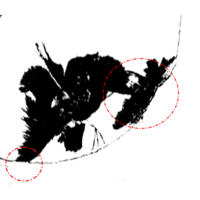
Reverse flows and flattening of a submerged jet under the action of a transverse magnetic field

Abdellah Kharicha, Alexander Vakhrushev, E. Karimi-Sibaki, M. Wu, and A. Ludwig

Phys. Rev. Fluids 6, 123701 (2021) - Published 9 December, 2021

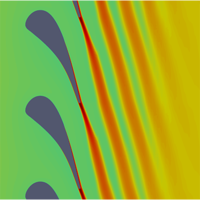
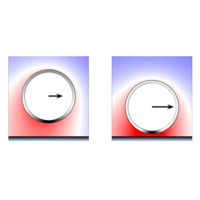
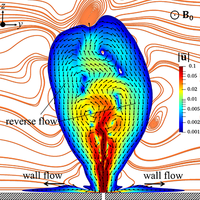
The application of a transverse magnetic field to a turbulent free jet can not be reduced to a damping or smearing effect. A detailed analysis shows surprising effects such as the development of two strong reverse jet flow zones adjacent to the main jet (flowing upward in the picture).

Hydrodynamic interactions between a point force and a slender filament

Ivan Tanasijević and Eric Lauga

Phys. Rev. Fluids 6, 124101 (2021) - Published 8 December, 2021

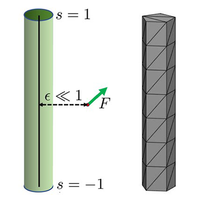
Motivated by the transport of cargo inside cells, we study the hydrodynamic interactions between a point-force and a rigid, slender filament at a separation distance between the filament radius and its length. Using asymptotic calculations and boundary element computations, we show that the leading-order interactions are captured by a new resistive-force theory with modified drag coefficients.

Generalized Newtonian fluid flow in porous media

Christopher A. Bowers and Cass T. Miller

Phys. Rev. Fluids 6, 123302 (2021) - Published 6 December, 2021

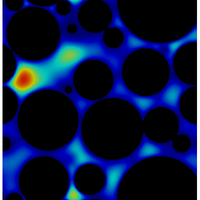
Thermodynamically constrained averaging theory was used to derive a macroscale model for the flow of generalized Newtonian fluids through porous media. The parameters needed for the model were determined from Newtonian flow systems. Predictions of flow for several shear-thinning Cross model fluids flowing in a variety of isotropic and anisotropic porous media agreed with microscale simulations within the numerical error of the simulator. Equating to the shift-factor, we found that it may be predicted a priori from geometric system and rheological properties. The proposed model obviates the need for experimental flow data for generalized Newtonian fluids in the porous medium of interest.

Weak branch and multimodal convection in rapidly rotating spheres at low Prandtl number

F. Garcia, F. Stefani, and E. Dormy

Phys. Rev. Fluids 6, 123501 (2021) - Published 6 December, 2021

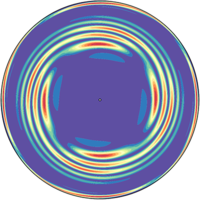
Many planetary core fluid processes can be modeled with low Prandtl number convection in a rapidly rotating sphere. Close to the onset a regime of multimodal convection is typically found. We analyze azimuthally drifting periodic flows from which multimodal convection arises in terms of bifurcation theory.

Generalizable physics-constrained modeling using learning and inference assisted by feature-space engineering

Vishal Srivastava and Karthik Duraisamy

Phys. Rev. Fluids 6, 124602 (2021) - Published 6 December, 2021

We present a data-driven framework that uses very limited data to learn generalizable bypass transition models. Trained on just two flat plate cases, the augmented model is shown to generalize to other flat plate cases and turbomachinery configurations.

Single-shot wideband active microrheology using multiple-sinusoid modulated optical tweezers

Avijit Kundu, Raunak Dey, Shuvojit Paul, and Ayan Banerjee

Phys. Rev. Fluids 6, 123301 (2021) - Published 3 December, 2021

Optically trapped colloidal probes have been widely used for active microrheology of viscoelastic fluids over the last decade. A significant issue which arises is measurement of complex viscoelastic parameters over a wide frequency range and a short time. We use a combination of square and sinusoidal waves to spatially modulate the trapped probe over a frequency range spanning five decades, and use the phase response to calculate complex viscoelastic parameters with high signal to noise in a little over three minutes. We test our method over a wide variety of linear viscoelastic samples at different concentrations, and find good agreement of the measured parameters with known values.

Real-time reactive control of stochastic disturbances in forced turbulent jets

Igor A. Maia, Peter Jordan, André V. G. Cavalieri, Eduardo Martini, Kenzo Sasaki, and Flávio J. Silvestre

Phys. Rev. Fluids 6, 123901 (2021) - Published 3 December, 2021

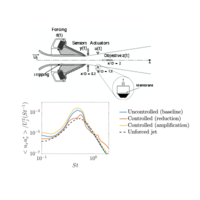
In this work we perform reactive control of axisymmetric disturbances in turbulent jets. The disturbances are produced by an external forcing and possess stochastic phases and amplitudes, akin to turbulent fluctuations found in unforced jets. The control law is based on an existing inverse feedforward scheme developed for transition control. Here we apply it to control convective growth mechanisms in fully turbulent jets and we build on previous works that considered control of harmonic disturbances. We demonstrate the successful implementation of real-time reactive control of the disturbances and achieve order-of-magnitude attenuations of velocity fluctuations.

Initial solidification dynamics of spreading droplets

Robin B. J. Koldeweij, Pallav Kant, Kirsten Harth, Rielle de Ruiter, Hanneke Gelderblom, Jacco H. Snoeijer, Detlef Lohse, and Michiel A. J. van Limbeek

Phys. Rev. Fluids 6, L121601 (2021) - Published 3 December, 2021

An experimental study is performed to investigate the influence of crystal growth on the contact line behavior of a droplet on an undercooled surface. We show the effect that the growing nucleus has on the arrest of the contact line and the underlying dependence on nucleation rate. Finally, based on classical nucleation theory and scaling relations for droplet spreading, we calculate the temporal evolution of the solidifying area.

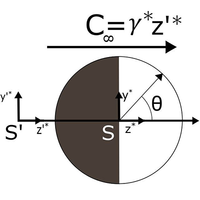
Effect of weak solute advection on a chemically active particle under the influence of an external concentration gradient

Prathmesh M. Vinze and S. Pushpavanam

Phys. Rev. Fluids 6, 124201 (2021) - Published 2 December, 2021

A Janus particle is an example of a micro swimmer which converts chemical energy present in the environment to its mechanical energy using surface reaction. In this work, we theoretically study the weak effect of solute advection on the swimming velocity of an active particle. Using the method of matched asymptotic expansion we provide a general framework for calculating first order corrections to the concentration field and the swimming velocity of an active particle in terms of Peclet number relative strength of advection to diffusion. The O(Pe) corrections reduce the magnitude of swimming velocity independent of other parameters

Editorial: Five Years of Physical Review Fluids

Eric Lauga, Beverley McKeon, Brad Rubin, Guido Boffetta, Michael Brenner, Cecile Cottin-Bizonne, Luminita Danaila, Nicolas Hadjiconstantinou, Guowei He, Petros Koumoutsakos, Sanjiva Lele, Eckart Meiburg, David Quere, Peter Schmid, Eric Shaqfeh, Jacco Snoeijer, Howard Stone, Bruce Sutherland, Emmanuel Villermaux, and Roberto Zenit

Phys. Rev. Fluids 6, 120001 (2021) - Published 1 December, 2021

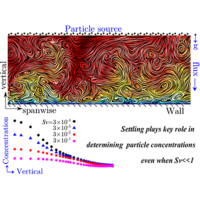
Settling strongly modifies particle concentrations in wall-bounded turbulent flows even when the settling parameter is asymptotically small

A. D. Bragg, D. H. Richter, and G. Wang

Phys. Rev. Fluids 6, 124301 (2021) - Published 1 December, 2021

Using theory and Direct Numerical simulations, we show that gravitational settling can contribute strongly to particle concentrations in wall-bounded turbulent flows even when the settling number Sv is very small. This occurs because the other competing mechanisms, e.g. the turbophoretic drift velocity, become very small in certain regions of the flow, such as very close to the wall, which we demonstrate using asymptotic analysis.

Cycling speeds in crosswinds

C. Clanet, Hector Abel, E. Brunet, Francesco Grasso, C. Robert, and C. Cohen

Phys. Rev. Fluids 6, 124601 (2021) - Published 1 December, 2021

What is the maximum speed that can be achieved for a given wind intensity and direction? The answer is detailed in our article using a new expression for the aerodynamic power dissipation. This evaluation of the aerodynamic power in crosswinds is established via precise wind tunnel experiments performed with a time trial specialist completed with a theoretical approach which allows determination of the maximum speed in any crosswind.

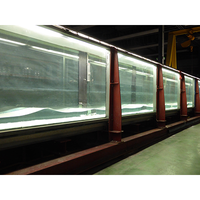
Experimental study of integrable turbulence in shallow water

Ivan Redor, Hervé Michallet, Nicolas Mordant, and Eric Barthélemy

Phys. Rev. Fluids 6, 124801 (2021) - Published 1 December, 2021

Integrable turbulence theoretically describes system states (in optics, hydrodynamics) where nonlinear phenomena dominate. Fourier analysis is challenged by the richness of such states also featuring solitons. Bidirectional soliton gases are generated in a straight 34 m long shallow water wave flume. The soliton content is quantified with a direct scattering transform provided by the finite-gap theory of the KdV equation. The conditions of soliton gas occurrence are discussed with regards to the wave-maker energy input and the viscous dissipation. The results of this study open up perspectives, for instance, to the understanding of sea states in shallow water.

Spectra of supersaturation and liquid water content in cloud turbulence

Toshiyuki Gotoh, Izumi Saito, and Takeshi Watanabe

Phys. Rev. Fluids 6, 110512 (2021) - Published 30 November, 2021

A set of equations for supersaturation (SS) and liquid water content (LWC) fluctuations in cloud turbulence are derived and their spectra are analyzed by using the Lagrangian renormalized approximation. The SS spectrum has three power law ranges, while the LWC spectrum has two power law ranges before the exponential roll off as the wavenumber increases.

Active nematic flows confined in a two-dimensional channel with hybrid alignment at the walls: A unified picture

C. Rorai, F. Toschi, and I. Pagonabarraga

Phys. Rev. Fluids 6, 113302 (2021) - Published 30 November, 2021

We study active nematic fluids confined in narrow channels with a conflicting anchoring at the walls. In this configuration flows are sustained even in the zero activity limit. We use a numerical approach to span a wide portion of parameter space and provide a unified picture of this system beyond the limiting regime explored previously, which stresses the key role played by the activity and the flow aligning parameter. We also show that solutions depend on two dimensionless parameters and present examples of biaxial solutions and the parameter values for which they are observed.

Instability and self-propulsion of active droplets along a wall

Nikhil Desai and Sébastien Michelin

Phys. Rev. Fluids 6, 114103 (2021) - Published 30 November, 2021

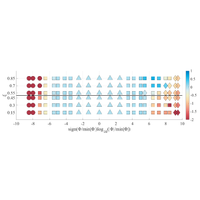
In experiments, chemically active drops most often swim along a rigid wall, the impact of which on self-propulsion is in general completely overlooked in models. Using linear stability analysis, we demonstrate here that the proximity to a rigid surface promotes droplet propulsion as a result of the localization of the strongest interfacial flows within the thin lubrication gap separating the droplet from the wall.

Turbulence structure and scales in canopy-wake reattachment

Hayoon Chung and Jeffrey Koseff

Phys. Rev. Fluids 6, 114605 (2021) - Published 30 November, 2021

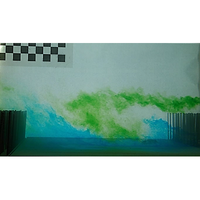
To better understand turbulent reattachment downstream of canopy edges we conducted analysis of velocity and visual data from flume experiments. We find that the mean flow and turbulence statistics suggests the presence of both canopy shear and backward facing step (BFS) dynamics. Depending on the canopy characteristics, the dominance of either dynamics varies spatially within the wake. In regions dominated by canopy-shear turbulence, the separation induced by the canopy edge (BFS dynamics) modifies the canopy signal by introducing both larger and smaller scales to the flow. We also find that turbulence development over the upstream canopy influences the reattachment length in the wake.

Slug bubble growth and dissolution by solute exchange

Daniël P. Faasen, Devaraj van der Meer, Detlef Lohse, and Pablo Peñas

Phys. Rev. Fluids 6, 113501 (2021) - Published 29 November, 2021

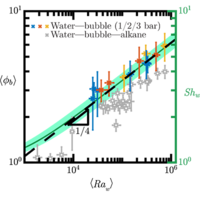
Mass transfer of gases in liquid solvents is a fundamental process during bubble generation for specific purposes or, vice versa, removal of entrapped bubbles. In our work, we address the growth dynamics of a trapped slug bubble in a vertical glass cylinder under a water barrier after replacing the ambient air atmosphere by a CO2 atmosphere at the same or higher pressure. The asymmetric exchange of the gaseous solutes between the CO2-rich water barrier and the air-rich bubble always results in net bubble growth, which we call solute exchange. We compare and explain the experimental results with a simple numerical model, with which the underlying mass transport processes are quantified.

Uniform blowing and suction applied to nonuniform adverse-pressure-gradient wing boundary layers

Marco Atzori, Ricardo Vinuesa, Alexander Stroh, Davide Gatti, Bettina Frohnapfel, and Philipp Schlatter

Phys. Rev. Fluids 6, 113904 (2021) - Published 29 November, 2021

We study different flow control methods on turbulent flow around a NACA4412 airfoil, using resolved large-eddy simulation (LES). We find that changes in total skin friction due to blowing and suction are not very sensitive to different pressure-gradient conditions nor the Reynolds number. However, the boundary-layer thickness, the intensity of the wall-normal convection, and turbulent fluctuations are much more affected, mostly due to the adverse-pressure-gradient conditions, as skin-friction decompositions show. Overall, we conclude that it is not possible to simply separate pressure-gradient and control effects, which is important for control design in practical applications.

Error estimation of a homogenized streamwise periodic boundary layer

Joseph Ruan and Guillaume Blanquart

Phys. Rev. Fluids 6, 114604 (2021) - Published 29 November, 2021
This work concerns the simulation of a homogenized streamwise periodic boundary layer which reduces the computational cost of direct numerical simulations of incompressible flat plate turbulent boundary layers. It expands upon the understanding of how the transpiration velocity changes dependent on whether a blending function is used to account for inner and outer self-similar scaling effects. With this rescaling correction, lower Reynolds number effects on the transpiration velocity are captured by the homogenized streamwise periodic boundary layer simulation.

Sign In to Your Journals Account

Filter

Recent Issues

Vol. 11, Iss. 10
October 2026
Vol. 11, Iss. 9
September 2026
Vol. 11, Iss. 8
August 2026
Vol. 11, Iss. 7
July 2026
Category
Article Type
Section

Filter

Article Lookup

Enter a citation