Recent Articles

Fluid dynamics of COVID-19 spread

Azar Eslam-Panah

Phys. Rev. Fluids 6, 110502 (2021) - Published 15 November, 2021

Tracking the air exhaled by an opera singer

Philippe Bourrianne, Paul R. Kaneelil, Manouk Abkarian, and Howard A. Stone

Phys. Rev. Fluids 6, 110503 (2021) - Published 15 November, 2021

Visualizations of direct fuel injection effects in a supersonic cavity flameholder

Hariswaran Sitaraman, Nicholas Brunhart-Lupo, Marc Henry de Frahan, Shashank Yellapantula, Bruce Perry, Jon Rood, Ray Grout, Marc Day, Roba Binyahib, and Kenny Gruchalla

Phys. Rev. Fluids 6, 110504 (2021) - Published 15 November, 2021

Spectral landscapes of flow instabilities in brain aneurysms

Thangam Natarajan, Daniel E. MacDonald, Lucas Temor, Peter W. Coppin, and David A. Steinman

Phys. Rev. Fluids 6, 110505 (2021) - Published 15 November, 2021

Viscous wrinkling of nonuniform sheets

Oliver McRae, Alexandros T. Oratis, and James C. Bird

Phys. Rev. Fluids 6, 110506 (2021) - Published 15 November, 2021

Rocket yeast

Severine Atis, Bryan T. Weinstein, Andrew W. Murray, and David R. Nelson

Phys. Rev. Fluids 6, 110507 (2021) - Published 15 November, 2021

Impact of high-speed diesel drop trains: Pursuing cleaner diesel engines

David Markt, Jr., Mehdi Raessi, Ashish Pathak, Seong-Young Lee, and Roberto Torelli

Phys. Rev. Fluids 6, 110508 (2021) - Published 15 November, 2021

Beauty of turbulent convection: A particle tracking endeavor

Philipp Godbersen, Johannes Bosbach, Daniel Schanz, and Andreas Schröder

Phys. Rev. Fluids 6, 110509 (2021) - Published 15 November, 2021

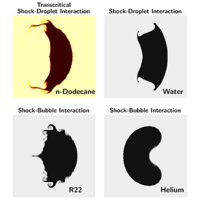
Numerical study of the transcritical shock-droplet interaction

Bradley Boyd and Dorrin Jarrahbashi

Phys. Rev. Fluids 6, 113601 (2021) - Published 15 November, 2021

A shock wave impacting an n-dodecane droplet in a nitrogen environment at near-critical conditions results in a transcritical shock-droplet interaction (TSDI). We illustrate the unique behavior of TSDI compared to the classical cases occurring away from the critical point; i.e., shock-bubble interactions (e.g., helium and R22 bubbles) and shock-droplet interactions (e.g., water droplet).

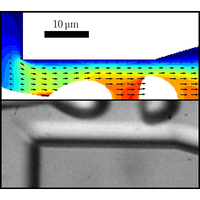
Time-resolved velocity and pressure field quantification in a flow-focusing device for ultrafast microbubble production

Sarah Cleve, Christian Diddens, Tim Segers, Guillaume Lajoinie, and Michel Versluis

Phys. Rev. Fluids 6, 114202 (2021) - Published 15 November, 2021

We present an experimental study of the time-dependent velocity and pressure fields during high-speed microbubble production in a flow-focusing device. Particle tracking velocimetry is used to resolve velocities up to 30 m/s at timescales down to 100 ns, while numerical simulations give access to both the gas and liquid velocity and pressure oscillations.

Settling and clustering of particles of moderate mass density in turbulence

Christian Reartes and Pablo D. Mininni

Phys. Rev. Fluids 6, 114304 (2021) - Published 15 November, 2021

We present a numerical study of settling and clustering of small inertial particles in homogeneous and isotropic turbulence. Particles are denser than the fluid, but not in the limit of being much heavier than the displaced fluid. At fixed Reynolds and Stokes numbers we vary the fluid-to-particle mass ratio γ and the gravitational acceleration. We report nonmonotonic behavior of the particles’ velocity skewness and kurtosis with the second parameter, and an associated anomalous behavior of the settling velocity compared to the free-fall Stokes velocity, including some cases of loitering. Clustering increases for increasing gravitational acceleration, and for decreasing γ.

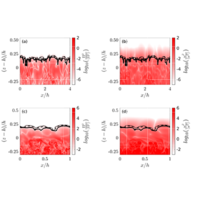
Potential-enstrophy lengthscale for the turbulent/nonturbulent interface in stratified flow

Marco Boetti, Maarten van Reeuwijk, and Alexander Liberzon

Phys. Rev. Fluids 6, 114803 (2021) - Published 15 November, 2021

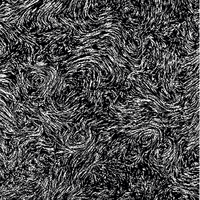
Turbulent/nonturbulent interfaces typically have a thickness of the order of the Kolmogorov scale. However, when we add a density or temperature stratification, we observe that the interface thickness scales differently. We analyze two different turbulent flows at moderate Reynolds numbers using direct numerical simulation and demonstrate that the results collapse on a single curve using a lengthscale based on the potential enstrophy.

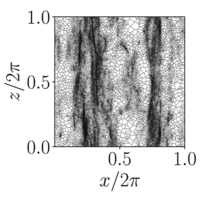
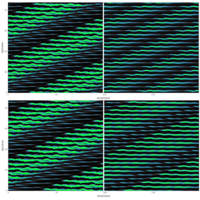
Periodic orbits exhibit oblique stripe patterns in plane Couette flow

Florian Reetz and Tobias M. Schneider

Phys. Rev. Fluids 6, 114401 (2021) - Published 12 November, 2021

Spatiotemporally chaotic dynamics of transitional plane Couette flow may give rise to regular turbulent-laminar stripe patterns with a large-scale pattern wavelength and an oblique orientation to the laminar flow direction. How the stripe pattern forms remains an open problem. To understand stripe pattern spatiotemporal dynamics we identify unstable periodic orbits of the 3D Naiver-Stokes equations that show oblique large-scale spatial amplitude modulation and a temporal evolution of standing waves. The unstable periodic orbits are embedded in the edge of chaos in a symmetry subspace of plane Couette flow and thereby may mediate transition to and from turbulent flows with oblique patterns.

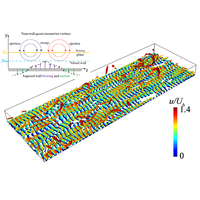
Drag reduction via opposition control in a compressible turbulent channel

Jie Yao and Fazle Hussain

Phys. Rev. Fluids 6, 114602 (2021) - Published 12 November, 2021

The compressibility effect on opposition drag control is investigated using direct numerical simulation of turbulent channel flows at a bulk Reynolds number Reb = 3000 for three different bulk Mach numbers: Mb = 0.3, 0.8, and 1.5. With increasing Mb, drag reduction slightly decreases at small sensing plane location yd+ but increases at large yd+. Interestingly, for large yd+ cases, a resonance buffer layer characterized by a streamwise periodic array of spanwise-coherent rollers is established, one of the primary reasons for the degradation of drag reduction performance.

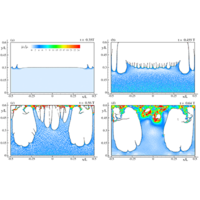
Numerical study on the dissipation mechanisms in sloshing flows induced by violent and high-frequency accelerations. I. Theoretical formulation and numerical investigation

S. Marrone, A. Colagrossi, F. Gambioli, and L. González-Gutiérrez

Phys. Rev. Fluids 6, 114801 (2021) - Published 12 November, 2021

A numerical study of damping effects on aircraft wings caused by liquid sloshing inside the fuel tanks has been performed. To model this phenomenon, a tank-fluid system is vertically excited with a periodic law of motion. The work has two parts. In the present Part I, a mathematical formalism of the global energy balance in different frames of reference is provided. Then, an enhanced Smoothed Particle Hydrodynamics model, (delta-LES-SPH), has been applied for the simulation of this violent flow. Multiple energy dissipation mechanisms such as liquid impacts and turbulence are discussed. Comparison with experimental results and the fluid-structure interaction case is carried out in Part II.

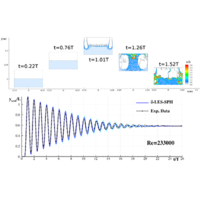
Numerical study on the dissipation mechanisms in sloshing flows induced by violent and high-frequency accelerations. II. Comparison against experimental data

S. Marrone, A. Colagrossi, J. Calderon-Sanchez, and J. Martinez-Carrascal

Phys. Rev. Fluids 6, 114802 (2021) - Published 12 November, 2021

As a continuation of Part I, where the energy balance of a periodically excited confined flow was studied, in this second part the numerical model is validated against experiments on a vertically excited tank-fluid system in decaying motion. In one of two numerical models, the decaying tank movement is prescribed according to the experimental measurements; in the second the tank is coupled to a mass-spring-damper equation resembling the experimental one. Both problems were studied for two different fluids with a difference in two orders of magnitude in Reynolds number. The numerical force and energy balance inside the fluid tank are compared to the experimental data showing good agreement.

Three-dimensional turbulence generated homogeneously by magnetic particles

A. Cazaubiel, J.-B. Gorce, J.-C. Bacri, M. Berhanu, C. Laroche, and E. Falcon

Phys. Rev. Fluids 6, L112601 (2021) - Published 12 November, 2021

Three-dimensional (3D) turbulence is often studied experimentally in closed containers with energy injected at a large scale from a container boundary. We conduct an experiment with remotely driven small magnetic particles to force fluid in volume, randomly in space and time. Such a forcing, like many direct numerical simulations, generates stationary, homogeneous and isotropic turbulence with almost no mean flow, as characterized by fluid velocity measurements. Different methods are used to estimate the energy dissipation rate consistently. We experimentally confirm Tennekes prediction for 3D turbulence without mean flow, and resolve conflicts among previously suggested values of Tennekes’ constant.

Instability of the one-dimensional thickness profile at the edge of a horizontal foam film and its Plateau border

Corentin Trégouët and Isabelle Cantat

Phys. Rev. Fluids 6, 114005 (2021) - Published 11 November, 2021

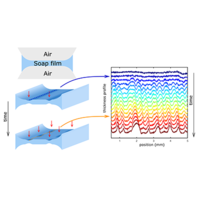
The thinning of the liquid films separating bubbles in a foam or in a bubbly liquid controls the coalescence process and the foam stability, and is highly relevant in many industrial processes. This thinning process leads to films of heterogeneous thickness, in which spontaneous symmetry breaking occurs, shown to be driven by surface minimization only.

Drops spreading on fluid surfaces: Transition from Laplace to Marangoni regime

Swaraj Deodhar, Sumesh P. Thampi, and Madivala G. Basavaraj

Phys. Rev. Fluids 6, L112001 (2021) - Published 11 November, 2021

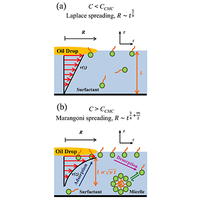
Oil drops placed on surfactant laden water surface exhibit a transition from surface tension driven to surface tension gradient driven spreading as a function of surfactant concentration. Interestingly, this transition occurs at the critical micellar concentration irrespective of surfactant chemistry demonstrating a connection between fluid flows and shuttling of surfactant between the bulk and the interface.

Oscillations of a flexible filament under surface gravity waves

Kamlesh Kumar, Vivek Kumar, P. Deepu, and Pritesh Ramya

Phys. Rev. Fluids 6, 114004 (2021) - Published 10 November, 2021

The response of an aquatic plant and an elastic fiber in an oscillatory flow field induced by gravity waves is studied. The flexible structure behaves like a driven harmonic oscillator. In the limit of drag-dominated oscillations, the frequency response of the structures exhibits no resonance. Our results show that in natural settings, the oscillations of such slender biological structures are generally in the drag-dominated regime and hence sharp resonance is unlikely.

Sign In to Your Journals Account

Filter

Recent Issues

Vol. 11, Iss. 10
October 2026
Vol. 11, Iss. 9
September 2026
Vol. 11, Iss. 8
August 2026
Vol. 11, Iss. 7
July 2026
Category
Article Type
Section

Filter

Article Lookup

Enter a citation