Recent Articles

Saturation mechanism of the fluctuation dynamo in supersonic turbulent plasmas

Amit Seta and Christoph Federrath

Phys. Rev. Fluids 6, 103701 (2021) - Published 4 October, 2021

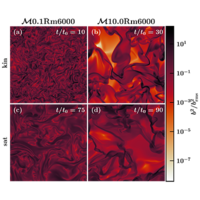
The physical mechanism of converting the kinetic energy of turbulence to magnetic energy is known as a dynamo. Fluctuation dynamo amplifies magnetic fields at scales smaller than the driving scale of turbulence. We show that the fluctuation dynamo in subsonic turbulent plasma is similar to the supersonic case in some aspects and very different in others.

Predator-prey plankton dynamics in turbulent flow past an obstacle

Alice Jaccod, Stefano Berti, Enrico Calzavarini, and Sergio Chibbaro

Phys. Rev. Fluids 6, 103802 (2021) - Published 4 October, 2021

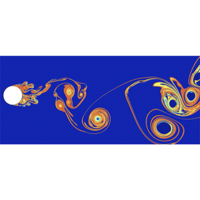
A predator-prey model of plankton dynamics in a turbulent flow past an idealized island is studied through fully-resolved numerical simulations to understand the complex interplay between biological excitable behavior and flow transport. We provide evidence that for a certain relation between advective and biological time scales, plankton accumulates in localized filamentary regions where velocity gradients compete with reaction-diffusion spreading, favoring persistence and primary production. The impact of small turbulent scales and of the geometrical details of the obstacle are investigated as well, quantifying their effects on plankton dynamics and patchiness.

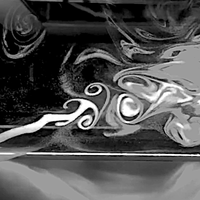
Contribution of Mach number to the evolution of the Richtmyer-Meshkov instability induced by a shock-accelerated square light bubble

Satyvir Singh

Phys. Rev. Fluids 6, 104001 (2021) - Published 4 October, 2021

The Richtmyer-Meshkov (RM) instability has long been an interesting subject due to its fundamental significance in scientific research. In the current study, the contribution of shock Mach number on the evolution of the RM instability induced by a shock-accelerated square light bubble is investigated numerically. The shock Mach number causes significant changes in flow morphology, resulting in complex wave patterns, vorticity generation, vortex formation, and bubble deformation. The Mach number effects are explored in detail through various physical phenomena such as vorticity production, kinetic energy, dissipation rate, and enstrophy.

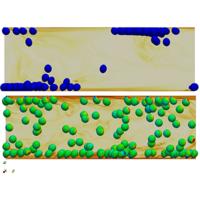
Polymer drag reduction in surfactant-contaminated turbulent bubbly channel flows

Daulet Izbassarov, Zaheer Ahmed, Pedro Costa, Ville Vuorinen, Outi Tammisola, and Metin Muradoglu

Phys. Rev. Fluids 6, 104302 (2021) - Published 4 October, 2021

Interface-resolved direct numerical simulations are performed to investigate the effects of clean (top) and contaminated (bottom) bubbles driven upward in Newtonian and viscoelastic turbulent channel flows. It is found that the viscoelasticity promotes formation of the bubble-wall layers and thus the polymer drag reduction is completely lost for the surfactant-free bubbly flows. An addition of a minute amount of Triton X-100 to the viscoelastic turbulent bubbly flow system is found to be sufficient to revive the polymer drag reduction effects.

Fluid dynamics beyond the continuum: A physical perspective on large-eddy simulation

Max Okraschevski, Sven Hoffmann, Katharina Stichling, Rainer Koch, and Hans-Joerg Bauer

Phys. Rev. Fluids 6, L102601 (2021) - Published 4 October, 2021

In our work, we motivate and rederive the Large-eddy simulation (LES) framework by coarse-graining of Lagrangian fluid elements making use of a statistical mechanics approach. Consequently, we understand that LES is much more than a numerical turbulence model, namely a perspective commonly taken by modern fluid dynamicists, not only in numerical simulations but also in experiments. From this point of view, we see the potential to develop a unified theory for LES and the Reynolds-averaged Navier-Stokes (RANS) framework and additionally reveal a link to uncertainty quantification in particle image velocimetry (PIV).

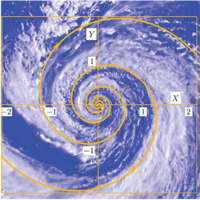
Dynamics of thin jets generated by temperature fronts

V. P. Goncharov

Phys. Rev. Fluids 6, 103801 (2021) - Published 1 October, 2021

This manuscript presents a derivation of path equations to describe the dynamics of thin jets evolving along temperature fronts. The results show spiral-like solutions, as opposed to the case of jets arising at potential vorticity fronts.

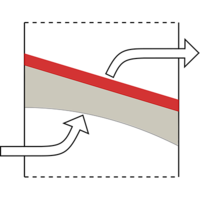
Role of caking in optimizing the performance of a concertinaed ceramic filtration membrane

V. E. Pereira, M. P. Dalwadi, and I. M. Griffiths

Phys. Rev. Fluids 6, 104301 (2021) - Published 1 October, 2021

A study of caking in a concertinaed filtration membrane uncovers potential inaccuracies in using flux–throughput curves to determine filter-blocking behavior, and further explores the effect of membrane properties and configuration on flow and blocking dynamics.

Rayleigh-Bénard convection: The container shape matters

Olga Shishkina

Phys. Rev. Fluids 6, 090502 (2021) - Published 28 September, 2021

In an effort to achieve very large Rayleigh numbers when studying turbulence on a Rayleigh–Baposenard configuration, one can carry out simulations and experiments in as high convection cells as possible which involves using convection cells with the smallest possible aspect ratio. However, with the increasing height of the cell, the Rayleigh number grows much slower than the critical Rayleigh number for the onset of convection in the same container. This article discusses how to estimate accurately the critical Rayleigh number for the onset of convection in confined geometries and the optimal shape of the container.

Liquid transport produced by a cluster of peristaltic contractions in a circular channel

Tomoki Oyama, Shunichi Ishida, Kohei Maeyama, Taimei Miyagawa, and Yohsuke Imai

Phys. Rev. Fluids 6, 093102 (2021) - Published 28 September, 2021

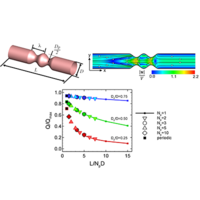
Clustered contractions are observed in the human small intestine after fatty meals or in patients with gastrointestinal diseases. We present a numerical and theoretical analysis of liquid flow produced by the cluster of peristaltic waves in a circular channel. We show that flow rate is not proportional to the number of peristaltic waves in a cluster, and the flow rates of different numbers of waves collapse onto a single curve of each contraction ratio.

Collective surfing of two self-propelled swimmers at liquid-air interface aided by self-induced Marangoni flow

Prajitha Mottammal, Sumesh P. Thampi, and Andrey Pototsky

Phys. Rev. Fluids 6, 094004 (2021) - Published 28 September, 2021

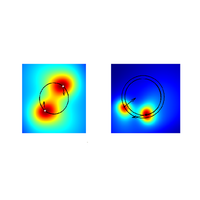
We study collective motion of two hydrodynamically coupled identical pushers at a planar fluid/air interface in the presence of self-induced Marangoni flow, which is generated by insoluble surfactant, excreted by the pushers at a constant rate. Surfactant decomposes homogeneously at a constant rate. Under specific initial conditions, the pushers form a stable rotational equilibrium, whereby each pusher follows a circular path and the distribution of surfactant in the co-rotating frame of reference is stationary. In the absence of the Marangoni flow, the rotational equilibrium becomes unstable and the pushers move away from each other.

Tollmien-Schlichting route to elastoinertial turbulence in channel flow

Ashwin Shekar, Ryan M. McMullen, Beverley J. McKeon, and Michael D. Graham

Phys. Rev. Fluids 6, 093301 (2021) - Published 27 September, 2021

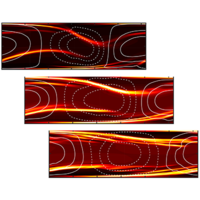
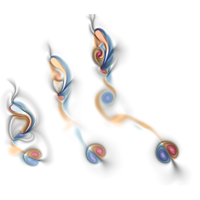
Elastoinertial turbulence (EIT) in dilute polymer solutions displays tilted sheets of polymer stretch with weak spanwise-oriented flow structures – a sharp contrast to the three-dimensional quasistreamwise vortex structures that make up inertia-driven Newtonian turbulence. We show that at for channel flow at sufficiently high Reynolds number, the Newtonian nonlinear Tollmien-Schlichting (TS) wave evolves continuously into EIT as the Weissenberg number increases, highlighting in particular a “sheet-shedding” process by which individual sheets are born in the Kelvin cat’s eye structure of the TS wave and break up to form the layered multi-sheet structure characteristic of EIT.

Kinematics of a bubble freely rising in a thin-gap cell with additional in-plane confinement

Lucas Pavlov, M. Verónica D'Angelo, Mario Cachile, Véronique Roig, and Patricia Ern

Phys. Rev. Fluids 6, 093605 (2021) - Published 27 September, 2021

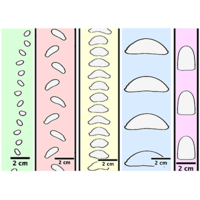
Bubbles freely rising in a fluid at rest can display a variety of complex paths and shapes. We investigate experimentally their behavior in the inertial regimes obtained for a Hele-Shaw cell, where additional lateral walls are introduced to modify the cell width, and thus the coupling between the bubbles’ velocity and shape. Scaling laws characterizing the different regimes of motion are provided.

Autonomous transport and splitting of a droplet on an open surface

Imdad Uddin Chowdhury, Pallab Sinha Mahapatra, Ashis Kumar Sen, Arvind Pattamatta, and Manish K. Tiwari

Phys. Rev. Fluids 6, 094003 (2021) - Published 27 September, 2021

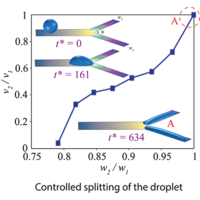
We show a standalone power-free technique for transporting and splitting a droplet on an open surface using continuous wettability-gradients. A three-dimensional phase-field Cahn-Hilliard model for interfaces and Navier-Stokes equations for transport are employed and solved numerically using the finite element method. We can control the droplet splitting ratio by manipulating the widths of the Y-branches. The physics of the droplet transport, flow pattern inside the droplet, and the splitting mechanisms have been explained through detailed numerical studies and scaling analysis.

Numerical dispersion effects on the energy cascade in large-eddy simulation

Gopal R. Yalla, Todd A. Oliver, and Robert D. Moser

Phys. Rev. Fluids 6, L092601 (2021) - Published 27 September, 2021

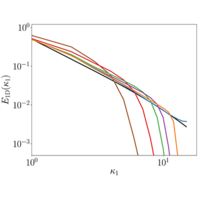
This work focuses on characterizing the effects of numerical dispersion error on the energy cascade in large-eddy simulation (LES) of convecting homogeneous isotropic turbulence. Numerical energy and transfer spectra reveal that energy is not transferred at the appropriate rate to wavemodes where significant dispersion error is present, leading to a deficiency of energy in highly dispersive modes and an accompanying pile up of energy in the well resolved modes. An asymptotic analysis indicates that dispersion error causes a phase decoherence between triad interacting wavemodes, leading to a reduction in the mean energy transfer rate for these scales.

Pulse modulation of synthetic jet actuators for control of separation

Thomas T. Rice, Keith Taylor, and Michael Amitay

Phys. Rev. Fluids 6, 093902 (2021) - Published 24 September, 2021

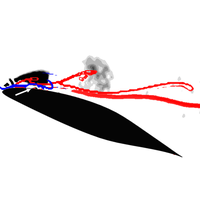
We investigate vortex shedding off an airfoil generated by pulsed actuation (or pulse modulation) of synthetic jets. This technique is shown to shed circulation in a controlled manner during dynamic stall, reducing many of its detrimental effects.

Physics-informed machine learning of the Lagrangian dynamics of velocity gradient tensor

Yifeng Tian, Daniel Livescu, and Michael Chertkov

Phys. Rev. Fluids 6, 094607 (2021) - Published 23 September, 2021

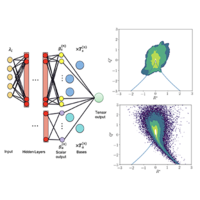
Reduced models describing the Lagrangian dynamics of the Velocity Gradient Tensor (VGT) in Homogeneous Isotropic Turbulence (HIT) are developed under the Physics-Informed Machine Learning (PIML) framework. We construct the pressure Hessian and sub-filter contributions using the integrity bases and invariants of VGT and express them with extended Tensor Basis Neural Network (TBNN). We observe that the PIML model provides an improved representation for the magnitude and orientation of the small-scale pressure Hessian contributions. Statistics of the flow, as indicated by the joint PDF of second and third invariants of the VGT, show good agreement with the “ground-truth” DNS data.

Electrohydrodynamic migration and dispersion of polyelectrolytes during simultaneous shear flow and electrophoresis

Dmitry I. Kopelevich and Jason E. Butler

Phys. Rev. Fluids 6, 094203 (2021) - Published 22 September, 2021

Simultaneous application of flow and electric fields along a microfluidic channel can focus flexible polyelectrolyte molecules. Electrohydrodynamic interactions drive the migration to the center. Though migration velocity increases monotonically with electric field strength, the polyelectrolyte concentration at the center of the channel diminishes after exceeding a critical electric field. The mean-field model developed here demonstrates that dispersion, induced by the electric field interacting with Brownian fluctuations in the polyelectrolyte configuration, causes this phenomena.

Marginally stable thermal equilibria of Rayleigh-Bénard convection

Liam O'Connor, Daniel Lecoanet, and Evan H. Anders

Phys. Rev. Fluids 6, 093501 (2021) - Published 21 September, 2021

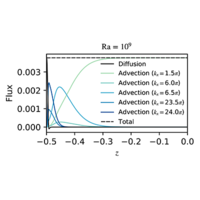
We study Boussinesq convection by computing marginally-stable mean temperature profiles for various Ra which are thermal equilibria of the quasilinear equations. We find these marginally-stable thermal equilibria by solving one-dimensional eigenvalue problems and allowing the mean temperature to evolve according to diffusion and advection by the eigenmodes. The mode amplitudes are chosen such that the mean temperature maintains marginally stability. We find that multiple marginally-stable modes become important for Ra > 106, and Nu ~ Ra1/3 up to our maximum Ra = 109.

Learning swimming escape patterns for larval fish under energy constraints

Ioannis Mandralis, Pascal Weber, Guido Novati, and Petros Koumoutsakos

Phys. Rev. Fluids 6, 093101 (2021) - Published 20 September, 2021

This study explores escape motions employed by larval fish using two-dimensional simulations. We demonstrate how a deep reinforcement learning framework, discovers swimming escape motions, not previously obtained through direct optimization, under various energy constraints. The study serves to showcase the richness of flow physics that can be discovered through the use of artificial intelligence.

Interplay of induced charge electroosmosis and electrothermal flow in insulator-based dielectrophoresis

Amirreza Malekanfard, Zhijian Liu, Hui Zhao, Yongxin Song, and Xiangchun Xuan

Phys. Rev. Fluids 6, 093702 (2021) - Published 16 September, 2021
A depth-averaged numerical model is developed to understand the experimentally observed interplay of induced charge electroosmosis and electrothermal flow in an insulator-based dielectrophoresis microdevice. The experimentally measured nonlinear fluid velocity matches asymptotically the predicted velocity of the electroosmotic flow in a low-concentration buffer and that of electrothermal flow in a high-concentration buffer. This agreement is consistent with a scaling analysis.

Sign In to Your Journals Account

Filter

Recent Issues

Vol. 11, Iss. 10
October 2026
Vol. 11, Iss. 9
September 2026
Vol. 11, Iss. 8
August 2026
Vol. 11, Iss. 7
July 2026
Category
Article Type
Section

Filter

Article Lookup

Enter a citation