Recent Articles

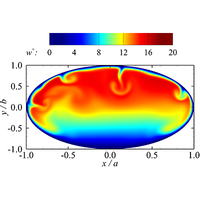
Direct numerical simulation of turbulent elliptical pipe flow under system rotation about the major axis

Rafael Hurtado Rosas, Zhao-Ping Zhang, and Bing-Chen Wang

Phys. Rev. Fluids 6, 084609 (2021) - Published 25 August, 2021

The effect of Coriolis forces on the turbulent flow in an elliptical pipe subjected to spanwise rotation has been studied using direct numerical simulations (DNS). In response to the system rotation, large-scale secondary flows appear in the cross-stream plane as a pair of counter-rotating vortices, which significantly impact the turbulence statistics and structures of the flow. The characteristics of the turbulence field is investigated in both physical and spectral spaces through analyses of the first- and second-order statistical moments, as well as the budget balance of the Reynolds stress transport equation and coherent flow structures.

Spanwise structuring and rivulet formation in suspended falling liquid films

Manuel Rietz, Reinhold Kneer, Benoit Scheid, and Wilko Rohlfs

Phys. Rev. Fluids 6, 084805 (2021) - Published 25 August, 2021

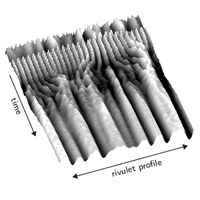
In thin films flowing down the underside of an inclined planar substrate, surface topology is known to evolve towards a spanwise structuring of rivulets. While experiments imply a connection between long-term spanwise structuring and primary instabilities (PI) of the film surface at low Reynolds number (Re), this connection is not conclusive if a larger parameter space of Re and Kapitza number (Ka) is considered. Using an integral boundary layer model for falling liquid films and varying imposed initial conditions, Re, Ka, and wall inclination, we numerically investigate long-term rivulet evolution and its connection to PI, obtaining excellent concordance with previous experimental data.

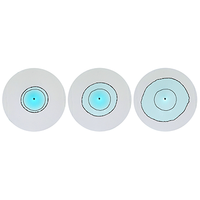
Unexpected scaling of interstitial velocities with permeability due to polymer retention in porous media

Shima Parsa, Ahmad Zareei, Enric Santanach-Carreras, Eliza J. Morris, Ariel Amir, Lizhi Xiao, and David A. Weitz

Phys. Rev. Fluids 6, L082302 (2021) - Published 25 August, 2021

Flow and retention of polymer in porous media result in an unexpected reduction in medium permeability. Our experiment and simulation of polymer retention show that these changes are a direct consequence of pore blockage and diversion of flow through the medium. Despite the complex changes in flow after polymer retention, we introduce a simple scaling for the distribution of pore-level velocities based on the bulk permeability of the medium.

Dynamics of a helical swimmer crossing viscosity gradients

Christian Esparza López, Jorge Gonzalez-Gutierrez, Francisco Solorio-Ordaz, Eric Lauga, and Roberto Zenit

Phys. Rev. Fluids 6, 083102 (2021) - Published 23 August, 2021

We study how helical swimmers move across a viscosity gradient, motivated by the need to understand how such heterogenous environments affect the motion of microorganisms. We find that the swimmer’s speed can be either decreased or increased while crossing the viscosity gradient, depending on the orientation of the tail and the gradient of viscosity. Our experimental findings are sustained by good agreement with a resistive-force based model.

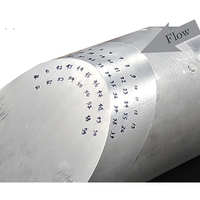
Beyond actuator line arrays in active flow control studies: Lessons from a genetic algorithm approach

Fernando Zigunov, Prabu Sellappan, and Farrukh Alvi

Phys. Rev. Fluids 6, 083903 (2021) - Published 23 August, 2021

Active flow control with microjets in crossflow is a promising technology to improve the performance of many engineering flows. Predicting effective placement for the microjets at the surface of the aerodynamic model remains an unsolved challenge due to the complex interactions between the jets and the main flow. We propose and demonstrate a fully experimental, model-free approach using a solenoid array and a genetic algorithm to find a highly effective actuator pattern for drag reduction in the flow over a simplified fuselage afterbody, deploying thousands of actuator configurations in a single experiment and reaching a configuration that achieves a 10% reduction in drag.

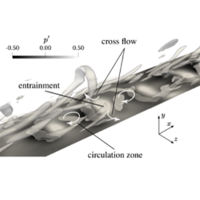
Effects of porous walls on near-wall supersonic turbulence

Yongkai Chen and Carlo Scalo

Phys. Rev. Fluids 6, 084607 (2021) - Published 23 August, 2021

Modification to the structure of wall-bounded turbulence due to the presence of porous walls has been investigated in the low and high supersonic regime. For sufficiently high degrees of wall permeability, streamwise-traveling surface waves are triggered and stay confined in the buffer layer region. These waves yield a sinusoidal modulation of the near-wall turbulent ejection and burst events.

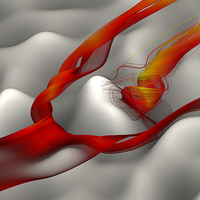
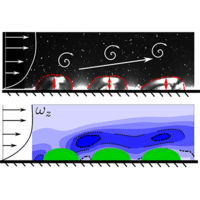
Numerical study of Fourier-filtered rough surfaces

F. Alves Portela, A. Busse, and N. D. Sandham

Phys. Rev. Fluids 6, 084606 (2021) - Published 20 August, 2021

Correlations between the properties of a rough surface and their associated drag are a very useful tool in engineering. Here, we assess the effect of different scales of roughness by numerically simulating the flow over surfaces constructed by band-passing the spectral content of a scanned grit-blasted surface. Although the velocity fluctuations are found overall to be resilient to the changes, we find existing drag correlations to be only qualitatively useful, while dispersive stresses (associated with mean flow inhomogeneity) are shown to depend on the roughness spectral content.

Symmetry analysis of the turbulent dissipation rate

Kalale Chola and Pinaki Chakraborty

Phys. Rev. Fluids 6, L082602 (2021) - Published 19 August, 2021

In 1935, G. I. Taylor invoked rotational symmetry to derive a remarkable formula for the turbulent dissipation rate. That derivation, though ingenious, leaves it unclear if the formula truly conforms with rotational symmetry. We use the machinery of Lie groups to furnish a rigorous derivation of Taylor’s formula under rotational symmetry and also under a symmetry not considered by Taylor, reflectional symmetry.

Relaxation of a fluid-filled blister on a porous substrate

Danielle L. Chase, Ching-Yao Lai, and Howard A. Stone

Phys. Rev. Fluids 6, 084101 (2021) - Published 18 August, 2021

We study the relaxation dynamics of a fluid-filled blister between an elastic sheet and a porous substrate using laboratory experiments and a mathematical model. The dynamics are controlled by the deformation of the elastic sheet, the viscous stresses in the pores, and the capillary pressure at the liquid-air interface due to imbibition. We identify two regimes of drainage, where for thick sheets and more permeable substrates, drainage is primarily due to the stresses in the deformed elastic sheet, and for thin sheets and less permeable substrates, drainage is driven by the imbibition of the liquid into the pore space.

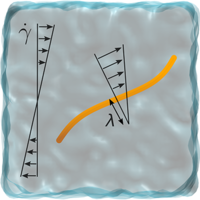
Alignment of a flexible platelike particle in shear flow: Effect of surface slip and edges

Catherine Kamal, Simon Gravelle, and Lorenzo Botto

Phys. Rev. Fluids 6, 084102 (2021) - Published 18 August, 2021

Rigid plate-like particles displaying interfacial slip can attain a constant orientation in a shear flow when the slip length is sufficiently large. But actual thin particles such as single-layer graphene are prone to bending deformations when exposed to shear stress. To study the effect of bending deformation on the particle’s stable orientation, we develop a two-dimensional fluid-structure interaction model. We find that (i) a stable alignment occurs even for relatively flexible particles, and that (ii) edges effects on the shape of the plate are important for values of the length-to-thickness aspect ratio as large as 100.

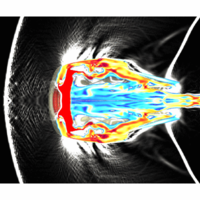
Droplet aerobreakup under the shear-induced entrainment regime using a multiscale two-fluid approach

Georgia Nykteri and Manolis Gavaises

Phys. Rev. Fluids 6, 084304 (2021) - Published 17 August, 2021

A droplet exposed to a high-speed gas flow is subject to a violent fragmentation, dominated by a widespread mist of multiscale structures that introduce significant complexities in numerical studies. The present work focuses on capturing all stages of the aerodynamic breakup of a waterlike droplet under the shear-induced entrainment regime. The numerical investigation is conducted within a physically consistent multiscale framework, which provides insight into the mist dynamics and the distribution of the produced secondary droplets under different postshock conditions.

Multiphase CFD modeling of front propagation in a Hele-Shaw cell featuring a localized constriction

Jonatan R. Mac Intyre, Antti Puisto, Marko Korhonen, Mikko Alava, and Jordi Ortín

Phys. Rev. Fluids 6, 084305 (2021) - Published 17 August, 2021

Liquid-gas front propagation in disordered media exhibits unique behavior during a repeated series of drainage-imbibition displacements. Such complex behavior in a disordered media can be simplified to a single mesa-shaped defect, which provides new insight into the collective behavior at the macro-scale. We show how the morphological difference in imbibition and drainage is affected by the capillary number and wetting properties.

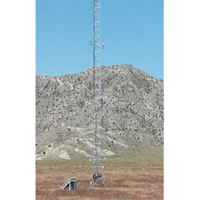
Structure functions in nocturnal atmospheric boundary layer turbulence

Eliezer Kit, Eli Barami, and H. J. S. Fernando

Phys. Rev. Fluids 6, 084605 (2021) - Published 17 August, 2021

Turbulence in a nocturnal stably stratified flow draining from a mountain range was captured using a probe system consisting of sonic and hot-film anemometers that communicate with each other through a neural network for optimal operation without any human intervention. This unique ‘Combo’ system allowed probing turbulence continuously down to energy dissipation scales, at Taylor Reynolds number greater than 1200. The data analyses, together with direct numerical simulation, reveal that, contrary to the Kolmogorov Self-Similarity Hypothesis, turbulence at dissipation scales is anisotropic, suggesting a new line of inquiry on turbulence in stable atmospheric boundary layers.

Erratum: Quantized orbital-chasing liquid metal heterodimers directed by an integrated pilot-wave field [Phys. Rev. Fluids 5, 053603 (2020)]

Jianbo Tang, Xi Zhao, and Jing Liu

Phys. Rev. Fluids 6, 089902 (2021) - Published 17 August, 2021

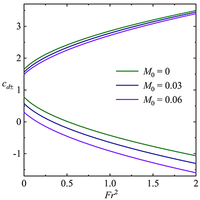
Model reduction of traveling-wave problems via Radon cumulative distribution transform

Jie Ren, William R. Wolf, and Xuerui Mao

Phys. Rev. Fluids 6, L082501 (2021) - Published 17 August, 2021

Due to their sizeable Kolmogorov n-width, travel-wave problems have brought critical challenges to conventional model reduction techniques. This study aims to provide new insights into this problem by exploiting the Radon cumulative distribution transform (R-CDT) that emerged in the sector of computer vision science. By virtue of the unique property that nonlinear invertible R-CDT renders both traveling and scaling components into amplitude modulations, a substantial model-reduction is achieved in the R-CDT space, while sustaining high accuracy. The method is parameter-free and data-driven, which lends itself to problems regardless of the dimensions or boundary conditions.

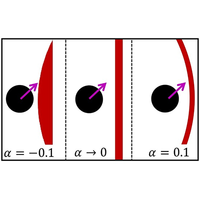
Wall-curvature driven dynamics of a microswimmer

Chaithanya K. V. S. and Sumesh P. Thampi

Phys. Rev. Fluids 6, 083101 (2021) - Published 16 August, 2021

We study the dynamics of a microswimmer near a wall with arbitrary curvature using theory and lattice Boltzmann simulations. The results are presented using several measures with experimental relevance. Extending the previous works on swimmer dynamics near a flat wall, we comprehensively explore the swimmer dynamics near flat, concave, and convex walls. We find that swimmers exhibit a greater affinity towards a concave boundary compared to a convex boundary. In addition, the combined effect of convex and concave walls is studied by confining the swimmer in an annulus.

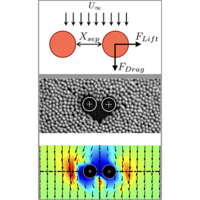
Attraction and repulsion between objects in a granular flow

G. A. Caballero-Robledo, M. F. Acevedo-Escalante, F. Mandujano, and C. Málaga

Phys. Rev. Fluids 6, 084303 (2021) - Published 13 August, 2021

For the first time, the lift force on a pair of obstacles placed side-by-side within a granular flow is studied experimentally. Attraction or repulsion exists between the obstacles depending on the flow velocity and the distance separating them. We found an interesting empirical relation between the lift force and the flow velocity around the obstacles. Our analysis supports the idea that the granular system behaves like a pair of hot intruders within a Newtonian fluid flow with temperature-dependent viscosity.

Stability of a thin viscoelastic film falling down an inclined plane

Tao Hu, Qing-fei Fu, Yan Xing, Li-jun Yang, and Luo Xie

Phys. Rev. Fluids 6, 083902 (2021) - Published 12 August, 2021

We study the long-wave instability of a falling film of the Oldroyd-B fluid. The weighted residual method is adopted to model the film dynamics in both linear and nonlinear regimes. The mechanism of the viscoelastic effect on the instability is explored within the framework of the Whitham wave hierarchy theory. We further analyze the film evolution and the traveling waves by means of nonlinear simulations.

Local relaminarization mechanism induced by a dynamic free-slip boundary

Cong Wang and Morteza Gharib

Phys. Rev. Fluids 6, 084604 (2021) - Published 12 August, 2021

Wall-attached dynamic free-slip surfaces effectively shift the near-wall transverse vorticity field and associated turbulent shearing motions away, creating a locally relaminarized zone in the near-wall region of the turbulent boundary layer.

Actuating water droplets on liquid infused surfaces: A rickshaw for droplets

Christophe Raufaste, Simon J. Cox, and Franck Celestini

Phys. Rev. Fluids 6, 083603 (2021) - Published 11 August, 2021
An efficient actuation method for millimetric droplets is described: Single droplets are driven on a liquid infused surface by a small bead that acts as a carrier, like a rickshaw. When the bead is moved at a fixed velocity the droplet follows its trajectory, up to a critical value of the velocity at which the bead and the droplet lose contact. The critical velocity is predicted from a balance between the bead/droplet adhesion force and the friction acting on the droplet where it is in contact with the substrate.

Sign In to Your Journals Account

Filter

Recent Issues

Vol. 11, Iss. 10
October 2026
Vol. 11, Iss. 9
September 2026
Vol. 11, Iss. 8
August 2026
Vol. 11, Iss. 7
July 2026
Category
Article Type
Section

Filter

Article Lookup

Enter a citation