Recent Articles

Linear theory of particulate Rayleigh-Bénard instability

Suryansh Prakhar and Andrea Prosperetti

Phys. Rev. Fluids 6, 083901 (2021) - Published 11 August, 2021

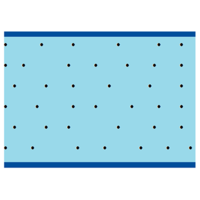
Particles falling uniformly through a Rayleigh-Bénard cell have a profound influence on the stability of the system. Mechanically, they exert a stabilizing effect akin to that of the solid phase in a porous medium. Their temperature, however, can markedly affect the undisturbed temperature distribution of the fluid phase with unexpected effects on the stability threshold.

Resolvent analysis of stratification effects on wall-bounded shear flows

M. A. Ahmed, H. J. Bae, A. F. Thompson, and B. J. McKeon

Phys. Rev. Fluids 6, 084804 (2021) - Published 11 August, 2021

The resolvent framework for the Navier-Stokes equations with the Boussinesq approximation was applied to a stratified turbulent boundary layer. The results show that despite using only a very limited range of representative scales, the resolvent model was able to reproduce the relative magnitude of turbulence intensities and the balance of the energy budget as well as provide meaningful analysis of structures in the flow. The resolvent response modes were able to predict the relative variation in turbulence intensities as a function of wall-normal distance and Richardson number (Riτ) for the Riτ under consideration in this study.

Quasiperiodic fluctuations of von Kármán turbulence driven by viscous stirring

Ryo Araki and Susumu Goto

Phys. Rev. Fluids 6, 084603 (2021) - Published 9 August, 2021

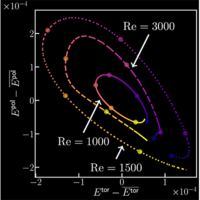
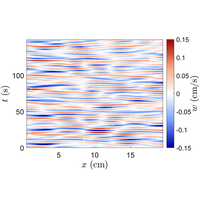
We conduct direct numerical simulations of the viscous-stirring von Karman turbulence which show that it undergoes quasiperiodic cycles. The quasiperiodicity can be explained by energy exchange between toroidal and poloidal components. The proposed scenario of the quasiperiodic energy cycle may persist at higher Reynolds numbers and in inertial-stirring von Karman flow.

Characteristics of vortex shedding from a sinusoidally pitching hydrofoil at high Reynolds number

Xiaobo Zheng, Stefan Pröbsting, Hongliang Wang, and Ye Li

Phys. Rev. Fluids 6, 084702 (2021) - Published 9 August, 2021

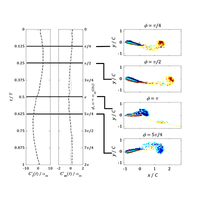
This experimental study characterizes vortex shedding from a sinusoidally pitching hydrofoil at high Reynolds number, reveals the effects of pitching amplitude, reduced frequency, and Reynolds number on the dynamic force responses beyond the linear inviscid theory, and sheds light on the correlation between vortex shedding regimes and dynamic force responses for a high Reynolds number pitching hydrofoil.

Reducing droplet contact time and area by craterlike surface structure

Chensen Lin, Kaixuan Zhang, Xiaocui Chen, Lanlan Xiao, Shuo Chen, Jun Zhu, and Tao Zou

Phys. Rev. Fluids 6, 083602 (2021) - Published 6 August, 2021

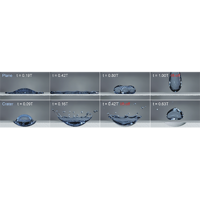
Minimizing the contact between impacting droplets and solid substate is useful in many applications, for example, anti-icing. This study shows that a simple crater-like decoration on a substate can reduce contact area and time simultaneously and cut the overall contact up to 75%. The novel simulation model used in this study has been validated with experiments and shows a great advantage in accurately measuring the dynamic wetting area between liquid and substrate, which can only be inferred with much difficulty in experiments.

Droplet evaporation on inclined substrates

Vasileios Charitatos, Truong Pham, and Satish Kumar

Phys. Rev. Fluids 6, 084001 (2021) - Published 6 August, 2021

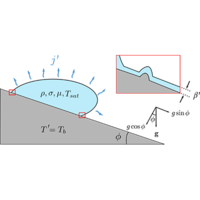
Drying of droplets on inclined surfaces is relevant to applications such as ink-jet printing, spray coating, and crime-scene reconstruction. We develop a lubrication-theory based model to investigate the effect of substrate inclination on the evaporation of pure-solvent and particle-laden droplets on smooth and rough inclined substrates. We find that the effect of inclination on evaporation mainly depends on substrate roughness and the Bond number. Our predictions qualitatively agree with previous experimental work and our model can be easily extended to more complex situations such as multiple droplets evaporating on inclined substrates.

Role of convective acceleration in the interfacial instability of liquid-gas coaxial jets

Guillaume Ricard, Nathanaël Machicoane, Rodrigo Osuna-Orozco, Peter D. Huck, and Alberto Aliseda

Phys. Rev. Fluids 6, 084302 (2021) - Published 6 August, 2021

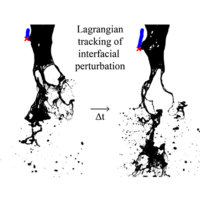
When a high-speed gas flow destabilizes a liquid jet into a spray (atomization), the gas-liquid interface undergoes instabilities that play a key role in the breakup events. We use high-speed backlit imaging to track the maxima of such interfacial perturbations as they get stretched and accelerated by the gas phase. The spatial gradients of the local ensemble-averaged velocity statistics exhibit two regimes with respect to the gas Reynolds numbers that are in good agreement with changes in atomization regimes.

Partially averaged Navier-Stokes closure modeling for variable-density turbulent flow

F. S. Pereira, F. F. Grinstein, D. M. Israel, R. Rauenzahn, and S. S. Girimaji

Phys. Rev. Fluids 6, 084602 (2021) - Published 6 August, 2021

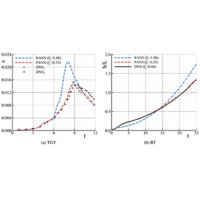
We extend the bridging Partially-Averaged Navier-Stokes (PANS) equations model to variable-density flow and develop a scale-dependent closure for complex flows. This includes a priori testing to develop guidelines for the efficient selection of parameters controlling the model resolution (range of resolved scales). Accuracy of the model is evaluated with simulations of two benchmark transitional problems: the Taylor-Green Vortex and Rayleigh-Taylor flow. The results show that the model can accurately and efficiently predict the selected flows while resolving only a fraction of the turbulence field.

Direction of the microjet produced by the collapse of a cavitation bubble located in a corner of a wall and a free surface

Akihito Kiyama, Takaaki Shimazaki, José Manuel Gordillo, and Yoshiyuki Tagawa

Phys. Rev. Fluids 6, 083601 (2021) - Published 5 August, 2021

A cavitation bubble is harmful to machines as it issues a fast microjet when it collapses near the boundary. This work focusses on a bubble located in a corner of a wall and a free surface, where both boundaries alter the jet direction. We present a simplified model to describe the jet direction as a function of the bubble location, which agrees with that measured in high-speed observation. This may give some insight for avoiding cavitation-induced damage in practical designs.

Stratified shear instability in the cabbeling regime

Taylor Hanson, Marek Stastna, and Aaron Coutino

Phys. Rev. Fluids 6, 084802 (2021) - Published 5 August, 2021

In temperate lakes, early springs typically lead to a weak thermal stratification involving water both above and below the temperature at which the density maximum occurs. This implies that mixing of two parcels with the same density, but different temperature, can lead to the creation of denser fluid: a phenomenon known as cabbeling. Here we document the nature of the three-dimensionalization of shear instability at moderate Reynolds number in the cabbeling regime of freshwater.

Planar hydraulic jump and associated hysteresis in near horizontal confined flow

Mrinmoy Dhar, Gargi Das, and Prasanta Kumar Das

Phys. Rev. Fluids 6, 084803 (2021) - Published 5 August, 2021

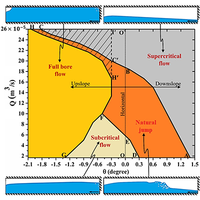
The present study explores the influence of conduit tilt as well as top and side wall confinements on planar hydraulic jumps by means of extensive experiments and theoretical analysis. The observations are consolidated as a phase diagram that identifies the natural jump regime bounded by full bore flow, subcritical flow, and supercritical flow throughout the conduit and also shows the presence of multiple hydrodynamic states for a certain range of input parameters. Upslope flow is found to exhibit unique instabilities and undergo a hysteretic excursion to regain the initial stable configuration. The jump induced hysteretic flow in sloping conduits is reported for the first time.

Erratum: Electrically switchable surface waves and bouncing droplets excited on a liquid metal bath [Phys. Rev. Fluids 3, 124804 (2018)]

Xi Zhao, Jianbo Tang, and Jing Liu

Phys. Rev. Fluids 6, 089901 (2021) - Published 5 August, 2021

Variable density model for the Rayleigh-Taylor instability and its transformation to the diffusive, inhomogeneous, incompressible Navier-Stokes equations

John D. Gibbon

Phys. Rev. Fluids 6, L082601 (2021) - Published 5 August, 2021

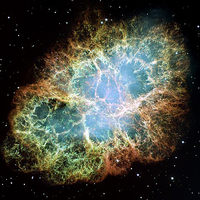
The Rayleigh-Taylor (RT) instability occurs at the interface between two fluids of different densities when the lighter fluid pushes against the heavier. For example, RT instability fingers are evident in the Crab Nebula. It plays a critical role in all known forms of fusion. The variable density model (VDM), which is comprised of a set of partial differential equations, best models the flow in the mixing layer. This paper shows that the VDM can be exactly transformed into the inhomogeneous, incompressible, forced Navier-Stokes equations.

Boundary conditions for two-temperature Navier-Stokes equations for a polyatomic gas

Shingo Kosuge, Kazuo Aoki, Marzia Bisi, Maria Groppi, and Giorgio Martalò

Phys. Rev. Fluids 6, 083401 (2021) - Published 4 August, 2021

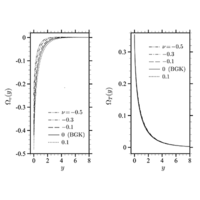
We previously derived the two-temperature Navier-Stokes system (a set of compressible Navier-Stokes equations with the translational and internal temperatures) for a polyatomic gas with slow relaxation of the internal modes from the ellipsoidal statistical model of the Boltzmann equation. In this paper, the appropriate boundary conditions for the two-temperature Navier-Stokes system are derived. The results are presented in a form that is applicable to practical applications immediately.

Finite-size coherent particle structures in high-Prandtl-number liquid bridges

Ilya Barmak, Francesco Romanò, and Hendrik C. Kuhlmann

Phys. Rev. Fluids 6, 084301 (2021) - Published 4 August, 2021

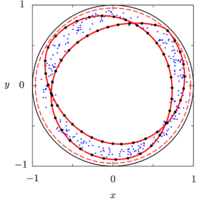
Clustering of small rigid spherical particles in particle accumulation structures (PAS) of various shapes is found with highly resolved numerical simulations in a thermocapillary liquid bridge at a Prandtl number of 68. The intricate Kolmogorov–Arnold–Moser (KAM) structure of the fluid flow is unraveled for several Reynolds numbers for flows periodic in time and space. For these flows, a rich variety of periodic and quasiperiodic attractors for particles nearly density-matched to the fluid is found near closed streamlines and KAM tori approaching the free surface closely. A large parametric study finds the PAS dependence on particle size, particle-to-fluid density ratio, and Reynolds number.

Nonlinear dynamics of two helical vortices: A dynamical system approach

Ivan Delbende, Can Selçuk, and Maurice Rossi

Phys. Rev. Fluids 6, 084701 (2021) - Published 3 August, 2021

Two interwoven helical vortices of the same circulation and pitch display a rich variety of dynamics. Using simplified models of straight vortices, ring vortices, and helical filaments, we introduce dynamical systems of a few degrees of freedom which we analyze in terms of orbits in phase spaces structured by hyperbolic and elliptic points. Possible inviscid motions, namely leapfrogging, overtaking and fluttering, are systematically described as a function of vortex pitch, core size, and initial configuration.

Evidence of collision-induced resuspension of microscopic particles from a monolayer deposit

Amir Banari, Christophe Henry, Rafael Henrique Fank Eidt, Pierre Lorenz, Klaus Zimmer, Uwe Hampel, and Gregory Lecrivain

Phys. Rev. Fluids 6, L082301 (2021) - Published 3 August, 2021

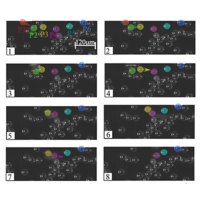
Even after one century of research on particle resuspension the multiphysics mechanism for it remains unclear. In this Letter we show evidence for the inter-particle collision in a monolayer deposit with an intermediate surface coverage. Previously, the inter-particle collision was neglected in monolayer deposits and was considered only in multilayer beds due to lack of evidence. This experimental work indicates that particle cluster resuspension plays an important role in the early stage of resuspension. This explains the strong bimodal character of the resuspension curve, which shows the remaining particle fraction as a function of the flow velocity.

Collective organization and screening in two-dimensional turbulence

Javier Jiménez

Phys. Rev. Fluids 6, 084601 (2021) - Published 2 August, 2021

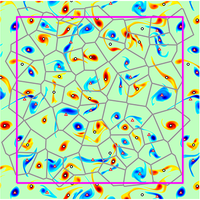
The kinetic energy in two-dimensional turbulence evolves towards larger sizes, eventually condensing into quasi-steady states of a few vortices at the scale of the simulation domain. When this happens in decaying turbulence, the flow initially segregates into a background of fast-moving small vortices and a system of larger ones that move more slowly. The slow component is shown here to form a low-energy ‘stochastic crystal’ in which vortices of opposite sign locally screen each other. Screening has long been conjectured for turbulence, and its mechanism is documented here, but global ordering is believed to be a new observation.

Large-scale flow driven by turbulently generated internal gravity waves

P. Léard, L. Margaillan, T. Raymond, M. Rouby, and M. Le Bars

Phys. Rev. Fluids 6, 084801 (2021) - Published 2 August, 2021

Oscillating large-scale flows observed in atmospheres are driven by turbulently generated internal gravity waves. We experimentally investigate this mechanism by studying the interaction between a turbulent layer and a stratified layer. The wave field is described, and a wave-driven flow is observed and analyzed, although it exhibits no oscillating dynamics.

Shear flows and their suppression at large aspect ratio: Two-dimensional simulations of a growing convection zone

J. R. Fuentes and A. Cumming

Phys. Rev. Fluids 6, 074502 (2021) - Published 30 July, 2021

Shear flows can form spontaneously in two-dimensional (2D) simulations of convection. These flows disperse convective plumes and decrease vertical transport. What is the physics of these flows? Can they be avoided in 2D? It was previously shown that increasing the simulation aspect ratio can prevent the onset of shear flows. With simulations of penetrative convection we explore a range of aspect ratios. We find that small shear perturbations can lead to the formation of strong shear flows by taking energy from convective motions, but the perturbations are suppressed in domains of large aspect ratio. This could allow 2D studies of convection at a lower computational cost than 3D simulations.

Sign In to Your Journals Account

Filter

Recent Issues

Vol. 11, Iss. 10
October 2026
Vol. 11, Iss. 9
September 2026
Vol. 11, Iss. 8
August 2026
Vol. 11, Iss. 7
July 2026
Category
Article Type
Section

Filter

Article Lookup

Enter a citation