Recent Articles

Ballooning in spiders using multiple silk threads

Charbel Habchi and Mohammad K. Jawed

Phys. Rev. E 105, 034401 (2022) - Published 4 March, 2022

Spiders can float in the air using their silk threads as a kind of balloon. This paper presents detailed simulations of this behavior which show that electrostatic charges play an important role, both by providing a lift force and by determining the spatial arrangement of multiple threads.

Lethal DNA damage caused by ion-induced shock waves in cells

Ida Friis, Alexey V. Verkhovtsev, Ilia A. Solov'yov, and Andrey V. Solov'yov

Phys. Rev. E 104, 054408 (2021) - Published 23 November, 2021

Simulations show that the mechanical force of shock waves propagating through cells may be a key component of ion radiation damage to DNA.

Frost spreading and pattern formation on microstructured surfaces

Lukas Hauer, William S. Y. Wong, Azadeh Sharifi-Aghili, Lou Kondic, and Doris Vollmer

Phys. Rev. E 104, 044901 (2021) - Published 1 October, 2021

A new imaging technique reveals the effects of humidity on the spread of frost across a micropatterned surface.

Self-organized multistability in the forest fire model

Diego Rybski, Van Butsic, and Jan W. Kantelhardt

Phys. Rev. E 104, L012201 (2021) - Published 29 July, 2021

Self-organizing properties, unnoticed for decades, are observed in changes in the density of trees in a forest that can catch fire.

Diffusive wave dynamics beyond the continuum limit

Paul B. Dieterle and Ariel Amir

Phys. Rev. E 104, 014406 (2021) - Published 15 July, 2021

A new model shows that the properties of waves produced in a cell-signaling process strongly depend on whether the cells are considered to be discrete entities or a collective mass.

Thermal noise of a cryocooled silicon cantilever locally heated up to its melting point

Alex Fontana, Richard Pedurand, Vincent Dolique, Ghaouti Hansali, and Ludovic Bellon

Phys. Rev. E 103, 062125 (2021) - Published 15 June, 2021

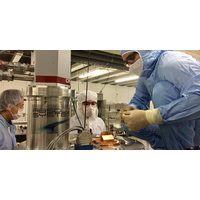
Multiple sources of mechanical dissipation seem to explain why a cantilever subject to an extreme temperature gradient has less thermal noise than theory predicts.

Polarization-density patterns of active particles in motility gradients

Sven Auschra, Viktor Holubec, Nicola Andreas Söker, Frank Cichos, and Klaus Kroy

Phys. Rev. E 103, 062601 (2021) - Published 1 June, 2021

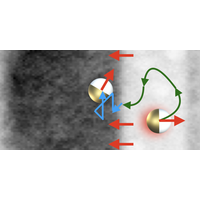
A self-propelled particle trapped in a potential well defined by energy availability, has a unique swimming pattern that comes from hidden currents in the fluid in which it swims.

Mechanisms underlying vaccination protocols that may optimally elicit broadly neutralizing antibodies against highly mutable pathogens

Raman S. Ganti and Arup K. Chakraborty

Phys. Rev. E 103, 052408 (2021) - Published 13 May, 2021

Researchers use nonequilibrium statistical physics methods to guide the design of vaccines that are effective against many strains of a virus, a holy grail of immunology.

Modeling ball possession dynamics in the game of football

A. Chacoma, N. Almeira, J. I. Perotti, and O. V. Billoni

Phys. Rev. E 102, 042120 (2020) - Published 15 October, 2020

What makes soccer so unpredictable with respect to other sports? The authors suggest that, contrary to basketball or baseball, an important part of the game dynamics is developed far from the ball, making data analysis more involved. They try to address this by analyzing a novel dataset and proposing a new theoretical framework that is able to reproduce the statistics of ball possession intervals.

Collective olfactory search in a turbulent environment

Mihir Durve, Lorenzo Piro, Massimo Cencini, Luca Biferale, and Antonio Celani

Phys. Rev. E 102, 012402 (2020) - Published 7 July, 2020

Simulations show that by trusting their neighbors and following their own “noses,” a swarm of fictitious organisms inspired by moths can quickly find a smell’s source in turbulent air.

Site-bond percolation solution to preventing the propagation of Phytophthora zoospores on plantations

J. E. Ramírez, C. Pajares, M. I. Martínez, R. Rodríguez Fernández, E. Molina-Gayosso, J. Lozada-Lechuga, and A. Fernández Téllez

Phys. Rev. E 101, 032301 (2020) - Published 5 March, 2020

A model for plant-disease spreading could aid in the design of an eco-friendly strategy for stopping the disease with barriers between plants.

Identifying knot types of polymer conformations by machine learning

Olafs Vandans, Kaiyuan Yang, Zhongtao Wu, and Liang Dai

Phys. Rev. E 101, 022502 (2020) - Published 11 February, 2020

Identifying if two knots are similar is an open problem that cuts across several disciplines from mathematics to physical sciences; the main challenge is that the knot type is a global property that cannot be determined by looking only locally. In this paper, the authors apply supervised learning techniques to the knot recognition problem in polymers, showing what artificial neural networks can do to address it.

Mechanics-based model for the cooking-induced deformation of spaghetti

Nathaniel N. Goldberg and Oliver M. O'Reilly

Phys. Rev. E 101, 013001 (2020) - Published 2 January, 2020

A strand of spaghetti changes shape as it is cooked. This paper proposes a theory that includes a time-dependent curvature, and models the evolution of the system based on previous observations. The authors compare their results with tabletop experiments and find good agreement.

Cyberphysical risks of hacked internet-connected vehicles

Skanda Vivek, David Yanni, Peter J. Yunker, and Jesse L. Silverberg

Phys. Rev. E 100, 012316 (2019) - Published 30 July, 2019

Researchers calculated the number of cars that hackers would have to bring down in order to cripple Manhattan traffic.

Pattern formation of skin cancers: Effects of cancer proliferation and hydrodynamic interactions

Takuma Hoshino, Ming-Wei Liu, Kuo-An Wu, Hsuan-Yi Chen, Tatsuaki Tsuruyama, and Shigeyuki Komura

Phys. Rev. E 99, 032416 (2019) - Published 21 March, 2019

Skin tumors can exhibit characteristic patterns that may help in diagnosing them. The authors use a phase-separation model with hydrodynamic effects to understand the formation of these patterns. A simulation that includes a growth term and a friction term is able to reproduce some of the clinically observed patterns.

Long-lived transient structure in collisionless self-gravitating systems

David Benhaiem, Francesco Sylos Labini, and Michael Joyce

Phys. Rev. E 99, 022125 (2019) - Published 14 February, 2019

Spiral galaxies are well-known astrophysical structures, but how they form is not fully understood. This paper describes simulations showing that they could be transient, nonequilibrium structures originating from the collapse of clouds of matter interacting solely through self-gravity.

Physics-based modeling and data representation of pairwise interactions among pedestrians

Alessandro Corbetta, Jasper A. Meeusen, Chung-min Lee, Roberto Benzi, and Federico Toschi

Phys. Rev. E 98, 062310 (2018) - Published 14 December, 2018

Observations of large numbers of pedestrians in two new studies offer insights into how humans avoid bumping into each other.

Pedestrian stepping dynamics in single-file movement

Yi Ma, Ying Ying Sun, Eric Wai Ming Lee, and Richard Kowk Kit Yuen

Phys. Rev. E 98, 062311 (2018) - Published 14 December, 2018

Observations of large numbers of pedestrians in two new studies offer insights into how humans avoid bumping into each other.

Modular and programmable material systems drawing from the architecture of skeletal muscle

Narayanan Kidambi, Ryan L. Harne, and Kon-Well Wang

Phys. Rev. E 98, 043001 (2018) - Published 9 October, 2018

A specially designed modular material can adopt many force-generating and energy-storing postures, which could be useful for soft robotics.

Edwards field theory for glasses and granular matter

E. DeGiuli

Phys. Rev. E 98, 033001 (2018) - Published 10 September, 2018

Using field theory, this work describes the existence of long-range stress correlations in amorphous solids with finite-range interactions. Whereas this had already been found in simulations, the paper provides a full theoretical background and shows that the correlations follow solely from mechanical equilibrium.

Sign In to Your Journals Account

Filter

Recent Issues

Vol. 114, Iss. 5
November 2026
Vol. 114, Iss. 4
October 2026
Vol. 114, Iss. 3
September 2026
Vol. 114, Iss. 2
August 2026
Category
Article Type
Section

Filter

Article Lookup

Enter a citation