Recent Articles

Interplay of self, epiphany, and positive actions in shaping individual careers

Rafael A. Bittencourt, H. B. de B. Pereira, M. A. Moret, S. Galam, and I. C. da Cunha Lima

Phys. Rev. E 108, 024314 (2023) - Published 29 August, 2023

A new model could predict the impacts of policy changes on career progression prior to their implementation.

Detecting partial synchrony in a complex oscillatory network using pseudovortices

Yasuhiro Yamada and Kensuke Inaba

Phys. Rev. E 108, 024307 (2023) - Published 17 August, 2023

The dynamics of a collection of coupled neurons resemble that of vortices in a commonly studied two-dimensional lattice model, a finding that could help in understanding brain function and dysfunction.

Substrate-mediated leg interactions play a key role in insect stability on granular slopes

Miguel Piñeirua, Anna Verbe, and Jérôme Casas

Phys. Rev. E 108, 014903 (2023) - Published 25 July, 2023

Experiments show that an optimal distance between points of contact helps insects and other multilegged creatures avoid slipping down a steep granular slope.

Forecasting landslides using community detection on geophysical satellite data

Vrinda D. Desai, Farnaz Fazelpour, Alexander L. Handwerger, and Karen E. Daniels

Phys. Rev. E 108, 014901 (2023) - Published 6 July, 2023

A new method based on satellite data and network models can identify hillsides that may be at risk of catastrophic landslides.

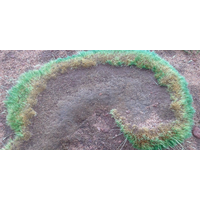
Role of herbivory in shaping the dryland vegetation ecosystem: Linking spiral vegetation patterns and nonlinear, nonlocal grazing

Mrinal Kanti Pal and Swarup Poria

Phys. Rev. E 107, 064403 (2023) - Published 6 June, 2023

Model improvements uncover more information on the link between grazing animals and the formation of spiral vegetation patterns in arid climates.

Oblique impact of a buckling table-tennis ball on a rigid surface

Théophile Rémond, Vincent Dolique, Renaud G. Rinaldi, and Jean-Christophe Géminard

Phys. Rev. E 107, 055007 (2023) - Published 26 May, 2023

The angle of incidence and the friction of the surface are the only factors that impact the spin of a table tennis ball after it collides with a rigid surface.

Evolution of road infrastructure in large urban areas

Erwan Taillanter and Marc Barthelemy

Phys. Rev. E 107, 034304 (2023) - Published 7 March, 2023

Researchers have identified the traffic thresholds at which cities build urban freeways and ring roads, which could help city administrators refine infrastructure plans.

Wealth dynamics in a market with information asymmetries

A. R. Bosco de Magalhães

Phys. Rev. E 107, 014305 (2023) - Published 27 January, 2023

Simulations of the behavior of individual financial traders show that imperfect market knowledge increases risk but not overall losses.

Sea urchin sperm exploit extremum seeking control to find the egg

Mahmoud Abdelgalil, Yasser Aboelkassem, and Haithem Taha

Phys. Rev. E 106, L062401 (2022) - Published 9 December, 2022

When searching for an egg, sea urchin sperm typically switch between two distinct navigation modes, depending on the relative orientation of their velocity with respect to the chemical gradient of the attractant released from the egg. This paper demonstrates that this navigational strategy can be described by the control algorithm known as extremum seeking. There is no need to define a threshold mechanism to explain the switching behavior, as suggested by previous work. This interdisciplinary work could serve as bridge between scientific communities.

Foot function enabled by human walking dynamics

Daniel Renjewski, Susanne Lipfert, and Michael Günther

Phys. Rev. E 106, 064405 (2022) - Published 8 December, 2022

When humans walk, our feet act as levers rather than landing pads as previously thought.

Pattern of inclusions inside rippled icicles

John Ladan and Stephen W. Morris

Phys. Rev. E 106, 054211 (2022) - Published 17 November, 2022

Some icicles develop surface ripples as they grow. Researchers now explain the growth mechanism, but a full explanation remains elusive.

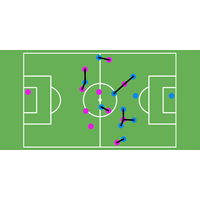
Complexity emerges in measures of the marking dynamics in football games

A. Chacoma, O. V. Billoni, and M. N. Kuperman

Phys. Rev. E 106, 044308 (2022) - Published 28 October, 2022

Network theory can show how successfully a soccer team performs when it’s on the defense.

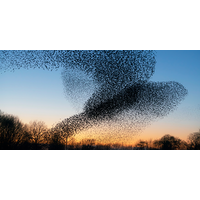
Hydrodynamic theory of two-dimensional incompressible polar active fluids with quenched and annealed disorder

Leiming Chen, Chiu Fan Lee, Ananyo Maitra, and John Toner

Phys. Rev. E 106, 044608 (2022) - Published 27 October, 2022

Predictions indicate that disorder induced by immobile imperfections does not prevent organisms from moving collectively as a group.

Exact solutions for viscous Marangoni spreading

Thomas Bickel and François Detcheverry

Phys. Rev. E 106, 045107 (2022) - Published 18 October, 2022

Researchers can now predict exactly how soap molecules spread across a body of water, an everyday but surprisingly complex process.

Emergence of local irreversibility in complex interacting systems

Christopher W. Lynn, Caroline M. Holmes, William Bialek, and David J. Schwab

Phys. Rev. E 106, 034102 (2022) - Published 6 September, 2022

The authors of this paper investigate irreversibility in a multicomponent system whose components may or may not break detailed balance, and describe a powerful method that can provide insight into the origin of irreversibility in biological systems. This is a must-read paper if you want to understand the details of their technique that “sorts” various sources of irreversibility into contributions from single elements, pairs, triplets, and higher-order interactions.

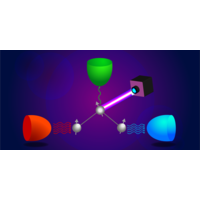
Floquet quantum thermal transistor

Nikhil Gupt, Srijan Bhattacharyya, Bikash Das, Subhadeep Datta, Victor Mukherjee, and Arnab Ghosh

Phys. Rev. E 106, 024110 (2022) - Published 9 August, 2022

A three-qubit transistor design offers a way to manipulate the system’s heat flow by hitting one of the qubits with a laser.

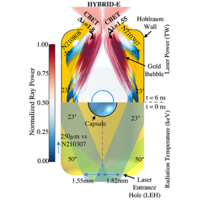
Design of an inertial fusion experiment exceeding the Lawson criterion for ignition

A. L. Kritcher et al.

Phys. Rev. E 106, 025201 (2022) - Published 8 August, 2022

A 2021 inertial fusion experiment at the National Ignition Facility exceeded the so-called Lawson criterion for ignition. This paper describes the key design changes that made this achievement possible.

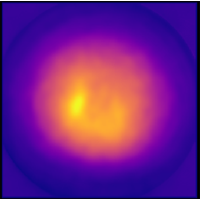
Experimental achievement and signatures of ignition at the National Ignition Facility

A. B. Zylstra et al.

Phys. Rev. E 106, 025202 (2022) - Published 8 August, 2022

Experimental measurements from last year’s igniting plasma experiment at NIF are presented. The results are consistent with self-heating as the dominant term in the power balance.

Information content of brain states is explained by structural constraints on state energetics

Leon Weninger, Pragya Srivastava, Dale Zhou, Jason Z. Kim, Eli J. Cornblath, Maxwell A. Bertolero, Ute Habel, Dorit Merhof, and Dani S. Bassett

Phys. Rev. E 106, 014401 (2022) - Published 5 July, 2022

The structure of connections in the brain determines how activity can propagate, and hence how brain states can evolve. The authors of this paper find that the human brain structure is especially suited to efficiently reach brain states with a high information content.

Morphological transformation from fibers to sheets in embiopteran silk

Aleimah C. Andrews, Sean Duffy, Janice S. Edgerly, and Richard P. Barber, Jr.

Phys. Rev. E 106, 014801 (2022) - Published 5 July, 2022

Using scanning electron microscopes, researchers have observed how water transforms individual silk threads into protective sheets to create waterproof habitats for web-spinning insects.

Sign In to Your Journals Account

Filter

Recent Issues

Vol. 114, Iss. 5
November 2026
Vol. 114, Iss. 4
October 2026
Vol. 114, Iss. 3
September 2026
Vol. 114, Iss. 2
August 2026
Category
Article Type
Section

Filter

Article Lookup

Enter a citation