Recent Articles

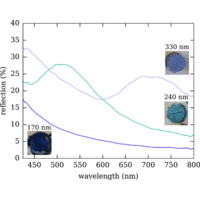
Absence of red structural color in photonic glasses, bird feathers, and certain beetles

Sofia Magkiriadou, Jin-Gyu Park, Young-Seok Kim, and Vinothan N. Manoharan

Phys. Rev. E 90, 062302 (2014) - Published 3 December, 2014

Colloidal glasses, bird feathers, and beetle scales can all show angle-independent structural colors, i.e., colors due to the microscopic structure of the material rather than to a pigment. However, there are few examples of such photonic glasses with red colors in nature. This work shows that the absence of pure red color can be explained by the tendency of individual particles to backscatter light more strongly in the blue, changing any red component into an overall purple color.

Effect of individual behavior on epidemic spreading in activity-driven networks

Alessandro Rizzo, Mattia Frasca, and Maurizio Porfiri

Phys. Rev. E 90, 042801 (2014) - Published 2 October, 2014

A mathematical model quantifies how the behavior of individuals can influence the spreading of diseases.

Scaling hypothesis for the Euclidean bipartite matching problem

S. Caracciolo, C. Lucibello, G. Parisi, and G. Sicuro

Phys. Rev. E 90, 012118 (2014) - Published 21 July, 2014

Mathematical tools from physics are enabling new ways to study a classic optimization problem.

Metastable states and activated dynamics in thin-film adhesion to patterned surfaces

Stefan B. Lindström, Lars Johansson, and Nils R. Karlsson

Phys. Rev. E 89, 062401 (2014) - Published 6 June, 2014

The attractive force that allows geckos to walk on the ceiling is not constant but fluctuates in time at the nanoscale, which weakens it, according to a theoretical analysis.

Relation between the psychological and thermodynamic arrows of time

Leonard Mlodinow and Todd A. Brun

Phys. Rev. E 89, 052102 (2014) - Published 2 May, 2014

This work studies the relationship between the thermodynamic arrow of time (associated with an increase in entropy) and the psychological arrow of time (associated with the existence of memory). The authors argue that the two arrows must necessarily align even for physical memories which are nondissipative and time reversible.

Impact fragmentation of model flocks

Pearson W. Miller and Nicholas T. Ouellette

Phys. Rev. E 89, 042806 (2014) - Published 15 April, 2014

Simulations show that flocks hitting a wall disintegrate like brittle solids rather than splash like fluid drops.

Gas flow in plant microfluidic networks controlled by capillary valves

M. Capron, Ph. Tordjeman, F. Charru, E. Badel, and H. Cochard

Phys. Rev. E 89, 033019 (2014) - Published 28 March, 2014

The authors use microfluidic experiments and imaging techniques to study the mechanism of air flow in the vascular tissue of plants. They conclude that the air diffusion is controlled by capillary valves which open at a critical pressure, a result that is important both for the understanding of plant physiology and for possible application in biomimetic devices.

Approach to failure in porous granular materials under compression

Ferenc Kun, Imre Varga, Sabine Lennartz-Sassinek, and Ian G. Main

Phys. Rev. E 88, 062207 (2013) - Published 23 December, 2013

Discrete-network versus modal representations of brain activity: Why a sparse regions-of-interest approach can work for analysis of continuous dynamics

P. A. Robinson

Phys. Rev. E 88, 054702 (2013) - Published 26 November, 2013

Reentrant phase behavior in active colloids with attraction

Gabriel S. Redner, Aparna Baskaran, and Michael F. Hagan

Phys. Rev. E 88, 012305 (2013) - Published 26 July, 2013

Crosstalk and transitions between multiple spatial maps in an attractor neural network model of the hippocampus: Phase diagram

R. Monasson and S. Rosay

Phys. Rev. E 87, 062813 (2013) - Published 20 June, 2013

Statistical mechanics approach to the sample deconvolution problem

N. Riedel and J. Berg

Phys. Rev. E 87, 042715 (2013) - Published 18 April, 2013

Microstructure identification via detrended fluctuation analysis of ultrasound signals

Paulo G. Normando, Romão S. Nascimento, Elineudo P. Moura, and André P. Vieira

Phys. Rev. E 87, 043304 (2013) - Published 5 April, 2013

Density-driven convection enhanced by an inclined boundary: Implications for geological CO2 storage

Peichun A. Tsai, Kathleen Riesing, and Howard A. Stone

Phys. Rev. E 87, 011003(R) (2013) - Published 31 January, 2013

Modeling a washboard road: From experimental measurements to linear stability analysis

Baptiste Percier, Sébastien Manneville, and Nicolas Taberlet

Phys. Rev. E 87, 012203 (2013) - Published 17 January, 2013

Modeling the mechanical properties of DNA nanostructures

Jean Michel Arbona, Jean-Pierre Aimé, and Juan Elezgaray

Phys. Rev. E 86, 051912 (2012) - Published 21 November, 2012

Quantum measurement and the first law of thermodynamics: The energy cost of measurement is the work value of the acquired information

Kurt Jacobs

Phys. Rev. E 86, 040106(R) (2012) - Published 25 October, 2012

Nonlinear shallow ocean-wave soliton interactions on flat beaches

Mark J. Ablowitz and Douglas E. Baldwin

Phys. Rev. E 86, 036305 (2012) - Published 6 September, 2012

Topology of plant-pollinator networks that are vulnerable to collapse from species extinction

Colin Campbell, Suann Yang, Katriona Shea, and Réka Albert

Phys. Rev. E 86, 021924 (2012) - Published 31 August, 2012

Nonequilibrium fluctuations of a remodeling in vitro cytoskeleton

Björn Stuhrmann, Marina Soares e Silva, Martin Depken, Frederick C. MacKintosh, and Gijsje H. Koenderink

Phys. Rev. E 86, 020901(R) (2012) - Published 23 August, 2012

Sign In to Your Journals Account

Filter

Recent Issues

Vol. 114, Iss. 5
November 2026
Vol. 114, Iss. 4
October 2026
Vol. 114, Iss. 3
September 2026
Vol. 114, Iss. 2
August 2026
Category
Article Type
Section

Filter

Article Lookup

Enter a citation