Highlights

Sequence of phase transitions in a model of interacting rods

Juliane U. Klamser, Tridib Sadhu, and Deepak Dhar

Phys. Rev. E 106, L052101 (2022) - Published 3 November, 2022

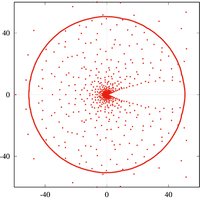
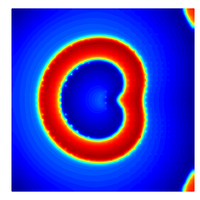
This article studies a system of rods pinned on a lattice with only rotational degrees of freedom, using Monte Carlo simulations. The system shows an infinite number of phase transitions as a function of the inverse temperature and the relative size of the rod with respect to the lattice, that can be broadly characterized as either Ising-like or of geometrical origin.

Complexity emerges in measures of the marking dynamics in football games

A. Chacoma, O. V. Billoni, and M. N. Kuperman

Phys. Rev. E 106, 044308 (2022) - Published 28 October, 2022

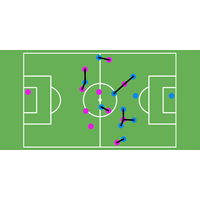
Network theory can show how successfully a soccer team performs when it’s on the defense.

Phase separation and critical size in molecular sorting

Elisa Floris, Andrea Piras, Francesco Saverio Pezzicoli, Marco Zamparo, Luca Dall'Asta, and Andrea Gamba

Phys. Rev. E 106, 044412 (2022) - Published 27 October, 2022

Cells can produce small vesicles containing specific proteins by concentrating the proteins in a domain, which then detaches from the cell membrane. This work proposes a link between the size of domains that successfully form such vesicles and the critical size for domain growth in the theory of phase separation.

Hydrodynamic theory of two-dimensional incompressible polar active fluids with quenched and annealed disorder

Leiming Chen, Chiu Fan Lee, Ananyo Maitra, and John Toner

Phys. Rev. E 106, 044608 (2022) - Published 27 October, 2022

Predictions indicate that disorder induced by immobile imperfections does not prevent organisms from moving collectively as a group.

Freezing phase transition in hard-core lattice gases on the triangular lattice with exclusion up to seventh next-nearest neighbor

Asweel Ahmed A. Jaleel, Dipanjan Mandal, Jetin E. Thomas, and R. Rajesh

Phys. Rev. E 106, 044136 (2022) - Published 26 October, 2022

Hard-core lattice gases are simple models that exhibit a phase transition, and that have applications in various areas of research. This paper uses a Monte Carlo algorithm to study these models with up to seventh neighbor exclusion on a triangular lattice, finding improvements over previous results.

Exact solutions for viscous Marangoni spreading

Thomas Bickel and François Detcheverry

Phys. Rev. E 106, 045107 (2022) - Published 18 October, 2022

Researchers can now predict exactly how soap molecules spread across a body of water, an everyday but surprisingly complex process.

Rectangle-triangle soft-matter quasicrystals with hexagonal symmetry

Andrew J. Archer, Tomonari Dotera, and Alastair M. Rucklidge

Phys. Rev. E 106, 044602 (2022) - Published 13 October, 2022

This paper describes an investigation of soft-matter quasicrystals with hexagonal symmetry. Examining two different examples of rectangle-triangle tilings, the authors demonstrate how to design stable aperiodic soft-matter systems containing two length scales. Their work suggests ways to find a wider variety of quasicrystals in soft matter systems.

Thermodynamic metric geometry and the Fisher-Widom line of simple fluids

Peter Mausbach, Robin Fingerhut, and Jadran Vrabec

Phys. Rev. E 106, 034136 (2022) - Published 28 September, 2022

The concept of curvature in Riemannian geometry can be used to study equilibrium thermodynamics. In this paper, the authors analyze the Ricci curvature for several simple model fluids and examine the behavior of two boundary lines in the fluids’ phase diagrams.

Experimental determination of the propulsion matrix of the body of helical Magnetospirillum magneticum cells

Liu Yu (虞柳), Lucas Le Nagard, Solomon Barkley, Lauren Smith, and Cécile Fradin

Phys. Rev. E 106, 034407 (2022) - Published 27 September, 2022

How microorganisms swim depends on the friction they experience under both translational and rotational motion. An experimental study of helical bacteria shows how various friction coefficients depend on the shape of the bacteria, and shows that cell body rotation could significantly contribute to cellular propulsion.

Direct measurement of the aerotactic response in a bacterial suspension

J. Bouvard, C. Douarche, P. Mergaert, H. Auradou, and F. Moisy

Phys. Rev. E 106, 034404 (2022) - Published 15 September, 2022

Many bacteria have the ability to move towards sources of oxygen. The authors’ experiments show that for such motion the response to an oxygen gradient scales as a power law with the oxygen concentration, which is in good agreement with existing models based on the biochemistry of bacterial membrane receptors.

Emergence of local irreversibility in complex interacting systems

Christopher W. Lynn, Caroline M. Holmes, William Bialek, and David J. Schwab

Phys. Rev. E 106, 034102 (2022) - Published 6 September, 2022

The authors of this paper investigate irreversibility in a multicomponent system whose components may or may not break detailed balance, and describe a powerful method that can provide insight into the origin of irreversibility in biological systems. This is a must-read paper if you want to understand the details of their technique that “sorts” various sources of irreversibility into contributions from single elements, pairs, triplets, and higher-order interactions.

Statistical limits of dictionary learning: Random matrix theory and the spectral replica method

Jean Barbier and Nicolas Macris

Phys. Rev. E 106, 024136 (2022) - Published 30 August, 2022

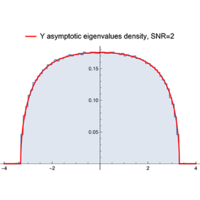
Dictionary learning, a machine learning technique using a representation in terms of dictionary elements, is commonly used for problems where the number of elements is small. Here, the authors use a replica method to address the case where the number of elements is large and scales with the system size, resulting in a more tractable calculation.

Autologous chemotaxis at high cell density

Michael Vennettilli, Louis González, Nicholas Hilgert, and Andrew Mugler

Phys. Rev. E 106, 024413 (2022) - Published 26 August, 2022

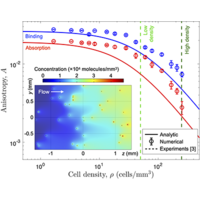
The authors investigated the effect of cell density on the ability of cells to detect the direction of fluid flow by self-communication. They calculated the critical density at which this process of autologous chemotaxis fails and determined how the critical density depends on system parameters. Interestingly, they also found conditions in which the direction sensed by the cell is opposite to the flow.

Gradient dynamics in reinforcement learning

Riccardo Fabbricatore and Vladimir V. Palyulin

Phys. Rev. E 106, 025315 (2022) - Published 26 August, 2022

Machine learning has been widely used and analyzed in the context of physics problems, but reinforcement learning algorithms have not received a lot of attention. The authors analyze a prototypical example and show that it obeys a Langevin equation corresponding to a drift-diffusion process. Additionally, they show that a generalized scheme can be mapped onto a p-spin glass model, and suggest that the connection with disordered systems can inspire further developments.

Fluid flow at interfaces driven by thermal gradients

Pietro Anzini, Zeno Filiberti, and Alberto Parola

Phys. Rev. E 106, 024116 (2022) - Published 16 August, 2022

Thermo-osmosis is the motion of a confined fluid due to a temperature gradient. This paper presents a derivation of the microscopic theory of this effect based on linear response theory, and an application to a simple fluid in a slab geometry.

Floquet quantum thermal transistor

Nikhil Gupt, Srijan Bhattacharyya, Bikash Das, Subhadeep Datta, Victor Mukherjee, and Arnab Ghosh

Phys. Rev. E 106, 024110 (2022) - Published 9 August, 2022

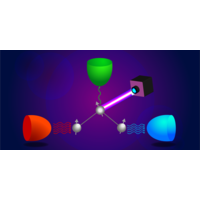
A three-qubit transistor design offers a way to manipulate the system’s heat flow by hitting one of the qubits with a laser.

Spiral wave drift under optical feedback in cardiac tissue

Yuan-Xun Xia, Xin-Pei Zhi, Teng-Chao Li, Jun-Ting Pan, Alexander V. Panfilov, and Hong Zhang

Phys. Rev. E 106, 024405 (2022) - Published 8 August, 2022

Drifting electrical spiral waves in cardiac tissue can induce life-threatening heart irregularities. This article proposes an optical method to control the drift of these spiral waves, and potentially eliminate them.

Design of an inertial fusion experiment exceeding the Lawson criterion for ignition

A. L. Kritcher et al.

Phys. Rev. E 106, 025201 (2022) - Published 8 August, 2022

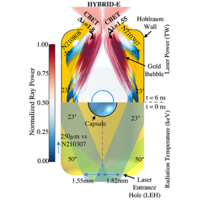
A 2021 inertial fusion experiment at the National Ignition Facility exceeded the so-called Lawson criterion for ignition. This paper describes the key design changes that made this achievement possible.

Experimental achievement and signatures of ignition at the National Ignition Facility

A. B. Zylstra et al.

Phys. Rev. E 106, 025202 (2022) - Published 8 August, 2022

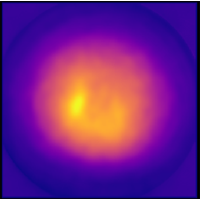
Experimental measurements from last year’s igniting plasma experiment at NIF are presented. The results are consistent with self-heating as the dominant term in the power balance.

Collective effects on the performance and stability of quantum heat engines

Leonardo da Silva Souza, Gonzalo Manzano, Rosario Fazio, and Fernando Iemini

Phys. Rev. E 106, 014143 (2022) - Published 28 July, 2022
The authors of this paper investigate the impact of collective effects on the performance of quantum heat engines, specifically the stability of output power with respect to fluctuations. They show a regime in which one can have enhanced stability for increasing but finite system sizes, while maintaining constant efficiency, which contradicts the classical bound based on the thermodynamic uncertainty relation.

Sign In to Your Journals Account

Filter

Section

Filter

Article Lookup

Enter a citation