Highlights

Adaptive power method for estimating large deviations in Markov chains

Francesco Coghi and Hugo Touchette

Phys. Rev. E 107, 034137 (2023) - Published 27 March, 2023

Large deviation functions can be used to describe fluctuations in model nonequilibrium systems. The authors study the properties of a numerical method for estimating these functions, and test it by applying it to a random walk on a random graph.

Evolution of road infrastructure in large urban areas

Erwan Taillanter and Marc Barthelemy

Phys. Rev. E 107, 034304 (2023) - Published 7 March, 2023

Researchers have identified the traffic thresholds at which cities build urban freeways and ring roads, which could help city administrators refine infrastructure plans.

Brownian motion of flexibly linked colloidal rings

Ruben W. Verweij, Julio Melio, Indrani Chakraborty, and Daniela J. Kraft

Phys. Rev. E 107, 034602 (2023) - Published 6 March, 2023

Motivated by the topological constraints imposed on cyclic polymers, the authors studied experimentally and numerically a model system for ring polymers. Their model system was created from micron-sized silica particles surrounded by a lipid bilayer and flexibly linked through DNA strands inserted in the bilayer. They compared the conformation and diffusive behavior of rings of four to eight segments with the behavior of linear polymers.

Sampling rare event energy landscapes via birth-death augmented dynamics

Benjamin Pampel, Simon Holbach, Lisa Hartung, and Omar Valsson

Phys. Rev. E 107, 024141 (2023) - Published 28 February, 2023

A common problem in simulations of complex systems is the separation of metastable states by high barriers that hinder transitions between the states. The authors address this by adapting a sampling algorithm that includes a birth-death process, and show that this scheme can efficiently sample energy landscapes with such barriers.

Flow-network-controlled shape transformation of a thin membrane through differential fluid storage and surface expansion

Yongtian Luo, Che-Ling Ho, Brent R. Helliker, and Eleni Katifori

Phys. Rev. E 107, 024419 (2023) - Published 28 February, 2023

Flows in a fluid network embedded in a thin material can change the shape of that material. Inspired by the unfolding of flower petals, the authors of this paper study this phenomenon using a simple model that couples hydraulic networks to deformation mechanics.

Self-dual quasiperiodic percolation

Grace M. Sommers, Michael J. Gullans, and David A. Huse

Phys. Rev. E 107, 024137 (2023) - Published 27 February, 2023

In commonly used percolation models, bonds of a lattice are occupied randomly and one asks if a connected cluster is present. In this paper, the authors study models in which bonds are occupied according to a deterministic and quasiperiodic pattern rather than randomly, and they find critical behavior quite different from random percolation.

Chemical Leslie effect in a chiral smectic-C★ film: Nonsingular target patterns

Félix Bunel and Patrick Oswald

Phys. Rev. E 107, 024703 (2023) - Published 22 February, 2023

When particles are made to flow through a chiral liquid crystal phase, they can induce flows in the liquid crystal and as well as a rotation of the director. This paper describes experiments with a flux of ethanol through a chiral smectic-C* film, and gives an interpretation of the results in the context of the Leslie theory.

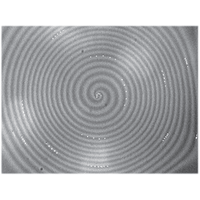
Chemical Leslie effect in a chiral smectic-C* film: Singular target patterns

Félix Bunel and Patrick Oswald

Phys. Rev. E 107, 024704 (2023) - Published 22 February, 2023

Ethanol flowing through a chiral smectic-C* film can produce roughly circular patterns, but under different conditions also spiral patterns. Further experiments show these patterns, and their theoretical explanation is confirmed.

Wealth dynamics in a market with information asymmetries

A. R. Bosco de Magalhães

Phys. Rev. E 107, 014305 (2023) - Published 27 January, 2023

Simulations of the behavior of individual financial traders show that imperfect market knowledge increases risk but not overall losses.

Information flows in macroscopic Maxwell's demons

Nahuel Freitas and Massimiliano Esposito

Phys. Rev. E 107, 014136 (2023) - Published 26 January, 2023

Maxwell’s demon works by rectifying microscopic fluctuations, but recently an implementation was proposed that can continue to work at macroscopic scales. This paper studies that proposal in more detail, with a particular focus on the flows of information.

Staggered scheme for the compressible fluctuating hydrodynamics of multispecies fluid mixtures

Ishan Srivastava, Daniel R. Ladiges, Andy J. Nonaka, Alejandro L. Garcia, and John B. Bell

Phys. Rev. E 107, 015305 (2023) - Published 24 January, 2023

Fluctuating hydrodynamics, a method that incorporates fluctuations into the continuum description of fluids, can only be solved when simplifying assumptions are made. This paper describes an approach that extends the method by using a staggered spatial discretization, and the results compare well with previous work and other methods.

Phototaxis of Chlamydomonas arises from a tuned adaptive photoresponse shared with multicellular Volvocine green algae

Kyriacos C. Leptos, Maurizio Chioccioli, Silvano Furlan, Adriana I. Pesci, and Raymond E. Goldstein

Phys. Rev. E 107, 014404 (2023) - Published 20 January, 2023

Many microorganisms have the ability to move toward a light source, and the authors study this process in Chlamydomonas, a unicellular member of a family of green algae. They show that the mechanism is shared with multicellular green algae in the same family, shedding light on the evolutionary transition from unicellular to multicellular organisms.

Tensor electromagnetism and emergent elasticity in jammed solids

Jishnu N. Nampoothiri, Michael D'Eon, Kabir Ramola, Bulbul Chakraborty, and Subhro Bhattacharjee

Phys. Rev. E 106, 065004 (2022) - Published 26 December, 2022

The classical theory of elasticity has trouble describing disordered jammed solids, such as sandpiles, because they have no unique reference configurations (e.g. a crystal structure). This paper presents a description based on force and torque balance that does not need a reference configuration, and that has a formal similarity with a generalized theory of electromagnetism.

Effect of scatterer interactions on photon transport in diffusing wave spectroscopy

Nicholas Sbalbi, Qi Li, and Eric M. Furst

Phys. Rev. E 106, 064609 (2022) - Published 16 December, 2022

Diffusing wave spectroscopy is a light scattering technique that is used to study the dynamics soft materials such as suspensions and gels. In this paper the authors show how interactions between the scattering particles affect the results: the effect is negligible if the scatterers are large enough, but it is significant when the particles are sufficiently small.

Sea urchin sperm exploit extremum seeking control to find the egg

Mahmoud Abdelgalil, Yasser Aboelkassem, and Haithem Taha

Phys. Rev. E 106, L062401 (2022) - Published 9 December, 2022

When searching for an egg, sea urchin sperm typically switch between two distinct navigation modes, depending on the relative orientation of their velocity with respect to the chemical gradient of the attractant released from the egg. This paper demonstrates that this navigational strategy can be described by the control algorithm known as extremum seeking. There is no need to define a threshold mechanism to explain the switching behavior, as suggested by previous work. This interdisciplinary work could serve as bridge between scientific communities.

Foot function enabled by human walking dynamics

Daniel Renjewski, Susanne Lipfert, and Michael Günther

Phys. Rev. E 106, 064405 (2022) - Published 8 December, 2022

When humans walk, our feet act as levers rather than landing pads as previously thought.

Fitting an active Brownian particle's mean-squared displacement with improved parameter estimation

Maximilian R. Bailey, Alexander R. Sprenger, Fabio Grillo, Hartmut Löwen, and Lucio Isa

Phys. Rev. E 106, L052602 (2022) - Published 22 November, 2022

Active matter experiments are often analyzed in terms of the active Brownian particle model. In this paper the authors show that a commonly used approximation to estimate model parameters can lead to erroneous results, and they propose an improved procedure.

Pattern of inclusions inside rippled icicles

John Ladan and Stephen W. Morris

Phys. Rev. E 106, 054211 (2022) - Published 17 November, 2022

Some icicles develop surface ripples as they grow. Researchers now explain the growth mechanism, but a full explanation remains elusive.

Hard-sphere jamming through the lens of linear optimization

Claudia Artiaco, Rafael Díaz Hernández Rojas, Giorgio Parisi, and Federico Ricci-Tersenghi

Phys. Rev. E 106, 055310 (2022) - Published 15 November, 2022

Simulating the jamming of hard spheres is difficult because of the singular interaction potential, which is either zero or infinite. This paper analyzes an algorithm that uses a mapping onto a constrained optimization problem to generate jammed hard-sphere packings that satisfy force balance and are globally stable.

Controlling the configuration space topology of mechanical structures

M. Berry, David Limberg, M. E. Lee-Trimble, Ryan Hayward, and C. D. Santangelo

Phys. Rev. E 106, 055002 (2022) - Published 7 November, 2022

Linkages are mechanical assemblies of rods connected by rotating joints that are of both practical and theoretical interest. They can be designed to perform certain motions, and this work describes a method to do so more easily by focusing on perturbations around special configurations called branch points.

Sign In to Your Journals Account

Filter

Section

Filter

Article Lookup

Enter a citation