Highlights

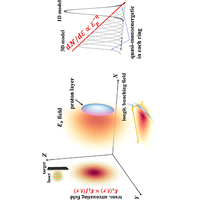
Faster-than-adiabatic cooling of non-neutral plasmas

Jan Bartsch, Alfio Borzì, Paul-Antoine Hervieux, and Giovanni Manfredi

Phys. Rev. E 114, 035208 (2026) - Published 8 September, 2026

This paper proposes an optimal control strategy to cool an antiproton plasma in a time much shorter than that required by an adiabatic process. The authors examine the length and stability of the plasma, in addition to its duration. The work suggests that optimal control techniques may be useful for experiments with plasmas, in particular with antimatter plasmas, which need to be confined and cooled before significant losses and annihilation occur.

#TimelyTopic #TechnicalAdvancement #ClearMotivation

Granular clogging across gravities: A unified scaling

Oliver Gaida, Olfa D'Angelo, and Jonathan E. Kollmer

Phys. Rev. E 114, 035405 (2026) - Published 2 September, 2026

This paper presents a predictive framework to scale granular flow from Earth to other gravitational environments, and shows that low gravity dramatically increases the probability of clogging. These findings explain previous contradictory results and establish a foundation for predicting and controlling granular flow in space.

#UniversalBehavior #ClearMotivation

Large-scale portfolio optimization with variational neural annealing

Nishan Ranabhat, Behnam Javanparast, David Goerz, and Estelle Inack

Phys. Rev. E 114, 024311 (2026) - Published 24 August, 2026

Using a variational neural annealing approach to solve constrained portfolio optimization problems, the authors establish a connection between phase transitions in physics and computational complexity in finance. They demonstrate scaling behavior in financial optimization problems analogous to critical phenomena in spin glasses.

#Interdisciplinary #UniversalBehavior

Dissipative self-assembly of colloidal suspensions

Jason Conradt and Eric M. Furst

Phys. Rev. E 114, 025416 (2026) - Published 21 August, 2026

Microgravity experiments reveal how toggled magnetic fields drive paramagnetic colloids past kinetic arrest into dynamic, highly anisotropic phases that are sustained by continuous energy dissipation.

#SoftMatterSpotlight #ElegantVisuals #ClearMotivation

Insight into the composition-dependent transition from auxetic nematic to frustrated smectic in liquid crystal elastomers

Emily J. Cooper, Stuart R. Berrow, Karine Margaryan, Gevorg Gevorgyan, Mariam Hakobyan, Thomas Raistrick, Ethan I. L. Jull, Devesh Mistry, Peter Hine, Aidan Street, Rafik Hakobyan, and Helen F. Gleeson

Phys. Rev. E 114, 025417 (2026) - Published 21 August, 2026

This paper provides a systematic investigation into composition-dependent properties of side-chain acrylate liquid crystal elastomers. The work shows how small changes in mesogenic content can induce a phase transition and suggests design approaches for customization of material properties.

#ClearMotivation #TimelyTopic

Arousal tunes neuronal avalanches across a directed percolation critical point

Brandon R. Munn, Christopher Whyte, Eli J. Müller, and James M. Shine

Phys. Rev. E 114, 024403 (2026) - Published 18 August, 2026

The authors present a study of critical phenomena in neural systems. They present evidence that cortical networks display criticality flexibly through arousal tuning. The work points out that arousal should be treated as an experimental control parameter, not as a source of noise.

#BiophysicsSpotlight #TimelyTopic

Supersonic and superluminal energy and speed of information via temporal interference in a dispersionless environment

John L. Spiesberger and Eugene Terray

Phys. Rev. E 114, 025107 (2026) - Published 18 August, 2026

A theory inspired by whale tracking suggests that interference could make the peak of a light-wave packet appear to travel faster than light—without transmitting information superluminally.

Towards probing velocity distributions in dense granular fluids: Utilizing fiber Bragg gratings

Marlo Kunzner, Luis Henriques, Fahad Puthalath, Leonardo Facchini, Mohammadhossein Shahsavari, Léa Gommeringer, Martin Angelmahr, Peidong Yu, Matthias Sperl, Till Böhmer, and Jan Philipp Gabriel

Phys. Rev. E 114, 025410 (2026) - Published 17 August, 2026

Velocity distributions in dense granular systems are difficult to measure because optical particle-tracking methods are hindered by opacity at high particle densities. In this work, a fiber Bragg grating sensor is introduced and shown to accurately recover granular velocity distributions by detecting collision-induced strain in an optical fiber, offering a viable alternative to existing methods for high volume fractions.

#ClearMotivation #TechnicalAdvancement

Thermodynamic geometry of friction on graphs: Resistance, commute times, and optimal transport

Jordan R. Sawchuk and David A. Sivak

Phys. Rev. E 114, L022105 (2026) - Published 17 August, 2026

Geometric ideas play a role in areas such as stochastic thermodynamics, spectral graph theory, and optimal transport. In this Letter, the authors link a thermodynamic friction metric that governs dissipation in slowly driven systems with two graph-theoretic geometries, the commute-time and resistance distances.

#TechnicalAdvancement #AdvancingField

Demonstration of ignition-driven radiation transport through a THOR hohlraum

R. S. Lester et al.

Phys. Rev. E 114, L023201 (2026) - Published 17 August, 2026

The authors demonstrate fusion ignition in a hohlraum modified with diagnostic windows that burn through prior to ignition. This provides a platform for laboratory-astrophysics experiments previously inaccessible. The x-ray flux escaping the holraum during and after ignition is the brightest radiation source available in the laboratory.

#TechnicalAdvancement #TimelyTopic

Escape over a saddle by colored noise: Theory and numerics

Jiayao Shao (邵家瑶), Tobias Grafke, and Robert S. MacKay

Phys. Rev. E 114, 024210 (2026) - Published 12 August, 2026

A computational approach efficiently models rare transition events driven by complex noise. It predicts optimal transition paths and rate scaling laws across unbounded time horizons.

#TechnicalAdvancement

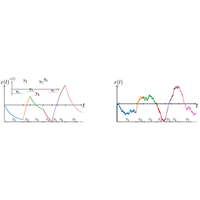
Nonreciprocal dynamics with weak noise: Aperiodic “Escher cycles” and their quasipotential landscape

Janik Schüttler, Robert L. Jack, and Michael E. Cates

Phys. Rev. E 114, 024104 (2026) - Published 3 August, 2026

Nonequilibrium systems with multiple metastable states can undergo noise-induced transitions that form cycles among the metastable states. To analyze this phenomenon, the authors introduce a minimal two-dimensional stochastic model with nonreciprocal couplings that can be treated analytically.

#TechnicalAdvancement #AdvancingField

Universal power-law spectral feature in laser-driven proton acceleration

S. Jiang, X. F. Shen, O. Rosmej, S. P. Zhu, X. T. He, A. Pukhov, and B. Qiao

Phys. Rev. E 114, 015222 (2026) - Published 29 July, 2026

Placed in the context of the pursuit of monoenergetic proton beams accelerated by lasers, this work explains the fact that they are not observed in experiments. The authors show that this is due to the to the transverse inhomogeneity of the laser and that this can be overcome with flat top laser profiles.

#AdvancingField #ClearMotivation

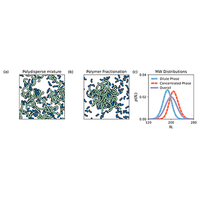
Polydisperse polymer fractionation between phases

J. Pedro de Souza, William M. Jacobs, and Howard A. Stone

Phys. Rev. E 114, 015421 (2026) - Published 27 July, 2026

An exact analytical Flory-Huggins model efficiently predicts polymer fractionation, demonstrating how the subtle tails of molecular weight distributions govern phase coexistence across the composition space.

#TechnicalAdvancement #SoftMatterSpotlight

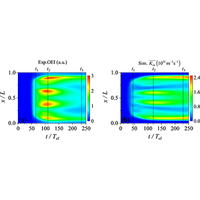
Transient striations during gas breakdown under radio-frequency excitation

De-Hua Shi, Xiao-Kun Wang, De-Qi Wen, and Yong-Xin Liu

Phys. Rev. E 114, L013201 (2026) - Published 23 July, 2026

While investigating radio-frequency gas breakdown, the authors experimentally observed and simulated a novel, time-dependent striated optical emission structure. The study reveals that these striking patterns are driven by differing electron-ion mobilities and locally amplified ionization, which are ultimately suppressed as the electric field becomes screened.

#AdvancingField

Exact stationary state of a d-dimensional run-and-tumble particle in a harmonic potential

Mathis Guéneau, Satya N. Majumdar, and Grégory Schehr

Phys. Rev. E 114, 014144 (2026) - Published 22 July, 2026

Understanding how active particles, such as swimming bacteria, move in confined environments remains a challenge. The authors obtain the exact stationary distribution of a run-and-tumble particle trapped by a harmonic potential in one, two, and three dimensions, providing quantitative benchmarks for experiments on confined active matter.

#SoftMatterSpotlight #TechnicalAdvancement

Universality of order statistics for Brownian reshuffling

Zdzislaw Burda, Mario Kieburg, and Tomasz Maciocha

Phys. Rev. E 114, 014130 (2026) - Published 16 July, 2026

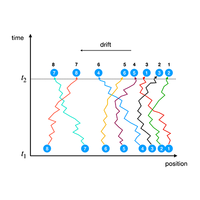
In a one-dimensional gas of particles confined by an asymptotically power-law potential, the ordering of the particles changes as they perform Brownian motion. The authors show that the order statistics that describe how the particles are reshuffled are universal and independent of the potential’s exponent, while the timescale of the reshuffling does depend on it.

#UniversalBehavior #AdvancingField

Work and heat exchanged during sudden quenches of strongly coupled quantum systems

Zohreh Davoudi, Christopher Jarzynski, Niklas Mueller, Greeshma Oruganti, Connor Powers, and Nicole Yunger Halpern

Phys. Rev. E 114, 014133 (2026) - Published 16 July, 2026

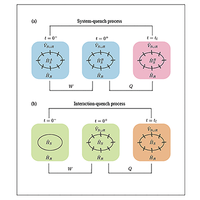
The authors examine three definitions of internal energy, work, and heat that have been used for quantum systems coupled strongly to the environment. Their study focuses on quenches, processes in which the Hamiltonian changes abruptly. In these processes, the first law of thermodynamics holds for each set of definitions by construction. The authors show that only two sets of definitions obey the second law. They illustrate their findings with a model of two coupled spins.

#ClearMotivation #AdvancingField

Long-pulse fast ignition in magnetized liner inertial fusion

Benjamin Wang, Henry Fetsch, and Nathaniel J. Fisch

Phys. Rev. E 114, 015211 (2026) - Published 15 July, 2026

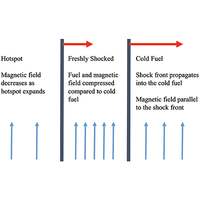
The fast ignition paradigm previously developed for inertial confinement fusion is here extended to magnetized linear inertial fusion. The authors’ model showcases fast ignition’s potential to lead to more practical, cost-effective, and engineering-wise viable magnetized linear inertial fusion designs.

#AdvancingField #ClearMotivation

THz dynamics of hydrogen sulfide: Search for collective modes of a non-hydrogen-bonded analog of water

Ferdinando Formisano, Alessio De Francesco, Francesco Sacchetti, Caterina Petrillo, and Eleonora Guarini

Phys. Rev. E 114, 015412 (2026) - Published 15 July, 2026

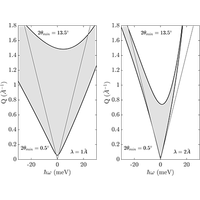
Using neutron inelastic scattering, the authors investigate the dynamics of liquid hydrogen sulfide, which is similar to water but lacks the hydrogen-bond network. While fast sound is preserved, the secondary weakly dispersive mode typical of hydrogen-bonded liquids is not detected.

#WellStructured #ClearMotivation #SoftMatterSpotlight

Sign In to Your Journals Account

Filter

Section

Filter

Article Lookup

Enter a citation