Highlights

Multiscale data assimilation in turbulent models

Francesco Fossella, Luca Biferale, Alberto Carrassi, Massimo Cencini, and Vikrant Gupta

Phys. Rev. E 113, 024208 (2026) - Published 17 February, 2026

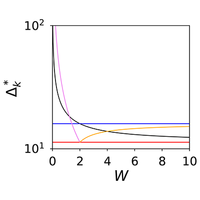
Data assimilation techniques make it possible to predict a system’s evolution by combining model predictions with sparse and noisy measurements. The authors apply these techniques to a chaotic multiscale model of turbulence, and find that measuring at intermediate scales can allow reconstruction of both large and small scales, while their technique compares well with other similar approaches.

#TechnicalAdvancement #AdvancingField

Molecular dynamics simulation on current-voltage characteristics of room temperature ionic liquids under strong electric field

Yufeng Cheng, Alberto T. Pérez, Weizong Wang, and Antonio Ramos

Phys. Rev. E 113, 025415 (2026) - Published 17 February, 2026

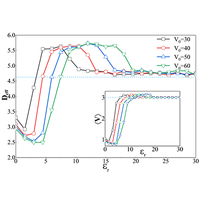
Researchers have used molecular dynamics simulations to study changes in the charge-transport properties of a room-temperature ionic liquid under a strong electric field.

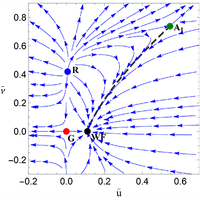
Generalized Lotka-Volterra systems with quenched random interactions and saturating nonlinear response

Marco Zenari, Francesco Ferraro, Sandro Azaele, Amos Maritan, and Samir Suweis

Phys. Rev. E 113, 024206 (2026) - Published 12 February, 2026

Generalized Lotka-Volterra models, common in ecology, are plagued by unbounded population growth. By adding a biologically realistic nonlinear interaction mechanism to address this issue, and studying the modified model’s phase diagram, the authors arrive at a more robust and ecologically grounded understanding of complex disordered ecosystems.

#ClearMotivation #TechnicalAdvancement

Fracture and failure of shear-jammed dense suspensions under impact

Malcolm Slutzky, Alice Pelosse, Michael van der Naald, and Heinrich M. Jaeger

Phys. Rev. E 113, 025410 (2026) - Published 9 February, 2026

By performing a systematic series of impact tests, varying parameters such as impact velocity, solvent viscosity, and surface tension, the authors sketch a state diagram for dense suspensions, highlighting fracturing and nonfracturing behaviors across shear jamming, shear thickening, and liquidlike regimes.

#PedagogicalExposition #ElegantVisuals #SoftMatterSpotlight

Acoustic transparency and absorption in dense granular suspensions

Arnaud Tourin, Yamil Abraham, Marie Palla, Arthur Le Ber, Romain Pierrat, Nicolas Benech, Carlos Negreira, and Xiaoping Jia

Phys. Rev. E 113, 025411 (2026) - Published 9 February, 2026

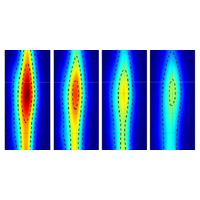
In this paper, the authors experimentally study wave propagation in two- and three-dimensional dense granular media and identify an acoustic transparency window, where scattering is substantially reduced, enabling low-frequency waves to propagate almost ballistically. They attribute this phenomenon to spatial correlations in the structural disorder of the medium, and support this interpretation with a theoretical model.

#TheoryExperiment #SoftMatterSpotlight

Detectability threshold in weighted modular networks

Filippo Radicchi, Filipi N. Silva, Alessandro Flammini, Santo Fortunato, and Sadamori Kojaku

Phys. Rev. E 113, 014318 (2026) - Published 30 January, 2026

Community detection is one of the most debated issues in network theory. Here, the authors study the detectability limits in the case of undirected weighted networks. The results indicate that large variability in edge weights can make communities less detectable.

#WellStructured #ClearMotivation #TechnicalAdvancement

Compressed ultrafast photography of plasmas formed from laser breakdown of dense gases reveals that internal processes dominate evolution at early times

Peng Wang, Yogeshwar Nath Mishra, Seth Pree, Lihong V. Wang, Dag Hanstorp, John P. Koulakis, Daniels Krimans, and Seth Putterman

Phys. Rev. E 113, 015209 (2026) - Published 30 January, 2026

Using a camera with 2-picosecond time resolution, researchers show that the atoms in a laser-induced plasma are more highly ionized than theory predicts.

Roughness-induced diffusion enhancement in asymmetric potentials under nonequilibrium fluctuations

Li-Ming Fan, Ming-Gen Li, Tian-Fu Gao, and Jing-Dong Bao

Phys. Rev. E 113, 014135 (2026) - Published 27 January, 2026

Roughness in a potential landscape is usually seen as a kinetic impediment that suppresses the diffusion of thermally driven particles. The authors demonstrate that for systems driven by nonequilibrium fluctuations, roughness on an asymmetric potential can instead act as an effective means to accelerate diffusion.

#AdvancingField #TechnicalAdvancement

Geometry of disordered porous environments regulates cell migration

Laeschkir Würthner and Frederik Graw

Phys. Rev. E 113, 014407 (2026) - Published 27 January, 2026

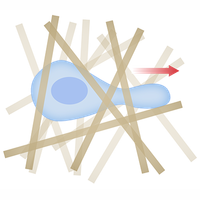
Several external factors are known to influence active cell movement, but little is known about the impact of the porous structure of the extracellular matrix. This work combines computational modeling and theory to show how such porous environments determine cell migration dynamics, and how spatial heterogeneities effectively guide cell movement towards regions of low porosity.

#BiophysicsSpotlight #AdvancingField #Interdisciplinary

Scaling behaviors in active model B+ via the functional renormalization group

Gergely Fejős, Zsolt Szép, and Naoki Yamamoto

Phys. Rev. E 113, 014130 (2026) - Published 22 January, 2026

This work applies the functional renormalization group to active model B+, uncovering global flows inaccessible by earlier methods. By pushing the theoretical description of nonequilibrium phase separation into a new regime, the results advance the state of the art in active-matter field theory.

#AdvancingField #TechnicalAdvancement

Electric response of multiarm protein crystals

D. Ray, F. Platten, and K. Kang

Phys. Rev. E 113, 014403 (2026) - Published 22 January, 2026

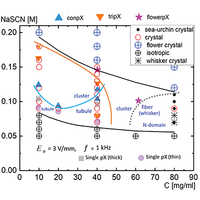
Applied electric fields precisely steer protein crystallization pathways, inducing distinct multiarm morphologies such as flowerlike and triconic structures. This field-driven control over angular ordering and phase behavior offers new insights into engineering complex protein architectures.

#BiophysicsSpotlight #TheoryExperiment

Triadic percolation on multilayer networks

Hanlin Sun, Filippo Radicchi, and Ginestra Bianconi

Phys. Rev. E 113, 014313 (2026) - Published 21 January, 2026

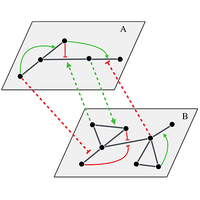
Triadic interactions between network nodes take place when interactions between two or more nodes are controlled by regulator nodes. Triadic regulators turn network percolation into a dynamical process very different from standard percolation, which has been extensively studied in single networks. Here, the authors go one step further and propose a framework to study triadic percolation in multilayer networks, called multilayer triadic percolation, and analyze how multilayer network structure affects the dynamical behavior of triadic percolation.

#AdvancingField #UniversalBehavior #ClearMotivation

Role of the density of states in Bose-Einstein condensation

Alexios P. Polychronakos and Stéphane Ouvry

Phys. Rev. E 113, 014122 (2026) - Published 16 January, 2026

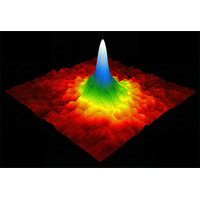
The onset of Bose-Einstein condensation in systems with various densities of states is examined. The authors consider, in particular, the behavior of the energy spectrum at low and high energies and resolve a puzzle resulting from different methods of analysis.

#ClearMotivation #TechnicalAdvancement

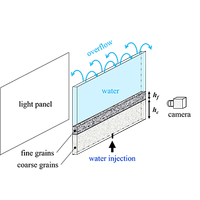
Emergence of periodic chimneys during fluidization at a coarse-fine grains interface

Camille Porceillon, Aurélien Gay, Alfredo Taboada, and Valérie Vidal

Phys. Rev. E 113, 015414 (2026) - Published 15 January, 2026

Fluid ascent through multilayered sediments takes place in many geophysical and industrial processes. In this paper, the authors perform experiments in a two-layer granular column consisting of coarse grains at the bottom and fine grains at the top, in which water is injected from below at a constant flow rate. They report the formation of a regular fluidization pattern at the two-layer interface in the form of dust chimneys, and propose a mechanism based on pressure-drop estimates to predict the wavelength of the fluidization pattern.

#AdvancingField #WellStructured #ClearMotivation

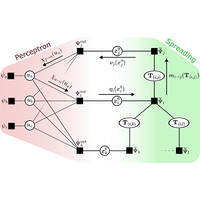
Inference in spreading processes with neural-network priors

Davide Ghio, Fabrizio Boncoraglio, and Lenka Zdeborová

Phys. Rev. E 113, 015301 (2026) - Published 7 January, 2026

In the inference problem for epidemic spreading processes on graphs in the case of correlated initial states (i.e., epidemic sources), the initial states can be given as the output of a neural network. This paper presents a framework to study this case.

#AdvancingField #MachineLearningSpotlight

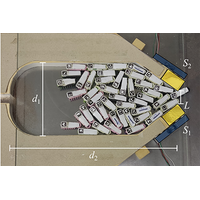
Pressure dynamics in the bottleneck flow of self-propelled particles

N. Colantuono, M. Ramdan Ferressini, I. Zuriguel, D. R. Parisi, and G. A. Patterson

Phys. Rev. E 113, 015406 (2026) - Published 7 January, 2026

Intermittency and clogging statistics have been extensively investigated in a variety of systems – from granular materials to pedestrian evacuations. Here, the authors experimentally study the evolution of mechanical pressure in a two-dimensional system of self-propelled agents flowing through a bottleneck, revealing a strong correlation between pressure dynamics and the system state (clogged vs unclogged).

#ClearMotivation #SoftMatterSpotlight

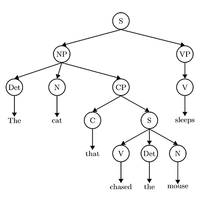
Scaling laws and representation learning in simple hierarchical languages: Transformers versus convolutional architectures

Francesco Cagnetta, Alessandro Favero, Antonio Sclocchi, and Matthieu Wyart

Phys. Rev. E 112, 065312 (2025) - Published 23 December, 2025

Transformers are a type of machine learning architecture. The authors investigate in this study how they can acquire an understanding of language structure when trained via next-token prediction. Notably, the authors find that when the data exhibit hierarchical structure, convolutional neural networks actually learn the task more efficiently than transformers. #MachineLearningSpotlight

Geometrically frustrated assembly at finite temperature: Phase transitions from self-limiting to bulk states

Nicholas W. Hackney and Gregory Grason

Phys. Rev. E 112, 065419 (2025) - Published 15 December, 2025

This is a comprehensive analysis of a lattice Hamiltonian designed to investigate geometrically frustrated assembly. The work sheds light on self-limiting assembly and results in a frustration-concentration phase diagram.

#ElegantVisuals #SoftMatterSpotlight

From lines to networks

Marc Barthelemy

Phys. Rev. E 112, 064304 (2025) - Published 5 December, 2025

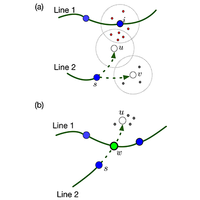
This study presents a novel model for spatial networks generated from intersecting lines. It is based on a principle of growth present in various real systems such as transportation networks, fungal hyphae, and vascular structures.

#ClearMotivation #Interdisciplinary

Class of exclusion processes capable of exhibiting current reversal

Ngo Phuoc Nguyen Ngoc and Lam Thi Nhung

Phys. Rev. E 112, 064108 (2025) - Published 4 December, 2025

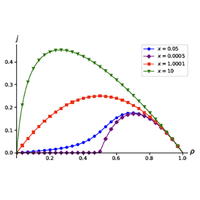
The authors introduce a class of generalized exclusion processes, modeling particles performing random walks on a one-dimensional lattice while obeying exclusion constraints. They provide a unifying framework for several such processes and highlight their rich dynamical properties.

#AdvancingField #WellStructured

Sign In to Your Journals Account

Filter

Section

Filter

Article Lookup

Enter a citation