Highlights

Decoding species coexistence: A reinforcement learning perspective

Kaiwen Jiang, Chenyang Zhao, Shengfeng Deng, Weiran Cai, Jiqiang Zhang, and Li Chen

Phys. Rev. E 113, 054411 (2026) - Published 18 May, 2026

This paper investigates maintenance of biodiversity in a spatial rock-paper-scissors game. The authors use reinforcement learning at the species level, rather than at an individual level, so that mobility in this model operates on “collective wisdom” of the species. Survival of biodiversity depends on the balance between two prominent tendencies: survival-priority (escaping from predators) and predation-priority (remaining near prey).

#ClearMotvation

Modeling spatial synchronization of predator-prey oscillations via the XY model under demographic stochasticity and migration

Solmaz Golmohammadi, Mina Zarei, and Jacopo Grilli

Phys. Rev. E 113, 054409 (2026) - Published 13 May, 2026

At the intersection of population ecology and statistical physics, this study addresses how two factors, demographic stochasticity and migration, govern the emergence of large-scale synchronization in predator-prey metapopulations. The authors demonstrate that the collective phase dynamics of coupled ecological oscillators can be rigorously mapped onto a theoretical framework analogous to the classic XY model of statistical mechanics.

#BiophysicsSpotlight #Interdisciplinary

Rhythm as an ordered phase of sound: How musical meter emerges in a statistical mechanical model

Robert St. Clair and Jesse Berezovsky

Phys. Rev. E 113, 054116 (2026) - Published 11 May, 2026

The authors develop a model of musical rhythm and meter based on optimizing the trade-off between human psychological preferences for perceiving repeated patterns in time with a desire for variety and complexity. Using a statistical physics analogy, they observe phase transitions in the model from disordered events in time to orderings that closely reproduce those seen in music, for example in the compositions of Johann Sebastian Bach.

#Interdisciplinary #BroadlyAccessible

Anomalous translational dynamics of molecular probes near the polymer glass transition

Jaladhar Mahato, Siyang Wang, and Laura J. Kaufman

Phys. Rev. E 113, 055401 (2026) - Published 4 May, 2026

Single-molecule measurements and a generalized Langevin framework show that subdiffusive, non-Gaussian probe transport near the glass transition arises from progressively softening viscoelastic confinement. This provides direct microscopic evidence of dynamic heterogeneity and suggests a pathway to more fully understand glassy dynamics in polymer glass formers.

#TheoryExperiment #SoftMatterSpotlight

Shape dictates the motion of topological defects in active nematics

Giacomo Marco La Montagna, Sumeja Bureković, Ananyo Maitra, and Cesare Nardini

Phys. Rev. E 113, L053401 (2026) - Published 4 May, 2026

Topological defects in active nematic systems are known to display strikingly different properties, such as self-propulsion, compared to their equilibrium counterparts. Combining analytical results with numerical simulations, the authors show that activity also modifies the shape of defects, which had been previously overlooked in the literature.

#SoftMatterSpotlight #ClearMotivation

Statistical field theory for dialectology

James Burridge

Phys. Rev. E 113, 044310 (2026) - Published 23 April, 2026

This paper is a step toward a statistical field theory of language evolution. The author combines tools of statistical physics with tools of statistical inference to create a model in which macroscopic language patterns are rooted in plausible human behaviors.

#Interdisciplinary #AdvancingField

Kinetic theory of emulsions with matter supply

Jacqueline Janssen, Frank Jülicher, and Christoph A. Weber

Phys. Rev. E 113, 045420 (2026) - Published 23 April, 2026

This study extends the classical Ostwald ripening theory to phase-separating systems that continuously receive material from an external reservoir. It considers two transport regimes: diffusion-limited transport through the dilute phase and interface-resistance-limited transport across droplet interfaces, as well as two modes of material input: constant supersaturation and constant supply rate.

#AdvancingField #ClassicProblem #SoftMatterSpotlight

Perfect adaptation in eukaryotic gradient sensing using cooperative allosteric binding

Vishnu Srinivasan, Wei Wang (汪巍), and Brian A. Camley

Phys. Rev. E 113, 044414 (2026) - Published 17 April, 2026

This study introduces a theoretical model explaining how eukaryotic cells can achieve perfect adaptation in chemical gradient sensing through cooperative allosteric regulation of receptor activity.

#AdvancingField #BiophysicsSpotlight

The FlEye camera: Sampling the joint distribution of natural scenes and motion

Charles J. Edelson, Paul Smith, Sima Setayeshgar, William Bialek, and Rob R. de Ruyter van Steveninck

Phys. Rev. E 113, 044412 (2026) - Published 14 April, 2026

By pairing a fly-eye-inspired camera with motion signals, this study shows that characteristic perceptual biases arise from input statistics. From camera data sampled in nature, the authors construct optimal motion estimators, suggesting that biological performance is limited more by environmental statistics than physiology.

#BiophysicsSpotlight #ElegantVisuals #TheoryExperiment

Milestone toward an electron cyclotron resonance ion plasma accelerator demonstrator

Andrea Cernuschi, Thomas Thuillier, and Laurent Garrigues

Phys. Rev. E 113, L043202 (2026) - Published 14 April, 2026

Plasma-based accelerators are often distinguished by their compact size. This paper presents theoretical designs for several compact plasma-based devices to accelerate ions relevant for medical applications. Design parameters are validated with a Monte Carlo particle-tracking code.

#TechnicalAdvancement #TimelyTopic

Diffusion in nonequilibrium two-dimensional crystals

Ashley Z. Guo, Sam Wilken, Dov Levine, and Paul M. Chaikin

Phys. Rev. E 113, 044108 (2026) - Published 2 April, 2026

The authors consider a two-dimensional nonequilibrium model, where particles interact only through repulsive kicks when they overlap. The system goes through a sequence of phase transitions exhibiting reentrancy, from a disordered phase to a hexagonal crystal and then to a second disordered phase. The driving parameter is the size of the repulsive kicks, which is the mechanism for both ordering and disordering.

#AdvancingField #Interdisciplinary

From scattered to focused: Task-dependent connectivity in honey bees, with midge swarms and bird flocks

Ishriak Ahmed, Md. Saiful Islam, and Imraan A. Faruque

Phys. Rev. E 113, 044403 (2026) - Published 2 April, 2026

This is a study of swarming in three different biological systems, honey bees, midges, and jackdaws. The authors combine three complementary network identification approaches with anisotropy analysis to identify task-dependent interaction neighborhood size. The work provides a framework for uncovering emergence of collective motion in different biological systems.

#BiophysicsSpotlight #ClearMotivation #WellStructured

Spontaneous rotation and propulsion of suspended capsules in active nematics

Júlio P. A. Santos, Margarida M. Telo da Gama, and Rodrigo C. V. Coelho

Phys. Rev. E 113, L043401 (2026) - Published 1 April, 2026

Elastic shells are present in nature, as in viral capsids and red blood cells, and are often found immersed in flowing fluids. In this manuscript, the authors study a two-dimensional active nematic fluid with an embedded elastic capsule and explore how the geometry and flexibility of these elastic shells dictate their motility via defect-mediated dynamics.

#SoftMatterSpotlight #ClearMotivation

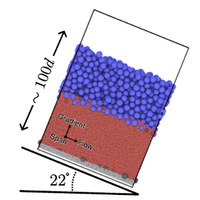
Reverse segregation and self-organization in inclined chute flows of bidisperse granular mixtures

Joseph M. Monti, Joel T. Clemmer, Ishan Srivastava, Leonardo E. Silbert, Gary S. Grest, and Jeremy B. Lechman

Phys. Rev. E 113, 035413 (2026) - Published 26 March, 2026

When a bidisperse system of granular spherical particles flows down an inclined plane, coarse particles tend to accumulate at the flow surface, but above a certain coarse-to-fine diameter ratio, reverse segregation takes place, and coarse particles begin to sink. The authors confirm this phenomenon in discrete element method simulations and study the development of alternating coarse and fine particle layers in the reverse segregation regime, showing that layer spacing correlates with coarse particle size.

#WellStructured #ClearMotivation #BroadlyAccessible

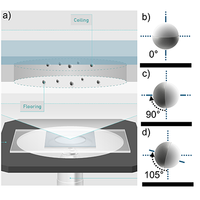
Coupled interfacial phenomena suppress propulsion in catalytic Janus colloids

Muhammad Haroon and Christopher Wirth

Phys. Rev. E 113, L033404 (2026) - Published 26 March, 2026

Closing a gap between theory and experiments, this work establishes substrate chemistry as a new control parameter in active matter. This has broad implications for nonequilibrium physics, self-assembly, and microscale transport.

#AdvancingField #SoftMatterSpotlight

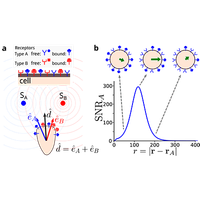
Competing chemical gradients change chemotactic dynamics and cell distribution

Emiliano Perez Ipiña and Brian A. Camley

Phys. Rev. E 113, 034406 (2026) - Published 23 March, 2026

Cells navigating multiple chemoattractant gradients prioritize signals according to how accurately each can be sensed, leading to diverse migration behaviors and spatial patterns in complex environments.

#BiophysicsSpotlight #ClearMotivation

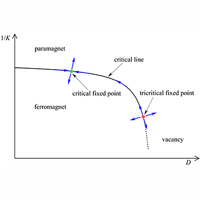
Backbone three-point correlation function in the two-dimensional Potts model

Ming Li, Youjin Deng, Jesper Lykke Jacobsen, and Jesús Salas

Phys. Rev. E 113, 034115 (2026) - Published 13 March, 2026

By high-precision Monte Carlo cluster simulations, the authors obtained the backbone three-point structure constant for the two-dimensional Q-state Potts model. The results are consequential for critical phenomena, percolation, and conformal field theory.

#AdvancingField #WellStructured

Scaling law of individual urban tour behavior

Xu-Jie Lin, Yitao Yang, Wei-Peng Nie, and Xiao-Yong Yan

Phys. Rev. E 113, 034303 (2026) - Published 6 March, 2026

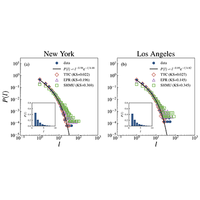
Using Foursquare users’ check-in data and heavy truck GPS trajectory data, the authors study the number of intermediate stops in a tour of humans and heavy trucks. They find that the tour length distribution follows a truncated power-law distribution and propose a tour terminate-continue model to explain this.

#Interdisciplinary #AdvancingField

Robustness and size dependence of circadian rhythms in multiscale suprachiasmatic-nucleus networks

Youhao Zhuo, Yingpeng Liu, Jiao Wu, Kesheng Xu, and Muhua Zheng

Phys. Rev. E 113, 034304 (2026) - Published 6 March, 2026

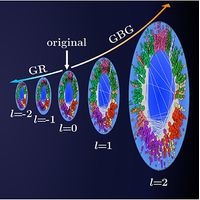
Bridging concepts from statistical physics, complex networks, and biological rhythm dynamics, the authors study how multiscale network structure influences circadian rhythms in the suprachiasmatic nucleus. The results highlight the resilience of suprachiasmatic-nucleus rhythms to network scaling and establish a framework for linking multiscale network organization to biological timekeeping.

#Interdisciplinary #BiophysicsSpotlight

Influence of the Casimir effect on the binding potential for three-dimensional wetting

Alessio Squarcini, José M. Romero-Enrique, and Andrew O. Parry

Phys. Rev. E 113, 024133 (2026) - Published 24 February, 2026

This paper discusses the influence of Casimir contributions to wetting transitions of fluid in the presence of a wall. Previous interfacial theories have overlooked this entropic contribution to the binding potential, which is equivalent to a thermal Casimir effect. The authors give physical insight into why the effect of bulk fluctuations matters and provide details about calculations.

#AdvancingField #TechnicalAdvancement

Sign In to Your Journals Account

Filter

Section

Filter

Article Lookup

Enter a citation