Highlights

High-energy acceleration phenomena in extreme-radiation–plasma interactions

J. C. Faure, D. Tordeux, L. Gremillet, and M. Lemoine

Phys. Rev. E 109, 015203 (2024) - Published 8 January, 2024

Powerful astrophysical sources are known to interact with their surroundings via extreme radiation-plasma interactions resulting from large quantities of emitted nonthermal radiation. This paper studies the physical processes involved in such interactions, combining analytical approximations with numerical simulations, and unveils a complex sequence of particle acceleration processes.

Nonequilibrium critical dynamics of the two-dimensional ±J Ising model

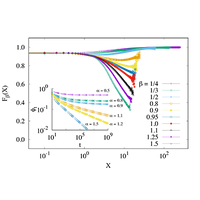
Ramgopal Agrawal, Leticia F. Cugliandolo, Lara Faoro, Lev B. Ioffe, and Marco Picco

Phys. Rev. E 108, 064131 (2023) - Published 21 December, 2023

Frustration has been shown to modify the critical properties of magnetic systems. By performing large-scale Monte Carlo simulations, the authors investigate the nonequilibrium critical dynamics and the geometrical features of the frustrated two-dimensional ±J Ising model after different temperature quenches.

Monte Carlo generation of localized particle trajectories

Ivan Ahumada and James P. Edwards

Phys. Rev. E 108, 065306 (2023) - Published 19 December, 2023

Monte Carlo simulations of path integrals suffer from reduced precision at large times due to undersampling. To address this problem the authors propose a scheme where the sampling trajectories are concentrated in more important regions, and they show the effectiveness of their method with some simple test cases.

Information content in continuous attractor neural networks is preserved in the presence of moderate disordered background connectivity

Tobias Kühn and Rémi Monasson

Phys. Rev. E 108, 064301 (2023) - Published 7 December, 2023

It is known that information such as the position of an animal can be represented in a recurrent attractor neural network by localized bumps of activity of neurons. This work addresses the question of how heterogeneities in the interactions of neurons affect the accuracy of information storage. The authors calculate the Fisher information as a function of the intensity of disordered interactions. They find that moderate disorder does not wipe out all information in their model.

Ergodic properties of Brownian motion under stochastic resetting

E. Barkai, R. Flaquer-Galmés, and V. Méndez

Phys. Rev. E 108, 064102 (2023) - Published 1 December, 2023

Stochastic processes with resetting can exhibit different ergodic behaviors depending on the distribution of resetting times. For one-dimensional Brownian motion with resetting, the authors find two ergodic transitions, one of which is related to a competition between returns to the origin by resetting and returns by the diffusion process itself.

Impact craters formed by spinning granular projectiles

Douglas D. Carvalho, Nicolao C. Lima, and Erick M. Franklin

Phys. Rev. E 108, 054904 (2023) - Published 22 November, 2023

Numerical simulations reveal that an impact crater’s shape can depend on the impactor’s spin and its degree of cohesion.

Geometric frustration of hard-disk packings on cones

Jessica H. Sun, Abigail Plummer, Grace H. Zhang, David R. Nelson, and Vinothan N. Manoharan

Phys. Rev. E 108, 054608 (2023) - Published 21 November, 2023

This work models slow reaction-limited growth of crystals on a conical surface. Frustration arises from closure constraints when the crystal wraps around the cone. Defects form a seam running along the axial direction of the cone; a disordered region forms near the tip. The authors study how various parameters affect details.

Single-file diffusion in spatially inhomogeneous systems

Benjamin Sorkin and David S. Dean

Phys. Rev. E 108, 054125 (2023) - Published 16 November, 2023

In single-file diffusion, particles in one dimension cannot cross each other due to a hard-core repulsion. For such a system with a periodically varying potential and diffusivity, the authors show that it has the same long-time behavior as Brownian particles in a spatially homogeneous system characterized by a known effective diffusion constant.

Universal to nonuniversal transition of the statistics of rare events during the spread of random walks

R. K. Singh and Stanislav Burov

Phys. Rev. E 108, L052102 (2023) - Published 2 November, 2023

In a large class of systems governed by rare event statistics, the probability density function for particle position shows a universal exponential decay. Using the continuous-time random walk method, this paper shows that there is a critical transition between this universal behavior and a more specific, slower decay.

How to train your demon to do fast information erasure without heat production

Stephen Whitelam

Phys. Rev. E 108, 044138 (2023) - Published 24 October, 2023

Time-dependent protocols that perform irreversible logical operations, such as memory erasure, cost work and produce heat, placing bounds on the efficiency of computers. Using a model of a physical memory, the author shows that a neural-network demon can learn feedback-control protocols to do fast memory erasure without input of work or production of heat.

Phase ordering dynamics of the random-field long-range Ising model in one dimension

Ramgopal Agrawal, Federico Corberi, Eugenio Lippiello, and Sanjay Puri

Phys. Rev. E 108, 044131 (2023) - Published 18 October, 2023

There has been progress in understanding the phase-ordering dynamics of systems with long-range interactions, but less is known for such systems with disorder. This work addresses that topic by studying the influence of long-range interactions on the phase ordering dynamics of the one-dimensional random-field Ising model.

Coulomb-Higgs phase transition of three-dimensional lattice Abelian Higgs gauge models with noncompact gauge variables and gauge fixing

Claudio Bonati, Andrea Pelissetto, and Ettore Vicari

Phys. Rev. E 108, 044125 (2023) - Published 12 October, 2023

The authors study critical behavior of three-dimensional lattice gauge models. Results are consistent with predictions of the Abelian Higgs field theory and provide information of interest for statistical physics, condensed matter, and high-energy physics.

Topologically constrained fluctuations and thermodynamics regulate nonequilibrium response

Gabriela Fernandes Martins and Jordan M. Horowitz

Phys. Rev. E 108, 044113 (2023) - Published 6 October, 2023

Near equilibrium, the fluctuation-dissipation theorem is an important tool in understanding how a system responds to external perturbations. Here the authors derive expressions that describe the response of physical observables outside of equilibrium, in terms of both the topology of the microscopic state space and the strength of thermodynamic driving.

Packing spheres in high dimensions with moderate computational effort

Veit Elser

Phys. Rev. E 108, 034117 (2023) - Published 21 September, 2023

An algorithm originally developed for imaging generates useful data for a problem in pure mathematics.

Mesoscopic critical fluctuations

Saikat Banerjee and Nikolai A. Sinitsyn

Phys. Rev. E 108, 034212 (2023) - Published 21 September, 2023

A system can be made to show critical behavior in a mesoscopic region by introducing a smooth spatial variation of a control parameter around its critical value. The authors investigate this situation using a minimal model based on the Ginzburg-Landau effective free-energy approach.

Evolutionary dynamics in non-Markovian models of microbial populations

Farshid Jafarpour, Ethan Levien, and Ariel Amir

Phys. Rev. E 108, 034402 (2023) - Published 5 September, 2023

The evolution of a population of microbes is influenced by features of single-cell growth and division processes. The authors observe that fluctuations in the cells’ division rate affect the long-term evolution of the population.

Microtubule search-and-capture model evaluates the effect of chromosomal volume conservation on spindle assembly during mitosis

Pinaki Nayak, Saptarshi Chatterjee, and Raja Paul

Phys. Rev. E 108, 034401 (2023) - Published 1 September, 2023

The authors study computationally how the speed and accuracy of mitotic spindle assembly depend on several parameters, such as chromosome number and volume and cell size and shape. This work is a step toward understanding the large variation in chromosome number found in some closely related species.

Interplay of self, epiphany, and positive actions in shaping individual careers

Rafael A. Bittencourt, H. B. de B. Pereira, M. A. Moret, S. Galam, and I. C. da Cunha Lima

Phys. Rev. E 108, 024314 (2023) - Published 29 August, 2023

A new model could predict the impacts of policy changes on career progression prior to their implementation.

Metastate analysis of the ground states of two-dimensional Ising spin glasses

A. K. Hartmann and A. P. Young

Phys. Rev. E 108, 024142 (2023) - Published 28 August, 2023

The authors numerically investigate the Ising spin glass state at zero temperature in two dimensions. They find a single ground state, in accordance with the droplet model, and also show that a single power law describes corrections to this result down to the smallest sizes.

Wildebeest herds on rolling hills: Flocking on arbitrary curved surfaces

Christina L. Hueschen, Alexander R. Dunn, and Rob Phillips

Phys. Rev. E 108, 024610 (2023) - Published 24 August, 2023

The collective motion of animal herds and other biological systems sometimes takes place in an environment with a complex geometrical structure. In this paper, the authors study such active matter systems on arbitrary curved surfaces and work towards a better understanding of various real-life systems.

Sign In to Your Journals Account

Filter

Section

Filter

Article Lookup

Enter a citation