Highlights

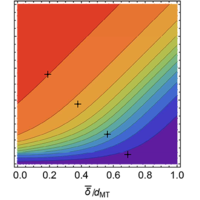
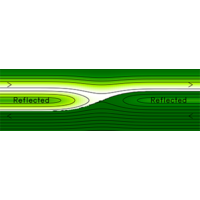
Nonadditive drag of tandem rods drafting in granular sediments

Brian Chang and Arshad Kudrolli

Phys. Rev. E 105, 034901 (2022) - Published 11 March, 2022

The drag on two objects moving in tandem through a fluid is not simply twice the drag on one of the objects. The authors study the drag on two rods moving through granular sediments and show that, unlike in Newtonian fluids, the leading rod can experience considerably more drag than the trailing one.

Ballooning in spiders using multiple silk threads

Charbel Habchi and Mohammad K. Jawed

Phys. Rev. E 105, 034401 (2022) - Published 4 March, 2022

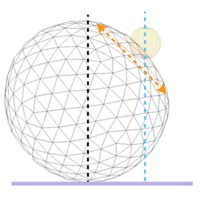
Spiders can float in the air using their silk threads as a kind of balloon. This paper presents detailed simulations of this behavior which show that electrostatic charges play an important role, both by providing a lift force and by determining the spatial arrangement of multiple threads.

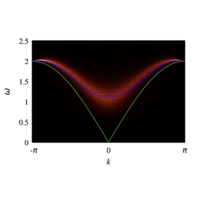
Heat transport in nonlinear lattices free from the umklapp process

Kazuyuki Yoshimura, Yusuke Doi, and Tomoya Kitamura

Phys. Rev. E 105, 024140 (2022) - Published 28 February, 2022

The authors develop a model that illustrates the role of umklapp processes in one-dimensional heat transport phenomena. They verify Peierls’ well-known hypothesis that only umklapp processes cause thermal resistance, and provide a starting point for understanding the emergence of this resistance.

Magnetized ablative Rayleigh-Taylor instability in three dimensions

C. A. Walsh

Phys. Rev. E 105, 025206 (2022) - Published 23 February, 2022

The ablative Rayleigh-Taylor instability plays an important role in the design of inertial confinement fusion implosions. The author develops three-dimensional magnetohydrodynamic simulations of this instability in magnetized plasmas and shows their advantage with respect to their two-dimensional counterparts.

Surface-field-induced heliconical instability in the cholesteric phase of a mixture of a flexible dimer (CB7CB) and a rodlike molecule (8CB)

Patrick Oswald

Phys. Rev. E 105, 024704 (2022) - Published 18 February, 2022

The author provides experimental evidence of the onset of a heliconical phase when a cholesteric liquid crystal is confined between two parallel plates with specific anchoring conditions. The confinement unwinds the cholesteric phase and plays a similar role as the electric field in previous experiments. The article also presents a theoretical treatment to explain the experimental observations.

Constructing periodic orbits of high-dimensional chaotic systems by an adjoint-based variational method

Sajjad Azimi, Omid Ashtari, and Tobias M. Schneider

Phys. Rev. E 105, 014217 (2022) - Published 31 January, 2022

What do periodic orbits and chaos have in common? The basic building blocks of chaotic dynamics are unstable periodic orbits, which are unstable nonchaotic time-periodic solutions of nonlinear equations such as the Navier-Stokes equations. Learn more by reading about the method proposed in this paper for computing such orbits in high-dimensional chaotic systems, a task that is computationally challenging even today.

Marangoni convection driven by temperature gradient near an isotropic-nematic phase transition point

Jun Yoshioka, Tasuku Sakikawa, Yuki Ito, and Koji Fukao

Phys. Rev. E 105, L012701 (2022) - Published 24 January, 2022

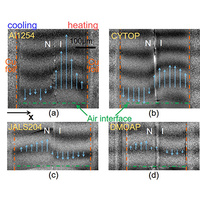
This work takes advantage of the nonmonotonic dependence of the surface tension of liquid crystals on temperature to study Marangoni flow in sandwich cells under controlled temperature. The authors find intricate behaviors depending on the phases of the material as well as on the anchoring conditions.

Mean-field theory accurately captures the variation of copy number distributions across the mRNA life cycle

Juraj Szavits-Nossan and Ramon Grima

Phys. Rev. E 105, 014410 (2022) - Published 14 January, 2022

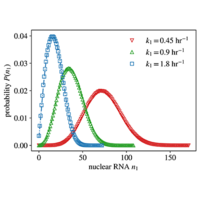
The life cycle of messenger RNA can be modeled by a reaction scheme that includes a stochastic element. The authors develop a mean-field approach that is able to predict the number of molecules at each stage of the mRNA life cycle, and confirm their result using stochastic simulations.

Phonon eigenfunctions of inhomogeneous lattices: Can you hear the shape of a cone?

Grace H. Zhang and David R. Nelson

Phys. Rev. E 104, 065005 (2021) - Published 27 December, 2021

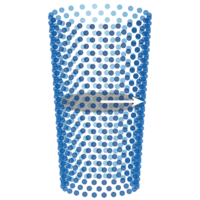
This work studies an inhomogeneous crystal, in this case a periodic lattice with a slowly varying lattice constant formed by interacting particles on the surface of a cone. The authors find that geometrical information, such as the opening angle of the cone, can be extracted from properties of the lattice excitations.

Statistical properties of avalanches via the c-record process

Vincenzo Maria Schimmenti, Satya N. Majumdar, and Alberto Rosso

Phys. Rev. E 104, 064129 (2021) - Published 20 December, 2021

The statistical description of record-breaking events can be used to study the jerky motion that is seen when an interface is pulled through a disordered medium. The authors describe a simple one-dimensional model that can be solved analytically and that successfully captures some of the features observed in real systems.

Stiffness heterogeneity of small viral capsids

Lucas Menou, Yeraldinne Carrasco Salas, Lauriane Lecoq, Anna Salvetti, Cendrine Faivre Moskalenko, and Martin Castelnovo

Phys. Rev. E 104, 064408 (2021) - Published 14 December, 2021

This experimental and modeling investigation studies the mechanical properties of small viruses, which are important in determining viral infectivity. The authors discover that the position of the AFM tip relative to the viral capsid has a non-negligible effect on stiffness measurements, and suggest alternative ways of measuring stiffness heterogeneities of small viral capsids.

Oscillating external force as a tool to tune motility characteristics of molecular motors

Andreja Šarlah

Phys. Rev. E 104, 064406 (2021) - Published 9 December, 2021

A variety of molecular motors exist that carry out mechanical tasks in cells, and different motors respond to applied forces in different ways. The author studies the effect of an oscillating force, as might occur in the dynamic environment inside a cell. The results agree with recent experiments and could serve as guidance for designing artificial molecular motors.

Predicting the outputs of finite deep neural networks trained with noisy gradients

Gadi Naveh, Oded Ben David, Haim Sompolinsky, and Zohar Ringel

Phys. Rev. E 104, 064301 (2021) - Published 2 December, 2021

Deep neural networks play an important role in the study of machine learning, but the theoretical understanding of their behavior is incomplete. In this paper the authors make progress in this area by establishing a correspondence between deep neural networks and a certain non-Gaussian stochastic process.

Asymmetric one-dimensional slow electron holes

I. H. Hutchinson

Phys. Rev. E 104, 055207 (2021) - Published 24 November, 2021

Slow electron holes, slowly moving localized plasma regions with a lower electron density than the surrounding plasma, are seen in simulations and in observations of space plasmas. The author performs a one-dimensional analysis of the equilibrium and stability of these electron holes, and finds criteria for their existence.

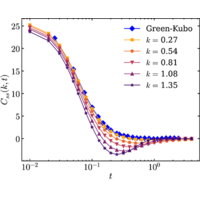
Generalized hydrodynamics of the Lennard-Jones liquid in view of hidden scale invariance

Solvej Knudsen, B. D. Todd, Jeppe C. Dyre, and J. S. Hansen

Phys. Rev. E 104, 054126 (2021) - Published 23 November, 2021

The authors use molecular dynamics simulations to look at the collective dynamics of a Lennard-Jones liquid along isomorphs, curves of approximate invariance in the phase diagram. They confirm that many physical quantities, including hydrodynamic characteristics, are nearly invariant along these curves.

Lethal DNA damage caused by ion-induced shock waves in cells

Ida Friis, Alexey V. Verkhovtsev, Ilia A. Solov'yov, and Andrey V. Solov'yov

Phys. Rev. E 104, 054408 (2021) - Published 23 November, 2021

Simulations show that the mechanical force of shock waves propagating through cells may be a key component of ion radiation damage to DNA.

Damage separation model: A replaceable particle method based on strain energy field

Yupeng Jiang, Peter Mora, Hans J. Herrmann, and Fernando Alonso-Marroquín

Phys. Rev. E 104, 045311 (2021) - Published 25 October, 2021

When simulating particle fragmentation in granular assemblies, it is a challenge to model the forces on individual particles accurately and to describe the resulting fragments in a realistic way. This paper describes a method that is based on the calculation of the strain energy field inside a particle, and it is shown to compare well with previous results.

Lattice Boltzmann method with moment-based boundary conditions for rarefied flow in the slip regime

S. Mohammed and T. Reis

Phys. Rev. E 104, 045309 (2021) - Published 21 October, 2021

Flows in microdevices typically take place in a regime where the Navier-Stokes equations do not provide a sufficient description. The authors use a lattice Boltzmann method with moment-based boundary conditions in that regime, and find that it compares well with analytical results and simulations.

Snowdrift game induces pattern formation in systems of self-propelled particles

Johanna Mayer, Michael Obermüller, Jonas Denk, and Erwin Frey

Phys. Rev. E 104, 044408 (2021) - Published 14 October, 2021

A system of two different types of self-propelled particles can produce a variety of spatiotemporal patterns through a simple game-theoretical interaction. In this analytical and numerical study, the authors find several distinct regions with qualitatively different collective behavior.

Frost spreading and pattern formation on microstructured surfaces

Lukas Hauer, William S. Y. Wong, Azadeh Sharifi-Aghili, Lou Kondic, and Doris Vollmer

Phys. Rev. E 104, 044901 (2021) - Published 1 October, 2021

A new imaging technique reveals the effects of humidity on the spread of frost across a micropatterned surface.

Sign In to Your Journals Account

Filter

Section

Filter

Article Lookup

Enter a citation