Highlights

Method of image charges for describing deformation of bounded two-dimensional solids with circular inclusions

Siddhartha Sarkar, Matjaž Čebron, Miha Brojan, and Andrej Košmrlj

Phys. Rev. E 103, 053004 (2021) - Published 24 May, 2021

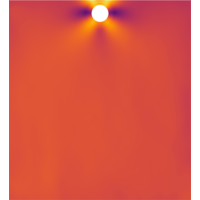
The authors generalize their theory for the deformation of solids with holes and inclusions to structures with boundaries, in analogy with the method of image charges in electrostatics. The theory improves in accuracy when higher-order multipoles are used, and is especially efficient when defects are spaced far apart and far from the boundaries.

Mechanisms underlying vaccination protocols that may optimally elicit broadly neutralizing antibodies against highly mutable pathogens

Raman S. Ganti and Arup K. Chakraborty

Phys. Rev. E 103, 052408 (2021) - Published 13 May, 2021

Researchers use nonequilibrium statistical physics methods to guide the design of vaccines that are effective against many strains of a virus, a holy grail of immunology.

Contribution of internal degree of freedom of soft molecules to Soret effect

Takeaki Araki and Natsumi Chikakiyo

Phys. Rev. E 103, 042611 (2021) - Published 29 April, 2021

Placing a fluid mixture in a temperature gradient can cause concentration gradients to build up, a phenomenon called the Soret effect. The authors simulate this effect for a mixture of monomers and dimers, and find a contribution from the internal degrees of freedom of the dimers. Under some conditions the sign of the effect is reversed.

Energetics of synchronization for model flagella and cilia

Weida Liao and Eric Lauga

Phys. Rev. E 103, 042419 (2021) - Published 22 April, 2021

Cells living in fluids at low Reynolds number swim by moving their flagella, often in a synchronized fashion. In this paper the authors study the cellular synchronization in relation to a minimization of the dissipated energy, extending known results to new geometries.

Local time for run and tumble particle

Prashant Singh and Anupam Kundu

Phys. Rev. E 103, 042119 (2021) - Published 13 April, 2021

This article examines statistics of the time that a run-and-tumble particle in one dimension spends in the neighborhood of a given point. The authors develop a path-counting analysis that enables them to find and interpret descriptions for both inhomogeneous and homogenous environments.

Predicting nucleation using machine learning in the Ising model

Shan Huang, William Klein, and Harvey Gould

Phys. Rev. E 103, 033305 (2021) - Published 24 March, 2021

Machine learning has been successfully applied to a number of physics problems, but the method works less well for a system that is near a critical point. An application to nucleation in the two-dimensional Ising model shows that as the spinodal is approached and the densities of the nucleating droplet and the background become similar, the method is less accurate.

Implicit molecular stresses in weakly compressible particle-based discretization methods for fluid flow

Max Okraschevski, Niklas Buerkle, Rainer Koch, and Hans-Joerg Bauer

Phys. Rev. E 103, 033304 (2021) - Published 18 March, 2021

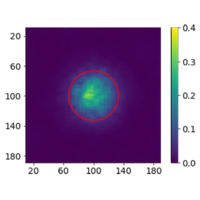
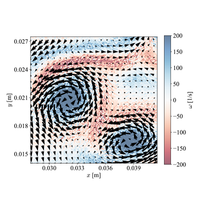
Methods such as weakly-compressible smoothed particle hydrodynamics are frequently used in fluid dynamics, but they are known to struggle with the direct numerical simulation of vortices and turbulence at finite resolution. By making a connection with nonequilibrium molecular dynamics, the authors identify a tensor quantity that may help understand and remedy these problems.

Covariance distributions in single particle tracking

Mary Lou P. Bailey, Hao Yan, Ivan Surovtsev, Jessica F. Williams, Megan C. King, and Simon G. J. Mochrie

Phys. Rev. E 103, 032405 (2021) - Published 9 March, 2021

Single-particle tracking makes it possible to record trajectories of individual particles, that can then be analyzed to characterize the underlying dynamics. This paper describes a tool to perform this analysis even in the case of anomalous diffusion, with a test on the in-vivo motion of a chromosomal locus in a species of yeast.

Statistical mechanics of dislocation pileups in two dimensions

Grace H. Zhang and David R. Nelson

Phys. Rev. E 103, 022139 (2021) - Published 24 February, 2021

Dislocations in crystals can cluster together, for example at grain boundaries, and such pileups affect the properties of the material. This work studies the behavior of one-dimensional dislocation pileups in two-dimensional crystals through mappings onto a Coulomb gas and quantum Brownian motion, and identifies two phase transitions as a function of temperature.

Morphoelasticity of large bending deformations of cell sheets during development

Pierre A. Haas and Raymond E. Goldstein

Phys. Rev. E 103, 022411 (2021) - Published 22 February, 2021

During development, plant and animal tissues undergo large bending deformations that are outside the validity of frequently used thin-shell theories. This work uses asymptotic expansion of a three-dimensional system to develop a theory of incompressible shells that is valid for large bending transformations and improves on the classical thin-shell theories. The theory is applied to the green alga Volvox, which has a spherical embryonic cell sheet that turns itself inside out during development.

New role for circuit expansion for learning in neural networks

Julia Steinberg, Madhu Advani, and Haim Sompolinsky

Phys. Rev. E 103, 022404 (2021) - Published 15 February, 2021

Learning in neural networks happens through the modification of synaptic connections among neurons, and expanding the network generally results in better performance. Using mean field theory and simulations, the authors of this paper show that the network’s performance is better even if the expansion is transient, revealing an intriguing similarity between artificial and biological neural networks.

Applicability of the absence of equilibrium in quantum system fully coupled to several fermionic and bosonic heat baths

V. V. Sargsyan, A. A. Hovhannisyan, G. G. Adamian, N. V. Antonenko, and D. Lacroix

Phys. Rev. E 103, 012137 (2021) - Published 29 January, 2021

Under certain conditions, a quantum oscillator coupled to multiple fermionic and bosonic heat baths does not evolve towards a steady state. The authors of this paper show that when one bath is bosonic and one bath is fermionic, the occupation number of the oscillator continues to vary with a frequency that depends on the oscillator frequency.

Position distribution in a generalized run-and-tumble process

David S. Dean, Satya N. Majumdar, and Hendrik Schawe

Phys. Rev. E 103, 012130 (2021) - Published 25 January, 2021

This paper studies the dynamics of a generalized run-and-tumble process subjected to active noise. The authors analyze the mean-squared displacement, as well as other properties, and back up their results with numerical simulations.

Pervasive orientational and directional locking at geometrically heterogeneous sliding interfaces

Xin Cao, Emanuele Panizon, Andrea Vanossi, Nicola Manini, Erio Tosatti, and Clemens Bechinger

Phys. Rev. E 103, 012606 (2021) - Published 13 January, 2021

The dynamical behavior of a crystalline cluster moving on an ordered surface can be quite complicated when the cluster and surface have different lattice symmetries. By performing experiments and simulations on clusters of colloidal particles, the authors investigate this behavior for various combinations of cluster and substrate symmetries.

Effect of the charge distribution of virus coat proteins on the length of packaged RNAs

Yinan Dong, Siyu Li, and Roya Zandi

Phys. Rev. E 102, 062423 (2020) - Published 28 December, 2020

Certain viruses enclose their genetic material in a protein shell called the capsid, and it is known that electrostatic interactions are an important driving force in capsid formation. The authors use mean-field theory to show that not only the total charge, but also the charge distribution and configurational entropy play a significant role in this formation process, leading to an improved understanding of virus assembly.

Recovering Gardner restacking with purely diffusive operations

E. J. Kolmes and N. J. Fisch

Phys. Rev. E 102, 063209 (2020) - Published 21 December, 2020

When a plasma is unstable, how large is the energy release that can be triggered by the instability? In this paper, the authors show that two existing approaches to this question are equivalent, and provide a prescription for calculating the maximum energy that can be extracted.

Dynamics behind rough sounds in the song of the Pitangus sulphuratus

Juan F. Döppler, Ana Amador, Franz Goller, and Gabriel B. Mindlin

Phys. Rev. E 102, 062415 (2020) - Published 11 December, 2020

This article presents experimental and modeling work to characterize the vocalizations of the great kiskadee, a song bird found in the Americas. The model, together with measurements of muscle activity, air pressure, and sound, suggests mechanisms for sound amplitude modulation and other features of the characteristic song of the great kiskadee.

Extreme first-passage times for random walks on networks

Sean D. Lawley

Phys. Rev. E 102, 062118 (2020) - Published 9 December, 2020

Have you wondered who started a rumor and how it reached you? What was the path that it took? In this work the author analyzes how rumors, or diseases, spread in a complex environment by computing analytically many properties of the fastest first passage time of searchers on a complex network.

Multicellular sensing at a feedback-induced critical point

Michael Vennettilli, Amir Erez, and Andrew Mugler

Phys. Rev. E 102, 052411 (2020) - Published 23 November, 2020

Some biological systems have been found to operate near criticality. This work uses a simple model of a multicellular biological system to probe implications of criticality for information sensing. The authors investigate tradeoffs between precision and rate of acquisition of information about an external signal and discuss implications for several well-studied biological systems.

Consistent approach for electrical resistivity within Ziman's theory from solid state to hot dense plasma: Application to aluminum

Nadine Wetta and Jean-Christophe Pain

Phys. Rev. E 102, 053209 (2020) - Published 16 November, 2020

The authors study the electrical conductivity of aluminum through a range of temperatures from the solid to the plasma state, including the warm dense matter regime. They propose a consistent approach to remove elastic contributions from the structure factor of the system, and the results compare well with previously published experimental and simulation data.

Sign In to Your Journals Account

Filter

Section

Filter

Article Lookup

Enter a citation