Recent Articles

Majorana bound states from cavity embedding in an interacting two-site Kitaev chain

Álvaro Gómez-León, Marco Schirò, and Olesia Dmytruk

Phys. Rev. B 111, 155410 (2025) - Published 9 April, 2025

Magnetic control of nonreciprocal charge transport

Xu Chen, Yuhao Fu, Xianjie Wang, Yu Sui, Hong Jian Zhao, and L. L. Tao

Phys. Rev. B 111, 155411 (2025) - Published 9 April, 2025

Al K-edge XANES of octahedral aluminum compounds: Similarities and differences via the analysis of excitonic properties

Newman Amoyaw, Abezu Agegnehu, Francesco Sottile, Matteo Gatti, and M. Laura Urquiza

Phys. Rev. B 111, 165112 (2025) - Published 9 April, 2025

Low-energy electrodynamics and a hidden Fermi liquid in the heavy-fermion compound CeCoIn5

L. Y. Shi, Zhenisbek Tagay, Jiahao Liang, Khoan Duong, Yi Wu, F. Ronning, Darrell G. Schlom, K. M. Shen, and N. P. Armitage

Phys. Rev. B 111, 165113 (2025) - Published 9 April, 2025

Geometric origin of self-intersection points in non-Hermitian energy spectra

Jinghui Pi, Chenyang Wang, Yong-Chun Liu, and Yangqian Yan

Phys. Rev. B 111, 165407 (2025) - Published 9 April, 2025

Evidence for reduced periodic lattice distortion within the Sb-terminated surface layer of the kagome metal CsV3Sb5

Felix Kurtz, Gevin von Witte, Lukas Jehn, Alp Akbiyik, Igor Vinograd, Matthieu Le Tacon, Amir A. Haghighirad, Dong Chen, Chandra Shekhar, Claudia Felser, and Claus Ropers

Phys. Rev. B 111, L140101 (2025) - Published 9 April, 2025

Ferroelectric control of spin and orbital Rashba effects at the Ni/HfO2 interface

Armando Pezo, Andrés Saul, Aurélien Manchon, and Rémi Arras

Phys. Rev. B 111, L140405 (2025) - Published 9 April, 2025

Coexistence of chiral Majorana edge states and Bogoliubov Fermi surfaces in two-dimensional nonsymmorphic Dirac semimetal/superconductor heterostructures

Yijie Mo, Xiao-Jiao Wang, Zheng-Yang Zhuang, and Zhongbo Yan

Phys. Rev. B 111, L140504 (2025) - Published 9 April, 2025

Antichiral surface states and Su-Schrieffer-Heeger physics in rutile altermagnets

Sopheak Sorn

Phys. Rev. B 111, L161109 (2025) - Published 9 April, 2025

Quantum skyrmion liquid

Dhiman Bhowmick, Andreas Haller, Deepak S. Kathyat, Thomas L. Schmidt, and Pinaki Sengupta

Phys. Rev. B 111, 134410 (2025) - Published 8 April, 2025

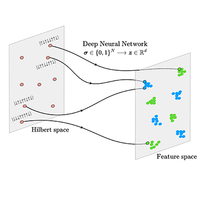
Transformer wave function for two dimensional frustrated magnets: Emergence of a spin-liquid phase in the Shastry-Sutherland model

Luciano Loris Viteritti, Riccardo Rende, Alberto Parola, Sebastian Goldt, and Federico Becca

Phys. Rev. B 111, 134411 (2025) - Published 8 April, 2025

The authors propose here a variational ansatz based on the Transformer architecture to investigate frustrated quantum magnets. The key idea is based on constructing a map, parametrized with a Transformer, from the space of the physical spin configurations to an abstract space, where the determination of the properties of the system is simplified. This method achieves an exceptionally accurate description of the ground-state properties of the Shastry-Sutherland model, successfully identifying the presence of a gapless quantum spin liquid phase.

Simultaneous optimization of lattice and spin configurations in atomic scale simulation of magnetic materials

Zhengtao Huang, Teng Yang, Hanxing Liu, and Ben Xu

Phys. Rev. B 111, 134412 (2025) - Published 8 April, 2025

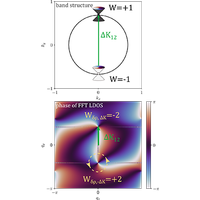
Detecting the topological winding of superconducting nodes via local density of states

Lena Engström, Pascal Simon, and Andrej Mesaros

Phys. Rev. B 111, 134505 (2025) - Published 8 April, 2025

The authors propose here a method to use impurity scattering to detect interference effects between two superconducting nodes, each of which carries locally a winding number as a topological invariant. Steps are outlined for choosing an impurity and a tip for the scanning tunnelling microscope, such that the winding difference of the nodes becomes measurable via the local density of states around the impurity. The formalism is demonstrated on a model of a two-dimensional superconductor, but applies to any nodal system with chiral symmetry.

Quantum phase transition in small-size one- and two-dimensional Josephson junction arrays: Analysis of experiments within the interacting plasmons picture

Samuel Feldman and Andrey Rogachev

Phys. Rev. B 111, 134506 (2025) - Published 8 April, 2025

Pressure-induced evolution of superconductivity and structural stability in a bulk 4Hb -TaSeS heterostructure

Yehua Huang, Hang Li, Xin Yang, Wenju Zhou, Donghan Jia, Jiajia Feng, He Zhang, Guoliang Niu, Bingmin Yan, Fuyang Liu, Qingchao Zeng, Guangwei Che, Runze Jiang, Junwei Li, Luhong Wang, Haozhe Liu, Ricardo D. dos Reis, Renbiao Tao, Xiaohui Yu, Qingyang Hu, Bin Chen, and Huiyang Gou

Phys. Rev. B 111, 144103 (2025) - Published 8 April, 2025

Quantum geometry embedded in unitarity of evolution: Revealing its impacts as geometric oscillation and dephasing in spin resonance and crystal bands

B. Q. Song, J. D. H. Smith, T. Jiang, Y. X. Yao, and J. Wang

Phys. Rev. B 111, 144305 (2025) - Published 8 April, 2025

Evaluating SCAN and r2SCAN meta-GGA functionals for predicting transition temperatures in antiferromagnetic materials

Nafise Rezaei, Mojtaba Alaei, and Artem R. Oganov

Phys. Rev. B 111, 144406 (2025) - Published 8 April, 2025

Dipolar Aleppo lattice: Ground state ordering and ergodic dynamics in the absence of vertex frustration

Davis Crater, Gopi Mahato, Christian Hoyt, Duncan Miertschin, Balaram Regmi, Kevin Hofhuis, Scott Dhuey, Barat Achinuq, Francesco Caravelli, and Alan Farhan

Phys. Rev. B 111, 144407 (2025) - Published 8 April, 2025

Role of domain nucleation and domain wall motion in all-optical helicity-dependent switching

Tian Xun Huang, Wei Zhang, Michel Hehn, Grégory Malinowski, Stéphane Mangin, and Julius Hohlfeld

Phys. Rev. B 111, 144408 (2025) - Published 8 April, 2025

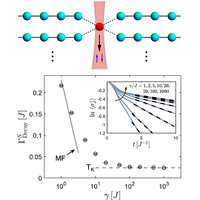
Variational approach to the dynamics of dissipative quantum impurity models

Yi-Fan Qu, Martino Stefanini, Tao Shi, Tilman Esslinger, Sarang Gopalakrishnan, Jamir Marino, and Eugene Demler

Phys. Rev. B 111, 155113 (2025) - Published 8 April, 2025
Simulating dissipative quantum many-body systems presents a significant theoretical challenge. Here, the authors develop an efficient nonperturbative framework that is tailored to dissipative impurity problems, combining a superposition of Gaussian states (SGS) variational ansatz with the quantum trajectory approach. They showcase the method with a model of a spinful impurity subject to two-body losses embedded in a fermionic bath, for which they explore the full crossover from weak to strong dissipation. Their approach captures the emergence of a loss-induced Kondo effect under strong dissipation, and reveals an exotic negative conductance phenomenon at intermediate loss rates.

Sign In to Your Journals Account

Filter

Recent Issues

Vol. 114, Iss. 24
15 October 2026
Vol. 114, Iss. 23
15 October 2026
Vol. 114, Iss. 22
15 October 2026
Vol. 114, Iss. 21
1 October 2026
Category
Article Type
Section

Filter

Article Lookup

Enter a citation