Recent Articles

Half-metallicity in antiferromagnetic MI3 bilayers

Hua-Ying Liu, Xiu-Cai Jiang, Xiao-Fang Ouyang, and Yu-Zhong Zhang

Phys. Rev. B 112, 024427 (2025) - Published 18 July, 2025

Trigonal distortion and orbital polarization of Co2+ in a honeycomb cobaltate film grown on a SrTiO3 substrate

Lei Wang, Long Wei, Ziyue Shen, Tianyang Wang, Runze Yao, Ziyang Wang, Chen Luo, Florin Radu, Yulin Gan, Kai Chen, and Zhaoliang Liao

Phys. Rev. B 112, 024428 (2025) - Published 18 July, 2025

Atomistic calculation of the τ0 inverse attempt frequency in Fe3O4 magnetite nanoparticles

Roberto Moreno, Sarah Jenkins, Wyn Williams, and Richard F. L. Evans

Phys. Rev. B 112, 024429 (2025) - Published 18 July, 2025

Electric field induced oscillations in multielectron bubbles in liquid helium-4

Pranaya Kishore Rath, Dillip Kumar Pradhan, Udit Chowdhury, J. Van Loock, J. Tempere, Yunhu Huang, Vaisakh Vadakkumbatt, and Ambarish Ghosh

Phys. Rev. B 112, 024510 (2025) - Published 18 July, 2025

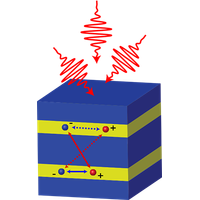
Indirect excitons and many-body interactions in InGaAs double quantum wells

Christopher L. Smallwood, Rachel Owen, Matthew W. Day, Takeshi Suzuki, Rohan Singh, Travis M. Autry, Smriti Bhalerao, Fauzia Jabeen, and Steven T. Cundiff

Phys. Rev. B 112, 035305 (2025) - Published 18 July, 2025

Spatially indirect excitons in semiconductors consist of electrons and holes residing in physically different locations. The particles in turn are characterized by enhanced moiré pattern sensitivity, extended lifetimes, and significant tunability. Here, the authors investigate indirect excitons in InGaAs double quantum wells using optical multidimensional coherent spectroscopy and discovering signatures of many-body effects that have relevance to exciton dephasing mechanisms and the role of free-electron continuum states. The findings will have impact on the design of coherent optical emitters, such as lasers.

Magnetic flux tunable electronic transport through domain walls in a three-dimensional second-order topological insulator

Zhe Hou and Ai-Min Guo

Phys. Rev. B 112, 035418 (2025) - Published 18 July, 2025

Generalized incommensurability: Role of anomalously strong spin-orbit coupling for the spin ordering in the quasi-two-dimensional system FeSe

Piotr Chudzinski, Abyay Ghosh, and Myrta Grüning

Phys. Rev. B 112, 035419 (2025) - Published 18 July, 2025

Direct visualization of an incommensurate unidirectional charge density wave in La4Ni3O10

Mingzhe Li, Jiashuo Gong, Yinghao Zhu, Ziyuan Chen, Jiakang Zhang, Enkang Zhang, Yuanji Li, Ruotong Yin, Shiyuan Wang, Jun Zhao, Dong-Lai Feng, Zengyi Du, and Ya-Jun Yan

Phys. Rev. B 112, 045132 (2025) - Published 18 July, 2025

Theory of a two-dimensional anharmonic piezoelectric crystal resonator

Karl H. Michel, Cem Sevik, and Milorad V. Milošević

Phys. Rev. B 112, 045133 (2025) - Published 18 July, 2025

Dielectric screening effects in the decoherence of excitons and exciton-phonon scattering in atomical monolayer WS2 semiconductors

Xuguang Cao, Debao Zhang, Wanggui Ye, Ji Zhou, Changcheng Zheng, Kenji Watanabe, Takashi Taniguchi, Jiqiang Ning, and Shijie Xu

Phys. Rev. B 112, 045420 (2025) - Published 18 July, 2025

Non-Ohmic behavior in (Bi1−xSbx)2Te3 by Joule heating

Sofie Kölling, Daan H. Wielens, İnanç Adagideli, and Alexander Brinkman

Phys. Rev. B 112, 045421 (2025) - Published 18 July, 2025

High harmonic generation in Haldane model quantum dots

Krishna Rana Magar and Vadym Apalkov

Phys. Rev. B 112, 045422 (2025) - Published 18 July, 2025

Boundary and defect criticality in topological insulators and superconductors

Xiaoyang Shen, Zhengzhi Wu, and Shao-Kai Jian

Phys. Rev. B 112, L041118 (2025) - Published 18 July, 2025

Tunable altermagnetism via interchain engineering in parallel-assembled atomic chains

Deping Guo, Canbo Zong, Weihan Zhang, Cong Wang, Junwei Liu, and Wei Ji

Phys. Rev. B 112, L041404 (2025) - Published 18 July, 2025

The authors demonstrate here the existence of altermagnetism in quasi-one-dimensional (Q1D) systems by assembling single-atomic magnetic chains into monolayers. Through systematic symmetry analysis and high-throughput calculations, they identify four altermagnetic prototypes and predict eight dynamically stable Q1D monolayers, including three intrinsic and five extrinsic candidates. The interchain spacing and external electric fields enable tunable spin splitting. These findings establish a highly versatile family of Q1D altermagnets with anisotropic interactions, offering new avenues for designing low-dimensional spintronic devices.

Pathways to crystal chirality: An algorithm to identify displacive chiral phase transitions

Fernando Gómez-Ortiz, Aldo H. Romero, and Eric Bousquet

Phys. Rev. B 112, 014107 (2025) - Published 17 July, 2025

Probing quantum phase transitions via short-depth quantum circuits for estimating quantum coherence and discrete Berry phases

Kok Chuan Tan, Deren Liu, Kishor Bharti, Dhiman Bhowmick, and Pinaki Sengupta

Phys. Rev. B 112, 014108 (2025) - Published 17 July, 2025

Analyzing the anharmonic phonon spectrum: Self-consistent approximation and temperature-dependent effective potential methods

Lorenzo Monacelli

Phys. Rev. B 112, 014109 (2025) - Published 17 July, 2025

Out-of-time-order correlator computation based on a discrete truncated Wigner approximation

Tatsuhiko Shirai and Takashi Mori

Phys. Rev. B 112, 014309 (2025) - Published 17 July, 2025

Color symmetry and altermagneticlike spin textures in noncollinear antiferromagnets

Paolo G. Radaelli and Gautam Gurung

Phys. Rev. B 112, 014431 (2025) - Published 17 July, 2025

Intrinsic flexomagnetism of antiferromagnetic monolayer FeSe

Ziming Tang, Qihua Gong, and Min Yi

Phys. Rev. B 112, 014432 (2025) - Published 17 July, 2025
Sign In to Your Journals Account

Filter

Recent Issues

Vol. 114, Iss. 24
15 October 2026
Vol. 114, Iss. 23
15 October 2026
Vol. 114, Iss. 22
15 October 2026
Vol. 114, Iss. 21
1 October 2026
Category
Article Type
Section

Filter

Article Lookup

Enter a citation