Recent Articles

Electronic band structure, phonon dispersion, and magnetic triple-q state in GdGaI

Tatsuya Kaneko, Ryota Mizuno, Shu Kamiyama, Hideo Miyamoto, and Masayuki Ochi

Phys. Rev. B 113, 045156 (2026) - Published 29 January, 2026

Reverse phonon thermal flux from an applied electric field

Chunhua Li and David Broido

Phys. Rev. B 113, 045205 (2026) - Published 29 January, 2026

Nonreciprocal zone boundary magnon propagation in Cu2OSeO3

T. Weber, N. Heinsdorf, M. Stekiel, P. Steffens, A. P. Schnyder, and C. Pfleiderer

Phys. Rev. B 113, L020414 (2026) - Published 29 January, 2026

Here, the authors employ inelastic neutron scattering to show that the magnon spectrum of the chiral magnet Cu2OSeO3 features a strong directional dichroism at the boundary of the nuclear Brillouin zone. The affected magnon modes show virtually no damping and can be influenced using a magnetic field, making them of great interest for research on high-frequency unidirectional magnonic applications such as switchable spin-wave diodes.

Anomalous Knudsen effect signaling long-lived modes in two-dimensional electron gases

Grigory A. Starkov and Björn Trauzettel

Phys. Rev. B 113, L041406 (2026) - Published 29 January, 2026

Probing quantum geometric nonlinear magnetization via second-harmonic magneto-optical Kerr effect

Xuan Qian, Xiao-Bin Qiang, Wenkai Zhu, Yuqing Huang, Yiyuan Chen, Hai-Zhou Lu, Yang Ji, and Kaiyou Wang

Phys. Rev. B 113, L041407 (2026) - Published 29 January, 2026

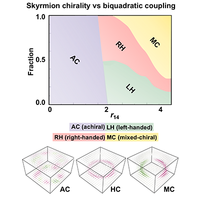
Chiral transformation of polar skyrmion bubbles: A phase field study

Mei-Xiong Zhu, Yun-Long Tang, Yin-Lian Zhu, Xiu-Liang Ma, and Yu-Jia Wang

Phys. Rev. B 113, 014118 (2026) - Published 28 January, 2026

The authors introduce here an extended phase-field model with a biquadratic polarization-gradient coupling that enables the spontaneous emergence of Bloch-type polarization in ferroelectric skyrmion bubbles. Using SrTiO3/PbTiO3/SrTiO3 heterostructures as a model system, the authors find a coupling-driven transition from achiral to chiral skyrmions and ultimately to mixed-chiral bubbles. While random initial states yield racemic chirality, homochiral vortex precursors deterministically imprint uniform skyrmion handedness under an applied electric field.

Transverse and unidirectional spin pumping

Ping Li, Chengyuan Cai, and Tao Yu

Phys. Rev. B 113, 014438 (2026) - Published 28 January, 2026

Superconducting gap symmetry of two-dimensional electron gas at (111)-oriented LaAlO3/SrTiO3 interface

Julian Czarnecki, Michał Zegrodnik, and Paweł Wójcik

Phys. Rev. B 113, 014519 (2026) - Published 28 January, 2026

Critical behavior and evidence of dimensional crossover in quasi-two-dimensional Li2FeSiO4

W. Hergett, K. Ackermann, E. Walendy, S. Spachmann, M. Jonak, M. Abdel-Hafiez, M. W. Haverkort, and R. Klingeler

Phys. Rev. B 113, 024435 (2026) - Published 28 January, 2026

Long-distance coupling between magnetic centers in ultrafast spin transfer: Dynamic Goodenough-Kanamori-Anderson rules

Jing Liu, Yiming Zhang, Shuai Xu, Kanchan Sarkar, Chun Li, Wei Jin, Wolfgang Hübner, and Georgios Lefkidis

Phys. Rev. B 113, 024436 (2026) - Published 28 January, 2026

Anisotropic symmetric Γ̂ interaction induced magnon D'yakonov-Perel' and Elliott-Yafet spin relaxation in two-dimensional antiferromagnets

Yating Hu, X. Wan, Sergey Y. Savrasov, and Yiqun Liu

Phys. Rev. B 113, 024437 (2026) - Published 28 January, 2026

Fulde-Ferrell-Larkin-Ovchinnikov states and topological Bogoliubov Fermi surfaces in altermagnets: An analytical study

Zhao Liu, Hui Hu, and Xia-Ji Liu

Phys. Rev. B 113, 024518 (2026) - Published 28 January, 2026

Superconducting diode effect in selectively grown topological insulator based Josephson junctions

Gerrit Behner, Abdur Rehman Jalil, Detlev Grützmacher, and Thomas Schäpers

Phys. Rev. B 113, 035440 (2026) - Published 28 January, 2026

Layer-dependent spin properties of charge carriers in vertically coupled telecom quantum dots

Marius Cizauskas, A. Kors, J. P. Reithmaier, A. Mark Fox, M. Benyoucef, Manfred Bayer, and Alex Greilich

Phys. Rev. B 113, 035441 (2026) - Published 28 January, 2026

Current-induced molecular dissociation: Topological insulators as robust reaction platforms

Erika L. Mehring, Amparo Figueroa, Matias Berdakin, and Hernán L. Calvo

Phys. Rev. B 113, 035442 (2026) - Published 28 January, 2026

Magnetic injection photocurrents in valley-polarized states of twisted bilayer graphene

Fernando Peñaranda, Héctor Ochoa, and Fernando de Juan

Phys. Rev. B 113, 035443 (2026) - Published 28 January, 2026

Magnetic field dependence of the spin fluctuations in CeCu5.8Ag0.2

X. Boraley, A. D. Christianson, J. Lass, C. Balz, M. Bartkowiak, Ch. Niedermayer, J. M. Lawrence, L. Poudel, D. G. Mandrus, F. Ronning, M. Janoschek, and D. G. Mazzone

Phys. Rev. B 113, 045154 (2026) - Published 28 January, 2026

Surface state dominated transport in HgTe topological insulator devices

M. Hofer, C. Fuchs, L. Fürst, T. Kießling, W. Beugeling, S. Schreyeck, H. Buhmann, and L. W. Molenkamp

Phys. Rev. B 113, 045303 (2026) - Published 28 January, 2026

Single-band triangular lattice Hubbard model with tunable anisotropy from twisted rhombic homobilayers

Wen Sun, Chuyi Tuo, and Hong Yao

Phys. Rev. B 113, L041119 (2026) - Published 28 January, 2026

The authors demonstrate here that twisted semiconductor homobilayers with band extrema at the Y valley on diamond lattices provide a promising platform for realizing a single-band triangular lattice Hubbard model with tunable hopping anisotropy via a displacement field. In the absence of a displacement field, the low-energy physics is governed by weakly coupled chains with quasi-one-dimensional band structure; increasing the displacement field generates interchain hopping, realizing a two-dimensional triangular lattice with tunable hopping anisotropy. To gain further insight into the role of hopping anisotropy, they employ density matrix renormalization group (DMRG) to explore the many-body physics of this model at U/t = 10 and half filling. The resulting phase diagram includes chiral spin liquid, nonmagnetic, and Néel antiferromagnetic phases, all accessible through displacement field control.

Fragmented quantum phases in the antiblockade regime of a Rydberg atom array

Han-Chao Chen, Zheng-Yuan Zhang, Meng Zhou, Xin Liu, Li-Hua Zhang, Bang Liu, Lu-Xia Wang, Dong-Sheng Ding, and Bao-Sen Shi

Phys. Rev. B 113, 014317 (2026) - Published 27 January, 2026

Sign In to Your Journals Account

Filter

Recent Issues

Vol. 114, Iss. 24
15 October 2026
Vol. 114, Iss. 23
15 October 2026
Vol. 114, Iss. 22
15 October 2026
Vol. 114, Iss. 21
1 October 2026
Category
Article Type
Section

Filter

Article Lookup

Enter a citation