Recent Articles

Wilson polygons and the topology of zero-dimensional systems

Gen Yin, Rameswar Bhattacharjee, Thomas Wang, and Miklos Kertesz

Phys. Rev. B 113, 115104 (2026) - Published 3 March, 2026

Bipartite fluctuations and charge fractionalization in quantum wires

Magali Korolev and Karyn Le Hur

Phys. Rev. B 113, 115105 (2026) - Published 3 March, 2026

Gauge theory and mixed state criticality

Takamasa Ando, Shinsei Ryu, and Masataka Watanabe

Phys. Rev. B 113, 115106 (2026) - Published 3 March, 2026

The authors develop here a systematic framework for constructing spontaneous symmetry-breaking (SSB) phases of strong symmetries, a concept specific to mixed quantum states. Starting from the ground-state phase diagram of lattice gauge theory models, the approach yields various mixed-state topological phases and explicit models for the critical points between them, including cases with gapless symmetry-protected topological order. They further clarify that lattice gauge theory ground states can be viewed as purifications of the corresponding mixed SSB states.

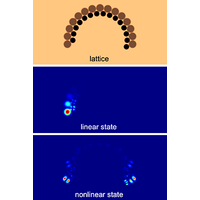
Topological edge states in curved zigzag superlattices in nonlinear semiconductor microcavity exciton polaritons

Jing Wang, Tobias Schneider, Wei Hu, Stefan Schumacher, and Xuekai Ma

Phys. Rev. B 113, 115302 (2026) - Published 3 March, 2026

Topological edge states are highly sought-after in zigzag chains. Here, the authors introduce a zigzag superlattice composed of two sublattices that supports multiple topological edge states. In this configuration, intercell and intracell couplings are imbalanced through eigenstate tunneling or the deformation of higher-order modes. Arranging the superlattices into an arc structure encourages specific bulk states to become more localized at the edge. A similar state transformation can be achieved via repulsive nonlinearity, which also facilitates the coexistence of distinct edge states.

Influence of magnon-magnon and magnon-phonon interactions on magnon relaxation under external strain and magnetic fields in monolayer MnSe2

Chang-Hao Ding, Wenwen Liu, Yuan Yao, Hao Chen, Nannan Luo, Jiang Zeng, Li-Ming Tang, Hui Pan, and Ke-Qiu Chen

Phys. Rev. B 113, 115403 (2026) - Published 3 March, 2026

Symmetry-driven intrinsic nonlinear pure spin Hall effect

Sayan Sarkar, Sunit Das, and Amit Agarwal

Phys. Rev. B 113, 125106 (2026) - Published 3 March, 2026

Hybrid between biologically and quantum-inspired many-body states

Miha Srdinšek and Xavier Waintal

Phys. Rev. B 113, 125107 (2026) - Published 3 March, 2026

Deep neural networks can fit a vast variety of data but they have limited mathematical structure. A typical large language model offers only the evaluation of the function, its gradient (automatic differentiation), and the ability to sample (autoregressive). Tensor networks offer much more—calculation of sums, scalar products, application of various operators—but are less expressive. Here, the authors take a step toward merging the two approaches to construct a variational ansatz that inherits some of both networks’ properties.

Charge puddles complicate nonlinear transport in large Berry phase materials

Arya Thenapparambil, Kajetan M. Fijalkowski, Mohamed AbdelGhany, Hartmut Buhmann, Charles Gould, and Laurens W. Molenkamp

Phys. Rev. B 113, 125108 (2026) - Published 3 March, 2026

Magnon scattering and transduction in Coulomb-coupled quantum Hall ferromagnets

Alexander Canright, Deepak Iyer, and Matthew S. Foster

Phys. Rev. B 113, 125301 (2026) - Published 3 March, 2026

Electron-phonon coupling probed by ultrafast coherent phonon spectroscopy in bulk van der Waals CrSBr

Xiaodong Shen, Jiajun Cao, Borong Cong, Bingsuo Zou, Weizheng Liang, Zanxiong Peng, Jialong Zhao, and Alexey Kavokin

Phys. Rev. B 113, 125406 (2026) - Published 3 March, 2026

Anomalous Hall effect in rhombohedral graphene

Vera Mikheeva, Daniele Guerci, Daniel Kaplan, and Elio J. König

Phys. Rev. B 113, 125407 (2026) - Published 3 March, 2026

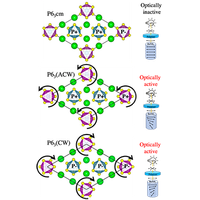
Strain-induced gyrotropic effects in ferroelectric BaTiS3

Wei Luo, Asier Zabalo, Guodong Ren, Gwan-Yeong Jung, Massimiliano Stengel, Rohan Mishra, Jayakanth Ravichandran, and Laurent Bellaiche

Phys. Rev. B 113, L100101 (2026) - Published 3 March, 2026

Here, the authors use first-principles calculations to uncover strain-engineered gyrotropic effects in ferroelectric BaTiS3. They predict a tensile strain induced transition to a chiral P63 phase enabling electric field switchable optical rotation, and a compressive strain driven insulator-to-polar Weyl semimetal transition that activates a nonlinear anomalous Hall effect with sign reversal. These results establish strain as a powerful route to control optical and transport responses in a single material.

Electrostatic interactions in atomistic and machine-learned potentials for polar materials

Lorenzo Monacelli and Nicola Marzari

Phys. Rev. B 113, 094101 (2026) - Published 2 March, 2026

This work presents a novel first-principles approach for simulating electrostatic forces in polar materials, a crucial component often lacking in machine-learning interatomic potentials. Long-range electrostatic interactions play a fundamental role and, although machine learning force fields have rapidly improved, their description of the atomic environment is local, thus hampering their applicability to real-world problems. Few methods have been proposed to address this issue, and all of them require extensive retraining of the force field. The approach here overcomes these limitations: it is derived from first principles and eliminates the need for new ab initio simulations on the training set. Furthermore, it can be easily implemented alongside existing and available force fields. The method is released as an open-source package that can be readily employed in simulations. It is highly versatile and user friendly. The authors anticipate that this new approach will have a significant impact on materials simulations.

Mechanical, electronic, and optical properties, and quantum capacitance of Janus ZrMCT2 (M=Ti, Cr, Mn, Hf; T=O, F, OH) MXenes: First-principles predictions

Xiao-Hong Li, Rui-Wen Yan, and Wu-Ming Liu

Phys. Rev. B 113, 094102 (2026) - Published 2 March, 2026

Incorporating Gibbs free energy into interatomic potential fitting

Liangrui Wei and Yang Sun

Phys. Rev. B 113, 094103 (2026) - Published 2 March, 2026

The Gibbs free energy is one of the most fundamental quantities governing the thermodynamics of materials, particularly under extreme conditions. Here, the authors introduce a framework that incorporates the Gibbs free energy into interatomic potential development. The method is rooted in Hamiltonian thermodynamic integration and is integrated with conventional fitting procedures, providing systematic control over both structural and thermodynamic properties. Applications to nickel and iron oxide systems demonstrate improved thermodynamic accuracy in molecular dynamics simulations at high pressures and temperatures.

Vibrational angular momentum generation in thermally driven chiral systems

Jichen Feng, Ethan Abraham, Joseph E. Subotnik, and Abraham Nitzan

Phys. Rev. B 113, 094301 (2026) - Published 2 March, 2026

Double exchange bias and ultraslow magnetization relaxation in TbFe-based bilayers

Johannes Seyd and Manfred Albrecht

Phys. Rev. B 113, 094401 (2026) - Published 2 March, 2026

Laser-induced ultrafast magnetization dynamics in BiYIG/Co-based heterostructures: Complementary insights from pump-probe Faraday and Kerr rotation measurements

Dimple Sneha Pamarthi, Elena Popova, Nirina Randrianantoandro, Michel Hehn, Niels Keller, and Marwan Deb

Phys. Rev. B 113, 094402 (2026) - Published 2 March, 2026

Nonreciprocal superradiant quantum phase transition induced by the magnon Kerr effect

Guo-Qiang Zhang, Si-Yan Lin, Wei Feng, Lijiong Shen, Yi-Hao Kang, and Wei Xiong

Phys. Rev. B 113, 094403 (2026) - Published 2 March, 2026

Hanle lineshapes and spin-rotation signatures from in-plane anisotropic spin relaxation in heterogeneous spin devices

Josef Světlík, Juan F. Sierra, Lorenzo Camosi, Williams Savero Torres, Franz Herling, Vera Marinova, Dimitre Dimitrov, and Sergio O. Valenzuela

Phys. Rev. B 113, 094404 (2026) - Published 2 March, 2026

Sign In to Your Journals Account

Filter

Recent Issues

Vol. 114, Iss. 24
15 October 2026
Vol. 114, Iss. 23
15 October 2026
Vol. 114, Iss. 22
15 October 2026
Vol. 114, Iss. 21
1 October 2026
Category
Article Type
Section

Filter

Article Lookup

Enter a citation