Recent Articles

Pressure-driven metal-insulator transition in BaMn2P2: A correlated Mn-pnictide analog of Fe-based superconductors

Youngro Lee, Daniil Evtushynsky, Richard Gaal, Igor Morozov, Anita Maksutova, Tomasz Poreba, Timur Kim, and Henrik M. Rønnow

Phys. Rev. B 113, 195131 (2026) - Published 18 May, 2026

Phase transitions on the dark side of the Gross-Neveu model: Spontaneous O(4N) symmetry breaking at repulsive coupling

Gabriel Osiander Rein, Fakher F. Assaad, and Igor F. Herbut

Phys. Rev. B 113, 195132 (2026) - Published 18 May, 2026

Bulk hydrodynamic transport in Weyl semimetals

Joan Bernabeu, Kitinan Pongsangangan, Henk T. C. Stoof, and Lars Fritz

Phys. Rev. B 113, 195133 (2026) - Published 18 May, 2026

Localized-to-itinerant transition in the quasi-one-dimensional Kondo lattice CeCo2Ga8

Chao Mu, Jiabin Song, Le Wang, Youguo Shi, Yi-feng Yang, Zheng Li, and Jianlin Luo

Phys. Rev. B 113, 195134 (2026) - Published 18 May, 2026

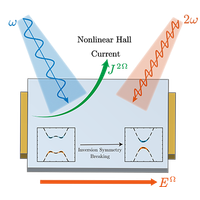
Nonlinear Hall effect induced by two-frequency drives

Jiong-Yi Zhu, Rui Chen, and Bin Zhou

Phys. Rev. B 113, 195422 (2026) - Published 18 May, 2026

Engineering light-matter interactions with two-frequency drives unlocks a new topological response. Here, the authors demonstrate that a commensurate drive with a frequency ratio of two intrinsically breaks inversion symmetry in 2D Dirac systems, inducing a tunable nonlinear Hall effect. Crucially, the resulting Berry curvature dipole is an even function of Fermi energy, different from the odd dependent relationship found in conventional tilted systems. This approach establishes a highly controllable route for manipulating nonlinear transport in quantum materials.

Spin- and valley-polarized transport in planar heterostructures modulated by circularly polarized light and antiferromagnetic exchange fields

Jing-Wen Huang and Yong Guo

Phys. Rev. B 113, 195423 (2026) - Published 18 May, 2026

Charge waves and dynamical signatures of topological phases in Su-Schrieffer-Heeger chains

T. Kwapiński, M. Kurzyna, and L. E. F. Foa Torres

Phys. Rev. B 113, 195424 (2026) - Published 18 May, 2026

Universal scheme for lasing and antilasing modes within multilayered conjugate metamaterials

Guohao Zhang, Yue Fei, Cong Niu, Daxing Dong, Youwen Liu, Chen Zhao, Guangwei Hu, and Yangyang Fu

Phys. Rev. B 113, 195425 (2026) - Published 18 May, 2026

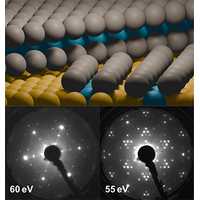
Growth and crystallographic structure of TiTe2 on Au(111): From submonolayer structures to single- and multilayer films

Andreas Raabgrund, Tilman Kißlinger, Alexander Wegerich, Lutz Hammer, and M. Alexander Schneider

Phys. Rev. B 113, 195426 (2026) - Published 18 May, 2026

Single-layer 1T-TiTe2 grown on a gold surface emerge from individual molecular building blocks. By combining STM, advanced LEED-IV, and DFT, the authors resolve here the atomic structure of epitaxial single-layer and multilayer TiTe2 films on Au(111), which evolve from isolated TiTe2 units with Ti atoms embedded in the topmost gold layer. The study uncovers Ti-induced restructuring of the Au surface, the formation of a moiré monolayer, and an unexpected lattice expansion persisting even in thicker TiTe2 films.

Theory and experiments of angle-dependent second-order nonlinear optical scattering

Hui Wang, Jesse B. Brown, Caulder Council, Anastasiia Tkachenko, Yuqin Qian, Lizheng Xue, Zhiqiang Li, Xiaojun Qi, and Yi Rao

Phys. Rev. B 113, 195427 (2026) - Published 18 May, 2026

Elliptical orbit motion of moiré exciton wave packets in twisted van der Waals heterobilayers

J. Rubstein, Andrey Chaves, T. A. S. Pereira, R. N. Costa Filho, F. M. Peeters, and D. R. da Costa

Phys. Rev. B 113, 195428 (2026) - Published 18 May, 2026

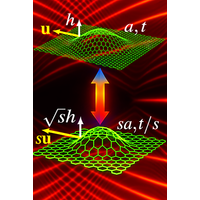
Scalable tight-binding model for strained graphene

Ming-Hao Liu (劉明豪), Christophe De Beule, Alina Mreńca-Kolasińska, Hsin-You Wu (吳欣祐), Aitor Garcia-Ruiz (艾飛宇), Denis Kochan, and Klaus Richter

Phys. Rev. B 113, 195429 (2026) - Published 18 May, 2026

The scalable tight-binding model for graphene has been very useful for modeling large-scale transport in pristine graphene. Here, the authors generalize the model to account for strained graphene. They find that the original model is readily applicable to elastically strained graphene, provided the corresponding lattice displacements are also properly scaled as summarized in the teaser image. This generalized approach facilitates the modeling of mesoscopic strained graphene devices, advancing the field of graphene straintronics.

Synthetic horizons in an atomic chain: Horizon-induced effects and connections to quantum Hall systems

Ali G. Moghaddam, Viktor Könye, Lotte Mertens, Jasper van Wezel, and Jeroen van den Brink

Phys. Rev. B 113, 195430 (2026) - Published 18 May, 2026

Current-induced magneto-optical Kerr effect as a probe of Dirac carriers in Bi1−xSbx alloy

Ryota Miyazaki, Shunzhen Wang, Guanxiong Qu, Yukihiro Marui, Yuta Kobayashi, Masashi Kawaguchi, and Masamitsu Hayashi

Phys. Rev. B 113, L180406 (2026) - Published 18 May, 2026

Stochastic dynamics of skyrmions on a racetrack: Impact of equilibrium and nonequilibrium noise

Anton V. Hlushchenko, Mykhailo I. Bratchenko, and Aleksei V. Chechkin

Phys. Rev. B 113, L180407 (2026) - Published 18 May, 2026

Dynamic deformations of multisublattice skyrmions

Elizaveta A. Tremsina and Geoffrey S. D. Beach

Phys. Rev. B 113, L180408 (2026) - Published 18 May, 2026

Floquet second-order topological insulator in strained graphene

Yu-Wen Xu, Xiaolin Wan, Zi-Ming Wang, Rui Wang, and Dong-Hui Xu

Phys. Rev. B 113, L201113 (2026) - Published 18 May, 2026

Valley current generation driven by surface acoustic waves in intervalley coherent states

Hiroto Tanaka and Youichi Yanase

Phys. Rev. B 113, L201114 (2026) - Published 18 May, 2026

Generalized boundary conditions in a thermodynamic model of ferroic materials

Sergey Nisnevich and Jonathan E. Spanier

Phys. Rev. B 113, 174110 (2026) - Published 15 May, 2026

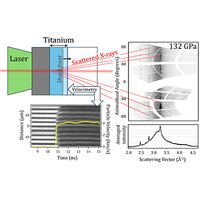
High-pressure melt dynamics in shock-compressed titanium

Saransh Singh, Reetam Paul, Nikhil Rampal, Rhys J. Bunting, Sebastien Hamel, Nathan Pulver, Christopher P. McGuire, Samantha M. Clarke, Amy L. Coleman, Cara Vennari, Trevor M. Hutchinson, Kimberly A. Pereira, Bob Nagler, Dimitri Khaghani, Hae Ja Lee, Nicholas A. Czapla, Travis Volz, Ian K. OCampo, James McNaney, Thomas E. Lockard, Jon H. Eggert, Amy Lazicki, Christopher E. Wehrenberg, Andrew Krygier, and Raymond F. Smith

Phys. Rev. B 113, 174111 (2026) - Published 15 May, 2026

Here, the authors combine laser-driven shock compression, femtosecond x-ray diffraction, and machine-learned molecular dynamics to show that titanium exhibits an unexpectedly broad solid-liquid coexistence regime. They find first evidence of liquid near 86 GPa and residual textured β-Ti to ~180 GPa, while identifying key experimental artifacts that can obscure both melt onset and completion.

Sign In to Your Journals Account

Filter

Recent Issues

Vol. 114, Iss. 24
15 October 2026
Vol. 114, Iss. 23
15 October 2026
Vol. 114, Iss. 22
15 October 2026
Vol. 114, Iss. 21
1 October 2026
Category
Article Type
Section

Filter

Article Lookup

Enter a citation