Recent Articles

Intersubband electric dipole spin resonance in transition metal dichalcogenide heterobilayers

K. K. Grigoryan and M. M. Glazov

Phys. Rev. B 113, 179605 (2026) - Published 20 May, 2026

E. I. Rashba predicted that an electric field can drive spin resonance—the electric dipole spin resonance (EDSR) effect which is extensively studied in conventional semiconductors. Here, the authors extend this concept to transition metal dichalcogenide heterobilayers. They demonstrate that the electric dipole inter-spin-subband transitions, symmetry-forbidden in monolayers, become allowed once two distinct layers are stacked. Through symmetry analysis and a microscopic spin-orbit mixing model, they derive selection rules for all six high-symmetry stackings and show that the EDSR rate exceeds that of magnetic-dipole transitions by orders of magnitude. The effect naturally gives rise to a Rashba-type Hamiltonian, opening a pathway for efficient THz control of spin and valley degrees of freedom.

Influence of Markovianity and self-consistency on time-resolved spectral functions of driven quantum systems

Thomas Blommel, M. Rey Lambert, Michael A. Kurniawan, Annabelle Canestraight, and Vojtech Vlcek

Phys. Rev. B 113, 195140 (2026) - Published 20 May, 2026

Anomalous hopping regime at the Mott transition from disordered semiconductor to disordered metal in Si-doped Ga2O3

F. Egyenes, M. Moško, Z. Chi, A. Vincze, K. Hušeková, E. Dobročka, A. Rosová, M. Precner, P. Ondrejka, E. Chikoidze, M. Mikolášek, M. Mičušík, M. Ťapajna, and F. Gucmann

Phys. Rev. B 113, 195205 (2026) - Published 20 May, 2026

Long-lived interlayer excitons and type-II band alignment in Janus MoTe2/CrSBr van der Waals heterostructures

Mohammad Ali Mohebpour, Peter C Sherrell, Catherine Stampfl, Carmine Autieri, and Meysam Bagheri Tagani

Phys. Rev. B 113, 195434 (2026) - Published 20 May, 2026

Non-Hermitian modal analysis of plasmon-exciton coupling in open systems

Jinyang Li, Guoming Huang, Yang Ge, Wenxuan Wang, Ningsheng Xu, Lei Shao, Wuchao Huang, Huanjun Chen, Zhaolong Cao, and Shaozhi Deng

Phys. Rev. B 113, 195435 (2026) - Published 20 May, 2026

Transitions between singlet and triplet trions in quantized magnetic fields

Yi Wang, Zhen-Nan Wang, Fei-Long Song, Shu-Yu Zheng, Li Lu, Kai Chang, Jun Zhang, and Chi Zhang

Phys. Rev. B 113, 195436 (2026) - Published 20 May, 2026

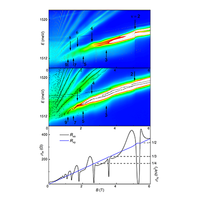
How do optical (or laser) fields and external magnetic fields affect the exciton and trion states of many-body physics? The authors investigate here the magneto-photoluminescence and transport of a high-quality two-dimensional electron channel, in which transitions involving spontaneous hidden symmetry breaking occur at integer Landau filling factors. The extremely intensive laser visualizes dark trions that are forbidden at low magnetic fields, and the accompanied robust Fano resonances, coming from a many-body effect, stem from the coupling between transition-forbidden (dark) trions and the Fermi sea continuum.

Oxygen vacancy driven metallic behavior and Kondo scattering in the incipient ferroelectric CaTiO3

Prithwijit Mandal, Sayantan Ghosh, Agrim Sharma, Suresh Chandra Joshi, Jyotirmay Maity, Manav Beniwal, Nandana Bhattacharya, Andrei Gloskovskii, Christoph Schlueter, Manish Jain, and Srimanta Middey

Phys. Rev. B 113, 205136 (2026) - Published 20 May, 2026

Spin-orbit driven Jeff = 12 magnetism in a d7 triangular-lattice monolayer cobaltate

Ritwik Das, Soumen Basak, Mohammad Rezwan Habib, and Indra Dasgupta

Phys. Rev. B 113, 205137 (2026) - Published 20 May, 2026

Probing quantum geometry with two-dimensional nonlinear optical spectroscopy

Paul Froese, Mark R. Hirsbrunner, and Yong Baek Kim

Phys. Rev. B 113, 205138 (2026) - Published 20 May, 2026

Phase and electronic structure control of altermagnetic α−MnTe thin films via epitaxy on InP (111)

Yuzhe Wang, Shiwu Su, Min Ge, Pengxu Ran, Tongrui Li, Xianglin Li, Sen Liao, Yu Liang, Jiaqin Wen, Jianghao Yao, Jiexiong Sun, Haoyuan Yan, Rui Xu, Shengtao Cui, Zhe Sun, Donglai Feng, and Juan Jiang

Phys. Rev. B 113, 205139 (2026) - Published 20 May, 2026

Su-Schrieffer-Heeger model driven by sequences of two unitaries: Periodic, quasiperiodic, aperiodic, and random protocols

Maitri Ganguli and Diptiman Sen

Phys. Rev. B 113, 205423 (2026) - Published 20 May, 2026

Coherently synchronized oscillations in many-body localization

Zi-Jian Li, Yi-Ting Tu, and Sankar Das Sarma

Phys. Rev. B 113, L180204 (2026) - Published 20 May, 2026

Nonlinear spin-wave Doppler effect for flexible tuning of magnonic frequencies

Jincheng Hou, Shaojie Hu, and Long You

Phys. Rev. B 113, L180411 (2026) - Published 20 May, 2026

Intrinsic correspondence between monoclinic and orthorhombic HfO2 via mutual induction of lattice modes on the domain wall

Hyun-Jae Lee, Pawan Kumar, Chang Hoon Kim, Jihoon Choi, Umesh Waghmare, and Jun Hee Lee

Phys. Rev. B 113, 174116 (2026) - Published 19 May, 2026

Origin of the unusual strain morphologies and polar moiré patterns in twisted ferroelectrics

Sergey Prosandeev, Charles Paillard, and L. Bellaiche

Phys. Rev. B 113, 174118 (2026) - Published 19 May, 2026

Noncommutative weak measurements: Entanglement, symmetry breaking, and the role of readout

Yuanchen Zhao, Li Rao, and Dong E. Liu

Phys. Rev. B 113, 174312 (2026) - Published 19 May, 2026

Coupled phonons–crystal field excitations and phonon anomalies in the triangular dipolar magnet Ba3Yb(BO3)3

Sonia Deswal, Rabindranath Bag, Sara Haravifard, and Pradeep Kumar

Phys. Rev. B 113, 174425 (2026) - Published 19 May, 2026

Tuning spin currents in collinear antiferromagnets and altermagnets

Sajjan Sheoran and Pratibha Dev

Phys. Rev. B 113, 174426 (2026) - Published 19 May, 2026

Spin and orbital-to-charge conversion in noncentrosymmetric materials: Hall versus Rashba-Edelstein effects

Diego García Ovalle and Aurélien Manchon

Phys. Rev. B 113, 174427 (2026) - Published 19 May, 2026

Accessing dirty-regime anomalous Hall effect in pure ferromagnetic metals

Tengfei Ma, Lingsong Huang, Ning Jiang, Yaoxiang Jiang, Guixin He, Shifeng Zhao, Cong Wang, Wenyu Xing, and Weibo Gao

Phys. Rev. B 113, 174428 (2026) - Published 19 May, 2026
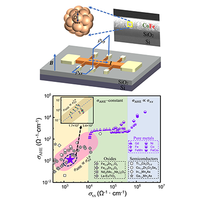
The anomalous Hall effect (AHE) in the dirty regime of pure ferromagnetic metals is challenging to access without doping. Here, the authors use cluster beam deposition to tune structural disorder in ferromagnetic nanogranular CoFe films, reaching a low- conductivity metallic state and enabling systematic study of the AHE in the dirty regime. The AHE is dominated by the intrinsic mechanism and follows the predicted scaling σAHE ≈ σxx1.6. This work fills a key experimental gap and establishes a disorder-based platform for engineering the AHE.

Sign In to Your Journals Account

Filter

Recent Issues

Vol. 114, Iss. 30
15 November 2026
Vol. 114, Iss. 29
15 November 2026
Vol. 114, Iss. 28
15 November 2026
Vol. 114, Iss. 27
1 November 2026
Category
Article Type
Section

Filter

Article Lookup

Enter a citation