

- Perspective
Intersubband electric dipole spin resonance in transition metal dichalcogenide heterobilayers
Phys. Rev. B 113, 179605 – Published 20 May, 2026
DOI: https://doi.org/10.1103/7dxr-8cck
Abstract
The theory of inter-spin-subband electric dipole spin resonance in transition metal dichalcogenide heterobilayers is proposed. Our symmetry analysis demonstrates that, in contrast to monolayers, the reduced symmetry of heterobilayers enables coupling between conduction band spin subbands by an electric field. We establish the optical selection rules for all six high-symmetry stacking configurations. The microscopic mechanism of the effect is identified as the spin-orbit coupling induced mixing of Bloch states from different conduction bands, which generates a nonzero momentum matrix element between the spin-split states. It also leads to the linear-in-wave-vector spin-dependent terms in the effective Hamiltonian, i.e., the Rashba effect. Our estimates show that the rate of electric-dipole spin-flip transitions exceeds by far that of the magnetic-dipole transitions in transition metal dichalcogenide heterobilayers.
Physics Subject Headings (PhySH)
Collections
This article appears in the following collection:
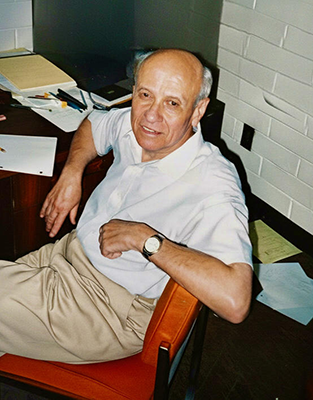
Honoring the legacy of Emmanuel Rashba
The passing of Professor Emmanuel Rashba in early 2025 was an irreparable loss to the physics community. For many decades prior, his numerous significant contributions have been driving solid state physics to surprising new places, realizations, and applications. To pay tribute to his many enduring, groundbreaking ideas, Physical Review B presents a special Collection with contributions by some of his disciples, collaborators, and connoisseurs of his mastery in top-shelf solid state research. Papers belonging to the collection will be published through 2026. It was initiated by Mark Dykman and Alexander Efros and colleagues. An Editorial from them and the contributed articles are linked below.
