Browse Issues:

HIGHLIGHTED ARTICLES

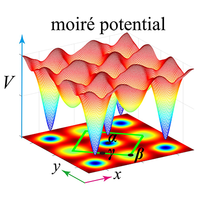
Observation of ultraflat bands in gapped moiré metamaterials

Xingjian Zhang, Tingzhi Liu, Qicheng Zhang, Xiying Fan, Fengcheng Wu, and Chunyin Qiu

Phys. Rev. B 111, 125143 (2025) - Published 19 March, 2025

The authors propose here a universal mechanism for ultraflat bands in moiré structures and experimentally validate it in acoustic metamaterials. Unlike magic-angle twisted bilayer graphene, these bands form over a broad range of twist angles, advancing moiré physics across diverse systems.

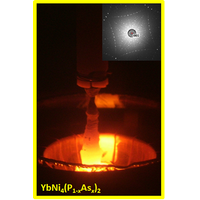
Physical properties of the ferromagnetic quantum critical system YbNi4(P1−xAsx)2

Kristin Kliemt, Jacintha Banda, Pavlo Khanenko, Ali Scherzad, Ulrike Stockert, Anna Efimenko, Kurt Kummer, Cornelius Krellner, and Manuel Brando

Phys. Rev. B 111, 125114 (2025) - Published 6 March, 2025

The heavy-fermion system YbNi4P2 is arguably the ferromagnetic (FM) metal with the lowest Curie temperature (Tc=0.17 K). It has been shown that replacing P with As tunes this system to a ferromagnetic quantum critical point (QCP) at x=0.1 As content. The authors here use the Czochralski method to grow high-quality single crystals of the series YbNi4(P1−xAsx)2 and studied their low-temperature properties. In particular, T-dependent measurements of the specific heat C(T) show that C(T)/T increases strongly towards lower T with similar power law for x= 0.1, 0.13, and 0.2. This suggests that in YbNi4(P1−xAsx)2 a FM quantum critical line rather than a FM QCP might exist.

Variational mapping of Chern bands to Landau levels: Application to fractional Chern insulators in twisted MoTe2

Bohao Li and Fengcheng Wu

Phys. Rev. B 111, 125122 (2025) - Published 10 March, 2025

Recent experimental breakthroughs have identified fractional Chern insulators (FCIs) in twisted bilayer MoTe2 (tMoTe2) at zero external magnetic field. The authors propose here a variational approach to map Bloch Chern bands in tMoTe2 to generalized Landau levels. This mapping sheds light on the formation mechanism and microscopic properties of FCIs in tMoTe2, offering a pathway to apply insights from fractional quantum Hall states to study FCIs in moiré materials.

Accurate and efficient localized basis sets for two-dimensional materials

Daniel Bennett, Michele Pizzochero, Javier Junquera, and Efthimios Kaxiras

Phys. Rev. B 111, 125123 (2025) - Published 10 March, 2025

First-principles codes that use a local basis are naturally suited to simulating two-dimensional (2D) materials, offering better scaling with system size and the ability to include large vacuum regions at no additional cost. Unlike plane-wave bases which can be systematically improved, local basis sets require manual optimization. The authors develop here optimized basis sets for graphene and hexagonal boron nitride, achieving excellent agreement with plane-wave calculations at a significantly reduced computational cost. These optimized basis sets will facilitate accurate and efficient large-scale simulations of 2D materials in future research.

Average-exact mixed anomalies and compatible phases

Yichen Xu and Chao-Ming Jian

Phys. Rev. B 111, 125128 (2025) - Published 11 March, 2025

Quantum anomalies strongly constrain possible low-energy physics of condensed matter systems. In particular, it prohibits the existence of a trivially gapped phase. Here, the authors extend the notion of quantum anomalies to disordered systems, where symmetries can be preserved on average by disorder. Through physical arguments and solvable lattice models, the authors discover a series of phases intrinsic to disordered systems that are compatible with quantum anomalies involving average symmetries. These results serve as compelling evidence of the nontriviality of quantum anomalies, even with loosened requirements on symmetry and quantum coherence.

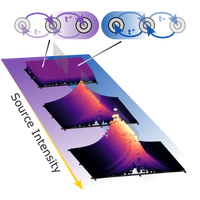
Observation of amplitude-driven nonreciprocity for energy guiding

Mathieu Padlewski, Romain Fleury, and Hervé Lissek

Phys. Rev. B 111, 125156 (2025) - Published 25 March, 2025

Imagine a tabletop composed of atoms that are nonlinearly and nonreciprocally coupled towards its center. A light tap on the surface generates typical nondispersive acoustic waves across the plane. In contrast, a hard hit triggers nonlinear nonreciprocity, directing energy towards the center, regardless of the impact location. By employing an extended Hatano-Nelson model and a highly configurable active acoustic metamaterial, the authors demonstrate here nonreciprocal systems where nonlinearities can strategically control energy guiding.

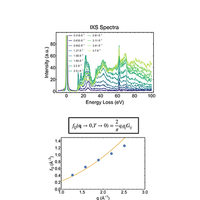
Quantum entanglement and quantum geometry measured with inelastic x-ray scattering

David Bałut, Barry Bradlyn, and Peter Abbamonte

Phys. Rev. B 111, 125161 (2025) - Published 31 March, 2025

The authors experimentally investigate here the quantum geometry and quantum information in the insulator LiF. Using sum rules for the measured density-density response, the authors compute the quantum Fisher information of LiF associated with density perturbations, and from these extrapolate a component of the quantum metric tensor. These results serve as a proof of principle that scattering techniques can quantify state-of-the-art quantum geometric quantities in materials, and establishes the quantum Fisher information as an experimentally accessible generalization of quantum geometry to real materials.

FeGe as a building block for the kagome 1:1, 1:6:6, and 1:3:5 families: Hidden d-orbital decoupling of flat band sectors, effective models, and interaction Hamiltonians

Yi Jiang, Haoyu Hu, Dumitru Călugăru, Claudia Felser, Santiago Blanco-Canosa, Hongming Weng, Yuanfeng Xu, and B. Andrei Bernevig

Phys. Rev. B 111, 125163 (2025) - Published 31 March, 2025

The authors develop here a trustworthy framework to model the electronic structure and interactions in kagome metals, starting with FeGe. By identifying symmetry-based orbital groupings, they construct minimal models that capture flat bands, von Hove singularities, and topology. Using these “LEGO-like” building blocks, they extend their approach to a wide range of kagome materials in the 1:1, 1:6:6, and 1:3:5 families, including MgFe6Ge6 and CsCr3Sb5. This framework provides realistic many-body models in order to explore interaction-driven phases in kagome and other materials.

Statistical analysis of spurious dot formation in silicon metal-oxide-semiconductor single electron transistors

Kuan-Chu Chen, Clement Godfrin, George Simion, Imri Fattal, Julien Jussot, Stefan Kubicek, Sofie Beyne, Bart Raes, Arne Loenders, Kuo-Hsing Kao, Danny Wan, and Kristiaan De Greve

Phys. Rev. B 111, 125301 (2025) - Published 5 March, 2025

The presence of spurious quantum dots in silicon-based spin qubit devices is a challenge for quantum system scalability. The authors use here electrostatic triangulation to statistically analyse their spatial distribution in silicon metal-oxide-semiconductor (SiMOS) single-electron transistors (SETs), fabricated on an industrial 300-mm process. By combining experimental mapping with simulations, they reveal that spurious dots primarily arise from strain and gate bias effects. This insight informs device design strategies to mitigate spurious dots while preserving tunability, advancing scalable silicon-based quantum technologies.

Quantum geometry probed by chiral excitonic optical response of Chern insulators

Wen-Xuan Qiu and Fengcheng Wu

Phys. Rev. B 111, L121104 (2025) - Published 17 March, 2025

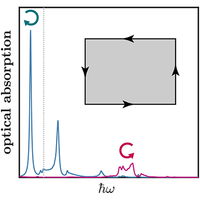
Quantum geometry describes phase and amplitude distances between quantum states, akin to Euclidean geometry in the classical world. The authors propose here probing the quantum geometry of Chern insulators via the excitonic optical response, using twisted bilayer MoTe2 as an example. In the terahertz frequency range, a single chiral exciton dominates the optical sum rule, enabling measurement of quantum geometry. This measurement could provide an assessment on the ideality of the quantum geometry, a key factor for realizing fractional Chern insulators.

Hall field and odd viscosity in near-hydrodynamic electron flows

Nitay Ben-Shachar, Joseph T. Johnson, Mayhar Madadi, Douglas R. Brumley, Jason Nassios, and John E. Sader

Phys. Rev. B 111, L121107 (2025) - Published 20 March, 2025

The Hall or odd viscosity governs hydrodynamic electron flows in the presence of an applied magnetic field. Here, the authors report a rigorous asymptotic theory of near-hydrodynamic electron flows and demonstrate a rarefaction effect that competes with the Hall viscosity. This resolves the discrepancy of prior hydrodynamic theories in predicting the Hall resistivity in channel flow, providing insight into the flow physics and an alternative to numerical solutions of the Boltzmann equation.

Dynamic mass generation on two-dimensional electronic hyperbolic lattices

Noble Gluscevich, Abhisek Samanta, Sourav Manna, and Bitan Roy

Phys. Rev. B 111, L121108 (2025) - Published 20 March, 2025

The authors show here that two-dimensional hyperbolic lattices can be classified as Dirac liquids, Fermi liquids, and flat bands, respectively, featuring vanishing, constant, and diverging density of states near half-filling. On such curved quantum crystals, on-site Hubbard and nearest-neighbor Coulomb repulsion stabilize antiferromagnetic and charge density wave ground states, respectively. The requisite critical couplings for these orderings decrease with the increasing curvature in hyperbolic Dirac fluids, suggesting a curvature-induced weak-coupling quantum phase transitions therein. By contrast, these two orderings develop even for infinitesimal interactions in Fermi liquids and flat-band systems.

Exploring the accuracy of the equation-of-motion coupled-cluster band gap of solids

Evgeny Moerman, Henrique Miranda, Alejandro Gallo, Andreas Irmler, Tobias Schäfer, Felix Hummel, Manuel Engel, Georg Kresse, Matthias Scheffler, and Andreas Grüneis

Phys. Rev. B 111, L121202 (2025) - Published 26 March, 2025

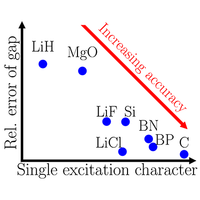
Calculating with controllable accuracy electronic band gaps in materials is a challenge for currently available ab initio methods. Here, the authors present a hybrid approach that combines equation-of-motion coupled-cluster theory with the GW approximation to efficiently estimate band gaps for semiconductors and insulators in the thermodynamic limit. The method significantly reduces the computational cost, while showing that errors in predicted gaps correlate with the reduced single excitation character of many-electron states.

Chiral terahertz photocurrent in quantum point contact–split ring resonator coupled systems in the quantum Hall regime

Jing Huang, Jinkwan Kwoen, Yasuhiko Arakawa, Kazuhiko Hirakawa, and Kazuyuki Kuroyama

Phys. Rev. B 111, L121407 (2025) - Published 20 March, 2025

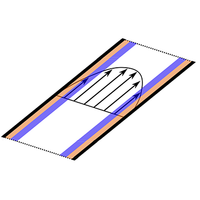
Light-matter interaction between cyclotron resonance and photons in a plasmonic resonator enables the formation of polaritons in the ultrastrong coupling regime. While optical studies are common, the authors demonstrate here electrical detection of ultrastrong coupling via terahertz-induced photocurrent through a quantum point contact and reveal the chiral behavior of the photocurrent with respect to magnetic field. Their theoretical model based on nonequilibrium electron distribution in edge channels agrees well with the experimental data, which offers new insights into light-matter interactions.

LETTERS

Electronic structure and strongly correlated systems

Nature of the high-pressure insulating state in Sr2IrO4: Mott picture

Guoren Zhang, Hanif Hadipour, and Eva Pavarini

Phys. Rev. B 111, L121101 (2025) - Published 4 March, 2025

Quantum metric induced oscillations in nearly dispersionless flat bands

Hui Zeng, Zijian Zhou, Wenhui Duan, and Huaqing Huang

Phys. Rev. B 111, L121102 (2025) - Published 11 March, 2025

Bound states in the continuum in cuprous oxide quantum wells

Angelos Aslanidis, Jörg Main, Patric Rommel, Stefan Scheel, and Pavel A. Belov

Phys. Rev. B 111, L121103 (2025) - Published 13 March, 2025

Quantum geometry probed by chiral excitonic optical response of Chern insulators

Wen-Xuan Qiu and Fengcheng Wu

Phys. Rev. B 111, L121104 (2025) - Published 17 March, 2025

Quantum geometry describes phase and amplitude distances between quantum states, akin to Euclidean geometry in the classical world. The authors propose here probing the quantum geometry of Chern insulators via the excitonic optical response, using twisted bilayer MoTe2 as an example. In the terahertz frequency range, a single chiral exciton dominates the optical sum rule, enabling measurement of quantum geometry. This measurement could provide an assessment on the ideality of the quantum geometry, a key factor for realizing fractional Chern insulators.

Van Hove tuning of Fermi surface instabilities through compensated metallicity

Hendrik Hohmann, Matteo Dürrnagel, Matthew Bunney, Stefan Enzner, Tilman Schwemmer, Titus Neupert, Giorgio Sangiovanni, Stephan Rachel, and Ronny Thomale

Phys. Rev. B 111, L121105 (2025) - Published 18 March, 2025

Collective modes and Raman response in Ta2NiSe5

Banhi Chatterjee, Jernej Mravlje, and Denis Golež

Phys. Rev. B 111, L121106 (2025) - Published 18 March, 2025

Hall field and odd viscosity in near-hydrodynamic electron flows

Nitay Ben-Shachar, Joseph T. Johnson, Mayhar Madadi, Douglas R. Brumley, Jason Nassios, and John E. Sader

Phys. Rev. B 111, L121107 (2025) - Published 20 March, 2025

The Hall or odd viscosity governs hydrodynamic electron flows in the presence of an applied magnetic field. Here, the authors report a rigorous asymptotic theory of near-hydrodynamic electron flows and demonstrate a rarefaction effect that competes with the Hall viscosity. This resolves the discrepancy of prior hydrodynamic theories in predicting the Hall resistivity in channel flow, providing insight into the flow physics and an alternative to numerical solutions of the Boltzmann equation.

Dynamic mass generation on two-dimensional electronic hyperbolic lattices

Noble Gluscevich, Abhisek Samanta, Sourav Manna, and Bitan Roy

Phys. Rev. B 111, L121108 (2025) - Published 20 March, 2025

The authors show here that two-dimensional hyperbolic lattices can be classified as Dirac liquids, Fermi liquids, and flat bands, respectively, featuring vanishing, constant, and diverging density of states near half-filling. On such curved quantum crystals, on-site Hubbard and nearest-neighbor Coulomb repulsion stabilize antiferromagnetic and charge density wave ground states, respectively. The requisite critical couplings for these orderings decrease with the increasing curvature in hyperbolic Dirac fluids, suggesting a curvature-induced weak-coupling quantum phase transitions therein. By contrast, these two orderings develop even for infinitesimal interactions in Fermi liquids and flat-band systems.

Stripe antiferromagnetic ground-state configuration of FeSe revealed by density functional theory

Luke Allen Myers, Nigel Lee En Hew, Shun-Li Shang, and Zi-Kui Liu

Phys. Rev. B 111, L121109 (2025) - Published 20 March, 2025

Optically tunable spin Hall effect in periodically driven monolayer transition metal dichalcogenides

Naoya Arakawa and Kenji Yonemitsu

Phys. Rev. B 111, L121110 (2025) - Published 21 March, 2025

Magnetotransport evidence of a potential low-lying Dirac node in NbAl3

Ying Kit Tsui, Chia-Nung Kuo, Makoto Shimizu, Yajian Hu, Youichi Yanase, Chin Shan Lue, Wei Zhang, and Swee K. Goh

Phys. Rev. B 111, L121111 (2025) - Published 24 March, 2025

Darkness in interlayer and charge density wave states of 2H-TaS2

Luigi Camerano, Dario Mastrippolito, Debora Pierucci, Ji Dai, Massimo Tallarida, Luca Ottaviano, Gianni Profeta, and Federico Bisti

Phys. Rev. B 111, L121112 (2025) - Published 24 March, 2025

Ultrafast photoinduced phase transition in the antiferromagnetic Dirac semimetal EuAgAs

Hao Liu, Chen Zhang, Qi-Yi Wu, Yahui Jin, Ziming Zhu, Jiao-Jiao Song, Sheng-Tao Cui, Zhe Sun, Honghong Wang, Bo Chen, Jun He, Hai-Yun Liu, Yu-Xia Duan, Peter M. Oppeneer, and Jian-Qiao Meng

Phys. Rev. B 111, L121113 (2025) - Published 25 March, 2025

Nonlocal quench spectroscopy of fermionic excitations in quantum spin chains

Saverio Bocini, Filippo Caleca, Fabio Mezzacapo, and Tommaso Roscilde

Phys. Rev. B 111, L121114 (2025) - Published 25 March, 2025

Axionic quantum criticality of generalized Weyl semimetals

Gabriel Malavé, Rodrigo Soto-Garrido, Vladimir Juričić, and Bitan Roy

Phys. Rev. B 111, L121115 (2025) - Published 31 March, 2025

Semiconductors I: bulk

Valley polarization dynamics of photoinjected carriers at the band edge in room-temperature silicon studied by terahertz polarimetry

Ami M. Shirai, Yuta Murotani, Tomohiro Fujimoto, Natsuki Kanda, Jun Yoshinobu, and Ryusuke Matsunaga

Phys. Rev. B 111, L121201 (2025) - Published 5 March, 2025

Exploring the accuracy of the equation-of-motion coupled-cluster band gap of solids

Evgeny Moerman, Henrique Miranda, Alejandro Gallo, Andreas Irmler, Tobias Schäfer, Felix Hummel, Manuel Engel, Georg Kresse, Matthias Scheffler, and Andreas Grüneis

Phys. Rev. B 111, L121202 (2025) - Published 26 March, 2025

Calculating with controllable accuracy electronic band gaps in materials is a challenge for currently available ab initio methods. Here, the authors present a hybrid approach that combines equation-of-motion coupled-cluster theory with the GW approximation to efficiently estimate band gaps for semiconductors and insulators in the thermodynamic limit. The method significantly reduces the computational cost, while showing that errors in predicted gaps correlate with the reduced single excitation character of many-electron states.

Semiconductors II: surfaces, interfaces, microstructures, and related topics

Exciton polariton critical non-Hermitian skin effect with spin-momentum-locked gains

Xingran Xu, Lingyu Tian, Zhiyuan An, Qihua Xiong, and Sanjib Ghosh

Phys. Rev. B 111, L121301 (2025) - Published 18 March, 2025

Surface physics, nanoscale physics, low-dimensional systems

Distinguishing between topological Majorana and trivial zero modes via transport and shot noise study in an altermagnet heterostructure

Debashish Mondal, Amartya Pal, Arijit Saha, and Tanay Nag

Phys. Rev. B 111, L121401 (2025) - Published 4 March, 2025

Orbital magnetization from interface reflections in a conductor with charge current

J. Voss, I. A. Ado, and M. Titov

Phys. Rev. B 111, L121402 (2025) - Published 4 March, 2025

Probing moiré electronic structures through quasiparticle interference

Luke C. Rhodes, Dylan C. Houston, Olivia R. Armitage, and Peter Wahl

Phys. Rev. B 111, L121403 (2025) - Published 10 March, 2025

Geometric approach to design of photonic crystals and metamaterials via optimal toric packings

A. Itin

Phys. Rev. B 111, L121404 (2025) - Published 10 March, 2025

Radiative Corbino effect in nonreciprocal many-body systems

Ivan Latella and Philippe Ben-Abdallah

Phys. Rev. B 111, L121405 (2025) - Published 12 March, 2025

Thermal rectification of Sierpiński tetrahedron fractals assembled from supertetrahedral T2-type tin selenide clusters

Peng-Hu Du, Qian Wang, Qiang Sun, and Puru Jena

Phys. Rev. B 111, L121406 (2025) - Published 17 March, 2025

Chiral terahertz photocurrent in quantum point contact–split ring resonator coupled systems in the quantum Hall regime

Jing Huang, Jinkwan Kwoen, Yasuhiko Arakawa, Kazuhiko Hirakawa, and Kazuyuki Kuroyama

Phys. Rev. B 111, L121407 (2025) - Published 20 March, 2025

Light-matter interaction between cyclotron resonance and photons in a plasmonic resonator enables the formation of polaritons in the ultrastrong coupling regime. While optical studies are common, the authors demonstrate here electrical detection of ultrastrong coupling via terahertz-induced photocurrent through a quantum point contact and reveal the chiral behavior of the photocurrent with respect to magnetic field. Their theoretical model based on nonequilibrium electron distribution in edge channels agrees well with the experimental data, which offers new insights into light-matter interactions.

ARTICLES

Electronic structure and strongly correlated systems

General construction of three-dimensional Z2 monopole charge nodal line semimetals and prediction of abundant candidate materials

Yongpan Li, Shifeng Qian, and Cheng-Cheng Liu

Phys. Rev. B 111, 125101 (2025) - Published 3 March, 2025

Ultrafast band structure dynamics in bulk 1T−VSe2

Wibke Bronsch, Manuel Tuniz, Denny Puntel, Francesco Sammartino, Alessandro Giammarino, Marco Morvillo, Fulvio Parmigiani, Chia-Nung Kuo, Chin Shan Lue, Yang-hao Chan, and Federico Cilento

Phys. Rev. B 111, 125102 (2025) - Published 3 March, 2025

Moment method and continued fraction expansion in Floquet operator Krylov space

Hsiu-Chung Yeh and Aditi Mitra

Phys. Rev. B 111, 125103 (2025) - Published 3 March, 2025

Floquet engineering of effective pairing interactions in a doped band insulator

Yugo Takahashi, Hideo Miyamoto, Kazuhiko Kuroki, and Tatsuya Kaneko

Phys. Rev. B 111, 125104 (2025) - Published 3 March, 2025

Ising phase transitions and thermodynamics of correlated fermions in a two-dimensional spin-dependent lattice potential

Zhuotao Xie, Yu-Feng Song, and Yuan-Yao He

Phys. Rev. B 111, 125105 (2025) - Published 4 March, 2025

Replica topological order in quantum mixed states and quantum error correction

Zhuan Li (李專) and Roger S. K. Mong (蒙紹璣)

Phys. Rev. B 111, 125106 (2025) - Published 5 March, 2025

Universality of extreme-broadening mechanisms in some near-edge x-ray spectra

Terrence Jach, John Vinson, Michael Woodcox, Adrian Jonas, Katja Frenzel, Rainer Unterumsberger, and Burkhard Beckhoff

Phys. Rev. B 111, 125107 (2025) - Published 5 March, 2025

From explicit to spontaneous charge order and the fate of the antiferromagnetic quantum Hall state

Mohsen Hafez-Torbati

Phys. Rev. B 111, 125108 (2025) - Published 5 March, 2025

Origin of spectral topology in non-Hermitian Aubry-André-Harper models

Xiaoming Cai

Phys. Rev. B 111, 125109 (2025) - Published 5 March, 2025

Revealing spinons by proximity effect

Antonio Maria Tagliente, Carlos Mejuto-Zaera, and Michele Fabrizio

Phys. Rev. B 111, 125110 (2025) - Published 5 March, 2025

DFT+DMFT study of correlated electronic structure in the monolayer-trilayer phase of La3Ni2O7

Zhenfeng Ouyang, Jia-Ming Wang, Rong-Qiang He, and Zhong-Yi Lu

Phys. Rev. B 111, 125111 (2025) - Published 5 March, 2025

Large anomalous Hall effect induced by skew scattering in the hexagonal ferromagnet PrCrGe3

Zhongjie Yu, Hongwei You, Xiaohua Luo, Yuyang Han, Rui Zhong, Qing Luo, Huiyang Yang, Hengheng Wu, Changcai Chen, Chunsheng Fang, Weijun Ren, and Shengcan Ma

Phys. Rev. B 111, 125112 (2025) - Published 5 March, 2025

Ab initio study of angle-resolved electron reflection spectroscopy of few-layer graphene

Aleš Paták, Martin Zouhar, Ivo Konvalina, Eliška Materna Mikmeková, Lukáš Průcha, Ilona Müllerová, Anna Charvátová Campbell, Miroslav Valtr, Michal Horák, Vlastimil Křápek, and Eugene Krasovskii

Phys. Rev. B 111, 125113 (2025) - Published 6 March, 2025

Physical properties of the ferromagnetic quantum critical system YbNi4(P1−xAsx)2

Kristin Kliemt, Jacintha Banda, Pavlo Khanenko, Ali Scherzad, Ulrike Stockert, Anna Efimenko, Kurt Kummer, Cornelius Krellner, and Manuel Brando

Phys. Rev. B 111, 125114 (2025) - Published 6 March, 2025

The heavy-fermion system YbNi4P2 is arguably the ferromagnetic (FM) metal with the lowest Curie temperature (Tc=0.17 K). It has been shown that replacing P with As tunes this system to a ferromagnetic quantum critical point (QCP) at x=0.1 As content. The authors here use the Czochralski method to grow high-quality single crystals of the series YbNi4(P1−xAsx)2 and studied their low-temperature properties. In particular, T-dependent measurements of the specific heat C(T) show that C(T)/T increases strongly towards lower T with similar power law for x= 0.1, 0.13, and 0.2. This suggests that in YbNi4(P1−xAsx)2 a FM quantum critical line rather than a FM QCP might exist.

Electronic structure, spin-orbit interaction, and electron-phonon coupling of triangular adatom lattices on semiconductor substrates

Lucca Marchetti, Matthew Bunney, Domenico Di Sante, and Stephan Rachel

Phys. Rev. B 111, 125115 (2025) - Published 6 March, 2025

Lattice dynamics and spin-phonon coupling in the kagome spin ice HoAgGe

Shangfei Wu, Lingxiao Zhao, Wei Song, Mingshu Tan, Feng Jin, Tianping Ying, Jia-Xin Yin, and Qingming Zhang

Phys. Rev. B 111, 125116 (2025) - Published 7 March, 2025

Enhanced magnetic ordering in the heavy lanthanide Er metal under megabar pressures

Hongyu Liu, Jing Song, Wei Wu, Baosen Min, Sijia Zhang, Shaomin Feng, Xiancheng Wang, and Changqing Jin

Phys. Rev. B 111, 125117 (2025) - Published 7 March, 2025

Lifshitz transition and triplet p-wave pairing from the induced ferromagnetic plaquette via spin differentiated nonlocal interaction

Rayan Farid, Daria Gazizova, B. D. E. McNiven, and J. P. F. LeBlanc

Phys. Rev. B 111, 125118 (2025) - Published 7 March, 2025

Diagnosing altermagnetic phases through quantum oscillations

Zhi-Xia Li, Hanjing Zhou, Xiangang Wan, and Wei Chen

Phys. Rev. B 111, 125119 (2025) - Published 10 March, 2025

Strong coupling impurity solver based on quantics tensor cross interpolation

Aaram J. Kim and Philipp Werner

Phys. Rev. B 111, 125120 (2025) - Published 10 March, 2025

Orbital Hall effect in transition metals from first-principles scattering calculations

Max Rang and Paul J. Kelly

Phys. Rev. B 111, 125121 (2025) - Published 10 March, 2025

Variational mapping of Chern bands to Landau levels: Application to fractional Chern insulators in twisted MoTe2

Bohao Li and Fengcheng Wu

Phys. Rev. B 111, 125122 (2025) - Published 10 March, 2025

Recent experimental breakthroughs have identified fractional Chern insulators (FCIs) in twisted bilayer MoTe2 (tMoTe2) at zero external magnetic field. The authors propose here a variational approach to map Bloch Chern bands in tMoTe2 to generalized Landau levels. This mapping sheds light on the formation mechanism and microscopic properties of FCIs in tMoTe2, offering a pathway to apply insights from fractional quantum Hall states to study FCIs in moiré materials.

Accurate and efficient localized basis sets for two-dimensional materials

Daniel Bennett, Michele Pizzochero, Javier Junquera, and Efthimios Kaxiras

Phys. Rev. B 111, 125123 (2025) - Published 10 March, 2025

First-principles codes that use a local basis are naturally suited to simulating two-dimensional (2D) materials, offering better scaling with system size and the ability to include large vacuum regions at no additional cost. Unlike plane-wave bases which can be systematically improved, local basis sets require manual optimization. The authors develop here optimized basis sets for graphene and hexagonal boron nitride, achieving excellent agreement with plane-wave calculations at a significantly reduced computational cost. These optimized basis sets will facilitate accurate and efficient large-scale simulations of 2D materials in future research.

Manipulation of helical edge states revealed by crossed Andreev reflection

Wei Luo, Yating Zhang, and Wei Chen

Phys. Rev. B 111, 125124 (2025) - Published 10 March, 2025

Chern insulators on a hyperbolic lattice with conical singularity

Xu-Hui Yan, Ying Han, Lu Qi, Yongjun Liu, and Ai-Lei He

Phys. Rev. B 111, 125125 (2025) - Published 10 March, 2025

Exact eigenstates with off-diagonal long-range order for interacting bosonic systems

C. H. Zhang and Z. Song

Phys. Rev. B 111, 125126 (2025) - Published 10 March, 2025

Influence of the Dirac sea on phase transitions in monolayer graphene under strong magnetic fields

Guopeng Xu and Chunli Huang

Phys. Rev. B 111, 125127 (2025) - Published 11 March, 2025

Average-exact mixed anomalies and compatible phases

Yichen Xu and Chao-Ming Jian

Phys. Rev. B 111, 125128 (2025) - Published 11 March, 2025

Quantum anomalies strongly constrain possible low-energy physics of condensed matter systems. In particular, it prohibits the existence of a trivially gapped phase. Here, the authors extend the notion of quantum anomalies to disordered systems, where symmetries can be preserved on average by disorder. Through physical arguments and solvable lattice models, the authors discover a series of phases intrinsic to disordered systems that are compatible with quantum anomalies involving average symmetries. These results serve as compelling evidence of the nontriviality of quantum anomalies, even with loosened requirements on symmetry and quantum coherence.

Protected fermionic zero modes in periodic gauge fields

Võ Tiến Phong and Eugene J. Mele

Phys. Rev. B 111, 125129 (2025) - Published 11 March, 2025

Insulator-metal transition and magnetic crossover in bilayer graphene

Amarnath Chakraborty, Aleksandr Rodin, Shaffique Adam, and Giovanni Vignale

Phys. Rev. B 111, 125130 (2025) - Published 11 March, 2025

Stacking-dependent electronic structure of ultrathin perovskite bilayers

Daniel T. Larson, Daniel Bennett, Abduhla Ali, Anderson S. Chaves, Raagya Arora, Karin M. Rabe, and Efthimios Kaxiras

Phys. Rev. B 111, 125131 (2025) - Published 12 March, 2025

Robust boundary Luttinger surfaces in topological band structures

Kai Chen and Pavan Hosur

Phys. Rev. B 111, 125132 (2025) - Published 12 March, 2025

Fast and stable tight-binding framework for nonlocal kinetic energy density functional reconstruction in orbital-free density functional calculations

Yongshuo Chen, Cheng Ma, Boning Cui, Tian Cui, Wenhui Mi, Qiang Xu, Yanchao Wang, and Yanming Ma

Phys. Rev. B 111, 125133 (2025) - Published 12 March, 2025

Inhomogeneous reduction-annealing effects on the electron-doped cuprate superconductor Pr1.3−xLa0.7CexCuO4 (x=0.08) revealed by microfocused angle-resolved photoemission spectroscopy

M. Miyamoto, M. Horio, K. Moriya, A. Takahashi, J. Osiecki, B. Thiagarajan, C. M. Polley, Y. Koike, T. Adachi, T. Mizokawa, and I. Matsuda

Phys. Rev. B 111, 125134 (2025) - Published 12 March, 2025

Fate of gapless edge states in two-dimensional topological insulators with Hatsugai-Kohmoto interaction

Jan Skolimowski and Wojciech Brzezicki

Phys. Rev. B 111, 125135 (2025) - Published 13 March, 2025

Optical lineshapes of the C center in silicon from ab initio calculations: Interplay of localized modes and bulk phonons

Rokas Silkinis, Marek Maciaszek, Vytautas Žalandauskas, Marianne Etzelmüller Bathen, Lasse Vines, Audrius Alkauskas, and Lukas Razinkovas

Phys. Rev. B 111, 125136 (2025) - Published 14 March, 2025

Influence of oxygen orbitals and boundary conditions on the pairing behavior in the Emery model for doped ladders

Gökmen Polat and Eric Jeckelmann

Phys. Rev. B 111, 125137 (2025) - Published 17 March, 2025

Fermion liquids as quantum Hall liquids in phase space: A unified approach for anomalies and responses

Jaychandran Padayasi, Ken K. W. Ma, and Kun Yang

Phys. Rev. B 111, 125138 (2025) - Published 17 March, 2025

Barycentric rational function approximation made simple: A fast analytic continuation method for Matsubara Green's functions

Li Huang and Changming Yue

Phys. Rev. B 111, 125139 (2025) - Published 17 March, 2025

Particle-hole asymmetric phases in doped twisted bilayer graphene

Run Hou, Shouvik Sur, Lucas K. Wagner, and Andriy H. Nevidomskyy

Phys. Rev. B 111, 125140 (2025) - Published 17 March, 2025

Resolving competition of charge density wave and superconducting phases using the matrix product state plus mean field algorithm

Gunnar Bollmark, Thomas Köhler, and Adrian Kantian

Phys. Rev. B 111, 125141 (2025) - Published 17 March, 2025

Quantum oscillations with topological phases in the kagome metal CsTi3Bi5

Yongkang Li, Hengxin Tan, and Binghai Yan

Phys. Rev. B 111, 125142 (2025) - Published 18 March, 2025

Observation of ultraflat bands in gapped moiré metamaterials

Xingjian Zhang, Tingzhi Liu, Qicheng Zhang, Xiying Fan, Fengcheng Wu, and Chunyin Qiu

Phys. Rev. B 111, 125143 (2025) - Published 19 March, 2025

The authors propose here a universal mechanism for ultraflat bands in moiré structures and experimentally validate it in acoustic metamaterials. Unlike magic-angle twisted bilayer graphene, these bands form over a broad range of twist angles, advancing moiré physics across diverse systems.

Two-stage evolution of magnetic correlations in the spiral spin liquid material Ca10Cr7O28

Changhyun Koo, Jaena Park, Johannes Werner, Suheon Lee, Christian Balz, A. T. M. Nazmul Islam, Yugo Oshima, Bella Lake, Kwang-Yong Choi, and Rüdiger Klingeler

Phys. Rev. B 111, 125144 (2025) - Published 19 March, 2025

Near-hydrodynamic electron flow according to the linearized Boltzmann equation

Nitay Ben-Shachar, Joseph T. Johnson, Mahyar Madadi, Douglas R. Brumley, Jason Nassios, and John E. Sader

Phys. Rev. B 111, 125145 (2025) - Published 20 March, 2025

Disentanglement of overlapping spectrograms in attosecond time-resolved photoelectron spectroscopy of solids

Andreas Gebauer, Tillmann Schabbehard, Luis Maschmann, and Walter Pfeiffer

Phys. Rev. B 111, 125146 (2025) - Published 20 March, 2025

Hydrodynamics as the effective field theory of strong-to-weak spontaneous symmetry breaking

Xiaoyang Huang, Marvin Qi, Jian-Hao Zhang, and Andrew Lucas

Phys. Rev. B 111, 125147 (2025) - Published 20 March, 2025

Broken symmetry solutions in one-dimensional lattice models via many-body perturbation theory

Matteo Quinzi, Tommaso Chiarotti, Marco Gibertini, and Andrea Ferretti

Phys. Rev. B 111, 125148 (2025) - Published 21 March, 2025

Microscopic study of interlayer magnetic coupling across the interface in antiferromagnetic bilayers

Sandip Halder, Sudip Mandal, and Kalpataru Pradhan

Phys. Rev. B 111, 125149 (2025) - Published 21 March, 2025

Monopole excitations in the U(1) Dirac spin liquid on the triangular lattice

Sasank Budaraju, Alberto Parola, Yasir Iqbal, Federico Becca, and Didier Poilblanc

Phys. Rev. B 111, 125150 (2025) - Published 21 March, 2025

Anomalous continuous symmetries and quantum topology of Goldstone modes

Naren Manjunath and Dominic V. Else

Phys. Rev. B 111, 125151 (2025) - Published 21 March, 2025

Electric field controlled magnetism and hole doping in monolayer FeSe on a polar NaCl substrate

Hui-Hui He, Shenyuan Yang, Zhong-Yi Lu, and Kai Liu

Phys. Rev. B 111, 125152 (2025) - Published 24 March, 2025

Odd-parity bond order and induced nonreciprocal transport in the kagome metal CsTi3Bi5 driven by quantum interference

Jianxin Huang, Youichi Yamakawa, Rina Tazai, Takahiro Morimoto, and Hiroshi Kontani

Phys. Rev. B 111, 125153 (2025) - Published 24 March, 2025

Excitonic quantum criticality: From multilayer graphene to narrow Chern bands

Zhengyan Darius Shi, Hart Goldman, Zhihuan Dong, and T. Senthil

Phys. Rev. B 111, 125154 (2025) - Published 25 March, 2025

Pair density wave solution for a self-consistent model

S. I. Matveenko and S. I. Mukhin

Phys. Rev. B 111, 125155 (2025) - Published 25 March, 2025

Observation of amplitude-driven nonreciprocity for energy guiding

Mathieu Padlewski, Romain Fleury, and Hervé Lissek

Phys. Rev. B 111, 125156 (2025) - Published 25 March, 2025

Imagine a tabletop composed of atoms that are nonlinearly and nonreciprocally coupled towards its center. A light tap on the surface generates typical nondispersive acoustic waves across the plane. In contrast, a hard hit triggers nonlinear nonreciprocity, directing energy towards the center, regardless of the impact location. By employing an extended Hatano-Nelson model and a highly configurable active acoustic metamaterial, the authors demonstrate here nonreciprocal systems where nonlinearities can strategically control energy guiding.

Correlation versus dissipation in a non-Hermitian Anderson impurity model

Kazuki Yamamoto, Masaya Nakagawa, and Norio Kawakami

Phys. Rev. B 111, 125157 (2025) - Published 25 March, 2025

Nonequilibrium carrier dynamics and band structure of graphene on two-dimensional tin

Maria-Elisabeth Federl, Niklas Witt, Biao Yang, Leonard Weigl, Niklas Hofmann, Johannes Gradl, Ignacio Piquero-Zulaica, Johannes V. Barth, Neeraj Mishra, Camilla Coletti, Tim O. Wehling, and Isabella Gierz

Phys. Rev. B 111, 125158 (2025) - Published 26 March, 2025

Discrete time crystal phase as a resource for quantum-enhanced sensing

Rozhin Yousefjani, Krzysztof Sacha, and Abolfazl Bayat

Phys. Rev. B 111, 125159 (2025) - Published 27 March, 2025

Highly variable carbon environment in the κ-(BEDT-TTF)2Cu2(CN)3 salt probed by carbon K-edge x-ray absorption and resonant inelastic x-ray scattering spectroscopy

Djénabou Bayo, Victor Balédent, Alberto Boccuni, Vita Ilakovac, Stéphane Carniato, Pascale Foury-Leylekian, Jean-Paul Pouget, Alessandro Nicolaou, Kari Ruotsalainen, Azzedine Bendounan, Meryem Bouaziz, Yves Joly, Kazuya Miyagawa, Kazushi Kanoda, and Silvia Tomić

Phys. Rev. B 111, 125160 (2025) - Published 27 March, 2025

Quantum entanglement and quantum geometry measured with inelastic x-ray scattering

David Bałut, Barry Bradlyn, and Peter Abbamonte

Phys. Rev. B 111, 125161 (2025) - Published 31 March, 2025

The authors experimentally investigate here the quantum geometry and quantum information in the insulator LiF. Using sum rules for the measured density-density response, the authors compute the quantum Fisher information of LiF associated with density perturbations, and from these extrapolate a component of the quantum metric tensor. These results serve as a proof of principle that scattering techniques can quantify state-of-the-art quantum geometric quantities in materials, and establishes the quantum Fisher information as an experimentally accessible generalization of quantum geometry to real materials.

Gapless Floquet topology

Gabriel Cardoso, Hsiu-Chung Yeh, Leonid Korneev, Alexander G. Abanov, and Aditi Mitra

Phys. Rev. B 111, 125162 (2025) - Published 31 March, 2025

FeGe as a building block for the kagome 1:1, 1:6:6, and 1:3:5 families: Hidden d-orbital decoupling of flat band sectors, effective models, and interaction Hamiltonians

Yi Jiang, Haoyu Hu, Dumitru Călugăru, Claudia Felser, Santiago Blanco-Canosa, Hongming Weng, Yuanfeng Xu, and B. Andrei Bernevig

Phys. Rev. B 111, 125163 (2025) - Published 31 March, 2025

The authors develop here a trustworthy framework to model the electronic structure and interactions in kagome metals, starting with FeGe. By identifying symmetry-based orbital groupings, they construct minimal models that capture flat bands, von Hove singularities, and topology. Using these “LEGO-like” building blocks, they extend their approach to a wide range of kagome materials in the 1:1, 1:6:6, and 1:3:5 families, including MgFe6Ge6 and CsCr3Sb5. This framework provides realistic many-body models in order to explore interaction-driven phases in kagome and other materials.

Semiconductors I: bulk

Band curvature effects on quantum transport of spin-1 chiral fermion systems

Risako Kikuchi and Ai Yamakage

Phys. Rev. B 111, 125201 (2025) - Published 6 March, 2025

Interband spectroscopy of Landau levels and magnetoexcitons in bulk black phosphorus

H. Okamura, S. Iguchi, T. Sasaki, Y. Ikemoto, T. Moriwaki, and Y. Akahama

Phys. Rev. B 111, 125202 (2025) - Published 24 March, 2025

Choosing tight-binding models for accurate optoelectronic responses

Andreas Ghosh, Aaron M. Schankler, and Andrew M. Rappe

Phys. Rev. B 111, 125203 (2025) - Published 26 March, 2025

Semiconductors II: surfaces, interfaces, microstructures, and related topics

Statistical analysis of spurious dot formation in silicon metal-oxide-semiconductor single electron transistors

Kuan-Chu Chen, Clement Godfrin, George Simion, Imri Fattal, Julien Jussot, Stefan Kubicek, Sofie Beyne, Bart Raes, Arne Loenders, Kuo-Hsing Kao, Danny Wan, and Kristiaan De Greve

Phys. Rev. B 111, 125301 (2025) - Published 5 March, 2025

The presence of spurious quantum dots in silicon-based spin qubit devices is a challenge for quantum system scalability. The authors use here electrostatic triangulation to statistically analyse their spatial distribution in silicon metal-oxide-semiconductor (SiMOS) single-electron transistors (SETs), fabricated on an industrial 300-mm process. By combining experimental mapping with simulations, they reveal that spurious dots primarily arise from strain and gate bias effects. This insight informs device design strategies to mitigate spurious dots while preserving tunability, advancing scalable silicon-based quantum technologies.

Obstacle-induced Gurzhi effect and hydrodynamic electron flow in two-dimensional systems

A. D. Levin, G. M. Gusev, V. A. Chitta, Z. D. Kvon, A. S. Jaroshevich, D. E. Utkin, D. V. Dmitriev, and A. K. Bakarov

Phys. Rev. B 111, 125302 (2025) - Published 6 March, 2025

Emergent spin and orbital angular momentum of light in twisted photonic bilayer

Egor S. Vyatkin, Alexander V. Poshakinskiy, and Sergey A. Tarasenko

Phys. Rev. B 111, 125303 (2025) - Published 6 March, 2025

Interband contributions to nonlinear transport in semiconductor nanostructures

Kazuki Nakazawa, Henry F. Legg, Jelena Klinovaja, and Daniel Loss

Phys. Rev. B 111, 125305 (2025) - Published 11 March, 2025

Finite-size effects in two-photon correlations of exciton Bose-Einstein condensates

R. D. Ivanovskikh, I. L. Kurbakov, N. A. Asriyan, and Yu. E. Lozovik

Phys. Rev. B 111, 125306 (2025) - Published 17 March, 2025

Nonsaturated large magnetoresistance and transport dynamics in a n-doped cryogenic WSe2 field-effect device

Wei-Chen Lin, Ching-Chen Yeh, Jia-Zhu Zou, Nhat Anh Nguyen Phan, Inayat Uddin, Hai Yen Le Thi, Kenji Watanabe, Takashi Taniguchi, Gil-Ho Kim, and Chi-Te Liang

Phys. Rev. B 111, 125307 (2025) - Published 24 March, 2025

Surface physics, nanoscale physics, low-dimensional systems

Plumbene layer grown on Si(111)3×3−B and its restructuring by Mg adsorption

A. N. Mihalyuk, L. V. Bondarenko, A. Y. Tupchaya, Y. E. Vekovshinin, N. V. Denisov, D. V. Gruznev, A. V. Zotov, and A. A. Saranin

Phys. Rev. B 111, 125401 (2025) - Published 3 March, 2025

Thermoelectric fluctuations of interfering Majorana bound states

Sergey Smirnov

Phys. Rev. B 111, 125402 (2025) - Published 5 March, 2025

Auto-organization of 2H|3R lateral boundaries in bilayer WSe2 grown by chemical vapor deposition

Gaia Di Berardino, Meryem Bouaziz, Gilles Patriarche, Julien Chaste, Abdelkarim Ouerghi, and Fabrice Oehler

Phys. Rev. B 111, 125403 (2025) - Published 7 March, 2025

Mpemba effect caused by anomalous heat conduction in a quantum dot system

Yufeng Su, Fenghua Qi, and Guojun Jin

Phys. Rev. B 111, 125404 (2025) - Published 10 March, 2025

Phase-coherent thermal transport in Josephson junctions based on altermagnets

Xiao-Yang Chen, Biao Wu, Jia-Wei Peng, Jianmei Shao, Gang Ouyang, and Hai Li

Phys. Rev. B 111, 125405 (2025) - Published 11 March, 2025

Fast, accurate, and local temperature control using qubits

Riya Baruah, Pedro Portugal, Joachim Wabnig, and Christian Flindt

Phys. Rev. B 111, 125406 (2025) - Published 11 March, 2025

Nonlinear Hall effect and scaling law analysis in twisted bilayer WSe2

Zheng-Yang Cao, An-Qi Wang, Xing-Yu Liu, Tong-Yang Zhao, Dapeng Yu, and Zhi-Min Liao

Phys. Rev. B 111, 125407 (2025) - Published 12 March, 2025

Energy levels and Aharonov-Bohm oscillations in twisted bilayer graphene quantum dots and rings

N. S. Bandeira, Andrey Chaves, L. V. de Castro, R. N. Costa Filho, M. Mirzakhani, F. M. Peeters, and D. R. da Costa

Phys. Rev. B 111, 125409 (2025) - Published 13 March, 2025

Topological insulator in twisted transition metal dichalcogenide heterotrilayers

Hao He, Zhao Gong, Qing-Jun Tong, Dawei Zhai, Wang Yao, and Xing-Tao An

Phys. Rev. B 111, 125410 (2025) - Published 17 March, 2025

Stacking effects on magnetic, vibrational, and optical properties of CrSBr bilayers

Huicong Li, Yali Yang, Zhonghao Xia, Yateng Wang, Jiacheng Wei, Jiangang He, and Rongming Wang

Phys. Rev. B 111, 125411 (2025) - Published 18 March, 2025

Effect of order of transfer matrix exceptional points on transport at band edges

Madhumita Saha, Bijay Kumar Agarwalla, Manas Kulkarni, and Archak Purkayastha

Phys. Rev. B 111, 125412 (2025) - Published 19 March, 2025

Low-energy excitations in multiple modulation-doped CdTe/(CdMg)Te quantum wells

D. Yavorskiy, F. Le Mardelé, I. Mohelsky, M. Orlita, Z. Adamus, T. Wojtowicz, J. Wróbel, K. Karpierz, and J. Łusakowski

Phys. Rev. B 111, 125414 (2025) - Published 20 March, 2025

Zero-bias anomaly indicating exchange interaction and spin readout in a canted quantum dot spin valve

Piotr Busz, Damian Tomaszewski, and Jan Martinek

Phys. Rev. B 111, 125415 (2025) - Published 21 March, 2025

Spin-dependent photovoltaic effect and anisotropic light absorption in the two-dimensional magnetic semiconductor MnNF

Nannan Luo, Jiang Zeng, Li-Ming Tang, and Ke-Qiu Chen

Phys. Rev. B 111, 125416 (2025) - Published 24 March, 2025

Effects of nonlinearity on phonon hydrodynamics in graphite

Wanying Liu and Yangyu Guo

Phys. Rev. B 111, 125417 (2025) - Published 25 March, 2025

Probing the elastic coupling at van der Waals interfaces of two-dimensional materials

Xiaomeng Wang, Erteng Chen, Qianglong Wu, Xiaoyi Yuan, Tianyi Zhang, Shuze Zhu, Zhaohe Dai, and Yang Gao

Phys. Rev. B 111, 125418 (2025) - Published 25 March, 2025

Time-varying Mie resonators for real-time manipulation of quantum emitter radiation

Mohammad Mojtaba Sadafi, Achiles Fontana da Mota, and Hossein Mosallaei

Phys. Rev. B 111, 125419 (2025) - Published 26 March, 2025

Topological wave phenomena in photonic time quasicrystals

Xiang Ni, Shixiong Yin, Huanan Li, and Andrea Alù

Phys. Rev. B 111, 125421 (2025) - Published 27 March, 2025

Correlated emission lasing in a single quantum dot embedded inside a bimodal photonic crystal cavity

Lavakumar Addepalli and P. K. Pathak

Phys. Rev. B 111, 125422 (2025) - Published 28 March, 2025

Sign In to Your Journals Account

Filter

Filter

Article Lookup

Enter a citation