Highlights

Heat due to system-reservoir correlations in thermal equilibrium

Joachim Ankerhold and Jukka P. Pekola

Phys. Rev. B 90, 075421 (2014) - Published 22 August, 2014

The authors study the dynamics of small quantum systems in contact with large heat reservoirs. They find that non-trivial effects arise when the system-bath is initialized in a correlated state.

Resonant x-ray scattering study of charge-density wave correlations in YBa2Cu3O6+x

S. Blanco-Canosa, A. Frano, E. Schierle, J. Porras, T. Loew, M. Minola, M. Bluschke, E. Weschke, B. Keimer, and M. Le Tacon

Phys. Rev. B 90, 054513 (2014) - Published 21 August, 2014

Using resonant x-ray scattering, this group maps the evolution of charge density wave correlations in a series of YBa2Cu3O6+x single crystals at a wide range of doping levels. Their data add important pieces to the cuprate phase diagram puzzle.

Competing charge, spin, and superconducting orders in underdoped YBa2Cu3Oy

M. Hücker, N. B. Christensen, A. T. Holmes, E. Blackburn, E. M. Forgan, Ruixing Liang, D. A. Bonn, W. N. Hardy, O. Gutowski, M. v. Zimmermann, S. M. Hayden, and J. Chang

Phys. Rev. B 90, 054514 (2014) - Published 21 August, 2014

A comprehensive x-ray diffraction study of the recently discovered charge density wave phase in YBa2Cu3Oy covering a broad doping range from the strongly underdoped regime up to optimum doping strongly indicates that charge density wave order not only competes with superconductivity, but also with spin density wave order.

Anomalous organic magnetoresistance from competing carrier-spin-dependent interactions with localized electronic and nuclear spins

Y. Wang, N. J. Harmon, K. Sahin-Tiras, M. Wohlgenannt, and M. E. Flatté

Phys. Rev. B 90, 060204(R) (2014) - Published 21 August, 2014

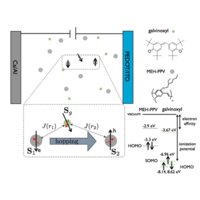
Spin transport in organic semiconductors has garnered increased interest in the last decade due in part to the large room temperature organic magnetoresistance (OMAR) effect. This effect originates from the nuclear interactions with bottlenecked carrier spin pairs which are suppressed by applied fields. In this article the authors describe a new regime for low-field magnetoresistance in organic semiconductors, in which the spin-relaxing effects of localized nuclear spins and electronic spins interfere. In addition to elucidating the fundamental mechanisms of OMAR, this result has implications for improving the design of organic-based devices.

Topological crystalline insulators and Dirac octets in antiperovskites

Timothy H. Hsieh, Junwei Liu, and Liang Fu

Phys. Rev. B 90, 081112(R) (2014) - Published 20 August, 2014

A combination of topological band theory, k⋅p modeling, and first-principles calculations leads to the prediction of a new class of topological crystalline insulators with antiperovskite structure, i.e. a perovskite with the positions of the rare-earth or alkaline-earth and oxygen atoms inverted. The authors predict that Ca3PbO and Sr3PbO are two representative examples from that class.

Vortices and charge order in high-Tc superconductors

M. Einenkel, H. Meier, C. Pépin, and K. B. Efetov

Phys. Rev. B 90, 054511 (2014) - Published 19 August, 2014

A theoretical analysis of the vortex state of the high-Tc cuprates from the point of view of a composite order parameter with competing superconducting and charge suborders shows that vortices feature a charge-ordered region in their cores, in line with recent experimental observations.

Analysis of the noise spectra from oxidized superparamagnetic nanoparticles

S. I. Woods, Snorri Ingvarsson, Shouheng Sun, and J. R. Kirtley

Phys. Rev. B 90, 060403(R) (2014) - Published 18 August, 2014

A quantitative understanding of ferromagnetism and exchange bias in magnetic nanoparticle systems is key to optimizing their performance. In this paper the authors demonstrate a measurement method using a micro-SQUID sensor in order to obtain noise spectra for analysing exchange bias in magnetic nanoparticles as a function of the oxidation state.

First-principles theory of nonradiative carrier capture via multiphonon emission

Audrius Alkauskas, Qimin Yan, and Chris G. Van de Walle

Phys. Rev. B 90, 075202 (2014) - Published 18 August, 2014

Understanding interaction of charge carriers with defects is important for improving performance of semiconductor devices. Researches now present an determination of nonradiative carrier capture rates at defect centers. Several capture rates are computed, with reasonable agreement with experimental information.

Kondo model in nonequilibrium: Interplay between voltage, temperature, and crossover from weak to strong coupling

Frank Reininghaus, Mikhail Pletyukhov, and Herbert Schoeller

Phys. Rev. B 90, 085121 (2014) - Published 15 August, 2014

Motivated by recent advances in theoretical and experimental studies of the nonequilibrium Kondo model, the authors address the question how the differential conductance depends on the temperature and the voltage in the weak coupling, strong coupling, and crossover regimes. They develop a variant of the real time renormalization group approach to study the non-equilibrium transport at zero magnetic field through a quantum dot.

Predictive GW calculations using plane waves and pseudopotentials

Jiří Klimeš, Merzuk Kaltak, and Georg Kresse

Phys. Rev. B 90, 075125 (2014) - Published 14 August, 2014

GW ab initio calculations are becoming increasingly popular. This paper presents two important steps forward in GW implementation: (i) a simple formula to approximately include high-energy plane-wave basis functions, which significantly improves convergence at negligible computational cost, and (ii) the identification of the need of norm-conserving partial waves in the PAW technique.

Thermal transport and Wiedemann-Franz law in the disordered Fermi liquid

G. Schwiete and A. M. Finkel'stein

Phys. Rev. B 90, 060201(R) (2014) - Published 13 August, 2014

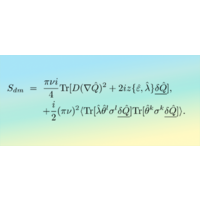
The field theoretic framework of nonlinear sigma models in the presence of gravitational potentials has been used to study disordered Fermi liquids. The authors demonstrate that the Wiedemann-Franz law remains valid despite the presence of interactions and slow diffusive modes.

Solvable models for unitary and nonunitary topological phases

Z. Papić

Phys. Rev. B 90, 075304 (2014) - Published 12 August, 2014

Hamiltonians of fractional quantum Hall liquids generally involve interactions between many-particle clusters. As such, analytic insight in the problem often appears impossible. Now a family of simple and tractable models for fractional quantum Hall states is proposed. This provides researchers with a new tool to study their excited states which could be both Abelian and non-Abelian.

Conductivity of a generic helical liquid

Nikolaos Kainaris, Igor V. Gornyi, Sam T. Carr, and Alexander D. Mirlin

Phys. Rev. B 90, 075118 (2014) - Published 11 August, 2014

This paper reports a thorough theoretical study of the conductivity of a helical liquid due to electron-electron and electron-impurity interactions and reach several illuminating conclusions, such as that the g5 electron-electron interaction is solely responsible for the finite conductivity of the perfectly clean system.

Supersymmetry in the Majorana Cooper-pair box

Jascha Ulrich, İnanç Adagideli, Dirk Schuricht, and Fabian Hassler

Phys. Rev. B 90, 075408 (2014) - Published 11 August, 2014

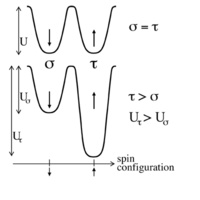
A quantum mechanical system is supersymmetric if each state has equal energy fermionic and bosonic partner states. Few such systems are known to exist. Here the authors show theoretically that bosonic superconducting states and fermionic Majorana modes in a Cooper pair box can be tuned to a supersymmetry and that the degeneracies which result could be probed with tunneling experiments.

Two-dimensional time-reversal-invariant topological superconductivity in a doped quantum spin-Hall insulator

Jing Wang, Yong Xu, and Shou-Cheng Zhang

Phys. Rev. B 90, 054503 (2014) - Published 7 August, 2014

A theoretical investigation of the pairing symmetry of a doped two-dimensional tin film reveals that under certain conditions a spin-triplet pairing is favored, making that system a good candidate for a two-dimensional topological superconductor.

Origin of the insulating state in exfoliated high-Tc two-dimensional atomic crystals

L. J. Sandilands, A. A. Reijnders, A. H. Su, V. Baydina, Z. Xu, A. Yang, G. Gu, T. Pedersen, F. Borondics, and K. S. Burch

Phys. Rev. B 90, 081402(R) (2014) - Published 7 August, 2014

An optical spectroscopic study of exfoliated two-dimensional atomic crystals of Bi2Sr2CaCu2O8+δ reveals a pronounced suppression of optical conductivity with thickness. Through detailed analysis, the authors interpret this finding as the formation of an insulating surface layer.

Coexistence and competition of multiple charge-density-wave orders in rare-earth tritellurides

B. F. Hu, B. Cheng, R. H. Yuan, T. Dong, and N. L. Wang

Phys. Rev. B 90, 085105 (2014) - Published 7 August, 2014

A family of quasi-two-dimensional earth telluride compounds exhibits a rich phase diagram. By measuring optical conductivity researchers now report the observation of a third, previously unknown charge-density wave order.

Experimental probe of topological orders and edge excitations in the second Landau level

S. Baer, C. Rössler, T. Ihn, K. Ensslin, C. Reichl, and W. Wegscheider

Phys. Rev. B 90, 075403 (2014) - Published 5 August, 2014

This paper reports careful experiments designed to shed light on the natures of the fractional quantized Hall states observed at filling fractions 5/2, 7/3, and 8/3 in very high quality GaAs quantum wells.

Electronic structure of black phosphorus studied by angle-resolved photoemission spectroscopy

C. Q. Han, M. Y. Yao, X. X. Bai, Lin Miao, Fengfeng Zhu, D. D. Guan, Shun Wang, C. L. Gao, Canhua Liu, Dong Qian, Y. Liu, and Jin-feng Jia

Phys. Rev. B 90, 085101 (2014) - Published 5 August, 2014

This comprehensive experimental study of the electronic structures of black phosphors reports ARPES measurements of the band dispersions along both out-of-plane and in-plane directions.

Efficient real-frequency solver for dynamical mean-field theory

Y. Lu, M. Höppner, O. Gunnarsson, and M. W. Haverkort

Phys. Rev. B 90, 085102 (2014) - Published 5 August, 2014

The exact diagonalization technique is employed in an efficient way to solve the correlated impurity problem for a large bath within the dynamical mean-field approach.

Sign In to Your Journals Account

Filter

Section

Filter

Article Lookup

Enter a citation