Highlights

Topological zero modes and Dirac points protected by spatial symmetry and chiral symmetry

Mikito Koshino, Takahiro Morimoto, and Masatoshi Sato

Phys. Rev. B 90, 115207 (2014) - Published 22 September, 2014

In this clear and thorough contribution, the authors present general arguments to show that topologically stable zero energy modes can be protected by the coexistence of both chiral symmetry and spatial symmetry.

Unidirectional sub-100-ps magnetic vortex core reversal

Matthias Noske, Ajay Gangwar, Hermann Stoll, Matthias Kammerer, Markus Sproll, Georg Dieterle, Markus Weigand, Manfred Fähnle, Georg Woltersdorf, Christian H. Back, and Gisela Schütz

Phys. Rev. B 90, 104415 (2014) - Published 19 September, 2014

Experiments and micro magnetic simulations show that a sequence of two orthogonal monopolar magnetic pulses speed up unidirectional reversal of the polarity of a magnetic vortex core to timescales below 100 ps. The authors explain this reversal using a gyromode – spin-wave coupling resulting in situations where vortex-antivortex pair formation does not produce reversal of the original vortex core polarization.

Resistance of helical edges formed in a semiconductor heterostructure

Jukka I. Väyrynen, Moshe Goldstein, Yuval Gefen, and Leonid I. Glazman

Phys. Rev. B 90, 115309 (2014) - Published 17 September, 2014

The authors develop a theory of inelastic backscattering of helical edge states from electron puddles in order to explain the observed deviation of conductance from its ideal value of e^2/h.

Dynamics of a Mn spin coupled to a single hole confined in a quantum dot

B. Varghese, H. Boukari, and L. Besombes

Phys. Rev. B 90, 115307 (2014) - Published 15 September, 2014

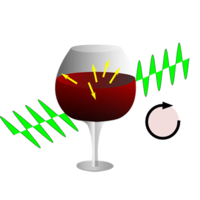
Realizing optical control of individual spins in semiconductors is motivated by a promise of using single spins as building blocks for quantum information processing devices. In this work, a group of authors from Grenoble, France study the spin dynamics of an individual Mn atom coupled with a single hole confined in a II-VI semiconductor quantum dot. They demonstrate how the spin of the hole-Mn system can be initialized by optical pumping with circularly polarized light and analyze the sources of the spin relaxation.

Spiral order in the honeycomb iridate Li2IrO3

Johannes Reuther, Ronny Thomale, and Stephan Rachel

Phys. Rev. B 90, 100405(R) (2014) - Published 12 September, 2014

The authors study the phase diagram of a Heisenberg-Kitaev model showing using a renormalization group that it contains a region characterized by an incommensurate spiral order.

Magneto-optical Faraday effect in spin-liquid candidates

Jacob R. Colbert, H. Dennis Drew, and Patrick A. Lee

Phys. Rev. B 90, 121105(R) (2014) - Published 12 September, 2014

Although in the last several years several materials have emerged as promising candidates where the elusive quantum spin liquid state could be realized, unambiguous experimental identification of the quantum spin liquid state is still an open problem. In this Rapid Communication, a group of researchers from Massachusetts Institute of Technology and University of Maryland at College Park propose a new test based on measuring the dynamical Hall conductivity via magneto-optical Faraday and Kerr effects. The authors suggest that the predicted effect is likely to be within experimental reach for Herbertsmithite and κ-(ET)2Cu2(CN)3.

TiN/(Al,Sc)N metal/dielectric superlattices and multilayers as hyperbolic metamaterials in the visible spectral range

Bivas Saha, Gururaj V. Naik, Sammy Saber, Cem Akatay, Eric A. Stach, Vladimir M. Shalaev, Alexandra Boltasseva, and Timothy D. Sands

Phys. Rev. B 90, 125420 (2014) - Published 12 September, 2014

A new class of hyperbolic metamaterials are made and characterized, based on epitaxial metal/dielectric superlattices of transition metal nitrides instead of the more common gold or silver. They are expected to be CMOS compatible and demonstrate higher figures of merit.

Luttinger-field approach to thermoelectric transport in nanoscale conductors

F. G. Eich, A. Principi, M. Di Ventra, and G. Vignale

Phys. Rev. B 90, 115116 (2014) - Published 8 September, 2014

In 1964 Q.M. Luttinger introduced an ingenious theoretical device to derive thermal transport coefficients. While thermal gradients that drive heat transport can not be included as a perturbation in the Hamiltonian, he showed that one could instead study a response to a pseudo-gravitational field that coupled to the energy density. The authors of this manuscript develop a formalism based on Luttinger’s pseudo-gravitational field to study thermal transport at nanoscale. They show that their approach can reproduce the results obtained from Landauer-Büttiker theory commonly used to study thermal transport in nanosize systems and it can be extended to describe time-dependent thermal phenomena that were inaccessible using the traditional approach.

Propulsion of a domain wall in an antiferromagnet by magnons

Se Kwon Kim, Yaroslav Tserkovnyak, and Oleg Tchernyshyov

Phys. Rev. B 90, 104406 (2014) - Published 5 September, 2014

An analytical solution to the complex problem of spin waves interacting with a domain wall elucidates how domain walls in an antiferromagnet can be propelled by reflected magnons and, less obviously, by magnons that are passing through them.

Statistics of sub-Poissonian nucleation in a nanophase

Frank Glas

Phys. Rev. B 90, 125406 (2014) - Published 5 September, 2014

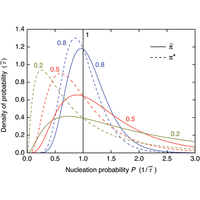
A stochastic analytical model developed for nucleation in a nanoscale phase and applied to vapor-liquid-solid growth agrees with earlier numerical simulations while providing significantly more information about parameters influencing nucleation. Future experiments may test the predictions made and lead to enhanced control of nucleation processes including the creation of more uniform nanostructures.

Characterizing wave functions in graphene nanodevices: Electronic transport through ultrashort graphene constrictions on a boron nitride substrate

D. Bischoff, F. Libisch, J. Burgdörfer, T. Ihn, and K. Ensslin

Phys. Rev. B 90, 115405 (2014) - Published 4 September, 2014

The nature of localized edge states in edge-disordered graphene nanoconstrictions connected to external leads is studied. Contrary to the general belief, the results show that the localization length is significantly longer than the size of the nanoconstriction, which results into charge spill over into the bulk as well.

Modified magnetism within the coherence volume of superconducting Fe1+δSexTe1−x

J. Leiner, V. Thampy, A. D. Christianson, D. L. Abernathy, M. B. Stone, M. D. Lumsden, A. S. Sefat, B. C. Sales, Jin Hu, Zhiqiang Mao, Wei Bao, and C. Broholm

Phys. Rev. B 90, 100501(R) (2014) - Published 2 September, 2014

A method to determine spatially resolved changes in magnetic exchange energy from magnetic neutron scattering data reveals that a significant reduction in the magnetic interaction energy exceeding the superconducting condensation energy by more than an order of magnitude occurs in Fe1+δSexTe1-x upon entering the superconducting state.

Elastic and anelastic relaxations associated with phase transitions in EuTiO3

Leszek J. Spalek, Siddharth S. Saxena, Christos Panagopoulos, Takuro Katsufuji, Jason A. Schiemer, and Michael A. Carpenter

Phys. Rev. B 90, 054119 (2014) - Published 29 August, 2014

Quantum paraelectrics such as SrTiO3 are materials where the intrinsic tendency for long-range ferroelectric ordering is suppressed by quantum fluctuations. EuTiO3 is a prototypical member of this family that, in addition, develops antiferromagnetic order below 5.5 K. Despite the long history of this material, several of its basic properties remain controversial. One of them is the existence and the nature of a structural cubic-tetragonal transition at high temperatures. In this manuscript, a collaboration of authors present a study of the transition in single-crystalline samples using Resonant Ultrasound Spectroscopy (RUS), a particularly sensitive probe for determining the elastic constants of materials.

Experimental realization of a quantum breathing pyrochlore antiferromagnet

K. Kimura, S. Nakatsuji, and T. Kimura

Phys. Rev. B 90, 060414(R) (2014) - Published 29 August, 2014

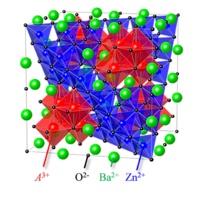
Several pyrochlore antiferromagnets are being considered as candidate materials where geometrical frustration may lead to quantum spin-liquid states. In a “breathing” pyrochlore lattice systems (see PRL 110, 097203 (2013)) the spins occupy the vertices of alternating tetrahedra of different size that are characterized by different exchange parameters J and J′.

Origin of photoresponse in black phosphorus phototransistors

Tony Low, Michael Engel, Mathias Steiner, and Phaedon Avouris

Phys. Rev. B 90, 081408(R) (2014) - Published 29 August, 2014

Experimental measurements of the photoresponse in doped multilayer black phosphorus phototransistors show that the photocurrent generation is dominated by thermoelectric and bolometric processes, not by the photovoltaic effect.

Interpretation of van der Waals density functionals

Per Hyldgaard, Kristian Berland, and Elsebeth Schröder

Phys. Rev. B 90, 075148 (2014) - Published 28 August, 2014

A proper interpretation of the van der Waal density functional (vdW-DF), developed by a collaboration between groups from Rutgers and Chalmers, had been lacking since the functional was originally proposed. This paper closes this important gap by placing the vdW-DF methodology into the context of Rapcewicz and Ashcroft’s work on non-local correlations.

Phase diagram of the Kane-Mele-Coulomb model

M. Hohenadler, F. Parisen Toldin, I. F. Herbut, and F. F. Assaad

Phys. Rev. B 90, 085146 (2014) - Published 28 August, 2014

The honeycomb lattice has elicited great interest because of the presence of Dirac cones and linear dispersion. In the Kane-Mele model, the presence of spin-orbit coupling opens the possibility of interesting topological effects. The addition of Hubbard or Coulomb interactions allows the study of the interplay of strong correlation effects and topology.

Wave propagation in twisted metamaterials

Amir Nader Askarpour, Yang Zhao, and Andrea Alù

Phys. Rev. B 90, 054305 (2014) - Published 25 August, 2014

Twisted metamaterials, i.e. arrays of identical planar metasurfaces stacked with a sequential rotation, offer new possibilities for manipulating and engineering wave propagation. This paper presents a generalized Floquet analysis to discuss wave propagation in these kind of structures. The authors show that the eigenmodes support specific circular polarization properties based on a lattice effect even when achiral inclusions are considered.

Exact NMR simulation of protein-size spin systems using tensor train formalism

D. V. Savostyanov, S. V. Dolgov, J. M. Werner, and Ilya Kuprov

Phys. Rev. B 90, 085139 (2014) - Published 25 August, 2014

The authors employ a matrix product state formalism to study time-dependent spin Hamiltonians which arise in the study of NMR spectra of proteins.

Negative Hall coefficient of ultrathin niobium in Si/Nb/Si trilayers

I. Zaytseva, O. Abal'oshev, P. Dłużewski, W. Paszkowicz, L. Y. Zhu, C. L. Chien, M. Kończykowski, and Marta Z. Cieplak

Phys. Rev. B 90, 060505(R) (2014) - Published 22 August, 2014

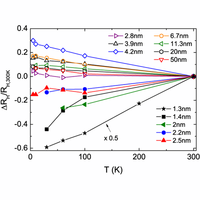
Detailed structural and transport characterization of ultrathin niobium films, as thin as 1.1 nm, reveals a change of the Hall coefficient sign from positive to negative in the thinnest films. This finding may have implications for understanding of disappearance of superconductivity in the ultrathin film limit.

Sign In to Your Journals Account

Filter

Section

Filter

Article Lookup

Enter a citation