Highlights

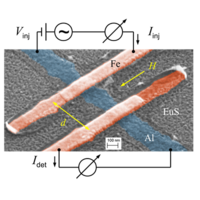
Spin-polarized quasiparticle transport in exchange-split superconducting aluminum on europium sulfide

M. J. Wolf, C. Sürgers, G. Fischer, and D. Beckmann

Phys. Rev. B 90, 144509 (2014) - Published 14 October, 2014

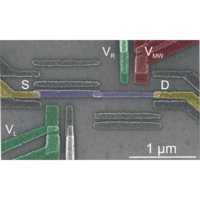
Using superconducting aluminum wires in contact with the ferromagnetic insulator europium sulfide, this group demonstrates that spin transport in superconductors can be manipulated by ferromagnetic insulators.

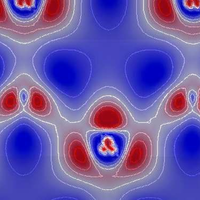
Antiferroelectricity in thin-film ZrO2 from first principles

Sebastian E. Reyes-Lillo, Kevin F. Garrity, and Karin M. Rabe

Phys. Rev. B 90, 140103(R) (2014) - Published 13 October, 2014

Recently antiferroelectric-like double-hysteresis loops have been experimentally reported in ZrO2, but the mechanism for this behavior has been unclear. In this work, the authors use first-principles calculations to show that antiferroelectricity is an intrinsic property of ZrO2 that appears via a previously unrecognized mechanism where the polarization is stabilized by zone-boundary modes.

Coexistence of superconductivity and density wave in Ba2Ti2Fe2As4O: An optical spectroscopy study

H. P. Wang, Y. L. Sun, X. B. Wang, Y. Huang, T. Dong, R. Y. Chen, G. H. Cao, and N. L. Wang

Phys. Rev. B 90, 144508 (2014) - Published 13 October, 2014

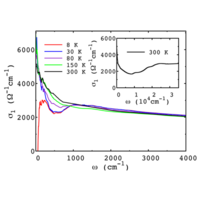
Ba2Ti2Fe2As4O is a newly discovered superconductor with a crystal structure that could be viewed as an intergrowth of BaFe2As2 and BaTi2As2O. Although neither BaFe2As2 nor BaTi2As2O is superconducting, the combined structure exhibits superconductivity at Tc=21.5 K without doping. This work presents the first optical spectroscopy study on single-crystalline samples of Ba2Ti2Fe2As4O showcasing valuable information on the charge-dynamical properties across the superconducting and the as of yet unspecified density-wave phase transition.

Structural and magnetic dynamics in the magnetic shape-memory alloy Ni2MnGa

S. O. Mariager, C. Dornes, J. A. Johnson, A. Ferrer, S. Grübel, T. Huber, A. Caviezel, S. L. Johnson, T. Eichhorn, G. Jakob, H. J. Elmers, P. Beaud, C. Quitmann, and G. Ingold

Phys. Rev. B 90, 161103(R) (2014) - Published 10 October, 2014

Ni2MnGa is a prototypical Heusler alloy where structural, electronic, and magnetic degrees of freedom conspire to produce a large magnetic shape memory effect. The authors demonstrate how the complex interaction between these subsystems can be disentangled by using state-of-the-art time-resolved techniques.

Experimental observation of the breaking and recombination of single Cooper pairs

N. J. Lambert, M. Edwards, A. A. Esmail, F. A. Pollock, S. D. Barrett, B. W. Lovett, and A. J. Ferguson

Phys. Rev. B 90, 140503(R) (2014) - Published 9 October, 2014

The authors measure the splitting of single Cooper pairs by single microwave photons, and their recombination, in a new type of superconducting double quantum dot. They envisage a single-photon detector based on the physical principles involved.

Plasmon losses due to electron-phonon scattering: The case of graphene encapsulated in hexagonal boron nitride

Alessandro Principi, Matteo Carrega, Mark B. Lundeberg, Achim Woessner, Frank H. L. Koppens, Giovanni Vignale, and Marco Polini

Phys. Rev. B 90, 165408 (2014) - Published 8 October, 2014

A theoretical study of plasmon damping in a hBN-Graphene-hBN stack due to graphene acoustic phonons and hBN optical phonons shows that the graphene acoustic phonons are the dominant plasmon scatterers. This study predicts that hBN-Graphene-hBN structures can host gate tunable lowloss plasmons in the mid-infrared spectral range.

Atomic diffusion theory challenging the Cahn-Hilliard method

M. Nastar

Phys. Rev. B 90, 144101 (2014) - Published 7 October, 2014

The author considers a theory of diffusion in nonuniform alloys at the atomic level going beyond the uncorrelated Cahn-Hilliard approximation. A surprising conclusion is reached that a thermodynamic (i.e. continuum) formulation of diffusion is impossible.

Stability of zero modes in parafermion chains

Adam S. Jermyn, Roger S. K. Mong, Jason Alicea, and Paul Fendley

Phys. Rev. B 90, 165106 (2014) - Published 7 October, 2014

Parafermion zero-modes, which are present in several one-dimensional topological phases, generalize widely studied Majorana fermions and present a promising route for topological quantum computation. In this paper, analytical and numerical methods are used to find the regimes in which exact parafermion zero-modes exist in a lattice model which is an extension of the Kitaev chain. The authors find that the stability conditions for the zero-modes in parafermion chains differs markedly from that of the Majorana case.

Magnon-skyrmion scattering in chiral magnets

Christoph Schütte and Markus Garst

Phys. Rev. B 90, 094423 (2014) - Published 30 September, 2014

Understanding interactions between skyrmions and magnons is an active area of research pursued by several groups. The authors of this manuscript present a comprehensive analytical theory for the effects of skyrmions on the magnon spectrum that can lead to a topological magnon Hall effect. Conversely, magnons affect the dynamics of skyrmions via an effective reactive force resulting in a large skyrmion Hall effect.

All-optical implementation of a dynamic decoupling protocol for hole spins in (In,Ga)As quantum dots

S. Varwig, E. Evers, A. Greilich, D. R. Yakovlev, D. Reuter, A. D. Wieck, and M. Bayer

Phys. Rev. B 90, 121306(R) (2014) - Published 30 September, 2014

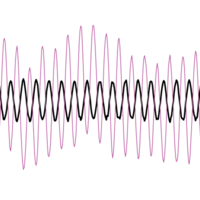
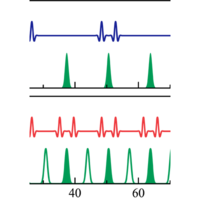
The first experiment to show dynamic decoupling of quantum dot hole spins by ultrashort laser pulses in the optical rather than microwave regime. By shortening the time delay between rotating pulses in spin echo experiments by a factor of two, the hole spin coherence times can be doubled. The technique used may lead to more complex dynamic decoupling schemes that are optimized for keeping the coherence of a quantum bit alive.

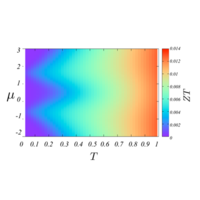
Vibrational cooling and thermoelectric response of nanoelectromechanical systems

Liliana Arrachea, Niels Bode, and Felix von Oppen

Phys. Rev. B 90, 125450 (2014) - Published 30 September, 2014

Cooling a nanomechanical system by applying an electron current through the nanomechanical structure is investigated in the context of the general theory of thermoelectrics. This allows the authors to discuss the efficiency of such phonon refrigerators and compare it with the fundamental Carnot limit. The results should provide guidance for the experimental implementation of the vibrational cooling mechanism based on the application of a current.

Heterophase fluctuations near Tc in the relaxor ferroelectrics (1−x)Pb(Zn1/3Nb2/3)O3−xPbTiO3 (x=0.09) studied by x-ray diffuse scattering and coherent x-ray scattering

Kenji Ohwada, Jun'ichiro Mizuki, Mitsuyoshi Matsushita, and Kazumichi Namikawa

Phys. Rev. B 90, 104109 (2014) - Published 29 September, 2014

Using a unique combination of two powerful experimental techniques, x-ray diffuse scattering (XDS) and coherent x-ray scattering (CXS), a heterophase fluctuation has been observed for the first time near the paraelectric to ferroelectric first-order phase transition in the relaxor ferroelectric (1-x)Pb(Zn1/3Nb2/3)O3-xPbTiO3. This heterophase fluctuation, during which two phases coexist as if they are in a thermodynamic equilibrium state, acts as a precursor phenomenon for the phase transition. The CXS technique used here is still under development but shows promise for future study of heterogeneous solids.

Electrons and holes in phosphorene

Pengke Li and Ian Appelbaum

Phys. Rev. B 90, 115439 (2014) - Published 29 September, 2014

A symmetry analysis of the band structure of monolayer black phosphorus (phosphorene) reveals the mechanism responsible for valence band distortion and possible lack of a true direct band gap. This theory should provide guidance for experiments on this new material, especially when single phosphorene layers can be made for device processing.

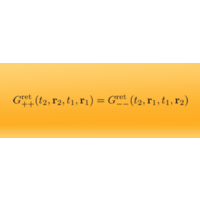
Relationship of time-reversal symmetry breaking to optical Kerr rotation

Alexander D. Fried

Phys. Rev. B 90, 121112(R) (2014) - Published 29 September, 2014

What symmetries must be broken in a material in order for a certain optical effect, known as Kerr rotation, to appear? Kerr rotation has been observed in some high temperature superconductors, but it was uncertain as to how to interpret these measurements and identify the material symmetries responsible for the effect. Elaborating on previous discussions (cf. e.g. PRB 90, 035135 (2014)) the author offers a proof based on the reciprocity theorem that the polar Kerr effect can be only observed if the system breaks time-reversal symmetry.

Odd-parity topological superconductor with nematic order: Application to CuxBi2Se3

Liang Fu

Phys. Rev. B 90, 100509(R) (2014) - Published 26 September, 2014

Inspired by recent experiments, the author makes a strong theoretical case for odd-parity superconductivity in CuxBi2Se3. In particular, he shows that the spin-orbit interaction plays a crucial role in removing would-be gap nodes, thus creating a fully-gapped superconducting state.

Rotated stripe order and its competition with superconductivity in La1.88Sr0.12CuO4

V. Thampy, M. P. M. Dean, N. B. Christensen, L. Steinke, Z. Islam, M. Oda, M. Ido, N. Momono, S. B. Wilkins, and J. P. Hill

Phys. Rev. B 90, 100510(R) (2014) - Published 26 September, 2014

Using soft and hard x-ray diffraction techniques, this group presents evidence of charge ordering in La1.88Sr0.12CuO4 that is rotated with respect to the Cu-O bond direction. In addition, and importantly, the authors show that the charge order is suppressed below Tc.

Optical conductivity of V4O7 across its metal-insulator transition

I. Lo Vecchio, M. Autore, F. D'Apuzzo, F. Giorgianni, A. Perucchi, U. Schade, V. N. Andreev, V. A. Klimov, and S. Lupi

Phys. Rev. B 90, 115149 (2014) - Published 26 September, 2014

Optical conductivity measurements show that the metal-insulator transition in vanadium oxide is driven by electron-phonon interaction rather than electron-electron interaction.

Band alignment at memristive metal-oxide interfaces investigated by hard x-ray photoemission spectroscopy

C. Lenser, A. Köhl, M. Patt, C. M. Schneider, R. Waser, and R. Dittmann

Phys. Rev. B 90, 115312 (2014) - Published 26 September, 2014

Nonvolatile memory elements, known as memristors, have recently received an attention boost by introducing transition-metal oxide /transition-metal bilayer structures. These structures enable the engineering of the electrical properties of the devices and the removal of unwanted forming steps though a redox-reaction at the interface. This work provides much needed information for the understanding of memristive behavior in such devices by providing the first systematic study of the electronic band alignment at the interface, which plays essential role in charge carrier transport.

Dielectric response of electron-doped ionic superconductor LixZrNCl

Antia S. Botana and Warren E. Pickett

Phys. Rev. B 90, 125145 (2014) - Published 25 September, 2014

By calculating the dielectric response versus frequency and concentration of doped electronic carriers of superconducting Li-doped ZrNCl the authors conclude that pairing based on electronic overscreening, which has been suggested as a mechanism of superconductivity, is not a viable scenario for this superconducting system.

Diagrammatic expansion for positive spectral functions beyond GW: Application to vertex corrections in the electron gas

G. Stefanucci, Y. Pavlyukh, A.-M. Uimonen, and R. van Leeuwen

Phys. Rev. B 90, 115134 (2014) - Published 22 September, 2014

Hedin’s GW (G=Green’s function, W=screened Coulomb interaction) approximation provides a solid ground for electronic structure first-principles calculations. It is becoming increasingly popular with new implementations appearing regularly in the literature, but little is done toward the fundamental theoretical development of the method. In this impressive theoretical work, the authors solve the long-standing problem of how to generate diagrammatic approximations to the Green’s function with positive spectral properties. As a major application of the formalism, they go beyond the GW approximation by including vertex corrections; they demonstrate the method on the example of homogeneous electron gas.

Sign In to Your Journals Account

Filter

Section

Filter

Article Lookup

Enter a citation