Highlights

Voltage-controlled oxide barriers in organic/hybrid spin valves based on tunneling anisotropic magnetoresistance

M. Grünewald, N. Homonnay, J. Kleinlein, and G. Schmidt

Phys. Rev. B 90, 205208 (2014) - Published 14 November, 2014

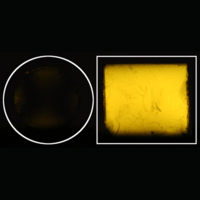
A clear interaction between a resistive switching and a magnetoresistance effect is observed in organic semiconductor/ferromagnetic oxide hybrid spin-valve-like structures. The results resolve a longstanding question by clearly locating the origin of the resistive switching in these devices at the functional interface between the oxide electrode and the organic semiconductor. The switching is caused by the formation, motion, and removal of pairs of oxygen vacancies and interstitial oxygen ions at this interface. Also, a tunneling anisotropic magnetoresistance is reported of up to 20%, which is six times higher than in the literature.

Statistics of energy dissipation in a quantum dot operating in the cotunneling regime

Yehuda Dinaii, Alexander Shnirman, and Yuval Gefen

Phys. Rev. B 90, 201404(R) (2014) - Published 13 November, 2014

The authors present a theoretical analysis of energy dissipation in a prototypical nanosystem, a quantum dot tuned to be in a Coulomb blockade valley. To describe this dissipation, they derive its cumulant generating function as well as its probability distribution function.

Quantum spin chains with frustration due to Dzyaloshinskii-Moriya interactions

M. Hälg, W. E. A. Lorenz, K. Yu. Povarov, M. Månsson, Y. Skourski, and A. Zheludev

Phys. Rev. B 90, 174413 (2014) - Published 12 November, 2014

The authors herein report x-ray, neutron, specific heat, and magnetization studies of two new quantum spin systems, K2CuSO4Cl4 and K2CuSO4Br4. They argue that in these systems neighboring chains have Dzyaloshinksii-Moriya interactions that are opposite in direction, so effectively leading to weak interchain interactions.

Unfolding of electronic structure through induced representations of space groups: Application to Fe-based superconductors

Milan Tomić, Harald O. Jeschke, and Roser Valentí

Phys. Rev. B 90, 195121 (2014) - Published 12 November, 2014

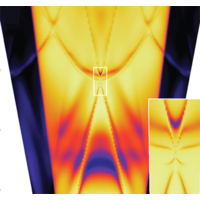
Through a rigorous consideration of the group-theoretical aspects of band structure unfolding the authors create a framework which facilitates the interpretation of ARPES experiments, and in particular allows for a clear understanding of the two- versus one-Fe description of the electronic properties of iron-based superconductors.

Valley polarization induced second harmonic generation in graphene

L. E. Golub and S. A. Tarasenko

Phys. Rev. B 90, 201402(R) (2014) - Published 11 November, 2014

This paper suggests that an optical method can be used to reliably probe valley polarization in graphene. It shows that at normal incidence of photons, imbalance of carrier populations in two valleys gives rise to second harmonic generation in graphene which can be used to experimentally determine both the degree and sign of the valley polarization.

Anisotropic effect of warping on the lifetime broadening of topological surface states in angle-resolved photoemission from Bi2Te3

J. Sánchez-Barriga, M. R. Scholz, E. Golias, E. Rienks, D. Marchenko, A. Varykhalov, L. V. Yashina, and O. Rader

Phys. Rev. B 90, 195413 (2014) - Published 10 November, 2014

Using angle resolved photoemission measurements, the authors detect a strong anisotropy of the lifetime broadening of the topological surface-state electrons of bismuth telluride, hence, demonstrating, for the first time, that the theoretically predicted strong band warping in this prototypical topological insulator results in a strong anisotropy of the electron scattering rates.

Unconventional magnetic order on the hyperhoneycomb Kitaev lattice in β−Li2IrO3: Full solution via magnetic resonant x-ray diffraction

A. Biffin, R. D. Johnson, Sungkyun Choi, F. Freund, S. Manni, A. Bombardi, P. Manuel, P. Gegenwart, and R. Coldea

Phys. Rev. B 90, 205116 (2014) - Published 10 November, 2014

Using a combined approach of neutron powder diffraction and single-crystal magnetic resonant xray diffraction, the authors determine the complex incommensurate magnetic ground state of β-Li2IrO3.

Critical behavior of zero-field magnetic fluctuations in perpendicularly magnetized thin films

A. L. Balk, M. D. Stiles, and J. Unguris

Phys. Rev. B 90, 184404 (2014) - Published 4 November, 2014

Magneto-optic Kerr effect is used to study the statistical properties of thermally driven magnetic domain walls in a thin film at zero magnetic field.

Magnetic fields above the superconducting ferromagnet UCoGe

D. J. Hykel, C. Paulsen, D. Aoki, J. R. Kirtley, and K. Hasselbach

Phys. Rev. B 90, 184501 (2014) - Published 4 November, 2014

This group reports the direct observation of the coexistence of ferromagnetism and superconductivity in UCoGe by scanning SQUID microscopy. Comparing the observations to models for flux expulsion and of the vortex state, they conclude that this compound presents a spontaneous vortex phase in zero applied field.

Non-Abelian topological insulators from an array of quantum wires

Eran Sagi and Yuval Oreg

Phys. Rev. B 90, 201102(R) (2014) - Published 4 November, 2014

In recent years much theoretical effort was invested into constructing systems which have a non-zero Hall conductance with a zero total magnetic flux. Motivated by previous results the authors consider microscopic models of coupled one dimensional wires and show that they can support fractional Chern insulator states.

Wire deconstructionism of two-dimensional topological phases

Titus Neupert, Claudio Chamon, Christopher Mudry, and Ronny Thomale

Phys. Rev. B 90, 205101 (2014) - Published 4 November, 2014

The classification of phases of matter according to topological properties is a central topic of current condensed matter research. In this work, the authors prove the validity of an existing classification of phases of noninteracting fermion systems in the presence of strong interactions. To that end, they employ an intuitive construction based on strongly coupled quantum wires. All these phases of matter have electron-like, non-fractionalized excitations. Within the same framework, the authors further show that every phase in this classification has a strongly interacting cousin with fractionalized excitations - a so-called intrinsically topologically order phase.

Enhanced self-diffusion of adsorbed methanol in silica aerogel

Jeongseop A. Lee, A. M. Mounce, Sangwon Oh, A. M. Zimmerman, and W. P. Halperin

Phys. Rev. B 90, 174501 (2014) - Published 3 November, 2014

Nuclear magnetic resonance techniques are used to study anomalously high diffusion of methanol in porous silica aerogel.

Structurally unstable AIIIBiO3 perovskites are predicted to be topological insulators but their stable structural forms are trivial band insulators

Giancarlo Trimarchi, Xiuwen Zhang, Arthur J. Freeman, and Alex Zunger

Phys. Rev. B 90, 161111(R) (2014) - Published 31 October, 2014

Structurally unstable compounds can be predicted to be topological insulators (TIs) but their stable structural forms are trivial band insulators. The authors illustrate the danger in such false positive predictions for the AIIIBiO3 bismuth oxides that have been recently proposed as TIs in a hypothetical “perovskite” crystal structure-type. They show that the inversion of anti-bonding with bonding electron levels may destabilize the material and argue that to predict new candidate TIs by quantum atomistic modeling, one should simultaneously test structural stability and topological character of the candidate materials.

Theory of melting at high pressures: Amending density functional theory with quantum Monte Carlo

L. Shulenburger, M. P. Desjarlais, and T. R. Mattsson

Phys. Rev. B 90, 140104(R) (2014) - Published 29 October, 2014

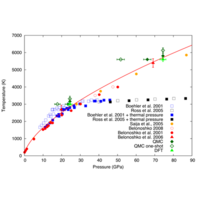
The melting behavior of materials under pressure is one of the fundamental properties necessary for understanding a wide variety of phenomena involving materials under extreme conditions. This article presents a case study of the melting of xenon under pressure. Combining state of the art density functional theory calculations of melting with high accuracy diffusion Monte Carlo calculations of total energy, the authors call the experimentally determined melt line into question.

Multiple nodeless superconducting gaps in optimally doped SrTi1−xNbxO3

Xiao Lin, Adrien Gourgout, German Bridoux, François Jomard, Alexandre Pourret, Benoît Fauqué, Dai Aoki, and Kamran Behnia

Phys. Rev. B 90, 140508(R) (2014) - Published 29 October, 2014

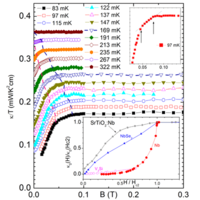
Although superconductivity in n-doped SrTiO3 was discovered in 1964, the symmetry of the superconducting order parameter is still elusive. By studying the thermal conductivity of optimally doped superconducting SrTiO3, the authors rule out the presence of nodal quasiparticles, while by its field dependence they deduce the existence of at least two distinct superconducting gaps.

Weyl semimetals from noncentrosymmetric topological insulators

Jianpeng Liu and David Vanderbilt

Phys. Rev. B 90, 155316 (2014) - Published 28 October, 2014

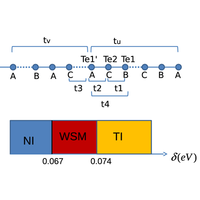
In contrast to some recently suggested scenarios, authors point out that in systems with broken inversion symmetry such as BiTeI a transition between normal and topological insulator phases should be bridged by an intermediate Weyl semimetal phase.

Single fermion manipulation via superconducting phase differences in multiterminal Josephson junctions

B. van Heck, S. Mi, and A. R. Akhmerov

Phys. Rev. B 90, 155450 (2014) - Published 28 October, 2014

The authors predict that a Josephson junction between three rather than the usual two superconductors enables the control of different spin states with unprecedented sensitivity. Moreover, a vortexlike flow of supercurrent can break an electron pair to trap an unpaired electron, showing a way to use the supercurrent as a novel tool for spin control, whose speed and locality of operation is superior to standard methods.

Lasing at the band edges of plasmonic lattices

A. Hinke Schokker and A. Femius Koenderink

Phys. Rev. B 90, 155452 (2014) - Published 28 October, 2014

This paper reports a comprehensive experimental study of silver and gold plasmonic crystal lasers. Such periodic plasmon particle systems have recently triggered large attention due to the fact that localized plasmons and collective lattice resonances conspire to give large light-matter interaction strength in narrow resonances. The authors provide a detailed report on the conditions required for lasing, and a complete analysis of the underlying plasmonic lattice band structure.

Anomalous density of states in multiband superconductors near the Lifshitz transition

A. E. Koshelev and K. A. Matveev

Phys. Rev. B 90, 140505(R) (2014) - Published 24 October, 2014

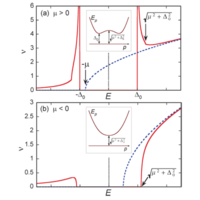
The authors describe anomalous superconducting properties in a shallow band in which Cooper pairing is induced by deep bands. They demonstrate that the thermodynamic topological phase transition is eliminated by superconductivity, but nevertheless the density of states shows likely detectable qualitative changes with variation of the chemical potential. The authors argue that the proposed physical scenario provides the most natural interpretation for the gap structure recently observed in some iron pnictides and chalcogenides with shallow bands.

Selectively localized Wannier functions

Runzhi Wang, Emanuel A. Lazar, Hyowon Park, Andrew J. Millis, and Chris A. Marianetti

Phys. Rev. B 90, 165125 (2014) - Published 17 October, 2014

The authors extend the theory of maximally localized Wannier functions, first developed by Marzari and Vanderbilt, by permitting the localizing objective function to be restricted to a chosen subset of orbitals, and the centers of the Wannier functions to be constrained to a chosen location. This is a very useful extension, particularly for implementations of DFT plus dynamical mean-field theory. Here, the method is demonstrated on GaAs, SrMnO3, and Co.

Sign In to Your Journals Account

Filter

Section

Filter

Article Lookup

Enter a citation